
Why Weather Contingencies Matter for AP Students
Picture this: you wake up on exam day—your mind steady, your review checklist checked twice—and then the first notification arrives: heavy snow warnings, widespread transit delays, or flash flooding on a familiar route. Suddenly, the hours you polished for weeks feel fragile. For AP students, arrival time matters. Test centers open on precise schedules, proctors follow strict protocols, and missing the exam or arriving panicked can cost you more than a day; it can cost your best performance.
This post is a calm, practical handbook for building rock-solid backup transport plans so weather surprises become manageable, not disastrous. It blends quick checklists, real-world scenarios, a simple decision table, and templates you can copy. Along the way I’ll share study- and stress-reduction tips and how targeted support—like Sparkl’s personalized tutoring—can help you focus on what matters most on test day.
Start Early: The 2-Week Weather Readiness Window
Weather rarely changes your exam outcome by itself; poor preparation under pressure does. Begin your contingency planning two weeks before your AP exam date. Why two weeks? That timeframe gives you time to:
- Monitor weather trends and forecasts for your exam region.
- Confirm alternative transport options (driving, public transit, ride share, parent or neighbor rides).
- Communicate with your AP coordinator and teacher about late-arrival protocols or exam accommodations.
In practice, spend an evening making a clear transport plan and writing down alternatives. That way, if the morning is chaotic, you don’t need to think—only to act.
Quick Two-Week Checklist
- Confirm exam time and testing location; note parking rules and building entrances.
- Gather contact numbers: AP coordinator, main school office, a trusted ride contact, and a backup adult.
- Map three routes to the test center and estimate travel times in normal and adverse conditions.
- Identify at least two backup transport methods (friend/parent drive, public transit, ride share, bicycle if weather allows).
- Create a simple decision tree so you know which option to pick for light rain, heavy rain, snow, or transit shutdown.
Know the Rules: What College Board and Your School Expect
Most schools and the College Board have strict administration windows and check-in procedures. That means arriving late could prevent you from taking a particular section or lead to an exam being voided. Talk with your AP coordinator about these policies well before exam day. Ask whether there is a late-check-in window, whether make-up exams exist in extreme cases, and how local weather closures are handled.
Documenting these answers in your phone notes helps you make informed decisions during a stressful morning.
Questions to Ask Your AP Coordinator
- What is the exact check-in time and late-arrival policy for each AP exam I’m taking?
- Where is the testing room entrance and is there alternate entrance for late arrivals?
- If the school is closed due to severe weather, will exams be rescheduled or offered at alternate locations?
- Who should I call if I cannot reach the school because of weather-related road closures?
Layered Transport Options: Build Your Top 3 Paths
Your goal is three realistic ways to reach the test center. Rank them by reliability and travel time under poor weather.
- Primary: The routine route you expect to use on a good morning (usually the fastest).
- Secondary: A slightly longer but more weather-resistant route (e.g., a major road that’s plowed regularly).
- Tertiary: A backup that relies on someone else (parent, neighbor, ride share) or a different transport mode.
How to Choose Each Path
- Prioritize roads that are high-traffic and therefore likely to be cleared quickly in snow.
- For flooding or storms, choose elevated routes and avoid roads that run along known flood zones.
- If public transit is your only option, identify the earliest train/bus that arrives well before check-in, and a backup from a different line.
Decision Table: Weather vs. Transport Choice
Here’s a simple table you can adapt and print. It helps translate weather conditions into concrete first, second, and third choices so you act fast on exam morning.
| Weather Scenario | Primary Transport | Secondary Transport | Tertiary Transport / Notes |
|---|---|---|---|
| Light Rain / Cool | Normal drive or bus; leave 15 extra minutes | Later bus/train that avoids small streets | Pack waterproof shoes and umbrella |
| Heavy Rain / Flood Advisories | Major roads only; avoid small low-lying streets | Parent or neighbor drive using alternate route | Call school if roads closed; have emergency contact |
| Snow / Icy Conditions | Roads plowed regularly; leave 30–45 extra minutes | Ride share if driver has winter experience | Dress warmly; carry ice traction devices for shoes |
| Transit Shutdown / Major Storm | Arrange early ride from family or neighbor | Move to alternate test center if school closed (only with coordinator) | Check official school/College Board messages |
Morning of the Exam: A Calm, Sequential Routine
Storm-induced adrenaline makes us forget simple things. Adopt a small, timed routine to eliminate panic:
- Three hours before check-in: Wake, hydrate, light review (no heavy studying).
- Two hours before check-in: Check weather, traffic app, and school notifications.
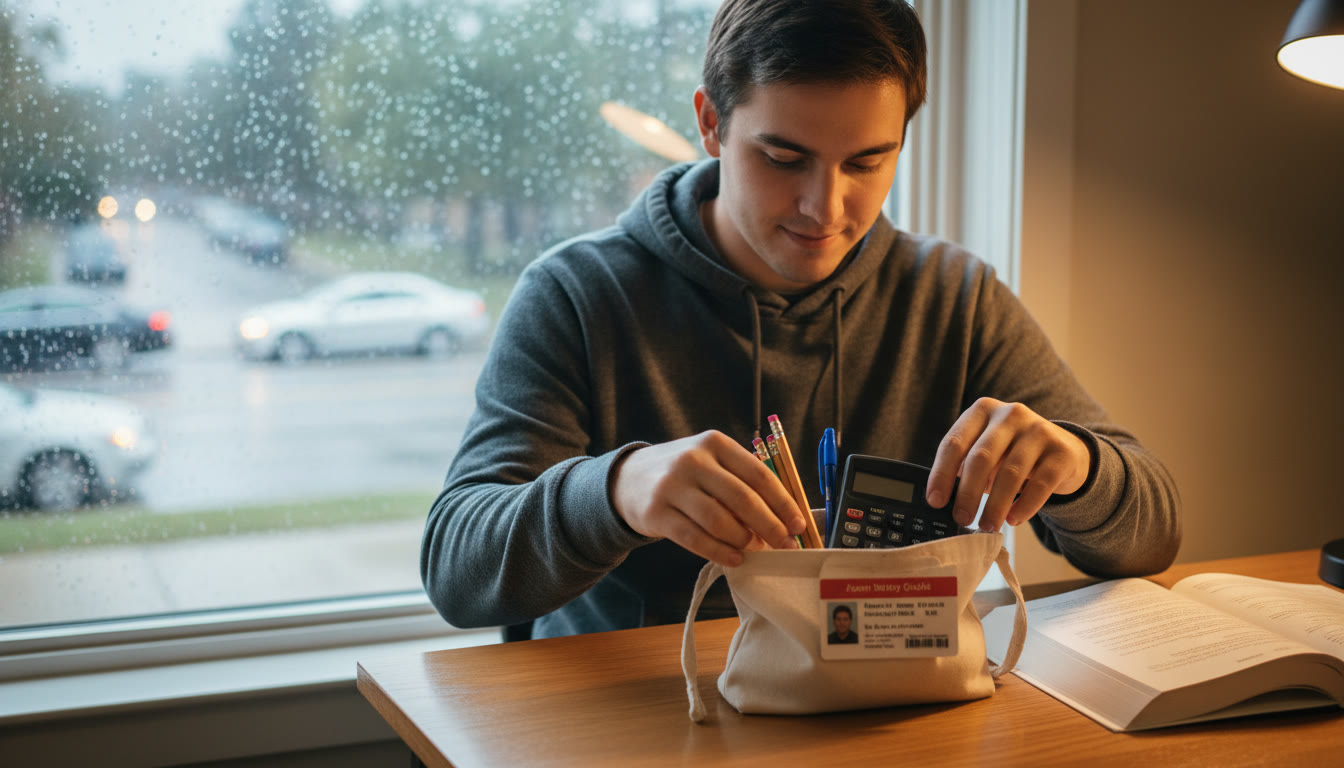
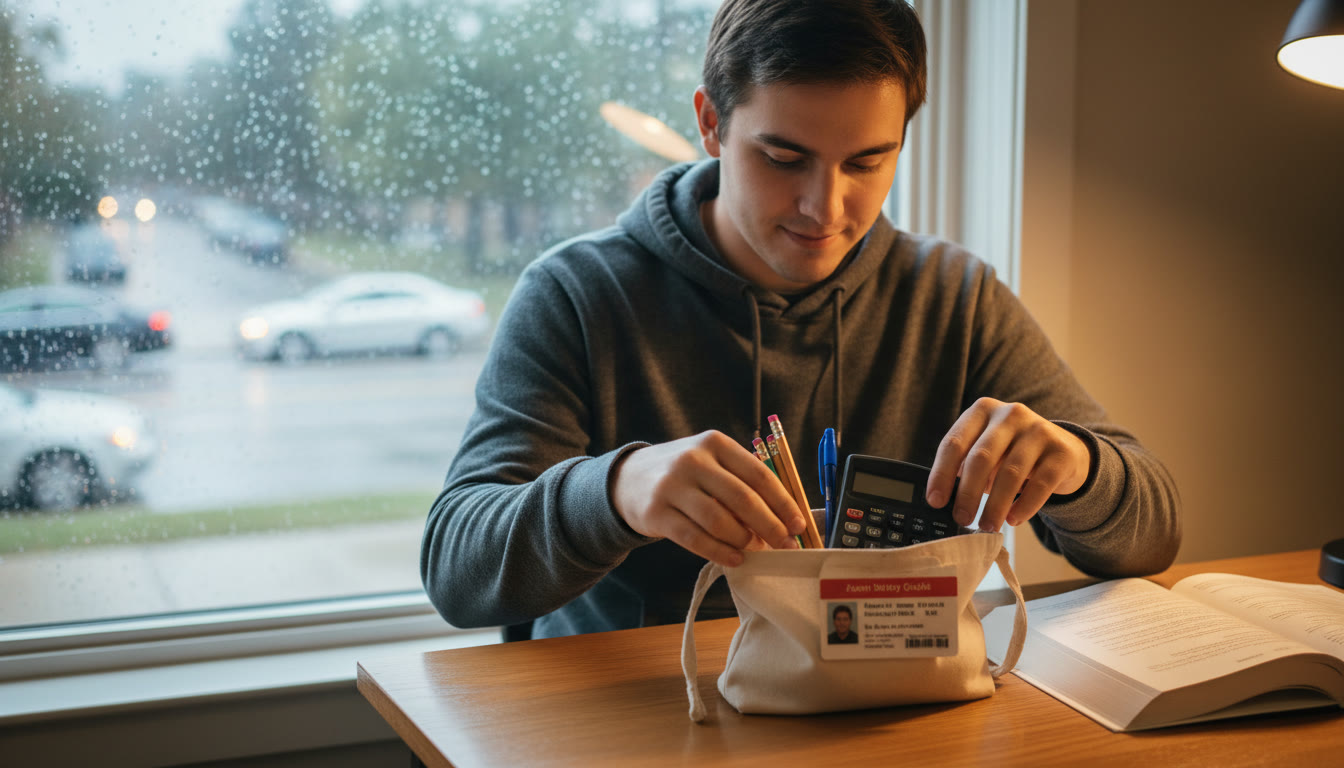
- 90 minutes before check-in: Put on outerwear; pack your exam bag (ID, pencils, allowed calculator, watch if permitted, snacks for after).
- 60 minutes before check-in: Confirm your chosen route; text your ride or parent with a one-line ETA and plan (e.g., “Leaving in 10. Driving to North High via Route A unless closed. I’ll update.”).
- 30 minutes before: Leave earlier than you think you need to—it’s better to wait in a safe spot than to race to the building stressed.
What to Put in Your Exam-Day Bag
- College Board approved ID and exam printout or registration slip if required.
- At least two No. 2 pencils, an eraser, pens for certain subjects, and spare batteries for approved calculators.
- A small bottle of water and an easily digestible snack for post-exam energy.
- Layers: a hooded jacket or sweater and waterproof shoes if weather threatens.

Communication Templates: Quick Messages to Save
When time is short, well-crafted short messages remove friction. Save these templates in your phone so you can quickly notify people:
- To a parent or ride: “Leaving now via Route A. ETA 30 minutes. If roads look bad I’ll switch to Route B—will update.”
- To AP coordinator (if you’ll be late): “Hi, this is [Your Name], taking AP [Subject] today. I’m delayed due to [snow/flooding/transit outage]. ETA approx [time]. Please advise on check-in.”
- To a friend: “Stuck in traffic near [landmark]. If I arrive late, keep my seat materials safe.”
Your Mental Game: Avoiding Panic When Plans Shift
The brain’s instinct is to catastrophize when a plan changes. Replace that instinct with a short mental script: Breathe, choose the best of your three options, and do a simple task (zip bag, text contact) to ground yourself. These short actions shift you from reactive to proactive.
If you have a tutor or coach—like Sparkl’s personalized tutoring—use a quick pre-exam session to run a calming routine or targeted review that fits the current timeline. Even a 15-minute coach-led check-in can sharpen focus and reduce anxiety, especially when weather forces earlier-than-planned departures.
Real-World Scenarios and How to Respond
Let’s walk through three realistic scenarios students face and practical responses you can follow.
Scenario 1: Light Snow, Roads Slow but Open
Response: Leave extra time. Use your primary route if it’s a major plowed road; otherwise switch to the secondary route you already mapped. Communicate ETA to your AP coordinator if your arrival is later than usual.
Scenario 2: Transit Delay and No Trains Running
Response: Immediately arrange a ride with a parent or neighbor. If that’s impossible, consider a ride share with a driver experienced in winter conditions or request a nearby friend to give you a lift. If all else fails, call your AP coordinator and explain the situation—document your attempts to reach the test center.
Scenario 3: Severe Weather Leads to School Closure
Response: Follow official statements from the school and College Board. Schools sometimes move exams to alternate dates or locations. Save your energy for communication: confirm with the coordinator if there will be a make-up, and preserve your materials and readiness for the rescheduled time. This is where patience and documentation matter most.
When to Consider Rescheduling (and How to Do It Gracefully)
Rescheduling is a last resort but sometimes necessary if safety is at risk. If your school is closed and no alternate location exists, follow these steps:
- Contact your AP coordinator immediately for official guidance.
- Document your attempts to reach the test center and any evidence of closures (local alerts, transit shutdown notifications).
- Keep calm and preserve your exam readiness—rescheduled dates still reward preparation.
Remember: safety first. Colleges recognize that extreme weather is beyond a student’s control; what matters is how you respond and how well you document the situation.
How Study Habits Connect to Transport Confidence
Backup plans reduce stress, and reduced stress improves performance. That idea is supported by a simple truth: when you control external variables (like arrival time), you free cognitive space to recall formulas, write essays, and manage time during the exam.
If you’re balancing content review with logistical preparation, try block scheduling: short, focused study blocks interleaved with planning tasks (confirming contacts, checking forecasts) so you’re studying and preparing simultaneously. For targeted help, Sparkl’s personalized tutoring can create tailored study blocks and coaching sessions that integrate logistics and content review—so you don’t lose study time to planning later on.
Tools and Apps That Make Planning Easier
Modern apps can be powerful allies if used wisely:
- Weather apps with hourly forecasts and severe-weather alerts (set push notifications).
- Traffic apps that show live conditions and alternative routes.
- Transit apps with real-time train/bus status.
- Calendar alerts: set a reminder 3 hours before check-in to start your morning routine.
Combine these tools with your printed decision table and you’ll be ready to make fast, informed choices.
Final Checklist: The Day-Of Quick Reference
- Confirm exam location and building entrance the night before.
- Save your AP coordinator’s phone number to the top of contacts.
- Pack your exam bag and lay out clothes the night before (including weather-appropriate outer layer).
- Check traffic and weather 90 and 60 minutes before leaving.
- Choose the highest-reliability route and leave early.
- If delayed, send a concise message to the coordinator and your ride contact; remain calm and document the situation.
Closing Thoughts: Turn Contingency Into Confidence
Weather can disrupt schedules, but it doesn’t have to upend your exam. The students who show up calm on AP exam day are the ones who prepared for the unexpected: practiced their routine, mapped alternatives, and communicated clearly. That preparation buys you something invaluable—mental bandwidth to do your best work.
If logistics feel overwhelming while you’re trying to study, remember that support exists. Short, focused help—whether a mentor who runs through test-day logistics or Sparkl’s personalized tutoring that pairs content coaching with time-management and pre-exam routines—can make one more variable disappear so you can focus purely on the test.
So: plan early, build three realistic routes, save the messages, and practice the calm routine. When the alarm goes off on exam day, you’ll know what to do—whatever the weather throws at you.
Printable Two-Page Summary
Take a screenshot or write down these three essentials: 1) Top three routes with ETA, 2) Two saved messages (to coordinator and ride), and 3) a packed exam bag by the door. Keep it simple—and keep it visible.
Good luck. You’ve prepared for the content. Now prepare for the weather—and let nothing steal your focus on test day.



























No Comments
Leave a comment Cancel