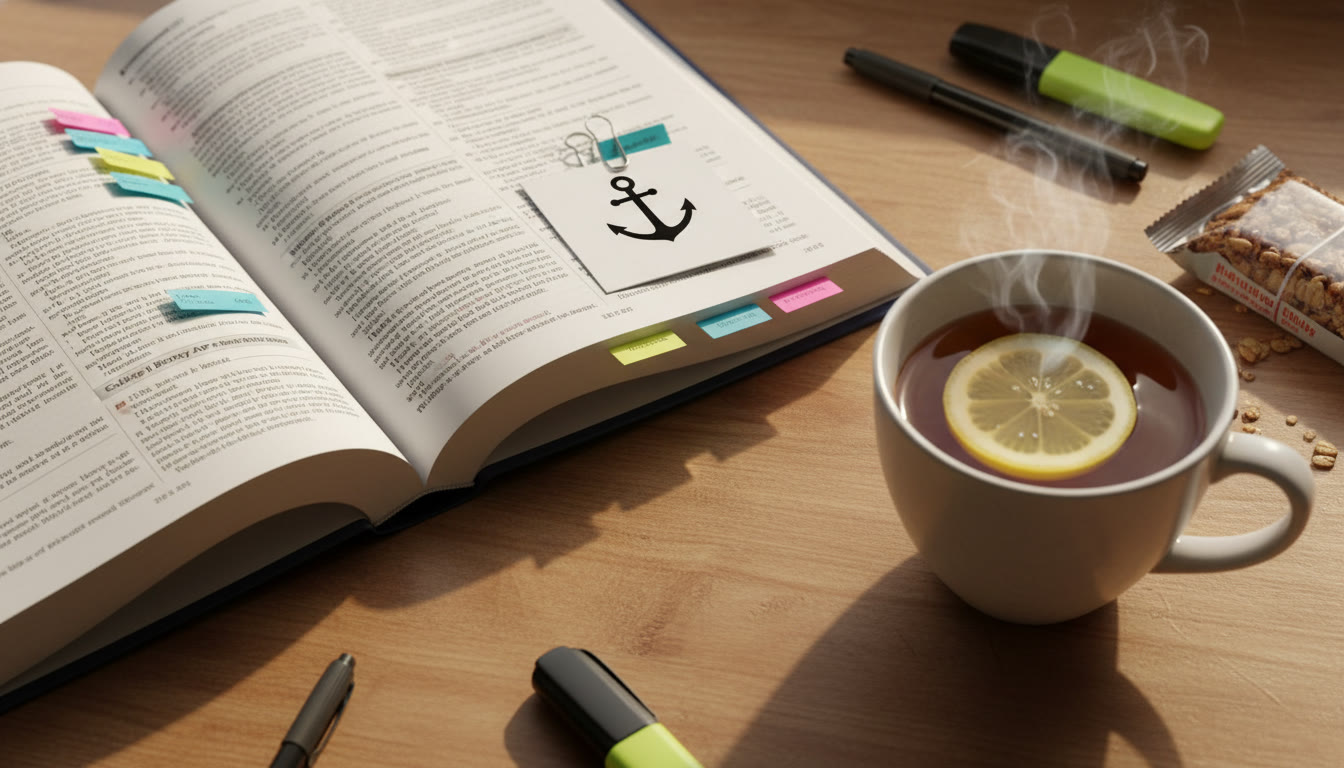

Visual Anchors: Why One Small Image Can Rescue a Distracted Study Session
We’ve all been there: you sit down to review an AP topic, open your notes, and—twenty minutes later—realize you’ve watched five minutes of a video, scrolled through your feed, and remembered nothing. Focus isn’t a moral failing; it’s a skill that can be trained. One of the fastest, simplest tools to pull your attention back is what I call a “visual anchor”—a deliberate visual cue that reorients your mind to the task at hand.
What a Visual Anchor Is (And Why It Works)
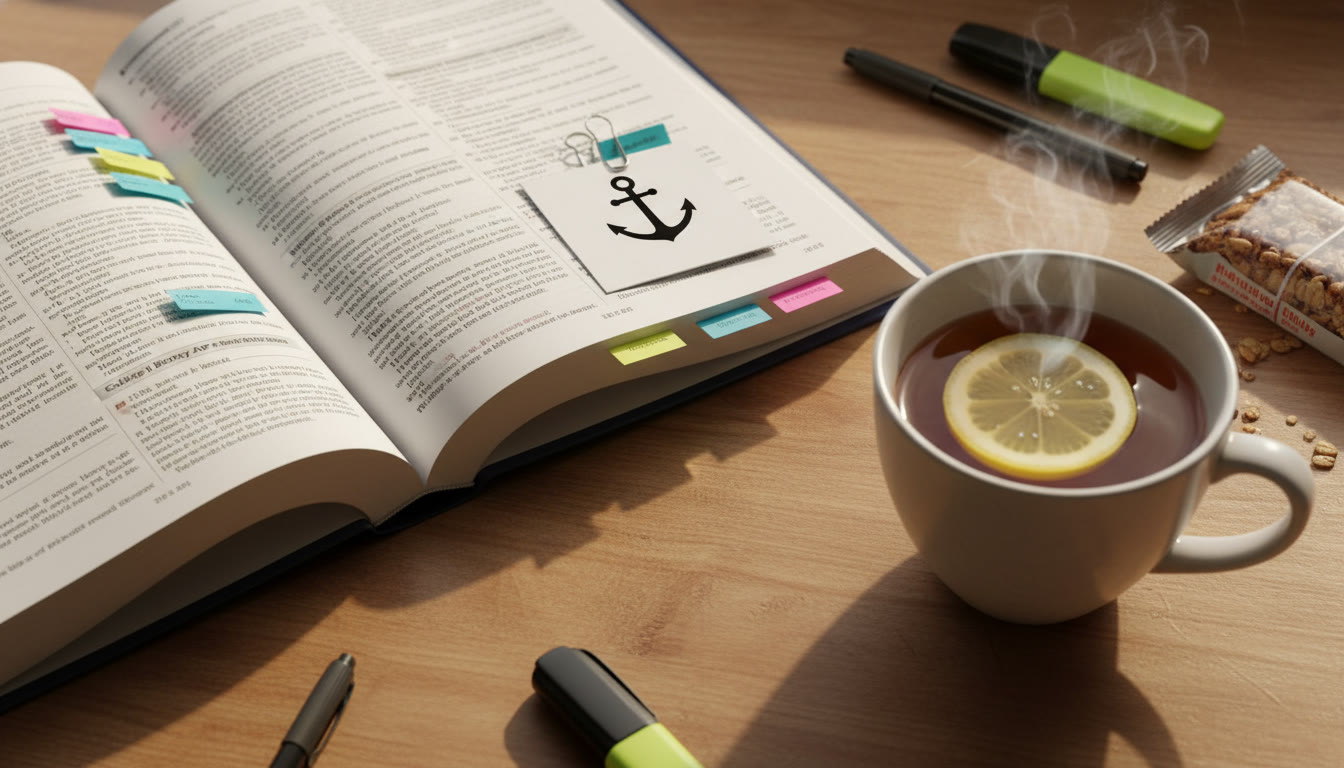
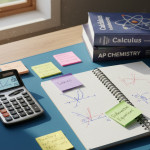
A visual anchor is any consistent, visible cue you place in your study environment to trigger focus and signal an intentional learning period. It could be a small drawing, a colored sticky tab with a symbol, a particular lamp, or even a physical object like a smooth stone. The trick is repetition: when your brain starts to associate that cue with concentrated study, seeing it automatically nudges attention back on task.
Why does this work? Attention is partly habit-driven. Our brains prefer shortcuts. When you repeatedly pair a visual cue with a focused activity, your brain learns to switch into study mode more quickly. For AP students—who must shift between dense content (like AP Biology, AP US History, or AP Calculus) and test skills—visual anchors provide a predictable, low-friction entry into productive work.
How to Choose Your Visual Anchors
Not every cue will do. The best anchors are:
- Simple — one clear shape or color is easier to recognize than a busy image.
- Portable — something you can move between desks, libraries, or study rooms.
- Intentional — use it only when you commit to focused work so it keeps a high signal-to-noise ratio.
- Pleasant — a cue that gives a tiny positive jolt (a favorite color, a small doodle) helps motivation.
Examples of great anchors:
- A 3×5 index card with a bright anchor icon used only during 25–50 minute study blocks.
- A particular lamp turned on only for serious study sessions.
- A colored sticky tab on the top right corner of the book or laptop screen.
- A small smooth stone or stress ball you place next to your notes.
Quick Setup: Build Your Visual Anchor in Five Minutes
- Pick one visual symbol (anchor, star, circle) and one color.
- Make two copies: one to keep at your main study spot and one portable version.
- Decide when you’ll use it (e.g., Pomodoro sessions, before timed practice, or during review).
- Commit to using the cue for at least two weeks—consistency builds the association.
Anchors + Routines: Why Pairing Matters
A visual anchor alone is helpful, but it becomes powerful when paired with a short, repeatable routine—a “pre-study ritual.” The ritual tells your brain: we’re doing focused AP work now. A strong ritual usually lasts 2–5 minutes and involves steps like setting a goal, turning on the anchor, and a deep breath to begin.
An Example Pre-Study Ritual (Perfect for AP Sessions)
- Step 1: Place your visual anchor visibly on your notes or laptop.
- Step 2: Write one clear goal for this session (example: “Complete 4 multiple-choice sets on acid-base titrations”).
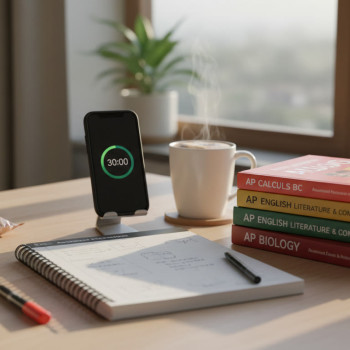
- Step 3: Set a timer for a focused block (25 or 50 minutes depending on stamina).
- Step 4: Take one slow deep breath in and out, then start.
This ritual is short but consistent. Over time, merely seeing the anchor and writing a single goal is enough to trigger concentration quickly.
Practical Visual Anchor Strategies for Different AP Subjects
Different AP exams demand different mental operations: memorization, math problem solving, essay structure, or visual analysis. Tailor your anchor strategy to the skill set you’re training.
AP Biology / AP Chemistry
- Use annotated diagrams as anchors: a standard labeled mitochondrion or reaction mechanism with a colored corner tab. Glance at it to cue a molecular or process-oriented mindset.
- During practice, place the anchor next to flashcards for quick retrieval practice.
AP Calculus / AP Physics
- Place a small graph sketch or formula card as your anchor—seeing it nudges your brain toward quantitative reasoning.
- Combine with a scratch sheet ritual: write down the variables and units before solving.
AP English / AP History
- Use a short phrase card (e.g., “Thesis First”) or a symbol for argument structure. When writing essays, seeing it reminds you to organize before you compose.
- For history, a timeline corner card that you place visibly during source analysis helps you mentally situate evidence chronologically.
Micro-Habits: Five Visual Anchors You Can Start Today
Here are five micro-habits—small tweaks you can make immediately. They’re low-effort but surprisingly effective.
- Color-Coded Corner Tabs: Put a colored triangle on the top corner of any page where you want intense review; treat the color as a “deep work” signal.
- Single-Goal Index Card: A 3×5 card with one sentence goal placed upright next to your screen.
- Motivational Sticky: One short affirmation or reason for studying (“You’ve got this—AP Bio 4/5”) kept only for study time.
- Dedicated Desk Lamp: Flick it on only when you plan to focus—after a week, the lamp becomes the trigger.
- Timer Sticker: A small, bright sticker on your timer or phone to mark it as a focus device rather than a distraction.
Measuring What Works: A Simple Table to Track Anchor Effectiveness
When you test techniques, measure them for one week each. Use this small table to compare a few metrics so you can iterate quickly.
| Anchor Type | Session Length | Work Completed | Distraction Count | Feeling of Focus (1–5) |
|---|---|---|---|---|
| Index Card Goal | 25 min | 3 practice problems | 1 | 4 |
| Colored Corner Tab | 50 min | Chapter summary notes | 2 | 3 |
| Study Lamp | 50 min | Timed essay draft | 0 | 5 |
Use the table weekly. Look for patterns: which anchor lowers your distraction count? Which one increases your feeling of focus? The goal is to find the shortest, most consistent cue that produces reliable results.
Combining Anchors with Active Study Techniques
Anchors don’t replace proven study strategies—they amplify them. Pair anchors with active techniques like spaced repetition, practice tests, and error logs to convert focused time into measurable learning gains.
Example Session: Anchors + Active Recall for AP Chemistry
- Place your anchor card on the right of your textbook.
- Write a single goal: “Explain Le Chatelier’s principle and do 10 MCQs.”
- Set timer for 50 minutes. Spend 30 minutes on concept summary and teaching the concept aloud, 15 minutes doing targeted MCQs, 5 minutes logging errors and planning next review.
This structure keeps the anchor central and makes every minute deliberate.
When Focus Fails: Gentle Recovery Moves
Even with an anchor, attention will wobble. Have a recovery plan so you don’t spiral into phone doomscrolling.
- Stop after five minutes of unproductive work. Move your anchor to a different spot and restart with a two-minute breathing reset.
- If you hit decision fatigue (not sure what to study), pick the simplest action—”open Chapter X and read the first paragraph.” Anchors excel at guiding low-friction starts.
- Use a two-minute tidy: clear the desk, place the anchor, and restart. Physical movement reboots concentration.
Study Sprints vs. Extended Blocks — Which Is Better for AP Prep?
The right block length depends on the task and your endurance. Short sprints (25 minutes) are fantastic for dense memorization and quick problem sets. Longer blocks (50–90 minutes) are better for deep synthesis—writing practice essays or building interconnected concept maps. Visual anchors help both: for sprints, use a portable index card; for extended blocks, combine the anchor with environmental signals like a study lamp and a full-page goal sheet.
Sample Weekly Plan Using Anchors
- Monday — 3×25-min sprints with index card goals (AP Calculus practice).
- Tuesday — 1×90-min block with lamp and anchor (AP US History DBQ practice).
- Wednesday — 4×25-min mixed review (flashcards + MCQs) using colored tabs.
- Thursday — 50-min synthesis session with anchor (AP Biology concept map).
- Friday — Timed practice test segment with full ritual and anchor.
- Weekend — Light review, reset anchor ritual, plan next week’s targets.
How Tutors and 1-on-1 Guidance Can Make Anchors Stick
Anchors are personal—what works for your friend might not work for you. That’s where tailored coaching helps. A tutor can observe your natural attention patterns, suggest personalized anchor designs, and help build a ritual that fits your day. If you work with a program like Sparkl’s personalized tutoring, you’ll get 1-on-1 guidance, tailored study plans, expert tutors who understand AP exam demands, and even AI-driven insights to spot weak spots faster. Those supports make it much easier to implement anchors consistently and to refine them based on real performance data.
Common Mistakes and How to Avoid Them
Students often set up anchors and then either misuse them or over-saturate their environment until the anchor loses meaning. Here’s how to avoid that:
- Don’t overuse: If you put the anchor everywhere, it becomes background noise. Keep it special—show it only during serious study blocks.
- Don’t rely on it alone: Anchors support, not replace, active study techniques like retrieval practice.
- Don’t expect overnight miracles: Conditioning takes time. Give an anchor two weeks of consistent use before judging its value.
Real-World Student Example: From Distracted to Disciplined
Consider Maya, an AP Chemistry student who used to open her notes and check her phone within 10 minutes. She created a small index card with a red anchor symbol and a single-line goal card. She paired it with a 25-minute sprint ritual and logged distractions. Two weeks later, her average uninterrupted time doubled. She scored higher on timed practice sections simply because she completed more deliberate practice. Small, consistent changes multiplied into real gains on practice exams.

Tools and Materials That Pair Nicely with Anchors
- Index cards and colored pens for quick goal cards.
- Small desk lamp or clip-on light to create a study-only environment.
- Sticky tabs in 2–3 colors for prioritizing topics.
- A small physical object (stone, token) you only use during study time.
- A simple planner or app to log sessions and distraction counts.
Final Checklist: Your 7-Day Visual Anchor Experiment
Use this checklist to run a focused experiment. Treat it like a mini science project: observe, record, and iterate.
- Day 0: Choose your anchor and create two copies (main and portable).
- Day 1–7: Use the anchor for at least one focused block each day, follow the pre-study ritual, and log results (work completed, distractions, feeling of focus).
- End of week: Review your table. Which anchor reduced distractions? Which increased output? Adjust colors/placement and repeat.
Wrap-Up: Small Visual Moves, Big AP Wins
Visual anchors are low-cost, high-return tools. They don’t magically create willpower, but they make it easier for your brain to find and keep attention. For AP students balancing multiple subjects, busy schedules, and exam stress, anchors are a practical lever—simple to set up, easy to carry, and powerful when paired with strong study techniques like spaced repetition and active recall.
Remember: consistency matters more than intensity. A tiny ritual repeated daily beats one heroic but sporadic marathon. If you’re the kind of student who benefits from personalized feedback, consider working with a tutor who can help you adapt anchors to your study style—programs that offer 1-on-1 guidance, tailored study plans, expert tutors, and AI-driven insights can accelerate the process and keep you accountable. With a few deliberate visual cues and a little practice, you’ll be surprised how quickly your study sessions transform.
One Last Tip
Choose an anchor you actually like. If it makes you smile, it will lower resistance to starting. Start small, be consistent, and let the little visual anchor guide you back to focus—one session at a time.
Good luck—your AP exams are big, but your daily habits are the real muscle. Anchor them well.
























No Comments
Leave a comment Cancel