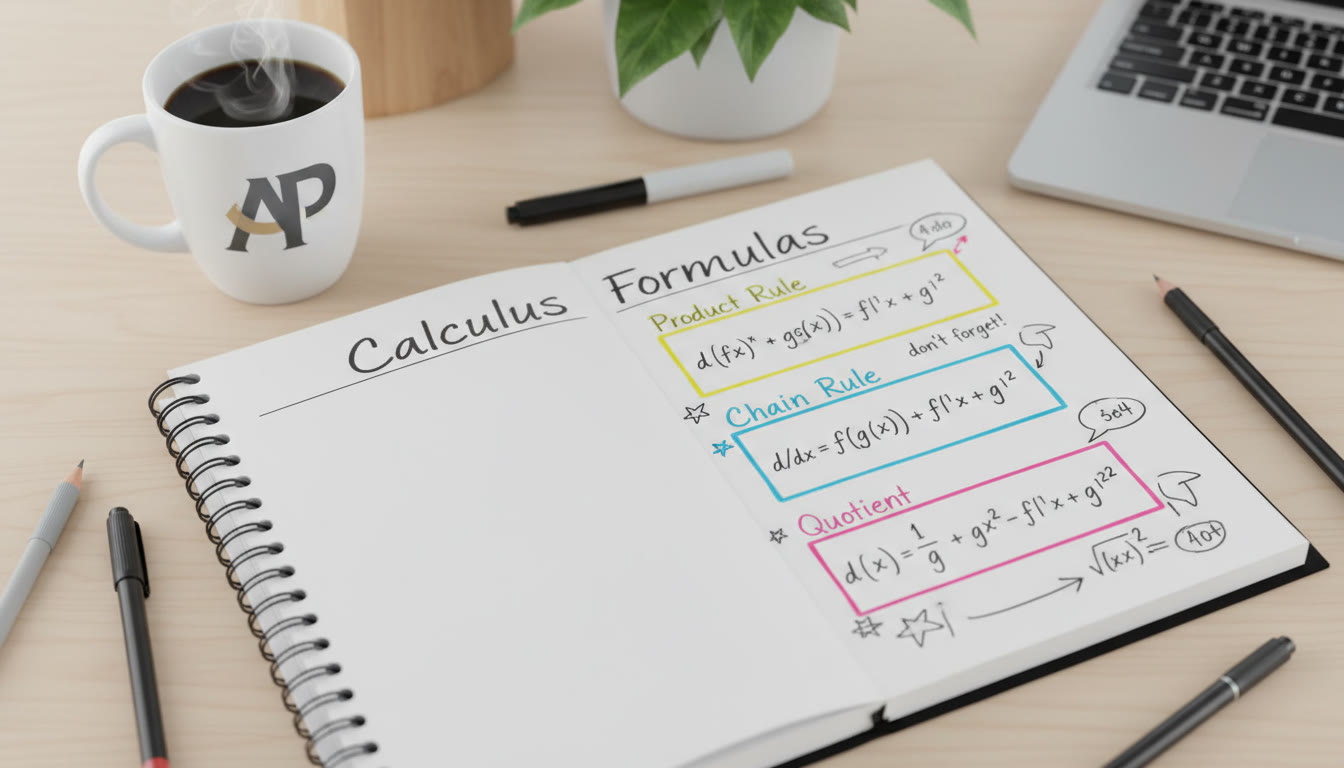

Why the Differentiation Rules Matter (and why you can actually enjoy them)
When you open an AP Calculus AB exam packet and see a tangled function—say, (x^2 * sin x) / (1 + e^x)—there’s a moment of silence. Then you smile, because this is precisely the kind of problem that the Product, Quotient, and Chain Rules were designed to make friendly. These three rules turn messy derivatives into predictable routines. With a little pattern recognition, a few carefully rehearsed steps, and smart shortcuts, you’ll go from hesitating to humming through problems.
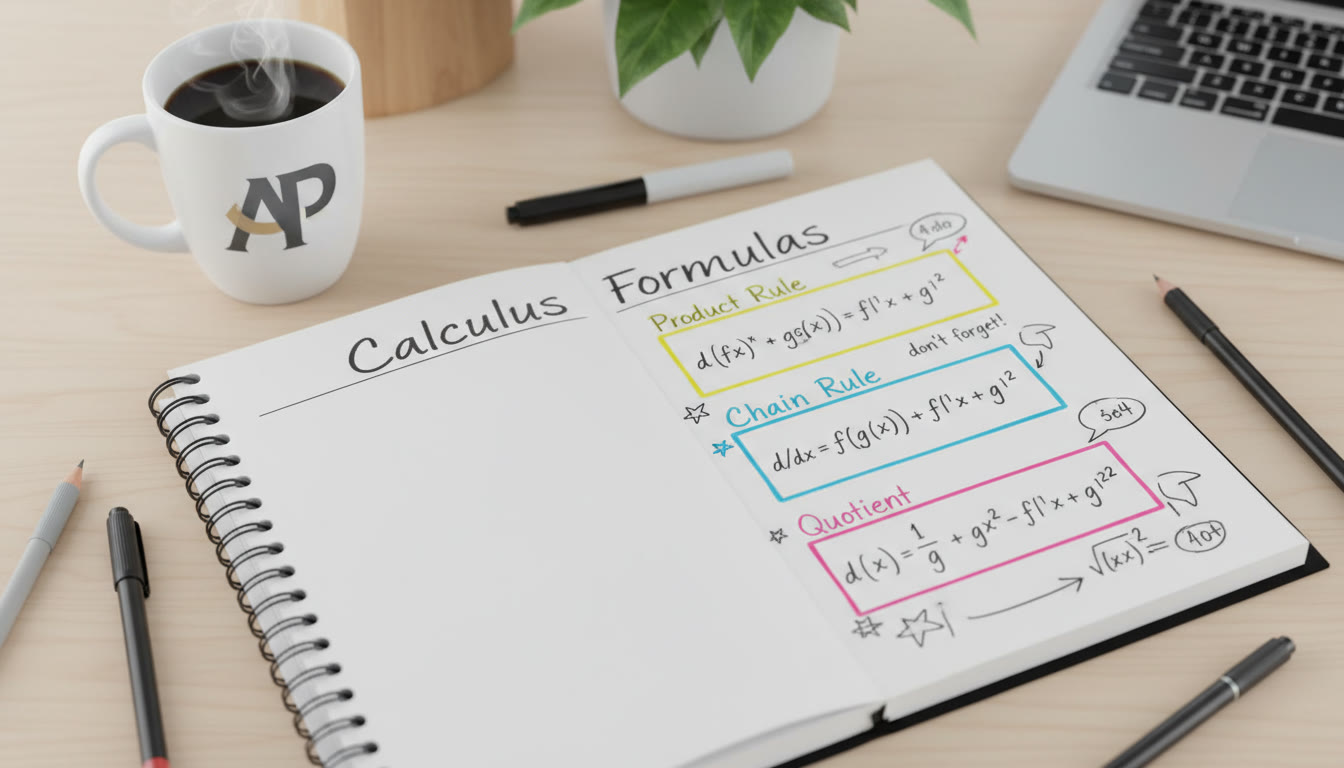
The three rules in a sentence
Before we unpack each rule, here’s a compact memory aid:
- Product Rule: derivative of f·g is f’·g + f·g’.
- Quotient Rule: derivative of f/g is (f’·g − f·g’)/g^2.
- Chain Rule: derivative of f(g(x)) is f'(g(x))·g'(x).
That sentence is useful, but to build speed you’ll want patterns, examples, and a few sanity checks you can do in seconds. Let’s go rule-by-rule with shortcuts, common pitfalls, and quick mental checks.
Product Rule: Speed, structure, and the “first-derivative-second + second-derivative-first” rhythm
When to use it
Use the Product Rule when two differentiable functions are multiplied: h(x) = f(x)·g(x). If one factor is constant, the product rule reduces to a constant multiple scenario, so first check for that to save time.
Quick mnemonic and mental checklist
- Say the phrase: “first derivative second plus second derivative first.”
- Always simplify after distributing—common factors often cancel or combine neatly.
- If one factor is a composite function, be ready to apply the Chain Rule inside each derivative.
Worked example
Differentiate y = x^3·cos x.
Step 1: Identify f(x) = x^3, g(x) = cos x.
Step 2: Compute f'(x) = 3x^2, g'(x) = −sin x.
Step 3: Apply the rule: y’ = 3x^2·cos x + x^3·(−sin x) = 3x^2 cos x − x^3 sin x.
Speed hacks
- If both factors share a power of x, factor it early. For example, x^3 cos x − x^2 sin x can be simplified by factoring x^2.
- When you see a product where one factor is a constant multiple (like 5·g(x)), factor the constant out and just differentiate g(x).
- For repeated practice, write the pattern f’g + fg’ at the top of your scratch paper as a template and plug pieces into slots like a calculator.
Quotient Rule: The reliable but sometimes avoidable tool
When to use it
Use the Quotient Rule when you have a function divided by another function: h(x) = f(x)/g(x), with g(x) ≠ 0. But here’s a secret: sometimes algebra can remove the need for the Quotient Rule entirely—rewriting can be faster and less error-prone.
Standard form and mental model
The rule is: (f/g)’ = (f’·g − f·g’) / g^2. To avoid sign mistakes, remember the order: numerator derivative times denominator, minus numerator times denominator derivative, all over denominator squared.
When to rewrite instead
If the denominator is a simple power of x or a constant, rewrite using negative exponents and apply the Product/Power Rule instead. Example: (x^3)/(x^2) = x, and (f(x))/(x^n) = f(x)·x^(−n) can be handled via Product Rule and Power Rule, avoiding the messy numerator expansion.
Worked example
Differentiate y = (x^2 + 1)/(x^3 − x).
Step 1: Let f(x) = x^2 + 1, g(x) = x^3 − x.
Step 2: Compute f'(x) = 2x, g'(x) = 3x^2 − 1.
Step 3: Apply quotient rule:
y’ = [2x·(x^3 − x) − (x^2 + 1)·(3x^2 − 1)] / (x^3 − x)^2.
Step 4: Expand and simplify if needed, but often leaving it factored is fine for the AP free-response — clarity wins speed.
Common pitfalls
- Mixing up the subtraction order. Always do f’·g minus f·g’.
- Forgetting to square the denominator. The denominator is always g(x)^2, never g'(x) or similar.
- Over-expanding unnecessarily. Keep expressions factored when possible to avoid algebra mistakes under time pressure.
Chain Rule: The powerhouse for composite functions
Why it’s fundamental
Many functions you meet are composed of layers: think of f(g(h(x))). The Chain Rule tells you how the outer layer’s rate interacts with the inner layer’s rate. Master this and you’ll be able to differentiate almost any structured function quickly.
Core statement and intuition
If y = f(g(x)), then dy/dx = f'(g(x))·g'(x). Intuitively: how fast does the outer function change, evaluated at the inner function, multiplied by how fast the inner function is changing.
Layering method (practical trick)
- Label the layers: u = inner, v = next layer, etc. For example, with y = sin(3x^2 + 1), let u = 3x^2 + 1, then y = sin u.
- Differentiate outward: dy/du = cos u, du/dx = 6x. Multiply: dy/dx = cos(3x^2 + 1)·6x.
- Write the final derivative all in terms of x—never leave u in the final answer on the AP exam unless you state the substitution clearly.
Worked example with nesting and algebra
Differentiate y = (3x^2 + 2x)^5.
Step 1: Let u = 3x^2 + 2x, so y = u^5.
Step 2: dy/du = 5u^4, du/dx = 6x + 2.
Step 3: dy/dx = 5(3x^2 + 2x)^4·(6x + 2).
Often the AP free-response wants the derivative left in factored form, which is both neat and less error-prone.
Combination with product and quotient rules
Composite functions often appear inside products or quotients. For example, differentiate y = e^{x^2}·sin(x^3). You’ll use the Product Rule, and inside each derivative you’ll apply the Chain Rule: derivative of e^{x^2} is e^{x^2}·2x (Chain Rule), derivative of sin(x^3) is cos(x^3)·3x^2. Tack them together cleanly and simplify where possible.
Compact cheat-sheet table: Rules at a glance
| Rule | Form | When to Use | Quick Tip |
|---|---|---|---|
| Product | (f·g)’ = f’·g + f·g’ | Two functions multiplied | Factor common terms after expanding |
| Quotient | (f/g)’ = (f’·g − f·g’)/g^2 | Function divided by function | Try algebraic rewrite to avoid it |
| Chain | (f∘g)’ = f'(g(x))·g'(x) | Composite functions | Label layers u, v, then differentiate outward |
| Power (special case) | (x^n)’ = n·x^{n−1} | Simple powers of x | Combine with Chain for (g(x))^n |
High-speed strategies for the AP Calc AB exam
1) Pattern recognition — practice the small library
You don’t need to memorize every possible function. Instead, build a compact mental library of common shapes: polynomials, exponentials, trig functions, logarithms, rational functions, and compositions of these. When you see a composite, ask: is it ( )^n? Is it exponential of a polynomial? Each pattern points to a specific combination of rules you’ll apply automatically.
2) Always do a quick sanity check
- Dimension check: If f(x) is dimensionless and g(x) scales like x^n, does the derivative scale like x^{n−1}? This is a rough check that often catches missing factors.
- Plug in easy x values: Evaluate derivative at x = 0 or x = 1 when plausible to verify sign or magnitude against a quick numerical derivative.
3) Favor factored final answers
AP graders value clarity. A factored derivative like 5(3x^2 + 2x)^4(6x + 2) is easier to read than an expanded polynomial with dozens of terms—and it’s less likely to host an algebra error.
4) Combine rules methodically
When a problem requires Product, Quotient, and Chain in one go, work in a small, labeled workspace: identify f and g for the product, label inner composites as u and v for the chain, and write each intermediate derivative before combining. The small overhead of writing these labels saves time by preventing rework.
Practice set with answers (speed pack)
Work through these under timed conditions. Aim for accuracy first, then speed. After you solve, compare with the answers and note where you hesitated.
- 1) Differentiate y = x^2·e^x.
- 2) Differentiate y = (sin x)/(x^2).
- 3) Differentiate y = (ln(3x + 1))^4.
- 4) Differentiate y = (x^2 + 1)·cos(x^3).
- 5) Differentiate y = e^{sin x} / x.
Answers (brief)
- 1) y’ = 2x·e^x + x^2·e^x = e^x(2x + x^2).
- 2) y’ = [cos x·x^2 − sin x·2x] / x^4 = (x^2 cos x − 2x sin x) / x^4; simplify if desired.
- 3) y’ = 4(ln(3x + 1))^3 · [3/(3x + 1)] = 12(ln(3x + 1))^3 / (3x + 1).
- 4) y’ = 2x·cos(x^3) + (x^2 + 1)·(−sin(x^3)·3x^2) (Product + Chain combined).
- 5) y’ = [e^{sin x}·cos x·x − e^{sin x}·1] / x^2 = e^{sin x}(x cos x − 1)/x^2 (Quotient + Chain).
Common exam traps and how to avoid them
- Missing a negative sign in trig derivatives. Memorize sin’ = cos, cos’ = −sin, and check signs by quick substitution x = 0.
- Forgetting to multiply by inner derivatives in Chain Rule—this is the most common slip. Label inner functions explicitly when in doubt.
- Expanding too early under time pressure. If the expression can stay factored, leave it that way.
- Dropping denominators in Quotient Rule—if you cancel later, show the algebra steps briefly so graders can follow your reasoning.
How to practice effectively (quality over quantity)
Smart practice beats mindless repetition. Here’s a weekly plan to increase speed without sacrificing accuracy:
- Day 1: Focus on recognition drills. Identify which rule(s) apply to 30 random functions in 20 minutes—no solving, just classification.
- Day 2: Guided practice. Work 10 problems mixing Product, Quotient, and Chain rules, writing neat, labeled steps. Time: 40 minutes.
- Day 3: Timed speed set. Pick 15 problems and solve them in 30 minutes; score yourself and analyze mistakes.
- Day 4: Error correction. Revisit errors and redo the problems untimed, writing alternative solution paths (e.g., rewrite quotient as product) to reinforce flexibility.
- Day 5: Mixed review. Integrate trig, exponential, and logs into your problems—composite practice is essential.
When to bring in a tutor (and how Sparkl’s approach can accelerate progress)
Everyone benefits from targeted guidance, especially when you’re trying to shave minutes off your exam time. A tutor can identify specific patterns where you consistently hesitate, offer immediate corrective feedback, and model exam-style solutions. Sparkl’s personalized tutoring can be particularly helpful: 1-on-1 guidance to tailor study plans to your strengths and weaknesses, expert tutors who break down each rule into practical micro-skills, and AI-driven insights that highlight where you lose points and why.
Use targeted sessions to practice transitions—like switching from identifying a product to recognizing an inner chain inside one of the factors. A coach who gives you techniques to factor answers for clarity, and who times and reviews your practice sets with precision, will speed up your learning curve dramatically.
Exam-day checklist for differentiation problems
- Read the function fully before writing: decide whether it’s a product, quotient, composite, or a combination.
- Label inner functions (u, v) for complex compositions.
- Write the rule you’ll apply in one line (f’g + fg’, etc.). The few seconds you spend now save minutes of algebra later.
- Keep answers factored when possible and show your intermediate derivatives—this helps graders award partial credit if you make a small algebra slip.
- If you simplify, do it cleanly; messy cancellation can hide errors.
Final pep talk: turning rules into reflex
Learning the Product, Quotient, and Chain Rules is like learning to tie your shoes: at first it takes attention and conscious steps, but with practice it becomes automatic. Focus on structure, label layers, and use algebraic rewrites to make your life easier. Don’t chase speed at the expense of clarity—speed arrives naturally after accuracy becomes second nature.

Parting practical resources (how to keep improving right away)
Practice mixed sets that mimic AP format, time yourself, and review mistakes carefully. If you want faster gains, consider booking a few focused sessions with a tutor who can create a targeted plan: warm-ups, timed drills, and error-focused reviews. Sparkl’s tailored study plans and 1-on-1 instruction are designed to do exactly that—sharpen your weak spots and streamline your study time, so every minute you put in yields measurable improvement.
Quick reference: one-page speed pack you can copy
Write this on one side of an index card and carry it into the final weeks of prep:
- Product: (f·g)’ = f’·g + f·g’
- Quotient: (f/g)’ = (f’·g − f·g’)/g^2
- Chain: (f∘g)’ = f'(g(x))·g'(x)
- Trig: sin’ = cos, cos’ = −sin, tan’ = sec^2
- Log/exp: (ln x)’ = 1/x, (e^{u})’ = e^{u}·u’
- Power composite: (g(x))^n’ = n·g(x)^{n−1}·g'(x)
Short example marathon (apply everything in one challenge)
Differentiate the following in a single, timed pass (15 minutes):
- a) y = (x^2·ln(1 + x^3)) / (sqrt{x + 1})
- b) y = (cos(2x)·e^{x^2}) / (1 + x^4)
Strategy: For both, label numerator and denominator, apply the Quotient Rule, and inside the numerator derivatives apply Product and Chain Rules as needed. Keep factors in factored form and show inner derivatives explicitly to capture partial credit if algebra slips happen.
A final note about confidence
As you practice, notice that your intuition about which rule to use becomes faster than your hand. That’s the tipping point: when your brain recognizes structure and your fingers execute the steps. With focused practice, clear labeling habits, and occasional targeted tutoring sessions—like the personalized, AI-informed coaching Sparkl offers—you’ll build that reflex quickly. Take a breath, trust the rules, and remember: differentiation may look mechanical, but understanding the ‘why’ behind each step turns it into something satisfying and elegant.
Go do one more timed set
Right now: set a 20-minute timer, choose 10 mixed differentiation problems that include Product, Quotient, and Chain Rules, and apply the methods above. When you finish, review errors immediately and write down one thing to fix tomorrow. Repetition with reflection is the secret sauce.
You’ve got this—one clear step at a time.





























No Comments
Leave a comment Cancel