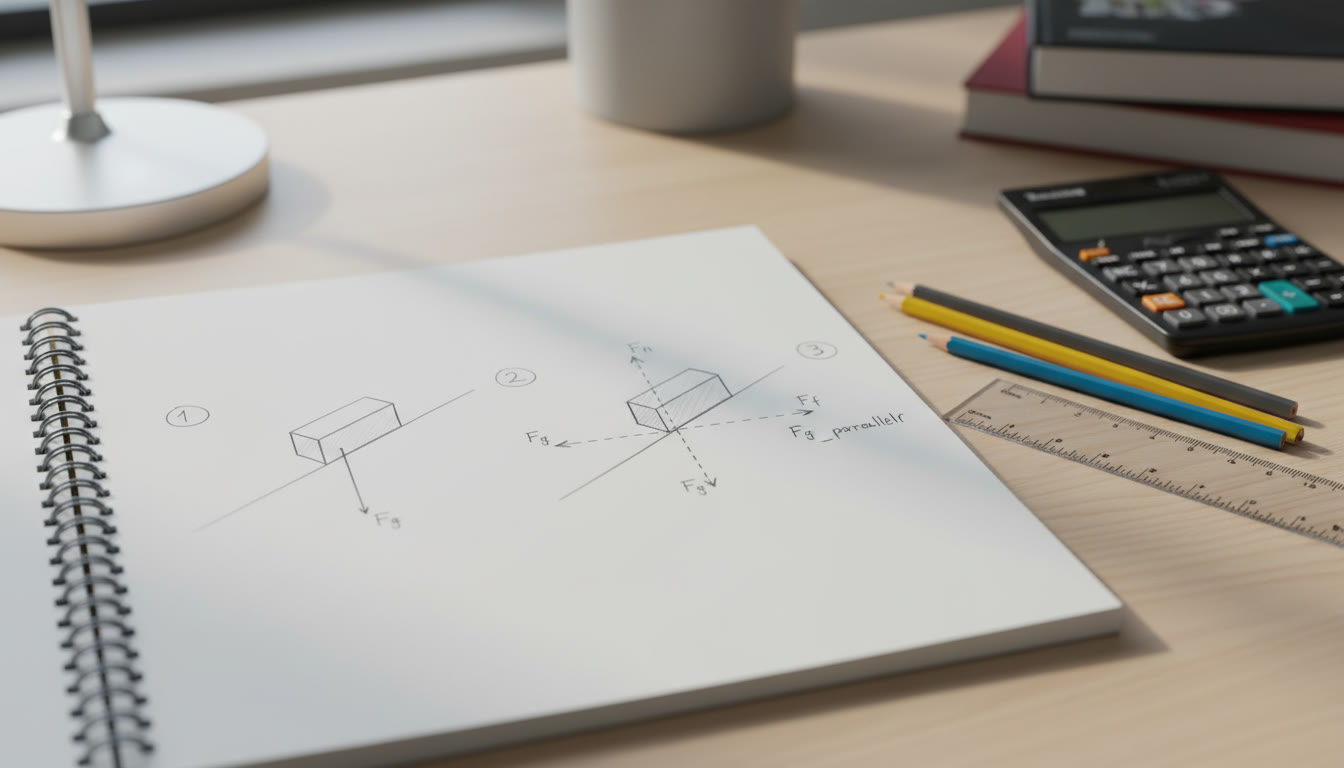

Why Free-Body Diagrams Matter (and Why You’ll Want Them in Your Toolkit)
If you’re taking AP Physics 1, free-body diagrams (FBDs) are the single most dependable tool you can master. They turn messy word problems into tidy, solvable pictures. The skill isn’t just about drawing arrows — it’s about converting a real-world scenario into a clear set of forces, directions, and relationships you can analyze with Newton’s laws. Students who use strong FBDs consistently score higher on exams because the diagrams reduce mistakes, expose hidden assumptions, and guide algebraic setup.
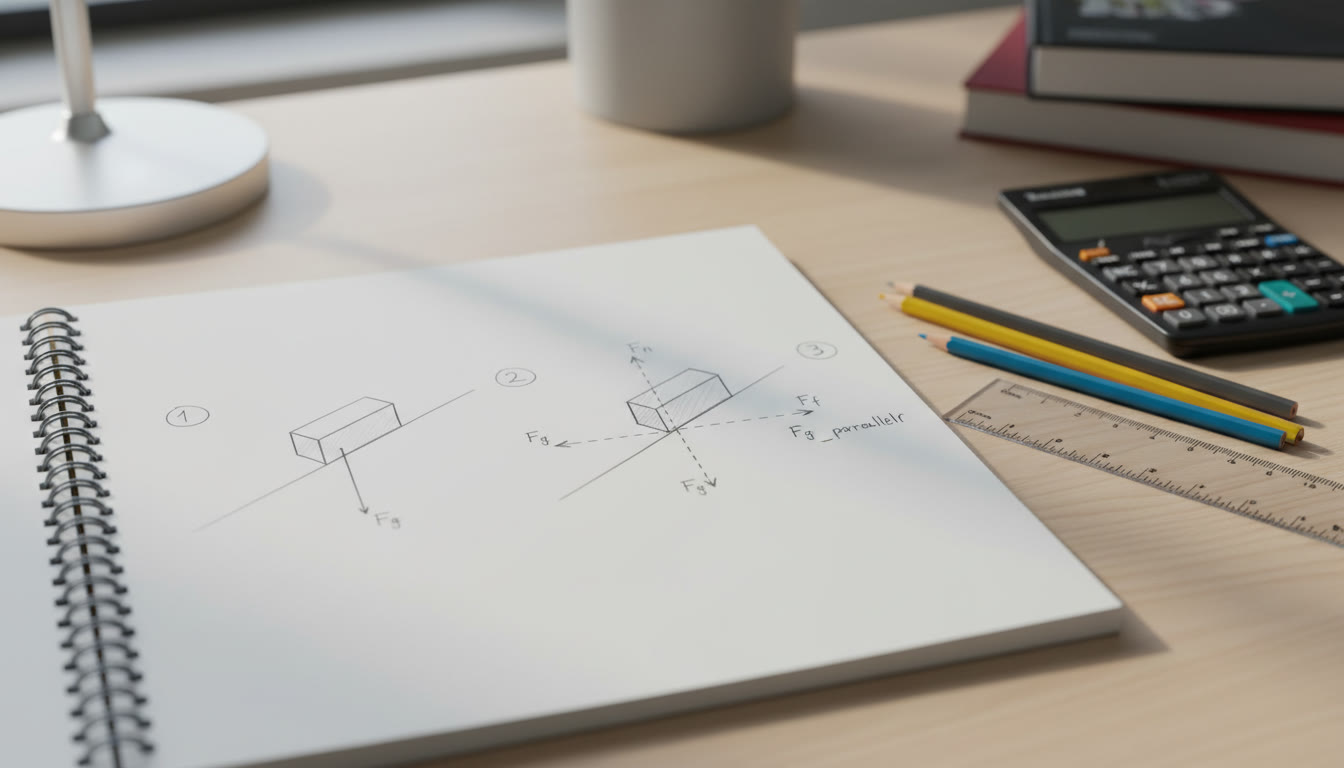
Fundamental Concepts to Keep in Mind
Before you sketch, review these bedrock ideas so your diagram is rooted in correct physics, not hopeful guessing.
- Object isolation: Draw the FBD for a single object. Everything else becomes forces acting on that object.
- Contact vs. field forces: Contact forces (normal, friction, tension) act at surfaces; field forces (gravity, electric) act at a distance and point toward/along the field.
- Choose your positive axes: Pick x and y axes that simplify the math — often aligned with motion or plane of contact.
- Newton’s Second Law: ΣF = ma in each axis is your algebraic translation of the diagram.
- Always label magnitudes and directions: A force arrow without a label invites algebraic errors.
Common Forces You’ll Draw Again and Again
Here are the standard forces and how to represent them:
- Weight (mg): Draw vertically downward from the object’s center — magnitude = m × g.
- Normal force (N): Perpendicular to the contact surface, away from the object.
- Tension (T): Along a rope or string, away from the object and toward the rope’s attachment.
- Kinetic friction (f_k): Opposes motion, parallel to surface; magnitude = μ_k N.
- Static friction (f_s ≤ μ_s N): Opposes incipient motion, up to a maximum value; direction opposes the tendency to move.
Step-by-Step: A Reliable Method for Drawing FBDs
Make this sequence a habit. The more automatic the steps become, the fewer silly mistakes you’ll make under timed AP conditions.
- Read and visualize: Read the problem twice. Close your eyes and picture the scenario — directions of motion, contact surfaces, and constraints.
- Isolate the object: Imagine cutting the object free from its environment so you see only the object and the forces acting on it.
- Sketch the object and forces: Draw a simple box or dot to represent the object. Add arrows for every force — no mysterious forces allowed.
- Choose axes: Pick x and y axes to simplify the problem. For inclines, align x with the plane and y perpendicular to it.
- Resolve components: Break angled forces into perpendicular components if they don’t align with your axes.
- Write ΣF equations: Sum forces along each axis and set equal to ma (or zero for equilibrium).
- Solve and check: Solve algebraically, then do a quick sanity check—units, direction, and limiting cases (what if m→0 or μ→0?).
Example: Block Sliding Down an Incline
Imagine a block of mass m on an incline θ, sliding down with kinetic friction μ_k. Walk through the steps:
- Isolate block → draw a box.
- Forces: mg (down), N (perpendicular to incline), f_k (up the plane opposing motion).
- Axes: x along plane (downhill positive), y perpendicular to plane.
- Resolve weight into components: mg sinθ along x (down) and mg cosθ along y (into plane).
- Normal force N = mg cosθ (since ΣF_y = 0 if no acceleration perpendicular to plane).
- Friction f_k = μ_k N = μ_k mg cosθ (up the plane).
- ΣF_x = mg sinθ − μ_k mg cosθ = ma → a = g(sinθ − μ_k cosθ).
That tidy result is a reward for a correct FBD. Without the diagram, you might forget to resolve mg into sinθ and cosθ components, which is the most common error.
Table: Quick Reference for Forces and Signs
| Force | Direction | Typical Formula | Sign In Equation |
|---|---|---|---|
| Weight (mg) | Downward (toward Earth) | mg | Negative if up is positive |
| Normal (N) | Perp. to surface, away from object | Often equals mg cosθ | Positive if away from object chosen as positive axis |
| Tension (T) | Along string toward anchor | T (unknown or from constraints) | Depends on chosen axis |
| Kinetic Friction (f_k) | Opposes motion, parallel to surface | μ_k N | Negative relative to direction of motion |
| Static Friction (f_s) | Opposes impending motion, ≤ max | f_s ≤ μ_s N | Sign chosen against tendency to move |
Algebra, Signs, and the Most Common Mistakes
Here are predictable stumbling blocks and how to fix them. If you train yourself to check for these, you’ll save time and points on the AP exam.
- Sign errors: After drawing forces, explicitly mark what you call positive. Rewriting ΣF equations with that label prevents reversed accelerations.
- Forgetting components: When an axis isn’t aligned with a force, write components immediately. Don’t try to remember sine vs cosine — derive them visually from the geometry.
- Mixing up static vs kinetic friction: Static friction is an inequality until you know it’s at maximum. Use f_s ≤ μ_s N and only substitute μ_s N when asked for max static friction.
- Overcounting forces: Only draw forces that act on the isolated object — don’t add reaction forces that act on other objects unless you isolate them too.
- Confusing normal and weight: Normal is a contact force and depends on the surface orientation — when surfaces accelerate (elevator, accelerating car), N ≠ mg.
Multiple-Object Problems and Constraints
Often AP problems involve pulleys, connected masses, or systems. The key is consistency: draw separate FBDs for each object, choose a consistent positive direction for each, and relate accelerations and tensions through constraints.
Example: Two Masses Connected by a Rope Over a Frictionless Pulley
Mass m1 on a horizontal table (with friction μ_k) connected to hanging mass m2. Steps:
- Draw FBD for m1: N = m1 g, friction f_k = μ_k N opposing motion, tension T to the right.
- Draw FBD for m2: weight m2 g down, tension T up.
- Set accelerations: if m2 descends, m1 moves right. Use same magnitude a for both (constraint).
- Write ΣF equations: for m1 → T − f_k = m1 a; for m2 → m2 g − T = m2 a. Combine to solve for a and T.
Breaking the system into two clear FBDs prevents confusion about signs and where friction enters.
How to Use FBDs Under AP Time Pressure
Timed practice is the only way to get fast. Here are strategies to help you be both quick and accurate.
- Practice a standardized sketch: Have a clean, consistent way you draw objects and label forces so your brain has a “template” during the test.
- Write the axes first: If you always decide axes immediately, you won’t waste time later rotating components mid-solution.
- Use short labels: Use m, g, θ, μ, T, N — these are quick to write and universally understood by graders.
- Reuse diagrams for multi-step problem parts: If a question asks multiple parts about the same setup, keep the FBD and annotate changes rather than redraw from scratch.
- Teach it back: If you can explain your diagram to a friend in one minute, you understand it. Practicing this boosts recall on exam day.
Practice Problems to Build Muscle Memory
Do practice that scales difficulty: start with single-block equilibrium problems, progress to inclines with friction, then try multi-body systems with pulleys and accelerations. After each solution, ask: “Would my FBD change if mass doubled? If μ doubled? If the surface accelerated upward?” These quick thought experiments reveal deeper understanding and prepare you for twisty AP prompts.
How Tutors and Personalized Study Help Sharpen Your FBDs
Learning FBDs benefits massively from personalized feedback. One-on-one tutoring helps because a skilled tutor can instantly spot small diagram mistakes, ask targeted questions that reveal hidden misconceptions, and present tailored practice problems that focus on your weak spots. Services like Sparkl offer 1-on-1 guidance, tailored study plans, expert tutors, and AI-driven insights that identify your recurring errors, helping you replace shaky habits with reliable processes. The right tutor accelerates the path from “I get it in class” to “I ace this on the AP exam.”
Sample Full Problem — Walkthrough
Problem: A 3.0 kg block sits on a 30° incline attached by a massless string over a frictionless pulley to a 2.0 kg hanging mass. The coefficient of kinetic friction between the block and incline is 0.20. Determine the acceleration of the system and the tension in the string.
Step 1: Sketch Two FBDs
- Block (m1 = 3.0 kg): Forces: N (perp), mg components (m1 g sin30° down plane, m1 g cos30° into plane), friction f_k up plane if motion is down, tension T up plane if opposing motion.
- Hanging mass (m2 = 2.0 kg): Forces: m2 g down, T up.
Step 2: Predict Motion
Compare m2 g vs component pulling down the plane plus friction. Intuition: m1 is heavier but part of its weight is supported by the plane; compute to be sure.
Step 3: Equations
For m1 along plane (down positive): m1 g sin30° − f_k − T = m1 a.
f_k = μ_k N = μ_k m1 g cos30°.
For m2 (downward positive): m2 g − T = m2 a.
Step 4: Solve (algebra summarized)
Combine equations to eliminate T: m1 g sin30° − μ_k m1 g cos30° − m2 g = (m1 + m2) a. Plugging numbers (g = 9.8 m/s²) gives a numeric a. Then substitute back to find T. (Work through the arithmetic on your scratch paper — the diagram makes the algebra straightforward.)
Checking and Interpreting Results
Once you have numbers, perform quick sanity checks:
- Units: are they m/s² and N? Good.
- Sign: does the acceleration direction match your initial motion prediction? If not, you may have a sign error or misidentified the direction of friction.
- Limits: if μ_k → 0, does acceleration increase? If m2 → 0, does acceleration approach zero? These limit checks catch algebra mistakes.
When Diagrams Must Be More Than Arrows: Rotational and Non-Inertial Cases
AP Physics 1 also touches on rotational dynamics and non-inertial frames. In these situations the same FBD principles apply, but you may add pseudo forces (in accelerating frames) or torques if an object is extended. For a student-level approach, treat each piece of the system separately and add extra terms only after the basic FBD is correct. Tutors and deliberate practice help demystify these trickier setups.
How to Turn Weakness into Strength: A 6-Week FBD Plan
Consistency wins. Here’s a compact schedule you can adapt:
- Week 1: Concept drills — isolate objects, label forces, and practice simple equilibrium FBDs.
- Week 2: Incline and component practice — focus on resolving mg and understanding normal forces.
- Week 3: Friction — static vs kinetic, inequality practice, and limiting cases.
- Week 4: Multi-body systems — pulleys, connected masses, constraint relationships.
- Week 5: Timed practice — 30–45 minute sessions doing past AP-style problems under time pressure.
- Week 6: Review and refinement — focus on your frequent mistakes, and use one-on-one tutoring sessions to iron out last-minute confusion.
Personalized tutoring like that offered by Sparkl can slot into any of these weeks, providing targeted practice and corrective feedback tailored to the errors you actually make, not the ones you think you make.
Final Tips — The Little Things That Add Up
- Always include units in final answers; AP graders expect them.
- Box your final answers so graders see them quickly during scoring.
- If a problem gives numeric approximations for g or μ, use the values provided unless instructed otherwise.
- Annotate your diagram with known numbers (masses, angles, μ) to avoid flipping between text and diagram.
- When stuck, redraw the FBD — fresh eyes, fewer mistakes.

Wrap-Up: Make Free-Body Diagrams Your Exam-Day Habit
Free-body diagrams are deceptively simple: a box and a few arrows, but they encode the physics behind motion. On the AP Physics 1 exam, clarity wins. A clear FBD makes algebra easier, reduces sign errors, and demonstrates understanding to the grader. Practice deliberately, check your signs and limits, and when you need faster improvement, use focused guidance. Personalized tutoring—like Sparkl’s 1-on-1 sessions and tailored study plans—can help you identify weak spots and accelerate progress so you walk into test day confident and ready.
Start today: pick a problem, draw an FBD, and compare your approach to the steps above. In a few weeks, what now feels mechanical will feel natural, and solving Physics 1 force problems will feel oddly satisfying — the way a neat diagram makes messy reality suddenly make sense.





























No Comments
Leave a comment Cancel