

Why Momentum Matters (and Why You Should Care)
Momentum sounds like one of those physics buzzwords you memorize for a unit test and promptly forget — but get beneath the vocabulary and you find one of the cleanest, most useful conservation principles in mechanics. If you want to think like a physicist on the AP Physics 1 exam, momentum and impulse are topics that reward intuition, clear diagrams, and a couple of reliable methods. This blog walks you through the ideas, shows how to approach every collision problem with confidence, and gives practical study strategies to lock the concepts into your brain for exam day.

What You’ll Learn Here
- Core definitions: momentum and impulse — what they are and why they’re linked.
- How to analyze elastic and inelastic collisions with simple steps.
- Common problem-solving templates and visual strategies for free-response and multiple-choice questions.
- Worked examples that turn abstract formulas into concrete answers.
- Study plan and exam-day tips, including how one-on-one tutoring (like Sparkl’s) can accelerate your progress.
Momentum and Impulse: The Definitions
Start with the fundamentals. Momentum (usually denoted p) is a vector quantity defined as the product of mass and velocity:
- p = m v
Impulse is the change in momentum and is produced by a force acting over a time interval:
- Impulse J = F_avg Δt = Δp = p_final − p_initial
Two quick mental notes:
- Because momentum depends on velocity, direction matters. Keep track of signs consistently.
- Impulse ties forces to momentum change — a large force for a short time can produce the same momentum change as a smaller force acting longer.
Conservation of Momentum: When It Applies
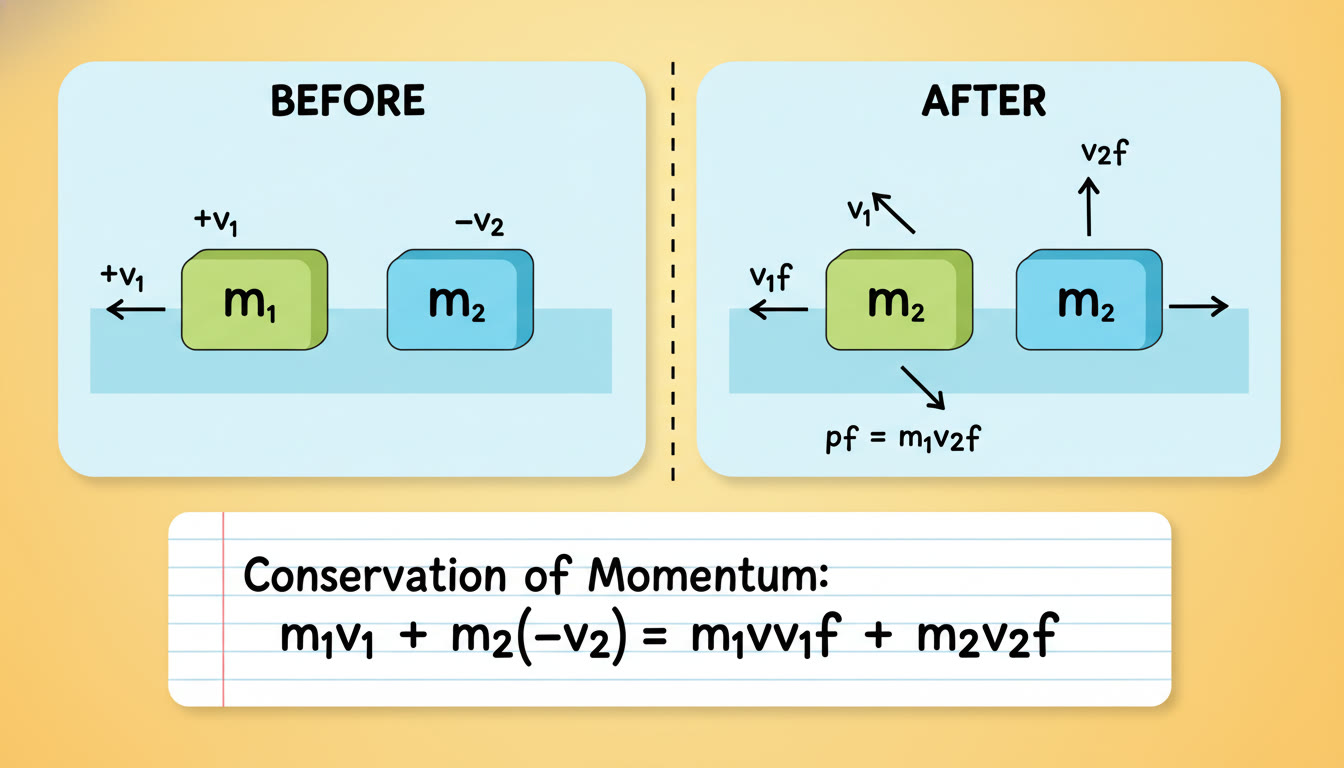
The conservation of linear momentum is a powerful tool because it eliminates force details when external influences are negligible. If the net external impulse on a system is zero, the total momentum of that isolated system remains constant:
- Σp_initial = Σp_final
In AP Physics 1, you’ll apply this principle most often to collisions in one or two dimensions. The key is to define your system (both colliding objects together) and check for external forces that could invalidate conservation (for example, friction from the ground or an external push). In many lab-style and exam problems, the collision happens quickly, making external impulse negligible — that’s the signal that conservation is permitted.
Elastic vs Inelastic Collisions — the practical difference
Collisions fall along a spectrum:
- Elastic collisions: Kinetic energy is conserved as well as momentum. Both energy and momentum equations help solve the problem (though in AP Physics 1, fully elastic problems are often simplified to one-dimensional cases).
- Inelastic collisions: Kinetic energy is not conserved; some is converted into internal energy, heat, or deformation. Momentum remains conserved. A perfectly inelastic collision is when objects stick together after colliding — this is the simplest case to analyze in many problems.
One-Dimensional Collision Template: A Step-by-Step Approach
Use this template to make collision problems routine rather than scary:
- Sketch the situation and choose a positive direction.
- Write down known masses and velocities (include signs for direction).
- Decide whether momentum is conserved (isolate system, check external impulses).
- If elastic, write momentum and kinetic energy equations. If inelastic, use momentum alone and, for perfectly inelastic, combine masses after collision.
- Solve algebraically for unknowns. Check units and limiting behavior (e.g., if one mass → 0, does the result make sense?).
- Double-check with a quick sanity check: is momentum sign and magnitude reasonable?
Worked Example 1 — Perfectly Inelastic Collision
Imagine a 0.80 kg cart moving to the right at 2.5 m/s collides and sticks to a 1.2 kg cart initially at rest. Find their speed after collision.
Step 1: Define positive to the right.
Step 2: Momentum before: p_initial = 0.80·2.5 + 1.2·0 = 2.0 kg·m/s.
Step 3: After collision they stick, so total mass = 2.0 kg. Conservation of momentum: (2.0 kg) v_final = 2.0 kg·m/s → v_final = 1.0 m/s to the right.
Short and sweet. That’s the power of momentum conservation.
Worked Example 2 — One-Dimensional Elastic Collision (Quick Method)
Elastic collisions involve both momentum and kinetic energy. There’s a useful trick for one-dimensional elastic collisions: the relative speed of separation equals the relative speed of approach. That is, v1_i − v2_i = −(v1_f − v2_f). This shortcut often avoids messy algebra.
Example: A 3 kg object moving at 6 m/s collides elastically with a 1 kg object at rest. Find final velocities.
Apply conservation of momentum: 3·6 + 1·0 = 3 v1_f + 1 v2_f → 18 = 3 v1_f + v2_f.
Use relative speed relation: 6 − 0 = −(v1_f − v2_f) → v1_f − v2_f = −6.
Solve the two equations: from relative speed, v1_f = v2_f − 6. Substitute: 18 = 3(v2_f − 6) + v2_f = 3 v2_f − 18 + v2_f → 18 = 4 v2_f − 18 → 4 v2_f = 36 → v2_f = 9 m/s. Then v1_f = 9 − 6 = 3 m/s.
Nice result: the initially faster mass slows but keeps moving forward; the initially stationary mass shoots off faster.
Two-Dimensional Collisions and Vector Components
When collisions aren’t head-on, treat momentum conservation component-wise. Break velocities into x- and y-components, write Σp_x(initial) = Σp_x(final) and Σp_y(initial) = Σp_y(final). Solve the component equations simultaneously for unknown components and then reconstruct magnitudes and directions with the Pythagorean theorem and inverse tangent.
Strategy Checklist for 2D Collisions
- Draw a clear diagram and label angles or axis directions.
- Resolve all given velocities into components immediately.
- Write momentum conservation separately for each orthogonal axis.
- Watch for symmetry: sometimes you can argue a component is zero without heavy algebra.
Impulse in Action: Forces Over Time
Whenever a force acts over a time interval, it changes momentum by the impulse. This is most useful when force varies with time — for instance, a braking force that grows as speed increases, or an impact force that spikes sharply.
Graphically, impulse is the area under an F vs t curve. If you see a problem that gives force as a function of time, integrate (or sum the areas) to find total impulse; then set that equal to Δp.
Example — Impulse From a Variable Force
Suppose a force acts on a 0.5 kg object for 0.2 s. The force varies linearly from 0 N to 20 N. The impulse is the area of a triangle: J = 0.5·base·height = 0.5·0.2·20 = 2.0 N·s. So the change in momentum is 2.0 kg·m/s. If the object started at rest, its final speed is 2.0 / 0.5 = 4.0 m/s.
Common Mistakes Students Make (And How To Avoid Them)
- Sign errors: Always choose and stick with a sign convention. Ink and arrows help.
- Confusing energy and momentum: kinetic energy is not conserved in inelastic collisions, even though momentum is.
- Forgetting to treat vectors component-wise in two dimensions.
- Using conservation where external impulses are significant — check for friction, external pushes, or impulse from the ground.
- Not labeling systems: clearly indicate whether you’re conserving momentum for both objects or part of a system.
How These Ideas Show Up on the AP Physics 1 Exam
AP Physics 1 typically allocates roughly 10%–15% of the exam to linear momentum and collisions. Expect both multiple-choice questions and free-response prompts that test:
- Ability to set up momentum conservation equations.
- Connections between impulse and force-time graphs.
- Comparisons between elastic and inelastic outcomes.
- Simple two-dimensional collisions requiring component analysis.
Free-response questions will reward clear diagrams, labeled axes, and step-by-step logic. It’s often not enough to get the right number — you also need to explain why conservation applies or how impulse alters momentum.
Table — Quick Reference for Collision Types and Equations
| Collision Type | Momentum | Kinetic Energy | Common Equation |
|---|---|---|---|
| Perfectly Inelastic | Conserved | Not conserved | (m1 v1 + m2 v2) = (m1 + m2) v_f |
| Elastic (1D) | Conserved | Conserved | Use Σp and ΣKE or relative-speed shortcut |
| General Inelastic | Conserved | Not conserved (partial loss) | Σp_initial = Σp_final; KE change = ΔE (heat, deformation) |
Active Study Techniques: How to Make Momentum Stick
Memorization won’t help much here — practice and reflection will. Try these active strategies:
- Sketch and talk aloud: Draw every problem, label directions and components, and explain your steps like you’re teaching a classmate.
- Do quick lab activities: If you can access carts and a track, measure before/after velocities and calculate momentum. A tactile sense of collision behavior cements intuition.
- Practice force-time graphs: Convert between F(t) and impulse, and sketch how shape affects area.
- Study with targeted mock FRQs: Time yourself, write full solutions, and compare against rubrics. Focus on clear reasoning and labeled steps.
- Use mini-tests: Set 20–30 minute problem sets focused only on collisions so you build speed and accuracy.
How Personalized Tutoring Can Speed Up Your Progress
Sometimes one hour with a focused tutor removes weeks of confusion. Personalized tutoring — like Sparkl’s one-on-one guidance — can clarify misconceptions (for example, when should you conserve kinetic energy? how do you set up components in awkward geometries?), create a tailored study plan for your weak points, and use diagnostic insights to allocate practice efficiently. If you struggle with translating verbal descriptions into momentum diagrams, targeted sessions can make that skill automatic.
Exam-Day Tips and Time Management
On test day, a calm, structured approach wins:
- Read through the section quickly first. Triage problems: do easy momentum questions first, flag harder two-dimensional collisions for later.
- For free-response, spend 1–2 minutes planning each solution: draw, define variables, and state conservation principles before diving into algebra.
- Keep your algebra neat. Transfer errors are common when you rush from an equation to a final number.
- If a numeric result looks weird, do a sanity check: is momentum direction correct? Does the magnitude scale with mass and velocity logically?
Putting It All Together: A Sample Study Week for Momentum and Collisions
Here’s a compact one-week plan you can use as a template. Adjust based on what you already know and how much time you have.
- Day 1 — Concept foundations: Re-derive p = mv and J = Δp; practice sign conventions and simple one-dimensional problems.
- Day 2 — Perfectly inelastic collisions: Do 8–10 problems; include lab data analysis if possible.
- Day 3 — Elastic collisions (1D): Practice both full algebraic solutions and the relative-speed trick; include 4 mixed-difficulty problems.
- Day 4 — Impulse and F vs t: Integrate areas; do a few variable-force problems and quick conceptual questions.
- Day 5 — Two-dimensional collisions: Break into components; practice at least 6 vector problems and one FRQ-style question.
- Day 6 — Mock FRQ session: Time yourself on 1–2 free-response problems and score them using rubric-style checklists (diagrams, justification, units, sign conventions).
- Day 7 — Review and reflection: Revisit errors, consolidate formulas, and practice 10 mixed multiple-choice questions for speed.
How to Use Tutoring Effectively During This Week
If you pair this study week with targeted tutoring, plan two short sessions: one early to clear up conceptual confusion and set a custom plan (e.g., which problem types you need most), and one after mock FRQs to analyze mistakes and refine exam strategies. Sparkl’s expert tutors and AI-driven insights can identify recurring error patterns and tailor follow-ups, helping you maximize efficiency.
Final Thoughts — Think Physically, Not Mechanically
Momentum and impulse reward physical intuition: think in terms of mass carrying momentum, forces being impulses, and collisions redistributing momentum within an isolated system. Diagrams, consistent signs, and a step-by-step template are your friends. Practice deliberately, use component decomposition for vectors, and when in doubt, ask: is the system isolated? If yes, conserve momentum; if not, account for external impulse.
Momentum problems are a perfect place to show clarity and reasoning on the AP Physics 1 exam. With consistent practice, the right shortcuts, and occasional tailored help — whether from a skilled tutor or a focused study partner — you’ll turn a topic that once felt abstract into one you can solve reliably and explain confidently. Good luck — keep sketching, keep checking signs, and let momentum carry you across the finish line.
Note: This guide is designed to align with the AP Physics 1 course framework. If you’d like a custom study plan, worked problem sets tailored to your weak spots, or guided sessions that target exactly the skills you need for exam day, Sparkl’s personalized tutoring can be a helpful next step.





























No Comments
Leave a comment Cancel