
Why AP Bio Labs Matter — and Why You Can Master Them
Walk into any AP Biology classroom and you’ll hear the same challenge whispered between students: “How do I make my lab write-ups actually stand out?” The truth is, labs aren’t just busywork. They’re the place where biological curiosity meets methodical thinking. On the AP, lab skills count not only for your practical understanding of big ideas, but also for the free-response questions, experiment design prompts, and long-form reasoning that can push your score from good to great.
This guide breaks down what makes an excellent biology investigation: thoughtful design, careful choice of variables, solid controls, clear data presentation, and persuasive commentary. You’ll get concrete examples, a sample data table, checklists you can use while prepping or writing, and study habits that stick. And because tailoring matters, I’ll also sprinkle in how Sparkl’s personalized tutoring can help when you want focused, 1-on-1 guidance or a targeted study plan for lab skills.
Beginning With Purpose: Defining Your Question and Hypothesis
Every strong lab starts with a clear, testable question — not a vague wonder. Instead of “Do plants grow differently under light?” sharpen it: “How does red light versus blue light affect the rate of photosynthetic oxygen production in Elodea over 24 hours?” See the difference? The refined question tells you what to measure, what to control, and gives your experiment focus.
From Question to Hypothesis
A hypothesis predicts an outcome and ties that prediction to biological reasoning. Use the if–then–because format to keep things crisp: if (manipulation), then (expected result), because (biological rationale). Example:
If Elodea is exposed to blue light rather than red light, then it will produce more oxygen per minute because blue light is absorbed more effectively by chlorophyll a and b, increasing photosynthetic rate.
That last clause — the biological rationale — is where you earn credibility. Even a concise sentence rooted in core concepts (pigments, enzymes, diffusion, osmosis, etc.) shows you understand why the experiment matters.
Experimental Design: The Blueprint of a Reliable Lab
A thoughtfully designed experiment reduces ambiguity and increases the chance that your data will answer the question. Think of design as architecture: you need a stable foundation (controls), clear walls (variables), and a floor plan for data collection (protocol and replication).
Essential Elements of an AP-Ready Design
- Clear independent variable (IV): the single factor you change intentionally.
- Measurable dependent variable (DV): what you record that responds to the IV.
- Controls and constants: what you keep the same so only the IV explains any difference.
- Replication: multiple trials or samples to reduce random error.
- Operational definitions: exactly how you measure concepts (e.g., “rate of oxygen production measured as mL O2 per minute using a gas syringe”).
- Data collection plan and timeline: when and how often you record observations.
Example Experimental Outline
Question: How does substrate concentration affect enzyme activity of catalase?
- IV: Hydrogen peroxide concentration (% v/v)
- DV: Volume of O2 produced in mL in first 60 seconds
- Controls: temperature, pH, catalase source (same potato extract batch), reaction volume
- Replication: three trials per concentration
- Operational definition: O2 measured with inverted graduated cylinder over water at 25°C
Variables: Naming and Controlling What Matters
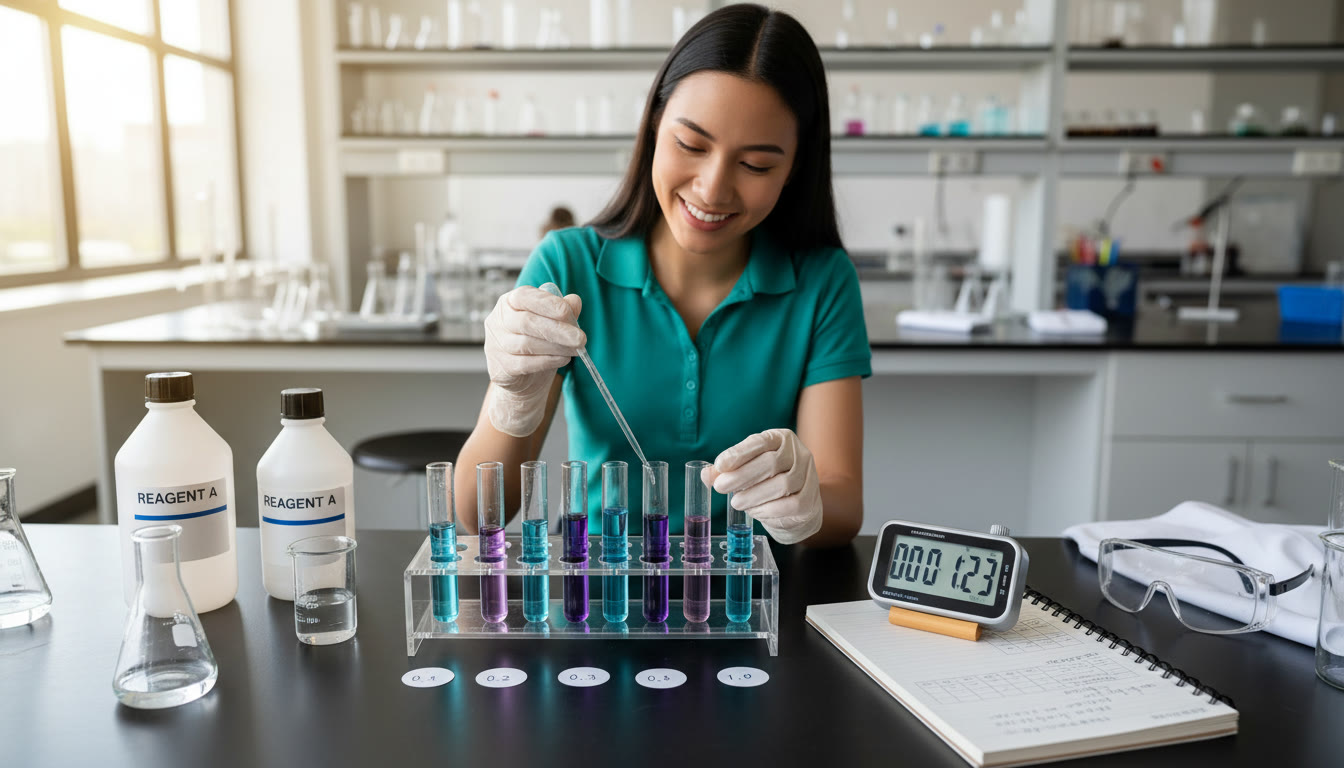
Variables are the language of experimental logic. AP graders expect you to identify and treat variables precisely.
Types of Variables Explained
- Independent Variable (IV): The variable you manipulate. It should be singular and well-defined.
- Dependent Variable (DV): What you measure. Always specify units and measurement method.
- Control Variables (Constants): Factors you hold constant to prevent confounding effects.
- Negative Control: A setup where you expect no effect — confirms that your measured effect requires the IV.
- Positive Control: A setup where you expect a known, measurable effect — confirms your methodology works.
- Confounding Variables: Uncontrolled factors that could influence the DV — list them and explain how you minimize them.
Common Mistakes With Variables
- Changing more than one IV at a time — this makes results uninterpretable.
- Unclear operational definitions (e.g., “growth” without specifying metrics such as mass, height, or leaf number).
- Insufficient replication — one trial is anecdote, not data.
- Forgetting to include both positive and negative controls when appropriate.
Controls: Your Lab’s Internal Validity
Controls are your experiment’s safety net. They answer the question: is the effect really caused by the IV or by something else?
Designing Effective Controls
Think of controls as checkpoints that validate each link in your chain of reasoning. If you’re testing whether a fertilizer increases plant growth, include:
- Negative control: plants with no fertilizer, same watering/light schedule.
- Positive control: plants given a fertilizer known to produce a moderate growth increase (if available), to verify your measurement system and environmental conditions can detect change.
- Sham control (when procedure itself could affect results): for example, if you inject a solution, inject the control group with an inert solution to rule out effects of injection.
In many AP investigations, you won’t have a ready-made positive control, and that’s fine — explain why and emphasize replication and strong constants instead.
Data: Collection, Presentation, and the Power of Tables
Data is the heart of your lab report. Collect it carefully, present it clearly, and analyze it thoughtfully. Tables are your friend: they show raw values with clarity, allow easy comparison, and prepare the reader for statistical or qualitative commentary.
How to Build an Effective Table
- Give the table a concise descriptive title.
- Label columns with variable name and units (e.g., “Time (s)”, “O2 Volume (mL)”).
- Include mean and standard deviation when you have replicates.
- Present raw data first, summary statistics second (or alongside in separate columns).
Sample Data Table: Catalase Activity at Different H2O2 Concentrations
| H2O2 Concentration (% v/v) | Trial 1 (mL) | Trial 2 (mL) | Trial 3 (mL) | Mean (mL) | Std Dev (mL) |
|---|---|---|---|---|---|
| 0.5 | 2.1 | 2.3 | 2.2 | 2.20 | 0.10 |
| 1.0 | 3.8 | 3.6 | 3.9 | 3.77 | 0.15 |
| 2.0 | 4.5 | 4.7 | 4.6 | 4.60 | 0.10 |
| 5.0 | 4.8 | 4.9 | 4.7 | 4.80 | 0.10 |
Note how the table lets readers immediately identify trends and variability. If you include graphical representations (e.g., line or bar charts), pair them with this table so the reader can cross-check visual patterns against raw numbers.
Data Commentary: From Numbers to Biological Story
Data commentary is where you interpret. Don’t just restate numbers; explain what they mean biologically, discuss trends, address anomalies, and link back to your hypothesis.
Structure for Strong Data Commentary
- Begin with a one-sentence summary: what pattern did you observe?
- Support with specific numbers: cite means, ranges, and deviations.
- Explain biological mechanisms: why might these results have occurred?
- Address anomalies and limitations: be honest about outliers, measurement error, or confounding variables.
- Conclude with how the data relate to the hypothesis and next steps for further investigation.
Example Commentary (Using the Catalase Table Above)
Summary: Catalase activity, as measured by O2 production in the first 60 seconds, increased from 0.5% to 2.0% H2O2 but plateaued between 2.0% and 5.0% concentrations. The mean oxygen volumes rose from 2.20 mL at 0.5% to 4.60 mL at 2.0%, then changed only slightly at 5.0% (4.80 mL), suggesting a saturation effect. The low standard deviations indicate consistent replication.
Biological interpretation: At low substrate concentrations, catalase activity is limited by available H2O2. As concentration increases, more enzyme active sites find substrate, raising reaction velocity. The plateau between 2.0% and 5.0% suggests that most catalase active sites may be occupied (approaching Vmax), or that substrate-related inhibition begins to balance further increases in rate.
Limitations and anomalies: If the catalytic activity truly approaches Vmax, a Michaelis–Menten analysis with more intermediate concentrations would refine Km and Vmax estimates. Additionally, high peroxide concentrations can denature proteins; though not observed here, a control monitoring enzyme integrity would strengthen future work. Temperature control was maintained at 25°C, but small variations in extract concentration between tubers could slightly influence observed rates.
Conclusion: The results partially support the hypothesis that increasing H2O2 concentration increases catalase activity up to a point. Future steps include more substrate concentrations between 1.0% and 3.0% and assays to verify enzyme integrity at higher peroxide levels.
Statistics and Uncertainty: Keep It Simple and Relevant
AP-level labs don’t require advanced statistics, but you should be comfortable with means, standard deviation, and the idea of error bars. If you perform regressions or t-tests, state why you used them, what assumptions they require, and what the results imply about your confidence in the observed trend.
Quick Statistics Checklist
- Always report sample size (n).
- Use mean ± standard deviation for small sample descriptive statistics.
- Plot error bars and explain what they represent.
- If you claim significance, name the test and the p-value threshold you used (e.g., p < 0.05) and justify the test selection.
Common Pitfalls and How to Avoid Them
Even the most promising experiments can be undermined by avoidable mistakes. Here are the ones I see most often and simple ways to avoid them:
- Ambiguous hypothesis: Use if–then–because and tie to a core concept in biology.
- No operational definitions: Write exactly how and when you measure variables.
- Insufficient replication: Aim for at least three trials, more when practical.
- Poor control of constants: Create a checklist and have a partner verify constants each trial.
- No error analysis: Even a sentence acknowledging sources of error ups your credibility.
Writing the Lab Report: A Practical Structure
When it’s time to write, follow a structure that makes grading easy and presents your thinking clearly:
- Title — concise and descriptive.
- Introduction — background biology, question and hypothesis.
- Materials and Methods — enough detail that someone else could reproduce your work.
- Results — tables and graphs first, then a short descriptive paragraph.
- Discussion — interpretation, limitations, link back to hypothesis, future directions.
- Conclusion — one- to two-sentence takeaways.
- References — any resources consulted for methods or background (if required).
Paragraph-Level Tips
Keep paragraphs purposeful: each one should make a single point. When describing results, avoid editorializing. Save explanations and implications for the Discussion. Use precise verbs: “increased,” “decreased,” “showed no significant change,” rather than vague language like “did better” or “got worse.”
Practice Makes Permanent: How to Study Lab Skills
Lab skills improve with deliberate practice. Here’s a study plan you can use across the semester to boost both confidence and competence.
Weekly Practice Checklist
- One small design exercise: turn a question from class into an experiment outline (IV, DV, controls, replication).
- One table and graph: practice transforming sample raw data into a clear table and a labeled graph.
- One short data commentary: 150–250 words discussing a small dataset.
- One review of lab safety and protocols: memorize key steps and rationales.
When you’re preparing for exam season, practice under time constraints. Convert a chosen dataset into a table, make a quick graph, and write a 5–7 sentence commentary in 15 minutes. Speed and clarity are exam-ready skills.
How Targeted Help Can Accelerate Progress
Sometimes you need a second pair of eyes: someone who can pinpoint where your experimental logic slips or how your commentary can better explain biological mechanisms. That’s where personalized tutoring becomes powerful. For students who want structured, one-on-one guidance — whether on experiment design, crafting data tables, or polishing write-ups — targeted support can convert confusion into clarity. For instance, tailored tutoring can provide:
- Walkthroughs of the AP lab manual investigations with emphasis on science practices.
- Feedback on lab reports focused on improving claims, evidence, and reasoning.
- Practice prompts and timed sessions to prepare for the exam’s free-response portion.
Small, focused improvements compound quickly. If you’re using additional help, choose sessions that give constructive feedback, model strong reasoning, and leave you with actionable next steps.
Real-World Connections: Why Lab Rigor Matters Beyond the AP
Good lab design isn’t just for tests. It’s how scientists create reliable evidence that policymakers, doctors, and educators depend on. Understanding variables and controls can help you evaluate news stories, judge the quality of health claims, and even design citizen science projects. When you learn to scrutinize how an experiment was done, you’re building a lifelong skill set in critical thinking.
Mini Case Study: From Classroom to Community
A high school team once used careful experimental design to study the effect of household detergents on aquatic invertebrates. By clearly identifying IVs, maintaining constant temperature and pH, and including negative controls, they produced reproducible results that they presented to a local conservation group. The rigorous approach used in the classroom translated directly into credible, actionable data for the community.
Final Checklist: Ready for a Top-Scoring Lab
Before you submit, run through this checklist. It catches the most common errors and boosts clarity.
- Is the hypothesis testable and connected to a biological mechanism?
- Is there one clear IV and one (or clearly defined) DV?
- Have you listed and justified controls (negative, positive, and constants)?
- Is your methods section detailed and replicable?
- Is your data presented in a titled table with units and sample size?
- Does your commentary relate numbers to biology, acknowledge limitations, and suggest next steps?
- Is replication adequate and are errors or uncertainties reported?
Parting Advice: Be Curious, Be Precise, and Tell the Story of Your Data
AP Biology labs reward students who combine curiosity with precision. Ask thoughtful questions, design experiments that isolate a single question, measure carefully, and tell a clear, evidence-based story with your results. A lab is more than data — it’s a narrative of discovery. The best reports show that you not only collected numbers, but that you understand their biological meaning.
If you want a faster path to mastery, consider focused, individualized practice: targeted feedback on your write-ups, practice experiments, and step-by-step critiques can shave months off your learning curve. Personalized tutoring that provides 1-on-1 guidance, tailored study plans, and expert feedback can be an efficient way to raise both confidence and exam performance.

Ready to design your next investigation? Start with a crisp question, keep one variable as the star of the show, guard your controls like gold, and let the data tell the story — with your commentary guiding the reader through the how and the why. That’s the lab work that earns points, deepens understanding, and prepares you for college-level thinking.
Good luck — and remember: practice deliberately, write clearly, and don’t be afraid to ask for feedback when you’re ready to refine your approach.




























No Comments
Leave a comment Cancel