

Why a 4-Week Push Works (and Why You’re Closer Than You Think)
Four weeks isn’t forever—but it’s plenty of time to sharpen the specific skills that turn an ordinary AP Lang performance into a score-of-five performance. The secret is not frantic cramming; it’s focused practice, feedback loops, and strategy. Think of this as a sprint with a map: every day has a purpose, every session has a measurable goal, and every practice essay gets you closer to the score you want.

What This Bootcamp Is (and Isn’t)
This is a purpose-built, four-week routine for students already familiar with the AP English Language & Composition course and ready to convert knowledge into high-scoring essays. It’s not a replacement for months of reading; it’s a high-leverage program designed to:
- Target the free-response essays (especially synthesis and rhetorical analysis).
- Improve thesis clarity, evidence selection, and organization.
- Build confident timed-writing habits.
- Create a feedback loop: write, assess, revise, repeat.
If your foundation is very weak (no prior AP class or extensive reading practice), you may need more time—but this bootcamp will still give you the structure to accelerate progress quickly.
Overview: The Four-Week Schedule
Each week emphasizes one core skill, with daily micro-goals and two full practice essays every week. Block off 3–5 hours per day on study days: a mix of active reading, targeted exercises, and timed writing. Rest days are part of the plan because recovery equals stronger performance.
| Week | Focus | Daily Ops | Weekly Checkpoint |
|---|---|---|---|
| Week 1 | Rhetorical Analysis & Close Reading | Short passages, annotation drills, one timed analysis | 1 scored analysis essay + rubric review |
| Week 2 | Argumentation & Thesis Craft | Claim building, SOAPStone/POV exercises, 1 timed argument | 1 scored argument essay + thesis checklist |
| Week 3 | Synthesis & Integrating Sources | Source evaluation, synthesis scaffolds, 1 timed synthesis | 1 scored synthesis essay + source matrix |
| Week 4 | Stamina, Refinement, and Full-Length Practice | Full practice exam timing, error logs, polishing language | Two full practice exams with review |
Week 1 — Rhetorical Analysis: Seeing the Author’s Tools
Goal
Identify rhetorical choices and explain their effects clearly and concisely. You should be able to move from annotation to an organized paragraph in under 10 minutes.
Daily Plan
- Day 1: Read three short opinion/editorial passages. Practice annotating for tone, diction, syntax, and rhetorical devices (anaphora, parallelism, antithesis, etc.).
- Day 2: Turn annotations into claim-driven paragraph responses. Emphasize the causal link: device → purpose → effect on audience.
- Day 3: Timed 40-minute rhetorical analysis (old FRQ-style). Score it against the rubric and mark the top three weaknesses.
- Day 4: Drill sentence-level clarity—rewrite two paragraphs for precision and tone.
- Day 5: Peer or tutor review. If you have access to Sparkl’s personalized tutoring, schedule a 1-on-1 feedback session to get targeted revision tips and an external rubric-aligned read.
- Day 6: Practice a short synthesis-turned-analysis task—use one source as a rhetorical object and analyze it.
- Day 7: Rest and passive review (listen to a podcast on rhetoric, skim examples).
Key Tips for Analysis
- Always anchor paragraphs in a claim. Don’t summarize the passage; explain choices and effects.
- Use varied sentence structures to show control. Examiners notice phrasing that clarifies causality and intent.
- Prioritize depth over breadth: two well-developed body paragraphs beat five thin ones.
Week 2 — Argumentation: Build a Persuasive Case
Goal
Write a defensible, nuanced argument with effective reasoning and persuasive evidence. Learn to anticipate counterclaims and address them succinctly.
Daily Plan
- Day 1: Work on claim precision. Turn broad prompts into narrow, defensible theses that set up an explicit line of reasoning.
- Day 2: Evidence drills—practice using rhetorical, factual, and hypothetical evidence. Note which evidence would be strongest for a particular prompt.
- Day 3: Counterargument and concession practice. Write concession paragraphs that strengthen your claim.
- Day 4: Timed 40-minute argument essay. Score it and extract the two recurring weaknesses.
- Day 5: Targeted revision day—rewrite the timed essay focusing exclusively on logical flow and evidence integration. Consider a 1-on-1 session with a Sparkl’s tutor to refine your argument structure and get AI-driven insights on recurring issues.
- Day 6: Language and style polishing—active verbs, concise phrasing, and transitions that signal logical movement.
- Day 7: Short reflective write-up: Document your improvement and update the study log.
Argumentation Tools You Should Master
- Claim framing: State, qualify, and preview your reasoning.
- Evidence categories: rhetorical (author’s choices), empirical (data/facts), anecdotal (short illustrative examples), and hypothetical (when real examples are unavailable).
- Counterclaims: Use a concise concession followed by a rebuttal that proves the concession strengthens your argument.
Week 3 — Synthesis: Weaving Sources into a Strong Essay
Goal
Integrate multiple sources smoothly into a coherent, original argument. Practice identifying which pieces of evidence best support which claims and how to attribute sources clearly.
Daily Plan
- Day 1: Source evaluation matrix—practice categorizing sources by reliability, bias, and usefulness.
- Day 2: Thesis + source map—create thesis statements that directly answer synthesis prompts and map which sources support each claim.
- Day 3: Paraphrase and quote practice—practice concise paraphrase, proper integration of brief quotes, and clear attribution (e.g., “As Source B argues…”).
- Day 4: Timed 60-minute synthesis essay. Focus on structure: introduction, body with integrated sources, and a forceful conclusion.
- Day 5: Targeted feedback—use a tutor or study partner to check attribution and whether any source is merely summarized rather than used in support.
- Day 6: Reverse-engineer a top-scoring synthesis essay—identify moves you can adopt.
- Day 7: Rest and light review of source matrices and common integration errors.
Source-Integration Checklist
- Does each claim have at least one source that explicitly supports it?
- Is the source paraphrased or quoted succinctly and attributed clearly?
- Do your sentences explain the source’s relevance (don’t assume it’s obvious)?
Week 4 — Stamina, Polishing, and Full Practice
Goal
Simulate test day and refine the small habits that sap time or clarity: planning, pacing, neat handwriting (if paper), and quick proofreading. Build endurance for the two-hour free-response block.
Daily Plan
- Day 1: Full diagnostic—do the entire free-response section under timed conditions. Treat it like a real test.
- Day 2: Review the diagnostic using the rubric. Note patterns: weak intros, weak evidence, rushed conclusions.
- Day 3: Targeted drills—fix the top two patterns discovered on Day 2.
- Day 4: Timed timed timed—two FRQs back-to-back. Practice pacing so you leave 5 minutes per essay for a micro-proofread.
- Day 5: Feedback day—get at least one of your recent essays reviewed by a tutor or teacher; use Sparkl’s personalized tutoring if available for a rapid, rubric-focused critique.
- Day 6: Language polish—work on clarity and tone; ensure each paragraph opens with a declarative sentence that signals its purpose.
- Day 7: Mental prep and light review. Practice relaxation and visualization techniques for test day.
Scoring Focus: Understand the Rubric So You Can Beat It
Writing well and scoring well are related but not identical. AP graders use clear analytic rubrics that reward specific moves: a clear thesis, controlled analysis, coherent organization, and consistent use of evidence. Learn the rubric. Translate each rubric criterion into a checklist you run through while proofreading.
| Rubric Dimension | What Graders Want | Daily Practice Drill |
|---|---|---|
| Thesis | Clear, defensible, and responsive to the prompt | Create 3 thesis variants for one prompt—choose the strongest. |
| Evidence | Relevant, well-explained, and properly attributed | Evidence selection drills—pick the best support from 5 options. |
| Analysis/Reasoning | Shows logic and explains why evidence matters | Rewrite summary sentences into analytic sentences. |
| Organization | Logical progression and clear paragraphs | Outlining exercises: write a 6-sentence paragraph plan before drafting. |
| Language | Varied syntax, precise vocabulary, controlled tone | Sentence-level revision: tighten and vary 5 sentences per day. |
Timed-Essay Strategy: A Reliable Game Plan
Here’s a portable, repeatable plan you can use on test day. Practice it until it’s reflexive.
- Minute 0–5: Read prompt (or prompts) carefully. Circle directive words (analyze, synthesize, explain). Draft a one-sentence thesis and a 3-bullet outline.
- Minute 5–10: Flesh out the introduction and plan evidence for each paragraph.
- Minute 10–35: Write first two body paragraphs (aim for 12–16 sentences each). Use one device/evidence per paragraph, then explain the effect.
- Minute 35–45: Write the concluding paragraph. If time permits, add a short counterargument/rebuttal for the argument or synthesis essay.
- Minute 45–50: Quick proofread—fix clarity, transitions, and any glaring grammatical mistakes.
Common Pitfalls and How to Avoid Them
- Summarizing the passage instead of analyzing it: Always ask “why this matters” about every paragraph you write.
- Using weak or irrelevant evidence: Pre-plan evidence categories and have quick go-to examples ready (history, literature, science, contemporary events) but don’t shoehorn them in.
- Overwriting: Long, tangled sentences can obscure good thinking. Aim for clear, forceful sentences—varied, but controlled.
- Running out of time: Practice pacing. If necessary, switch to writing slightly shorter but denser paragraphs.
How to Make Feedback Work: The Revision Loop
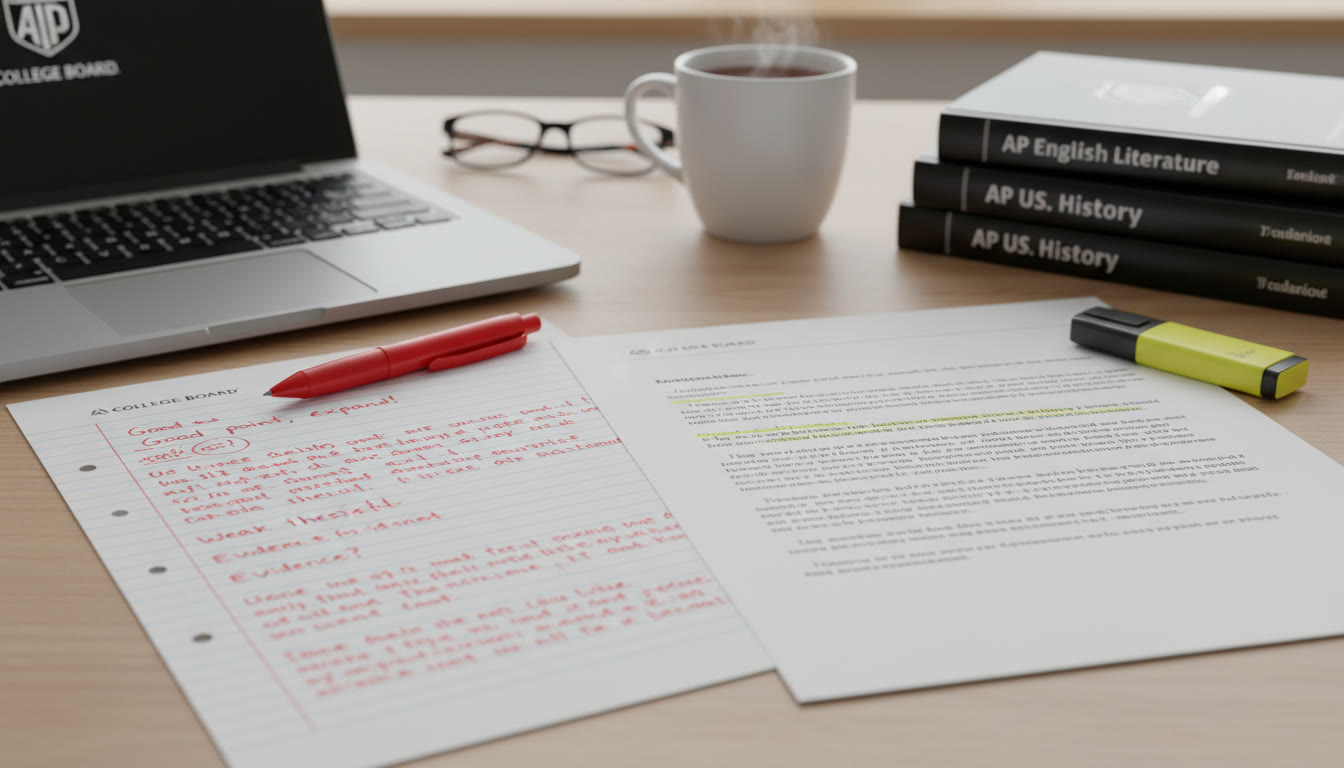
Feedback is only useful if you act on it. Create a simple revision loop: write → self-score with rubric → get external feedback → revise → re-test. Keep a one-page “error ledger” to track recurring problems (thesis vagueness, weak evidence, shaky topic sentences). In four weeks, you should see the same problems disappear from the ledger.
Using Personalized Tutoring Effectively
If you have access to Sparkl’s personalized tutoring, it can accelerate this loop. Use a 1-on-1 session to:
- Get a focused rubric-aligned critique of a timed essay.
- Create a tailored study plan that targets your unique weaknesses.
- Receive AI-driven insights that highlight recurring language or structural patterns in your writing and suggest concrete edits.
Book short, frequent sessions (30–45 minutes) rather than one long meeting—consistent, quick feedback beats sporadic marathon reviews.
Practical Examples: Turning a Prompt Into a 5-Level Response
Example prompt (synthesis): “Write an essay that argues a position on the role of technology in public discourse, using at least three of the provided sources to support your argument.”
Step 1 — Create a Focused Thesis
Weak thesis: “Technology affects public discourse in many ways.” Strong thesis: “While technology broadens access to information, it ultimately erodes the quality of public discourse unless institutions and users adopt norms that prioritize verification and civil exchange.”
Step 2 — Map Sources to Claims
Use a quick source matrix: Source A documents the speed of information spread; Source B shows misinformation effects on policy; Source C offers a study about digital civility initiatives. Map each to the claim it supports.
Step 3 — Build Analytic Paragraphs
Paragraph 1: Evidence from Source A (data) to prove access+amplification. Explain the effect on attention and surface-level engagement. Paragraph 2: Source B to demonstrate real-world harm (policy mistakes). Explain causal steps. Paragraph 3: Source C as a counterweight—shows how norms can mitigate harm; use this to introduce a concession/rebuttal and end with synthesis.
Language and Style: Small Moves That Add Up
- Favor strong verbs: “underscores,” “complicates,” “erodes.”
- Use transitions that show relationships: “Consequently,” “Nevertheless,” “This suggests.”
- Vary sentence length to control pacing: short declaratives for emphasis, longer sentences for nuance.
- Be precise with qualifiers: “often,” “frequently,” “in this context.” Overuse of “always” or “never” is rarely helpful.
Practice Resources and How to Use Them
Use released prompts and scoring guides to calibrate your writing against official expectations. Make every practice essay count by scoring it yourself first, then comparing to sample responses and rubrics. If you’re short on time, focus on the most recent samples and the analytic rubrics—those tell you exactly what graders reward.
Test-Day Checklist
- Arrive rested and fed. Small meal with protein and complex carbs.
- Pack two pens (black or blue), a watch for pacing, and your admission ticket/ID as required by your school.
- Begin each essay by writing a clear thesis and a three-bullet outline—this saves time and clarifies thinking.
- Leave five minutes per essay to proofread for clarity and fix glaring mechanical errors.
Measuring Progress: How to Know You’re Ready
By the end of week four, you should be able to do two things consistently under timed conditions:
- Write an essay that a rubric reader would identify as clearly meeting the criteria for a 4 or 5—clear thesis, developed evidence, good reasoning, and organized structure.
- Identify your top two recurring errors and demonstrate consistent improvement with each practice (documented in your error ledger).
Final Notes: Motivation, Confidence, and the Spark of Improvement
Getting to a 5 on AP Lang is not magic; it’s the product of deliberate practice. Your progress will feel uneven: sometimes you’ll plateau, sometimes you’ll leap. That’s normal. Keep an eye on the specifics—rubric items, evidence selection, pacing—and treat each essay as a mini-experiment.
If you want coaching that keeps you accountable and focused during these four weeks, Sparkl’s personalized tutoring can plug directly into this plan with 1-on-1 guidance, tailored study plans, expert tutors who know the rubric, and AI-driven insights that spot recurring patterns in your writing. Use that help strategically: short, focused sessions that refine your highest-leverage moves.
A Quick Pep Talk
Four weeks from now, you can be measurably better. You don’t need to memorize everything—just practice the right moves until they become second nature. Show up, write with clarity, and let feedback do the heavy lifting. You’ve got this.
Appendix: Sample Week-by-Week Checklist
| Item | Week 1 | Week 2 | Week 3 | Week 4 |
|---|---|---|---|---|
| Timed Essays | 1 analysis | 1 argument | 1 synthesis | 2 full FRQ sessions |
| Feedback Sessions | Self-score + peer | Rubric check + tutor | Sparkl’s session recommended | Full review |
| Micro-Drills | Annotation | Thesis variations | Source matrix | Pacing drills |
| Rest | Day 7 | Day 7 | Day 7 | Day 7 |
Closing: Next Steps
Start by scheduling your first diagnostic and building your error ledger. If you want targeted, efficient help, pair this bootcamp with a Sparkl’s 1-on-1 tutoring session to get customized feedback and a study plan that adapts to your strengths. Follow the plan, trust the process, and treat every practice essay as the small victory it is. Four weeks of smart work can make a big difference—let’s get you to a 5.



























No Comments
Leave a comment Cancel