
Why a Self-Checklist Is Your Best Last-Minute Strategy
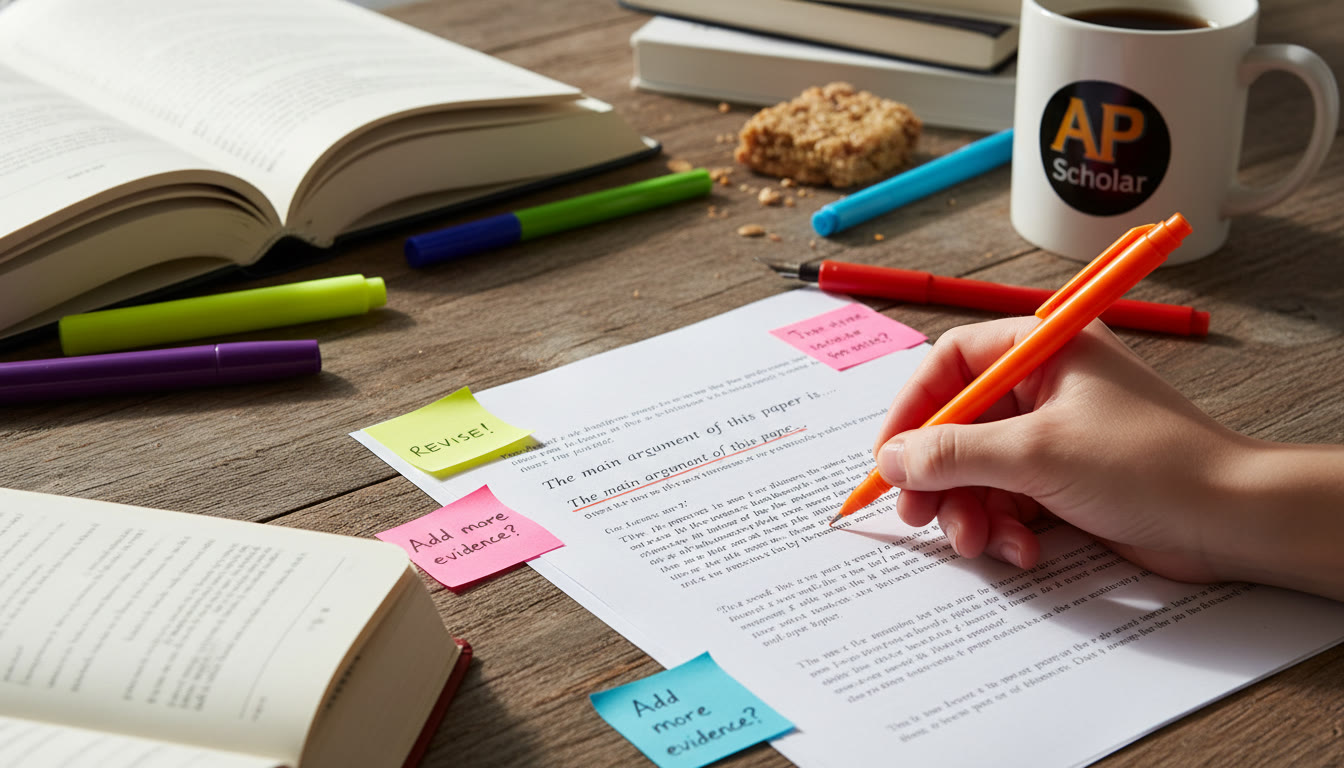
Imagine you’ve written an AP essay that answers the prompt, includes evidence, and even sounds pretty smart when read aloud. You hit submit and—later—see a score that’s lower than you expected. Frustrating, right? Often the difference between a good and a great AP essay is not a single brilliant sentence but a careful final sweep: a self-check that catches unclear thesis phrasing, unsupported claims, awkward transitions, or tiny grammar errors that distract the reader.
This guide arms you with a friendly, effective self-checklist designed for AP students. It’s not a rigid rubric but a practical set of steps you can run through in the last 10–30 minutes before you hand anything in. Use it for timed in-class responses, practice prompts, and full-length practice exams. I’ll also show concrete examples, offer revision strategies, and suggest how targeted help—like Sparkl’s personalized tutoring—can fast-track your improvement when you’re stuck.
How to Use This Checklist: Quick Routine vs Deep Revision
Not all submissions get the same treatment. Decide quickly which routine you need:
- Quick Sweep (5–10 minutes): For timed responses and in-class essays. Focus on thesis, structure, and 1–2 glaring grammar issues.
- Full Polish (20–30 minutes): For practice essays or final drafts. Run every item below carefully: clarity, evidence quality, transitions, style, and surface corrections.
Tip: Keep a printed or digital copy of this checklist in your study space so the steps become automatic.
Section 1 — Content and Argument: Does Your Essay Do the Job?
1.1 Check Your Thesis: Clear, Specific, Defensible
Your thesis is the essay’s central claim. If it’s vague, the whole essay drifts. Run this quick test:
- Can you state your thesis in one sentence? If not, rewrite it.
- Is it specific? Replace words like “some” or “many” with precise descriptors where possible.
- Is it defensible? Make sure it’s an arguable position—one a reader could reasonably disagree with.
Example (weak): “The author uses imagery to make the reader think.”
Example (strong): “The author uses nature imagery and recurring water motifs to cast the protagonist’s moral confusion as an external, destabilizing force, reinforcing the theme of lost agency.”
1.2 Check Your Claims and Evidence: Are You Showing, Not Just Telling?
AP readers look for well-supported claims. Each paragraph should make a point and directly connect that point to your thesis.
- Do you have at least one clear piece of evidence—quote, statistic, or specific example—per major claim?
- Do you explain how the evidence supports the claim? This is often the weakest link: analysis beats summary every time.
- If you use a quote, is it integrated smoothly and followed by explanation? Avoid dropping a quote without commentary.
1.3 Balance Breadth and Depth
AP essays often suffer from trying to say too many things too briefly. If you have many undeveloped points, choose fewer and develop them more deeply. Depth wins.
Section 2 — Structure and Flow: Is Your Essay Easy to Follow?
2.1 Paragraph-Level Structure
Each paragraph should function like a mini-essay: topic sentence, evidence, analysis, and a short wrap that ties back to the thesis.
- Does your topic sentence preview the paragraph’s argument?
- Are your sentences ordered logically? If a reader needs to pause or re-read to follow the idea, reorder or add a transitional phrase.
2.2 Transitions and Cohesion
Good transitions signal relationships between ideas. Look for places where you jump from one idea to another and add linking words or brief sentences that explain the connection.
Section 3 — Style and Voice: Are You Writing Like a College-Level Student?
3.1 Tone and Formality
AP essays should sound confident and academic—conversational is okay in moderation but avoid slang and overly casual phrases. Choose precise vocabulary over vague adjectives.
3.2 Sentence Variety and Clarity
A mix of short and long sentences keeps the reader engaged. Watch for:
- Run-on sentences that blur meaning—split them.
- Overly choppy sentences—combine when it improves flow.
- Repetitive phrasing—use synonyms or restructure sentences.
Section 4 — Technical Accuracy: Grammar, Usage, and Mechanics
4.1 Most Common Micro-Mistakes to Catch
In a final read, prioritize common, score-affecting errors:
- Subject-verb agreement.
- Pronoun agreement and clear antecedents.
- Proper punctuation with quotes and commas.
- Verb tense consistency.
- Confused words (their/they’re/there, affect/effect).
4.2 Formatting and Presentation
Follow the exam or instructor’s formatting instructions exactly: required margins, length, or labeling of parts. In AP practice, neatness and readability help the grader focus on your reasoning.
Section 5 — Timing Your Final Pass
Time yourself. If you have:
- Less than 10 minutes: Run a targeted sweep—thesis clarity, one paragraph’s evidence, and surface errors.
- 10–20 minutes: Do full paragraph checks, read aloud for flow, and fix the most frequent technical mistakes.
- 20–30 minutes: Perform the complete checklist below and refine language and transitions.
Comprehensive Self-Checklist (Run in Order)
| Step | What to Do | Goal |
|---|---|---|
| 1 — Thesis | Rewrite thesis in one decisive sentence. | Clear guiding claim. |
| 2 — Structure | Check topic sentence and paragraph order. | Logical flow. |
| 3 — Evidence | Confirm each major claim has evidence + analysis. | Support and insight. |
| 4 — Transitions | Add or smooth transitions between paragraphs. | Coherent progression. |
| 5 — Language | Vary sentence structure; tighten wordy phrases. | Engaging, readable prose. |
| 6 — Mechanics | Fix grammar, punctuation, and formatting. | Polished final product. |
| 7 — Final Read | Read aloud for rhythm and meaning. | Catch lingering awkwardness. |
Practical Examples: Before and After Revisions
Example 1 — Thesis Tightening
Before: “In the passage the writer talks about how society is bad and that people lose themselves.”
After: “The writer argues that rapid industrialization erodes communal bonds, causing individuals to adopt self-protective behaviors that ultimately isolate them from meaningful relationships.”
Why it works: The revised thesis is specific about cause (industrialization), effect (erodes communal bonds), and consequences (isolation). That gives you clear topics for body paragraphs.
Example 2 — Turning Summary Into Analysis
Before: “The author uses imagery of winter to show sadness.”
After: “Winter imagery—barren fields, brittle winds, and frozen streams—operates as a metaphor for the protagonist’s emotional stasis, suggesting that grief has halted personal growth rather than merely coloring the narrative mood.”
Why it works: The after version unpacks HOW the imagery functions; it connects the device to theme and character development.
When to Call for Help: Use Sparkl Strategically
Sometimes self-editing hits a wall. Maybe your essays feel repetitive, your commentary stays at surface level, or time pressure ruins your structure. That’s a great moment to bring in targeted support rather than pushing alone.
Sparkl offers 1-on-1 guidance and tailored study plans that can speed up your learning curve. A few ways Sparkl can help:
- Personalized tutoring focused on essay structure and scoring rubrics.
- AI-driven insights that highlight patterns in your mistakes across multiple essays.
- Practice prompts with feedback calibrated to AP scoring standards and clear action items.
Use tutoring time to target the precise items from this checklist where you need the most improvement—thesis development, evidence analysis, or time management under test conditions.
Study Habits to Internalize the Checklist
Practicing the checklist until it becomes instinctive is the real goal. Here’s a weekly plan you can follow:
- Monday: Write one timed 40–50 minute practice essay. Use the Quick Sweep.
- Wednesday: Revisit the Monday essay; perform a Full Polish and log three recurring mistakes.
- Friday: Focused drills—thesis-building practice and evidence-integration exercises.
- Weekend: Optional Sparkl tutoring session to review weak spots and get a personalized study plan.
Common Pitfalls and How to Avoid Them
Pitfall 1 — Over-Reliance on Summary
Fix: After every two sentences of summary, ask yourself: “How does this prove my thesis?” If you can’t answer immediately, add analysis.
Pitfall 2 — Vague Language
Fix: Replace weak qualifiers. “Very,” “somewhat,” and “a lot” are red flags—find specifics.
Pitfall 3 — Not Managing Time
Fix: Practice under timed conditions and reserve the last 5–10 minutes always for the Quick Sweep.
Mini-Checklist You Can Tape to Your Desk
- Thesis clear in one sentence?
- Every paragraph has evidence + analysis?
- Transitions present and logical?
- Strong sentence variety?
- Key grammar issues fixed?
- Read aloud—does it sound natural?
Final Thoughts: Editing Is Where Scores Move
Great ideas matter, but they’re only persuasive if communicated clearly and convincingly. The difference between a B and an A often comes down to how well you revise: tightening a thesis, deepening one example, smoothing transitions, and eliminating distracting errors. Make this checklist a habit and you’ll find your essays becoming more precise, more persuasive, and easier to grade well.
And remember: targeted help is a smart investment. If you find the same weaknesses surfacing on practice after practice, Sparkl’s personalized tutoring can provide one-on-one guidance and AI-driven diagnostics so you spend time improving the right things. That’s efficiency and confidence rolled into one.
Resources to Keep Improving
Make checklist practice part of your study routine, track recurring mistakes in a revision log, and treat each practice essay as a focused experiment: change one thing (e.g., stronger topic sentences) and see if your score improves. Over time, these small experiments compound into reliable performance on test day.
Quick Printable Self-Check: The 7-Point Final Sweep
- One-line Thesis — Done?
- Topic Sentence for Each Paragraph — Done?
- Evidence + Explanation — Done?
- Transitions — Smooth?
- Sentence Variety — Yes/No?
- Top 3 Grammar Mistakes Fixed?
- Read Aloud — Sounds Right?
Run this sweep with a stopwatch. If you can finish it reliably in 10 minutes, you’re in excellent shape for timed AP responses.
One Last Tip
Be kinder than you think. Revision isn’t just about fixing mistakes; it’s about amplifying the best parts of your argument so a grader can see them quickly and clearly. Keep the checklist handy, practice deliberately, and don’t hesitate to get focused help when you need it. You’ve got this.



























No Comments
Leave a comment Cancel