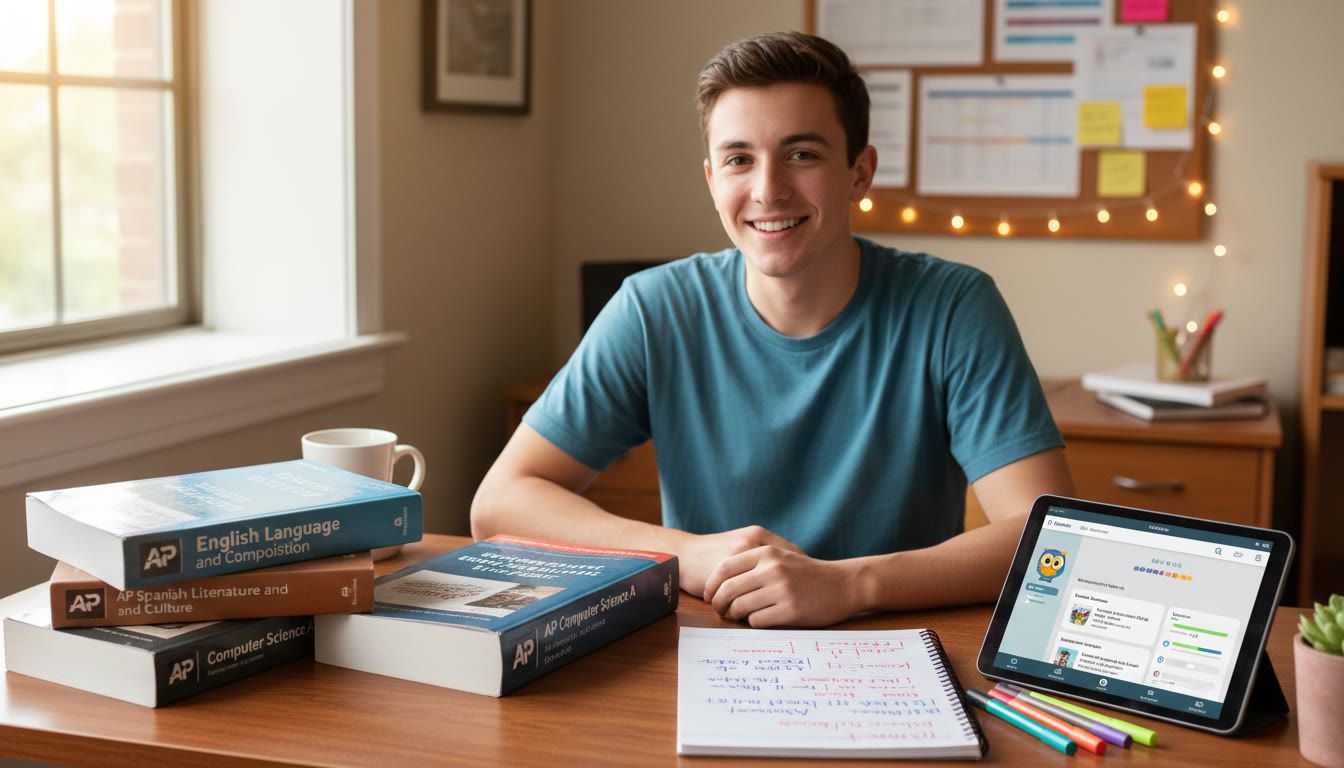

Why Look Beyond AP? Real Credentials for Global Communication
If you’re a student who’s taken or is considering AP language classes, congratulations — you’ve already started building an impressive academic profile. But what if you want more than course credit or an AP score? What if you want a certified, internationally recognized proof of language ability that employers, universities, and exchange programs respect around the world? That’s where certifications like DELE, DELF, TestDaF, HSK and Latin proficiency exams come in.
This guide walks you through what each of these exams measures, how they compare to AP exams, practical study strategies, and a realistic timeline to prepare. We’ll also show ways to combine AP study with certification prep, and how tailored support — such as Sparkl’s personalized tutoring — can keep you efficient and confident on test day.
Quick Snapshot: The Exams at a Glance
Before we dive deeper, here’s a compact comparison to orient you. Use it as a quick reference to decide which exams match your goals.
| Exam | Language | International Recognition | Levels Tested | Best For |
|---|---|---|---|---|
| DELE | Spanish | High (Instituto Cervantes) | A1 to C2 | Academic, immigration, professional proof |
| DELF/DALF | French | High (France Éducation) | A1 to C2 (DELF: A1–B2; DALF: C1–C2) | University admission, language credentials |
| TestDaF | German | Recognized by German universities | TDN 3 to TDN 5 (intermediate–advanced) | University entry in Germany |
| HSK | Chinese (Mandarin) | Growing global recognition | HSK 1 to HSK 6 (Basic to advanced) | Academic programs, scholarships, work |
| Latin Certifications | Latin | Varies (academic, exam boards) | Often basic to advanced proficiency/reading exams | Classical studies, college credit, humanities |
How These Certifications Differ from AP Exams
AP language exams (such as AP Spanish Language and Culture or AP French Language and Culture) are college-board assessments tied to U.S. high school curricula and commonly used for college credit and placement. International language certificates are different in three important ways:
1) Scope and Purpose
- AP: Measures how well you’ve mastered a specific curriculum; often grants college credit or placement in the U.S.
- Certifications: Measure actual communicative competence using internationally standardized scales (like the CEFR). They’re portable worldwide and speak to real-world ability.
2) Format and Skills Emphasized
- AP: Combines interpretive, interpersonal, and presentational modes; includes cultural knowledge and integrated tasks.
- Certifications: Most break skills into discrete sections (listening, reading, writing, speaking) with tasks designed to mirror daily academic or professional situations.
3) Recognition and Use
- AP scores: Great for US college credit. Not always accepted outside the U.S. as proof of language proficiency.
- Certifications: Used globally for university admissions, professional credentials, or immigration purposes where proof of language is required.
Exam Deep Dives: What to Expect and Who Should Take Each
DELE (Diplomas de Español como Lengua Extranjera)
DELE is the official Spanish language certification awarded by Instituto Cervantes on behalf of Spain’s Ministry of Education. Levels range from A1 (beginner) to C2 (near-native). Each level tests listening, reading, writing and speaking, with tasks that grow more complex at higher levels.
Who should take it: Anyone who needs internationally recognized proof of Spanish ability for study abroad, work, or long-term plans in Spanish-speaking countries.
DELF/DALF (Diplôme d’Études en Langue Française / Diplôme Approfondi de Langue Française)
DELF covers A1–B2 and DALF covers C1–C2. These diplomas evaluate communicative competence in real-world contexts, and many universities in francophone countries accept them for admission.
Who should take it: Students aiming for French-taught programs or careers that require validated French proficiency.
TestDaF (Test Deutsch als Fremdsprache)
TestDaF is oriented toward those seeking to study in Germany; it corresponds roughly to upper-intermediate and advanced levels. Scores are given as TDN 3–5 for each skill; many German universities require TDN 4 or 5 in each section for admission to degree programs.
Who should take it: Students who want to study at German universities or who need recognized German language proof.
HSK (Hanyu Shuiping Kaoshi)
HSK measures Mandarin proficiency from HSK 1 (basic) to HSK 6 (advanced). The exam emphasis shifts from vocabulary recognition and basic sentences at lower levels to nuanced reading, listening and essay writing at higher levels. Universities and scholarship programs increasingly use HSK as an admissions credential.
Who should take it: Learners of Mandarin seeking formal certification for academic or professional purposes.
Latin Certifications
Latin certification options are less centralized globally, but standardized exams assessing comprehension, translation and contextual knowledge are available through academic boards and university programs. These tests evaluate reading proficiency and knowledge of grammar and classical literature more than conversational skill (since Latin is not a spoken community language in modern contexts).
Who should take it: Students pursuing classics, ancient history, philosophy, or anyone seeking demonstrated command of Latin for academic reasons.
How to Choose the Right Certification for You
Not every certification suits every student. Ask yourself these questions:
- What are your goals? (College admission, study abroad, scholarship, career, personal enrichment.)
- Where do you want your certificate to be recognized? (Country-specific universities vs. global portability.)
- What level do you realistically want to reach in 6–12 months?
- Do you prefer a skills-balanced test or one that stresses academic language?
Example: If you’re planning to study engineering in Germany, TestDaF or TestDaF-equivalent certification should top your list. If you want flexible global recognition for Spanish, DELE is very powerful.
Combining AP and Certification Prep: A Smart Strategy
AP classes give structure and content depth; certifications validate real-world communicative ability. Here’s how you can use AP and certification study together efficiently:
- Use AP coursework to build academic vocabulary and interpretive skills.
- Supplement with targeted certification practice for speaking and specific test tasks (e.g., oral expression rubrics, formal letter writing for DELF/DELE).
- Schedule certification practice tests in the semester after your AP exam to keep momentum — they often test overlapping skills but in different formats.
Study Plan Examples: Timelines and Weekly Routines
Below are two sample timelines — one for a student preparing over six months, another for an ambitious 12-month plan. Both assume concurrent AP coursework or review.
| Timeline | Key Milestones | Weekly Focus (Sample) |
|---|---|---|
| 6 Months |
|
|
| 12 Months |
|
|
Study Techniques That Actually Work
Language certification exams reward steady, deliberate practice. Here are high-ROI techniques to add to your routine.
Active Listening and Shadowing
Listen to short native clips, then “shadow” them — speak along immediately to match rhythm and pronunciation. This builds oral fluency and listening comprehension simultaneously.
Task-Based Practice
Replicate exam tasks in timed conditions. For speaking: give a 2–3 minute response to a prompt and record it. For writing: draft under time limits, then self-edit and seek feedback. Make the practice uncomfortable; that’s where learning accelerates.
Vocabulary With Context, Not Flashcards Alone
Learn words in collocations and sentence frames. For instance, learn “hacer una presentación” (to give a presentation) rather than isolated words. Contextual knowledge is especially helpful for DELE/DELF style tasks.
Frequent Low-Stakes Output
Short, daily production beats occasional marathon sessions. A 10-minute oral diary or a 15-minute written recap of your day builds fluency and reduces anxiety for the exam’s spontaneous prompts.
Practice Resources and Mock-Test Strategies
Consistent mock testing is the single best predictor of success. Use official practice materials when you can; otherwise, build mock tasks closely modeled on exam rubrics. Always score or review against the official criteria — it’s the rubric, not just the raw score, that determines your strengths and weaknesses.
Common Pitfalls and How to Avoid Them
- Over-reliance on passive study: Passive reading without active output won’t prepare you for speaking/writing sections.
- Ignoring exam format: Each certification has unique task structures. Practicing the wrong task types leaves you unprepared for time constraints.
- Poor feedback loops: Without targeted feedback, errors fossilize. Use peers, teachers, or tutors (like those at Sparkl) to pinpoint and correct recurring mistakes.
How Personalized Tutoring Makes the Difference
Language certification success depends as much on strategy as on content knowledge. This is where personalized tutoring is a game-changer. Tutors can:
- Create tailored study plans aligned with your target level and schedule.
- Provide 1-on-1 speaking practice with focused corrective feedback.
- Deliver targeted grammar and vocabulary coaching specific to exam tasks.
- Use AI-driven insights (where available) to track progress and suggest micro-adjustments — for example, helping you prioritize which vocabulary sets or task types will yield the biggest gains.
Sparkl’s personalized tutoring blends human expertise with data-informed study plans to help students close weak areas efficiently. If you’re balancing AP classes and certification prep, a tailored plan and regular check-ins will keep you on track without burning out.
Sample Study Week: Blending AP and Certification Work
This sample week assumes ongoing AP coursework and preparation for a certification exam in 4–6 months.
- Monday — 45 minutes: AP reading/grammar practice; 15 minutes: spaced vocabulary review.
- Tuesday — 30 minutes: certification listening drills; 30 minutes: speaking shadowing and recorded response.
- Wednesday — 60 minutes: AP practice exam section; brief reflection on errors.
- Thursday — 45 minutes: certification writing task (timed) + tutor feedback review.
- Friday — 30 minutes: culture-focused reading (news, short essays) to build context for AP and certification prompts.
- Saturday — 2 hours: Extended mock practice (rotate reading/listening/writing each week).
- Sunday — Rest or light 20–30 minute recap; set goals for next week.
Day-of-Exam Tips: Practical and Psychological
- Know the format and timing exactly. Arrive early, familiar with test center logistics or digital platform quirks.
- Eat a balanced meal and hydrate. Short-term cognitive performance benefits from stable blood glucose.
- Use warm-up speaking exercises before oral sections: a quick two-minute summary of your day eases nerves.
- For writing, plan for 3–5 minutes outlining major points; this prevents rambling and demonstrates organization.
- After the exam, record a quick review of what felt difficult — those notes guide immediate post-test learning for the next attempt.
Real-World Payoffs: How These Certificates Help
Certifications can unlock opportunities that AP scores sometimes cannot: formal recognition for university admissions abroad, scholarship eligibility, internship credibility, and even immigration or professional licensing in some contexts. They act as portable proof — a standardized report card for your communication ability in another language.
Making the Decision: Practical Checklist
Before you register or commit to a full prep schedule, run through this quick checklist:
- Do you need the certificate for a specific program or country? If yes, choose the corresponding exam (e.g., TestDaF for Germany).
- What level is realistically achievable in your timeframe? (Use the sample timelines above.)
- Do you have access to speaking partners or tutors? If not, factor that into the prep plan.
- Have you compared test dates and registration deadlines for the year you plan to apply?
Moving Forward: Next Steps and Action Items
Take this guide and pick one immediate action:
- Do a short diagnostic: take an official-level practice task for the certification you’re interested in.
- Create a 6-month calendar marking AP test dates and your target certification date.
- Book a short consultation with a tutor to create a tailored plan — for many students, 1-on-1 guidance from an expert speeds progress and prevents wasted effort.
If you’d like, Sparkl can help design a personalized roadmap combining your AP goals with certification targets — balancing classroom responsibilities, exam techniques, and efficient use of study time.

Final Thoughts: A Language Credential Is More Than a Test Score
Language certifications are tangible proof that you can use another language in real contexts — in lecture halls, interviews, internships, and workplaces. They complement AP achievements by adding an internationally recognized dimension to your academic profile. Whether your goal is a university abroad, a scholarship, or simply deeper confidence speaking another language, a structured plan, smart practice, and targeted support will take you there.
Start with one measured step: a diagnostic, a short study calendar, or a trial tutoring session. With deliberate practice and the right feedback — for instance, 1-on-1 expert guidance, tailored study plans, and AI-informed progress checks like those Sparkl offers — you’ll convert effort into achievement and carry your language skills confidently beyond AP.
Want Help Building Your Plan?
If you want a customizable plan that respects your AP schedule and targets a specific certification, ask for a sample 6-month roadmap. Tell us which certification you’re aiming for and how many hours per week you can commit — we’ll sketch a realistic, efficient plan to get you there.





























No Comments
Leave a comment Cancel