
Why 3D Thinking Matters: From Sketch to Space
When you walk into a gallery and your eyes shift around an object from every angle, you’re experiencing the power of three-dimensional thinking. For AP Studio Art and any student who wants to communicate ideas through sculpture, installation, or product design, understanding 3D form and space is fundamental. This blog is a friendly, practical guide—full of examples, small exercises, and craft-forward advice—to help you move from a two-dimensional concept to a confident, tactile object.
What This Post Covers
- How maquettes (small-scale models) speed up the creative process.
- How to think about scale, proportion, and translation between sizes.
- Practical craft techniques for materials you probably already have.
- How to document and present your 3D work for AP portfolios and critiques.
- Study and planning tips, including how Sparkl’s personalized tutoring can support your 3D practice.
Maquettes: The Key to Low-Stakes Experimentation
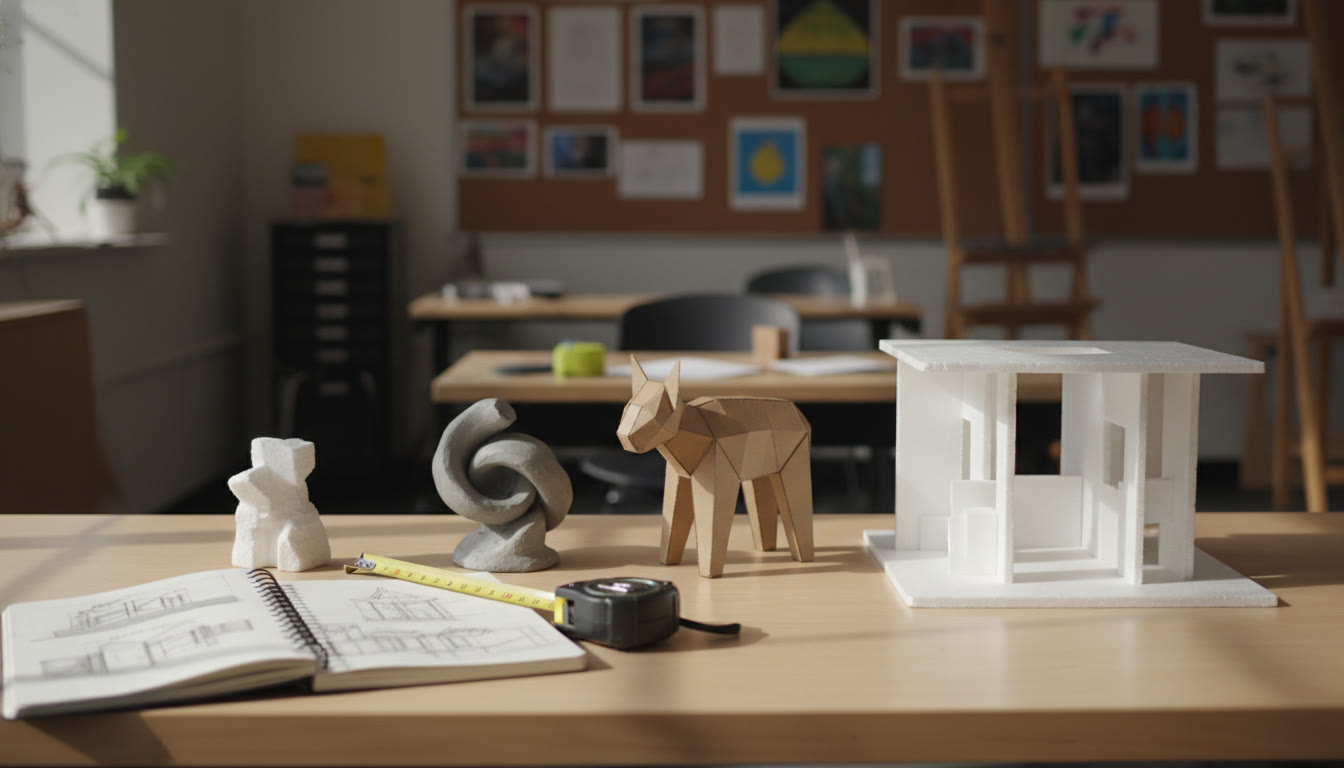
A maquette is a small, usually quick model of a larger work. Think of it as the sketchbook entry for 3D: cheap, fast, and forgiving. Artists use maquettes to test composition, negative space, balance, and how light interacts with surfaces before committing to full-scale materials and expensive studio time.
Why Start with Maquettes?
- They clarify structure and resolve technical problems early.
- They let you test scale relationships—what feels monumental versus intimate.
- They save time and materials while encouraging bold, iterative decisions.
Example: If you’re planning an outdoor installation with interlocking steel shapes, building a cardboard maquette can reveal awkward joints and balance issues you might not notice in a digital sketch. Much better to discover these when you can patch cardboard with tape than when you’re bending metal at a fabrication shop.
Simple Maquette Materials and Methods
- Foam core or cardboard: fast, planar pieces for exploring silhouette and planar rhythm.
- Oil-based or polymer clay: great for organic forms and textural exploration.
- Wire armatures: useful when testing gestures and skeletal balance.
- Found materials: bottle caps, toothpicks, and fabric can suggest surface and scale.
Tip: Keep a maquette kit. A shoebox of scraps, a pocket knife, glue, clay, and a roll of masking tape will become your best creative companion. Spend thirty minutes making three very different maquettes from the same prompt—this builds fluency in solving 3D problems.
Scale and Proportion: Translating Ideas Across Sizes
Scale is more than size; it’s the relationship between parts and their environment. A tiny figure on a vast plinth reads differently than a large figure in a small space. Translating a maquette into a finished piece requires intention about scale and how viewers will move around the work.
Rules of Thumb for Scale Decisions
- Consider the viewer’s line of sight—eye-level placement emphasizes intimacy, while low or high placement changes power dynamics.
- Think about circulation: people need space to walk around and view a three-dimensional object. Don’t crowd sightlines.
- Use scale to emphasize concept: large scale can signal monumentality; small scale can invite closer, slower looking.
Example: A hand-sized object that requires you to crouch to look at it creates a private encounter. If the same object is enlarged to human scale, it becomes social and public. Decide which experience supports your concept.
Translating Maquette Measurements to Full Scale
When you scale up, math helps—but so does a practical workflow. Here’s a small table to visualize how to translate measurements and preserve proportions.
| Maquette Size | Scale Ratio | Full-Scale Dimension Example | Practical Notes |
|---|---|---|---|
| 3 in (small hand maquette) | 1:6 | 18 in finished | Good for small sculptural objects; use armature to maintain structure. |
| 6 in (tabletop maquette) | 1:4 | 24 in finished | Common for gallery works; revisit weight and base support. |
| 12 in (detailed maquette) | 1:2 | 24 in finished | Useful when you need more surface detail and accurate joints. |
Technique: Multiply every maquette measurement by the scale ratio. If the maquette’s arm is 1.5 inches and your scale is 1:4, the full-scale arm is 6 inches. Draw elevation and plan views at full scale before cutting materials. This prevents surprises in assembly.
Craft Techniques That Make Ideas Real
Great craft is invisible—meaning it supports the concept without calling attention to its own construction flaws. For students, precise craft can elevate a concept from “nice idea” to “professional presentation.”
Joinery and Structural Thinking
- Dry-fit first: assemble pieces without glue to check alignment and balance.
- Hidden supports: metal rods, dowels, or armatures can be concealed inside a form to keep surfaces clean.
- Finish with intention: seams can be part of the design (exposed stitching, brass rivets) or hidden completely for a smooth surface.
Example techniques by material:
- Cardboard/foam core: layer and lam with PVA or contact cement; score for clean folds.
- Clay: build on an armature, refine with water or solvent, and fire or cure as appropriate.
- Wood: sand progressively, use biscuits or mortise-and-tenon joints for strength.
- Metal: consider welding or bolted flanges for large works; a professional fab shop can help if you design appropriately.
Surface Treatments and Light
Surface is where material meets perception. A painted cardboard surface reads differently than polished metal. Light will reveal texture, so test your work under the actual lighting conditions where it will be shown—daylight, gallery track, or a dim corner.
Process: From Idea to Submission
AP portfolios (and any serious studio project) value process as much as polished outcomes. Documenting decisions shows your creative thinking and problem-solving abilities.
Documenting Maquettes and Scale Changes
- Photograph maquettes from multiple angles with consistent lighting.
- Include sketches, notes, and scaled drawings in your process pages.
- Capture construction steps—close-ups of joints, armatures, and material tests.
When you submit images, aim for clarity: neutral backgrounds, tripod-stable shots, and at least one contextual image that shows the work in space (with a person or by proportioning to a doorframe). This helps reviewers understand scale and interaction.
Sample Process Timeline for a Single Work
- Week 1: Research and thumbnail sketches; prompt three maquettes.
- Week 2: Select a maquette, make detailed drawings, and plan materials.
- Week 3–4: Build full-scale armature, rough out form, and troubleshoot structure.
- Week 5: Refine surface, finish, and test lighting or installation requirements.
- Week 6: Document, photograph, and write an artist statement draft.
Pro tip: Build buffer time into this schedule. Materials arrive late, glue needs curing, and kilns have queues. A realistic timeline keeps your best work from becoming a panic job.
Exercises to Train 3D Thinking
Small, regular practices will transform how you see and solve three-dimensional problems. Here are a few student-tested exercises to add to your routine.
Three Quick Exercises
- One-Hour Maquette: Choose a prompt (gesture, memory, shape) and build a maquette in 60 minutes using only tape, cardboard, and scissors. Focus on silhouette and rhythm, not finish.
- Scale Swap: Make a small maquette and then make a second maquette of the same idea at double the size. Notice what elements need structural change.
- Negative Space Study: Create a simple open form and photograph the negative space at multiple distances. Compose the full-scale work to prioritize those openings.
Repeat these exercises weekly. Over a semester you’ll notice more confident decisions and fewer “fix-it” moments during construction.
Presentation and Critique: Telling the Story of Your 3D Work
Presentation is storytelling. Judges and viewers need to understand intent, process, and decisions. Your images and statement should guide them through your choices—why scale was chosen, why certain materials were used, and how maquettes informed the final piece.
What to Include in a Critique Packet
- Clear title and short statement (100–200 words) describing concept and material choices.
- Photographs: full object, detail, and contextual shot showing scale.
- Process pages: sketches, maquettes, and a short timeline of development.
Good critique etiquette: arrive prepared to describe what you tried, what worked, and what you would do differently. That reflection shows maturity and critical thinking.
How Sparkl’s Personalized Tutoring Supports 3D Practice
Some students benefit from one-on-one guidance while navigating materials, deadlines, and portfolio requirements. Sparkl’s personalized tutoring provides tailored study plans, expert tutors with studio experience, and AI-driven insights to help you reflect on process and plan next steps. Whether you need structure to build a coherent series, critique prep, or help translating a maquette into a full-scale project, a focused tutoring session can save time and sharpen outcomes.
When you pair hands-on practice with targeted feedback—especially feedback that’s specific about scale decisions and craft techniques—you’ll see faster improvement. Sparkl’s tutors can also help you create documentation strategies that present your work clearly for AP portfolio reviewers.
Materials Budgeting and Studio Safety
Great ideas don’t require endless money, but they do require planning. Think about materials, tools, and safety measures early in the process. Sometimes a modest change of medium will achieve the same concept with a safer or cheaper workflow.
Budgeting Tips
- Prioritize armature and support materials—these are often the most important for structural success.
- Use test panels to try finishes before applying them to your final work.
- Shop smart: salvage yards, art-supply swaps, and community fabrication spaces stretch budgets.
Basic Studio Safety
- Ventilate when using solvents, spray paints, or adhesives.
- Wear eye protection and gloves for cutting and sanding.
- Secure large pieces while working on them—weight and balance accidents are common.
Always read product instructions and ask a teacher or expert if you’re unsure about a technique like welding, kiln firing, or chemical casting.
Real-World Context: Where 3D Skills Lead You
3D thinking opens a surprising number of doors. Beyond fine art, skills in modeling, material literacy, and spatial reasoning translate to fields like industrial design, architecture, set design, conservation, and prototyping. Employers and admissions committees notice students who can conceptualize, iterate, and execute physical ideas.
Example pathways:
- Product design: prototyping with rapid iteration mirrors the maquette-to-full-scale workflow.
- Architecture: understanding scale and human circulation is core to both disciplines.
- Set and exhibition design: balancing sightlines, access, and surface finish matters in performance spaces and galleries.
Final Checklist: From Concept to Cohesive Submission
Use this checklist to make sure your 3D project is both conceptually strong and presentation-ready.
- Concept clarity: Can you state your idea in one or two sentences?
- Maquette evidence: Are at least two maquettes documented and photographed?
- Scale rationale: Is the choice of final scale explained in your statement?
- Craft standards: Are seams, joins, and finishes intentional and clean?
- Documentation: Do you have full-object, detail, and context photos with neutral backgrounds?
- Safety and budget: Are materials and tools accounted for and used safely?
One Last Tip
Every semester, set aside a ‘sandbox day’—no pressure, no grading, just play. Build absurd maquettes, test a weird texture, try a new joint. Those low-stakes experiments become the source of breakthroughs. If you ever feel stuck, a short, focused conversation with a tutor—someone who can point out an overlooked structural idea or suggest a material substitution—can be a game-changer. Sparkl’s personalized tutoring can be that nudge, providing tailored plans and targeted critiques to accelerate your practice.
Closing Thoughts
Working in three dimensions is an invitation: to think with your hands, to test ideas in space, and to communicate in a language that all viewers feel physically. Maquettes are your fastest path to clarity. Scale choices are the grammar that make your object readable. Craft is the punctuation that makes your work convincing. If you keep practicing, document your process, and welcome critique, you’ll build a portfolio that shows both skill and curiosity.
Whether you’re preparing an AP submission or inventing a personal series, the habits you build—regular maquette-making, thoughtful scaling, careful craft, and clear documentation—will pay off. And remember: strategic, personalized support, like Sparkl’s 1-on-1 tutoring and tailored study plans, can help you focus your time and avoid common pitfalls so your best ideas get the attention they deserve.
Now: clear a space, take out that shoebox of scraps, and make something that surprises you.




























No Comments
Leave a comment Cancel