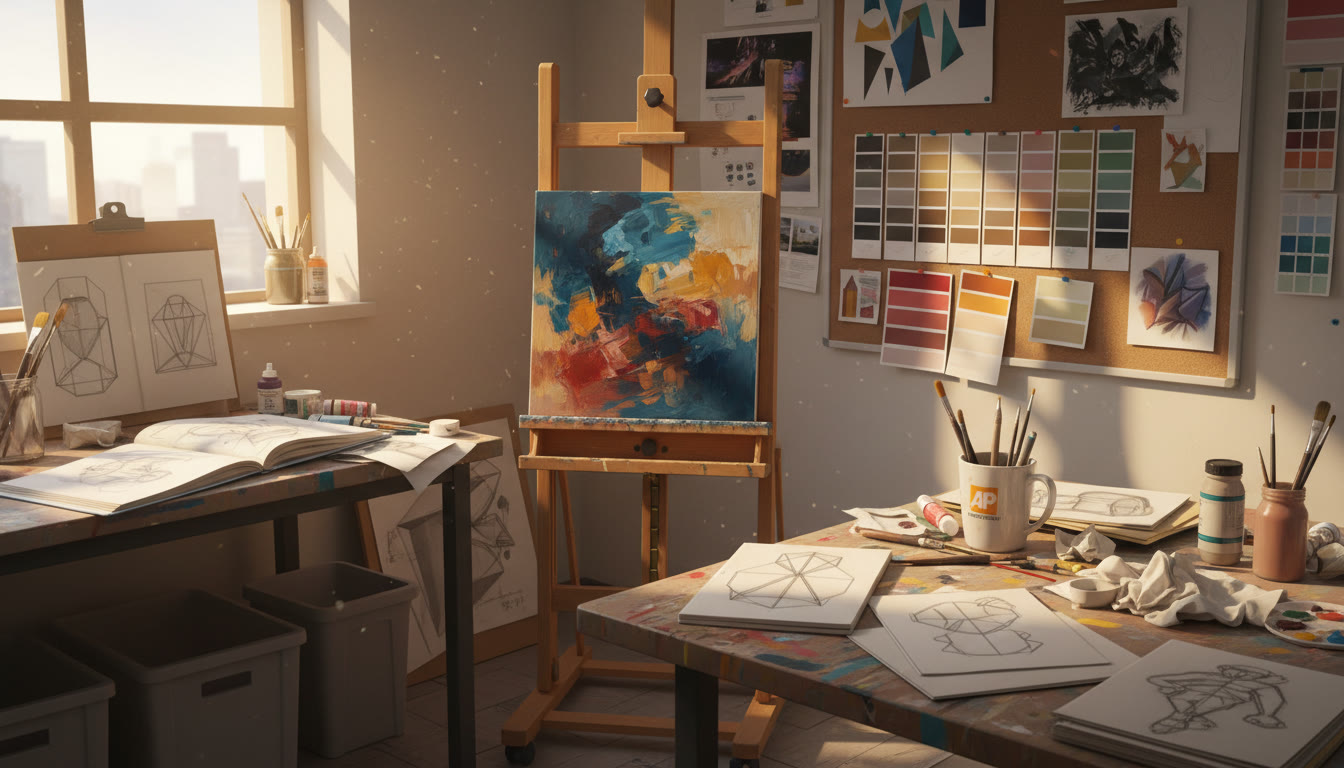

Why Reflection, Iteration, and Risk Taking Matter for AP Art Students
When you’re building an AP art portfolio—whether it’s AP Drawing, 2-D Design, or 3-D Design—your work isn’t just a collection of finished pieces. It’s a story: of choices made, of problems solved, of experiments that failed and those that surprised you. Reflection turns that story into evidence of thinking. Iteration shows growth. Risk taking reveals your willingness to push boundaries. Together, they make your portfolio honest, dynamic, and memorable.
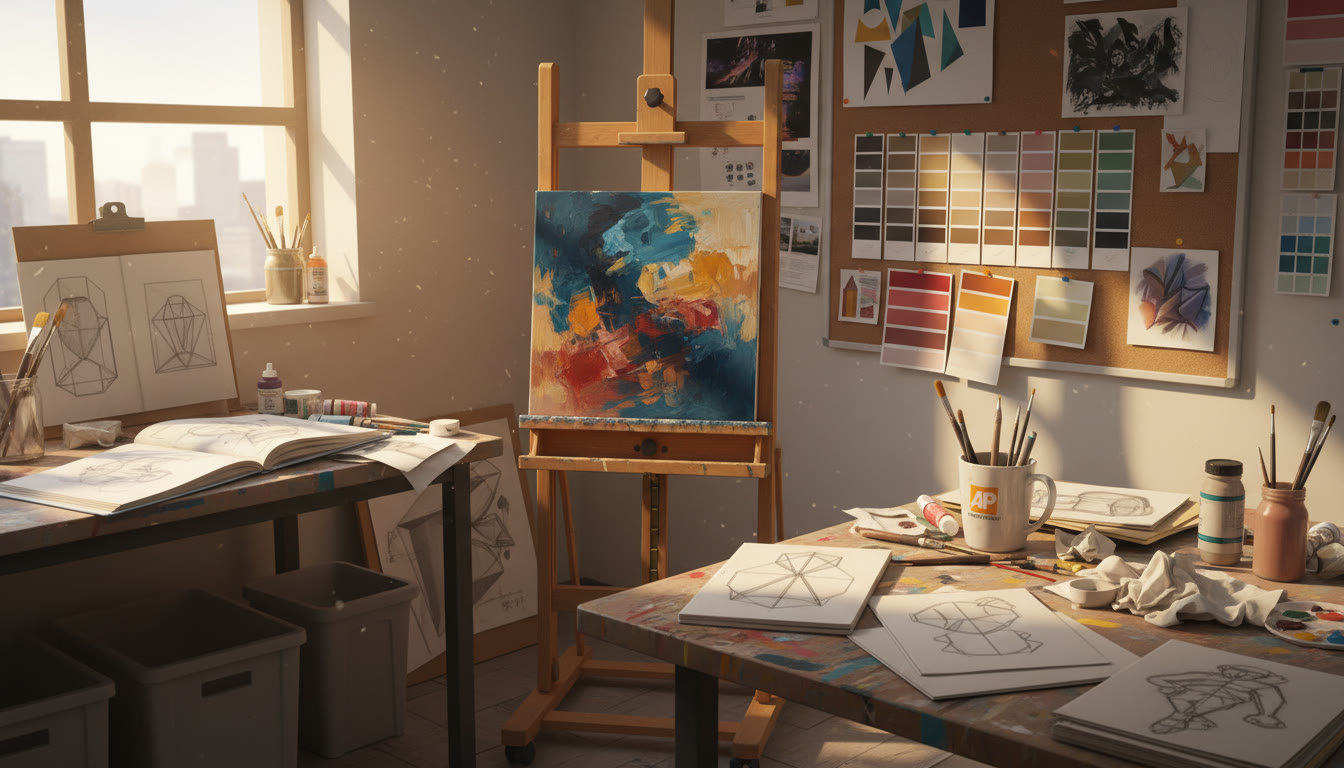
What the College Board Looks For (In Practice)
The AP assessments reward depth of investigation, technical skill, and conceptual development. But beyond technique, assessors look for clear documentation of your process: how an initial idea became a final work, which alternatives you explored, and why you chose one direction over another. That’s the heart of reflection. When you write observations and prompts into your materials, you’re giving the reader a map of your creative decisions.
How to Use Reflection Prompts Effectively
Reflection prompts are not a chore to check off; they’re tools to sharpen awareness. Use them during ideation, mid-project, after critiques, and at the end of a series. Rotate the prompts so you reflect from different angles: technical, conceptual, emotional, and practical.
Timing Your Reflections
- Before you begin: capture initial impulses and constraints.
- After early experiments: document surprises and what you learned.
- Mid-iteration: reassess goals and adapt your plan.
- After critiques or feedback: identify which suggestions you’ll try and why.
- Final reflection: summarize growth and next questions to investigate.
50 Art Reflection Prompts Focused on Iteration & Risk
Below are prompts you can return to regularly. Treat them like warm-ups for your thinking as much as your hands. Pick three prompts for each work and rotate through them across a sequence of pieces.
Initial Idea Prompts
- What pulled me toward this subject in the first place?
- If I describe this work in one sentence, what would it say?
- What assumptions do I have about the audience for this piece?
- What is the simplest iteration of this idea I can make in one sitting?
- What materials or techniques might challenge me to look at the idea in a new way?
Experimentation & Iteration Prompts
- List three variations you can make by changing only one element (color, scale, texture).
- Which experiment felt most uncomfortable—and why might that be a clue?
- What failed experiments revealed something useful?
- How does scaling this composition up or down change the narrative?
- What would happen if I combined two of my experiments?
Risk Taking Prompts
- What would I try if I knew I couldn’t fail?
- What old rule can I break that would lead to a stronger concept?
- How can I incorporate an unfamiliar material or process this week?
- Which part of this piece makes me nervous—and why might that be the most essential part?
- If I remove my favorite element, how does the piece change?
Feedback & Revision Prompts
- Summarize feedback in three bullet points and write how you’ll test each suggestion.
- Which suggested change will most clearly reveal growth if implemented?
- Which critiques do I disagree with—and can I articulate why?
- How many more iterations does this piece need before it feels resolved?
- What would a viewer miss if I didn’t explain my process?
Final Reflection Prompts
- How did this piece change from first sketch to final presentation?
- What did I learn about the medium or my working habits?
- Which risks paid off, and which taught me without success?
- What question does this work leave me with for my next project?
- How does this work sit within the rest of my portfolio—what role does it play?
Concrete Examples: Using Prompts Across a Project
Let’s walk through a hypothetical series: you’re exploring “urban solitude” across five mixed-media works. Here’s how you might use prompts to iterate and take risks.
Phase 1 — Research & First Iteration
Use initial prompts to collect impressions: photographs of empty subway cars, textures of graffiti, the color of neon at midnight. Make a one-sitting study that simplifies the idea. The goal is to create a low-stakes starting point.
Phase 2 — Experimental Variations
Try three variations: a tonal collage, a high-contrast ink drawing, and a sculptural relief using found cardboard. Document what each reveals. A prompt like “Which experiment felt most uncomfortable?” can reveal which approach stretches you conceptually.
Phase 3 — Feedback & Risk
Share mid-iteration images with classmates or a mentor. Put this into action: if feedback suggests stronger gesture, take a risk by reworking scale or adding an unexpected color that contradicts the mood. Record why you made that choice.
Phase 4 — Finalizing
Do a final reflection: describe how the risk altered the meaning of the piece and show a mini-timeline of iterations. This kind of transparency is exactly what portfolio reviewers want to see.
Table: A Practical Reflection Log Template
Use this table as a model you can copy into your sketchbook or digital portfolio to track iterations and risks.
| Stage | Date | Action / Experiment | What I Learned | Next Step | Risk Level (Low/Med/High) |
|---|---|---|---|---|---|
| Initial Sketch | 2025-02-12 | Quick charcoal study of empty station | Value relationships are key; composition feels cramped | Open negative space in next iteration | Low |
| Material Test | 2025-02-18 | Collage with transit maps and tissue paper | Texture added depth but made focal point unclear | Simplify collage to highlight focal area | Medium |
| Feedback Session | 2025-02-23 | Class critique—focus on mood and contrast | Neon accent would create tension and guide eye | Add neon wash and re-balance edges | High |
| Final | 2025-03-05 | Combined collage and neon wash | Risk created striking contrast; narrative shifted to hopeful solitude | Document iterations in portfolio and reflect on risk | High |
How to Write Reflections That Read Well in Your AP Portfolio
Clarity and specificity matter more than flowery language. Reviewers want to see decisions, not vague sentiments. Here’s how to structure reflections so they’re concise, honest, and compelling.
Templates for Reflections
- Short Process Note (1–2 sentences): “I began with a charcoal study to capture spatial tension; subsequent collage experiments helped me explore texture while neon accents introduced contrast and narrative change.”
- Mid-Project Note (3–4 sentences): “After trying three compositional variations, I found that simplifying background elements strengthened the focus on the central figure. A risk I tried was adding a fluorescent wash, which initially felt jarring but ultimately clarified the piece’s emotional arc.”
- Final Reflection (3–6 sentences): “Through multiple iterations I learned that restraint in the background amplifies the theme of solitude. Risk taking—particularly material juxtaposition—shifted the work from melancholy to tentative optimism and revealed a new direction I want to pursue in future pieces.”
Common Pitfalls and How to Avoid Them
Students often fall into predictable traps. Here are ways to navigate them so reflection becomes a strength rather than a checkbox.
- Vague Language: Avoid “I felt” without elaboration. Instead, pair emotion with an observable cause (e.g., “I felt unsettled when the composition tilted because the figure was off-center; this suggested a deliberate imbalance I later embraced.”)
- Over-Polishing Early: Don’t finalize prematurely. Keep sketch iterations visible; they demonstrate risk and exploration.
- Ignoring Failed Experiments: Record failures—the most useful insights often come from them.
- Too Much Jargon: Use accessible language; clarity beats technical name-dropping.
Making Risk Taking Manageable
Risk doesn’t mean reckless. Break risks into small, testable experiments so failure feels safe and informative.
Small-Scale Risk Strategies
- Time-box experiments (e.g., 30 minutes to test a new medium).
- Limit stakes: do high-risk tests on studies rather than final pieces.
- Use low-cost materials for big conceptual shifts to avoid wasted resources.
- Pair risks with hypotheses: “If I add neon, the focal area will read brighter and shift the mood toward urgency.”
Using Feedback: How to Separate Noise from Useful Critique
Not all feedback is created equal. Learn to parse suggestions into categories: technical, conceptual, and taste-based. Test meaningful suggestions; decline others thoughtfully.
A Simple Feedback Filter
- Is the suggestion about how something reads (conceptual)? Test it.
- Is it about how something is made (technical)? Try a focused experiment.
- Is it purely preference? Reflect, but prioritize feedback that aligns with your goals.
How Personalized Support Can Help You Iterate Faster
Working with a mentor or tutor accelerates iteration by offering targeted questions and techniques you might not see alone. Personalized tutoring—like Sparkl’s personalized tutoring—can provide 1-on-1 guidance, tailored study plans, and expert tutors who suggest experiments and help you document process in ways that align with AP expectations. Their AI-driven insights can also surface patterns across your work so you know which risks repeatedly pay off.
What to Ask a Tutor or Mentor
- Which experiments should I prioritize right now?
- How can I best document this risk for my portfolio?
- Which elements of my process should appear in the written reflections?
- How do I demonstrate sustained investigation across multiple works?
Bringing It Together: A Week-by-Week Reflection Routine
Set a consistent habit: weekly reflection sessions keep momentum and make iteration visible. Here’s a simple routine you can adapt.
- Monday: Rapid ideation (30–60 minutes) using two initial prompts.
- Wednesday: Mid-week experiment and documentation (try a small risk).
- Friday: Peer/mentor feedback and a short reflection note (1–3 sentences).
- Weekend: Consolidate into your portfolio log and decide next week’s focus.
Final Thoughts: Make Iteration and Risk Part of Your Voice
AP portfolios that sing are rarely those that only show polished outcomes. They’re the ones that show curiosity in motion—iterations that respond to questions, and risks that expand the work’s emotional or formal possibilities. Use reflection prompts to unlock those stories. Keep your notes honest and specific. Treat failed experiments as evidence, not embarrassment. Over time, your portfolio will become less a display case and more a conversation between you and your practice.
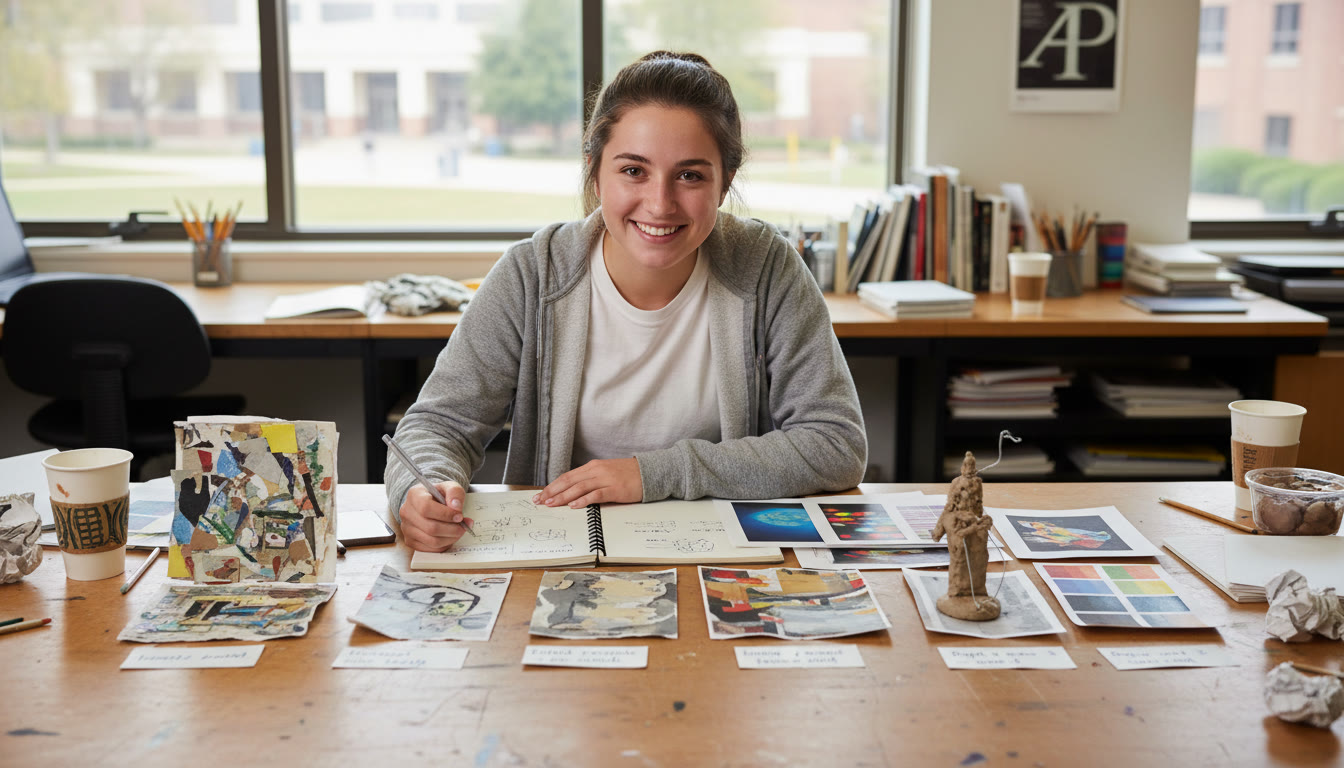
And remember: you don’t have to do it alone. Focused 1-on-1 help can shorten the learning curve—whether that’s by refining a prompt, suggesting a material test, or helping you craft reflections that communicate your growth. When iteration and risk taking are paired with clear documentation, your AP portfolio becomes a compelling record of who you are as an artist and where you’re going next.
Quick Checklist Before You Submit Your Portfolio
- Every piece has at least one process image or sketch documented.
- Your reflections include specific decisions, learning points, and next questions.
- There is visible evidence of iteration (3+ stages shown for major works).
- At least one well-executed risk is clearly described and justified.
- Your portfolio shows a coherent thread across works—conceptually or formally.
Use these strategies to make your AP submission not just a set of artworks, but a narrative of curiosity, courage, and clear progression. That narrative is what stays with reviewers—and what will ultimately help your voice as an artist keep growing long after the portfolio is evaluated.
Good luck, and enjoy the messy, beautiful work of making. Keep asking questions, take smart risks, iterate often, and let your reflections tell the true story of your development.























No Comments
Leave a comment Cancel