

Why deciding what not to study is as important as choosing what to study
There’s a strange freedom in the idea of cutting things out. For IB students, it’s a strategic freedom: the ability to say “no” to lower-payoff topics so you can say “yes” to the few things that actually move your grade and deepen understanding. The Diploma Programme is broad by design — six subject groups, Higher Level and Standard Level choices, and the core components — and trying to learn every single detail deeply is the fastest route to exhaustion. What separates steady, confident students from burned-out overachievers is not how many pages they highlight, but how thoughtfully they decide what to leave off the page.
This blog is a practical guide: a clear framework that helps you decide what not to study, and where those decisions fit into a two-year IB roadmap. It’s not about shortcuts or cutting corners. It’s about prioritising with purpose so you build depth where it counts, shore up weak spots when necessary, and keep your energy for skills that transfer across papers and subjects. Expect examples, checklists, and a few realistic templates you can adapt to your own DP journey.

Core principles that make omission intelligent
Before you start crossing topics off a syllabus, hold a compass: a handful of principles that keep omission strategic rather than risky.
- Assessment-first thinking: Look at what the assessments reward — command terms, question styles, and mark schemes — then work backwards.
- Pareto mindset: Often 20% of topics yield 80% of marks. Find the high-yield topics and secure them.
- Transferability over trivia: Prioritise skills and concepts that appear across questions, papers, or even subjects (e.g., data analysis, essay structure, mathematical reasoning).
- Risk-calibrated omission: The decision to skip a topic depends on the probability it will appear, the marks it’s likely to award, and your personal vulnerability on it.
- Iterative evaluation: Treat your roadmap as a living document — try an omission for a term, test it, then reintroduce if necessary.
What to map first: the evidence map
Start by building a compact “evidence map” for each subject: syllabus pages you can navigate quickly to see outcomes, a list of past-paper topics you’ve seen repeatedly, and your own performance pattern in class and mocks. This lightweight map is the factual backbone of any omission decision.
- Collect: mark-scheme patterns, teacher emphasis, and your mock/quiz results.
- Annotate: highlight topics that reappear or connect to core skills.
- Rank: assign a simple high/medium/low label for impact and risk.
A step-by-step framework to decide what not to study
Use this six-step process as your decision algorithm. Each step forces a concrete judgment, which keeps omission accountable.
Step 1 — Clarify the academic aim
Are you targeting a competitive university pathway, a subject-specific scholarship, or simply a solid Diploma outcome? Your target affects acceptable risk. High-cutoff aims mean shorter tolerance for skipping high-mark content.
Step 2 — Identify high-yield topics
For every subject, list the concepts that show up repeatedly on higher-mark questions or that underpin many other topics (e.g., conservation laws in sciences, core theorems in math, or critical lenses in Language A).
Step 3 — Score topics on four axes
Give each topic a quick score (1–5) for: likelihood of appearing, mark contribution when it appears, time-to-master (effort), and transferability to other topics. Topics with low likelihood, low marks, high time cost, and low transferability are omission candidates.
Step 4 — Trial omission and test
Don’t drop forever. Skip a topic for a fixed window (for example, one term), then attempt targeted past-paper questions on it during a mock week. If your answers show a manageable gap, keep it omitted; if not, reintroduce with a focused revision slot.
Step 5 — Protect the core
Never permanently omit procedural or practical skills that feed internal assessment (IAs), labs, or coursework. Also keep the three core DP components — Extended Essay, Theory of Knowledge, and CAS — as priorities that cannot be sacrificed without significant consequences.
Step 6 — Iterate at mock checkpoints
Use school mock exams and internal assessments as truth tests. Update scores and reshuffle priorities at clear checkpoints: the end of each semester, a full mock, and three months before final exams.
Decision matrix: a compact example
Here’s an illustrative matrix you can copy. It’s deliberately simple — numerical values help with objectivity but keep the labels understandable.
| Topic | Likelihood (1–5) | Marks if tested (1–5) | Time to master (1–5) | Transferability (1–5) | Quick decision |
|---|---|---|---|---|---|
| Core mechanics (Physics HL) | 5 | 5 | 3 | 5 | Keep / Prioritise |
| Optional topic: Astrophysics | 2 | 2 | 4 | 2 | Consider omission / Test in mock |
| Statistical tests (Math SL) | 4 | 4 | 2 | 4 | Keep / Fast revision |
Use the matrix to make tension visible: a topic with low likelihood but high mark value might still be worth learning; a low-mark, high-effort topic is an obvious place to thin study time.
Where omission fits in a two-year DP roadmap
Below is a template roadmap that balances foundational building, selective omission, consolidation, and final intensive practice. Customize the labels to match your school’s term structure.
| Phase | Main focus | Activities | Suggested time allocation |
|---|---|---|---|
| Year 1 — Foundations | Core concepts and breadth | Complete syllabus exposure, baseline mocks, begin EE research | 60% breadth, 40% depth |
| Mid Year 1 — Controlled omission | Trial selective omission | Reduce hours on identified low-yield topics; focus on high-yield practice | Rebalance weekly hours; monitor via quizzes |
| Year 2 — Consolidation | Deepening HL, targeted SL reinforcement | Mock exams, IA finalisation, EE drafting, TOK linking | 70% deep practice, 30% catch-up |
| Final months — Intense practice | Exam technique and timing | Past papers, mark-scheme reviews, flashcard SRS | 80% exam practice, 20% last-minute concept polish |
A few roadmap notes
- Use Year 1 to gather data: teacher signals, IA progress, and mock feedback. This is when your evidence map becomes reliable.
- Controlled omission is reversible. Always schedule a re-test slot in the next mock cycle.
- Reserve the final months for exam-format practice: timed papers and mark-scheme awareness trump passive rereading.
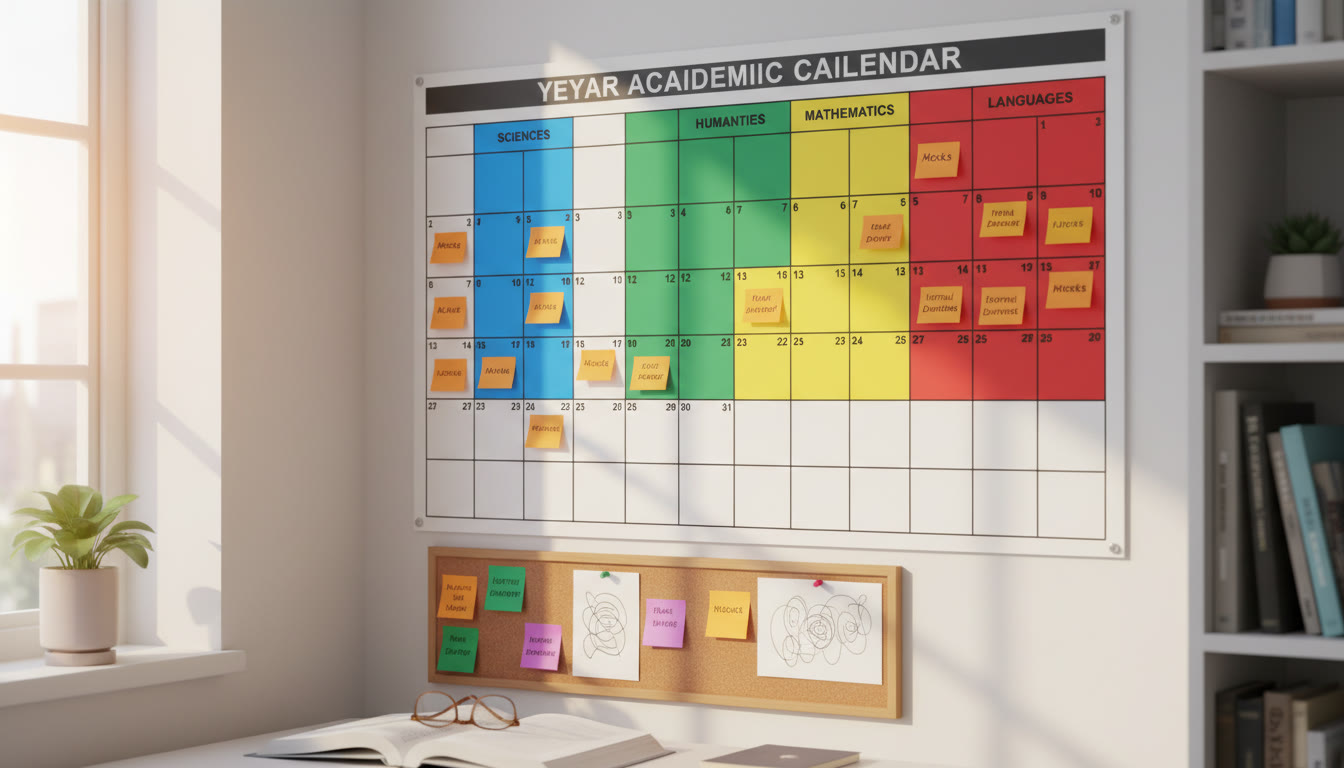
Subject-specific pointers (practical, not prescriptive)
Every subject has different patterns, but these heuristics often help students decide what to thin or drop.
Sciences (Physics, Chemistry, Biology)
- Keep core laws and experimental techniques; these underpin many exam questions and IAs.
- Optional topics or highly specialised modules can be skimmed if their exam presence is rare and they require heavy new math/physics tools.
- Practical skills are non-negotiable for experiments and internal assessments.
Mathematics (All routes)
- Prioritise conceptual understanding and exam techniques for problem types that recur across papers.
- Optional extended topics that need many new techniques — if optional for your route — are candidates to deprioritise close to exams, provided you can attempt representative questions in mocks.
- Accuracy under timed conditions is often worth more than mastering every exotic method.
Language A and B
- For Language A essays, focus on a small toolbox of critical lenses and a handful of strong examples you can apply flexibly.
- For Language B, oral proficiency and core grammar often give more marks than obscure vocabulary; weight practice accordingly.
Individuals & Societies and Arts
- In subjects with large bodies of content (e.g., history), narrative minutiae can be deprioritised in favour of themes, causation chains, and historiography shortcuts.
- For arts subjects, practice creation and documentation — portfolios and process work — rather than chasing every theoretical text.
Study techniques that make omission safer
Omission only works if your remaining study is efficient. These techniques amplify the benefit of cutting low-yield material.
- Active recall: Practice retrieving facts and procedures from memory rather than re-reading notes.
- Spaced repetition: Space review sessions so that you only revisit content as the forgetting curve demands.
- Interleaving: Mix question types and subjects during practice to build flexible application skills.
- Past-paper triage: Prioritise past-paper questions on topics you kept; use the mark schemes to learn examiner expectations.
- Micro-feedback loops: After each practice session, write a one-line improvement plan and the next practice target.
If you want tailored help implementing these techniques — for example, a weekly practice schedule that folds in omission trials and mock checkpoints — personalised tutoring can accelerate the process. Sparkl offers one-on-one guidance, tailored study plans, and expert tutors who can help translate your evidence map into a realistic weekly plan.
How to test and validate an omission
Treat omission like an experiment with a clear hypothesis and checkpoints. Your hypothesis might be: “Reducing weekly time on Topic X by half for one term will not lower my mock score by more than 5% on questions covering Topic X.” Then follow a simple validation plan:
- Document baseline performance on Topic X.
- Reduce study time for a fixed period and track time spent.
- Attempt a blind past-paper question on Topic X under timed conditions at the end of the period.
- Compare performance to your baseline and decide whether to reinstate full study, maintain reduced input, or accept the omission.
Common pitfalls and ethical guardrails
Omission can backfire if handled carelessly. Watch out for these traps.
- Chasing comfort: Don’t use omission as an excuse to avoid genuinely weak areas that require deliberate practice.
- Ignoring internal assessments: Skipping practical skills or IA-related topics can harm grades even if those topics are rare in final papers.
- Over-optimistic probability judgments: Past papers change; a topic with low historical frequency could still appear. That’s why trial windows and mock checks are essential.
- Burning bridges: Don’t omit content that’s prerequisite for later HL topics you plan to prioritise.
Simple trackers and metrics for the roadmap
Keep your roadmap honest with a few compact metrics. These are small, measurable checkpoints you can update weekly or after each mock.
| Metric | What to record | How often |
|---|---|---|
| Mock score by topic | Percent score on each topic area | Every mock |
| Time-on-topic | Weekly hours spent per topic | Weekly |
| Confidence rating | 1–5 subjective confidence per topic | Weekly |
| IA progress | Milestones completed (proposal, draft, final) | Monthly |
Use a simple spreadsheet to chart trends. If confidence drops but mock scores stay steady, your omission may be working. If mock scores fall in omitted areas, reinstate targeted review.
When you need a second opinion — a sanity check on your evidence map or a mock-analysis session — external tutors can provide that calibration. A short series of focused sessions can turn subjective guesses into objective plan tweaks. For example, Sparkl‘s tutors can run focused mock debriefs or build custom practice that targets the riskier omissions.
Putting it all together: a short case study
Imagine a student taking Physics HL and English A SL. They notice a pattern: many marks in Physics come from classical mechanics and waves; the optional topic they chose appears rarely on past papers and demands new advanced math. In English, close-reading skills and two strong text examples appear more useful than memorising dozens of minor critical theorists.
Applying the framework:
- Score the optional Physics topic low on likelihood and high on time cost → trial omission for six weeks while maintaining exposure to core mechanics.
- In English, shift memorisation hours into weekly close-reading practice and exam-style timed essays.
- Use the next school mock to test both decisions; score against the metrics; reintroduce any topic whose drop produced unacceptable score decline.
Final academic conclusion
Deciding what not to study is a disciplined, evidence-driven skill that sits alongside note-taking and exam practice. Treat omission as a reversible experiment: map syllabus evidence, score topics for likelihood and payoff, trial a controlled omission window, and validate with mocks and data. When guided by assessment patterns, transferability, and iterative checkpoints, omission helps you focus cognitive energy on the concepts and techniques that reliably produce the largest returns in understanding and marks.























No Comments
Leave a comment Cancel