

Choosing the right IB subjects for architecture
If architecture feels like a natural mix of imagination and logic to you — sketching one moment, solving a structural puzzle the next — then choosing your IB DP subjects is one of the most strategic moves you’ll make. Pick wisely and you’ll build a coherent profile that showcases both creative flare and academic rigor; pick poorly and you might end up juggling mismatched workloads or missing key portfolio material. This guide is written for students who want clarity: the subject combinations that work, why they work, how to show your skills in admissions, and how to balance schoolwork with meaningful design practice.

What admissions teams and architecture programmes really look for
Across universities worldwide, architecture programmes look beyond single grades. They want evidence that you can think spatially, solve problems, communicate visually and verbally, and commit to a long, iterative process. That means a strong portfolio, good analytical thinking, and academic foundations in maths or technology when required. Your IB subject choices should build a narrative: each subject gives you material for essays, your Extended Essay (EE), internal assessments, and portfolio work.
Core IB subjects to consider — and why they matter
Group 1 — Language and communication
Strong written and oral communication is vital. Architecture students write project rationales, crit reports, and reflective statements. If you’re confident in your first language, a higher-level language course helps you develop the precision and critical thinking needed for essays and portfolio texts. If English isn’t your first language and you plan to study in English, choose the language option that best prepares you for academic writing.
Group 2 — Language acquisition
Architecture is global: clients, contexts and regulations vary by country. A strong second language helps if you’re interested in international study or cross-cultural design projects. It’s also a subtle way to demonstrate curiosity and communication skills on application forms.
Group 3 — Individuals and societies
Subjects like History, Geography and Economics are especially useful. History gives you a sense of architectural lineage; Geography sharpens your understanding of place, climate, and human-environment interaction; Economics helps when you study urban planning, project feasibility and the business side of design. If “History of art” or a course that examines built heritage is offered at your school, treat it as a strong option for architecture-focused context.
Group 4 — Experimental sciences and design
Physics can be a sensible choice if you want to understand structure, forces and materials. Design Technology (if offered) teaches process, materials thinking and prototype development — skills that translate directly into model-making and technical drawing. Environmental systems subjects add sustainable design thinking, an increasingly central theme in architecture.
Group 5 — Mathematics: an essential ally
Math is non-negotiable for many architecture routes. Geometry, algebra, trigonometry and an introduction to calculus and vectors are all useful when you start exploring structures, loads and parametric logic. If you enjoy abstraction and want the strongest preparation, opt for the more analysis-focused mathematics course at higher level; if you prefer modelling and applied problem-solving, the applications-focused course can still support your portfolio and technical understanding.
Group 6 — The arts (your creative laboratory)
Visual Arts as an HL subject is a direct bridge to architecture. It trains you in concept development, visual research, process documentation and formal presentation — all portfolio essentials. If Visual Arts isn’t available, take another creative subject or substitute a second science or maths if that fits your university plan.
Sample IB DP subject combinations that work for architecture
Below are thoughtfully curated combinations that reflect different strengths and application strategies: creative-focused, technical-focused, balanced, and competitive for highly selective architecture schools. Each combination assumes three higher level (HL) subjects and three standard level (SL) subjects, plus the DP core (EE, TOK, CAS). Use them as starting points and adapt to your school’s options and your own strengths.
| Combination | Typical subjects (HL listed first) | Core strengths | Best for |
|---|---|---|---|
| Creative + Context | Visual Arts HL, History HL, Mathematics SL, Language A HL, Physics SL, Language B SL | Strong portfolio, architectural context, competent maths | Portfolio-driven applicants aiming for creative routes |
| Design & Tech | Design Technology HL, Mathematics HL, Physics SL, Language A HL, Geography SL, Language B SL | Technical problem solving, prototyping and structural thinking | Students who want a hands-on approach and technical depth |
| Balanced Analyst | Mathematics HL, Visual Arts HL, Geography SL, Language A HL, Physics SL, Language B SL | Mix of rigorous maths and visual development | Those who want both quantitative strength and a polished portfolio |
| Research-Oriented | Mathematics HL, Chemistry/Physics HL, History HL, Language A HL, Visual Arts SL, Language B SL | Analytical research skills, deep historical/contextual knowledge | Applicants interested in conservation, materials research, or urban studies |
| International Practice | Visual Arts HL, Language A HL, Language B HL, Mathematics SL, Environmental Systems SL, Economics SL | Strong communication, sustainability and policy understanding | Students planning for international or sustainable architecture work |
How to choose from these combinations
- Be honest about what you enjoy — HL subjects demand sustained interest.
- Pair one creative HL with one quantitative HL to show dual strengths.
- Use SL slots to add complementary skills (a second language, environmental awareness, or a practical science).
- Check the subjects your target universities recommend; some schools explicitly prefer mathematics at HL.
Extended Essay, TOK and CAS — use the core to amplify your architecture profile
The DP core is a giant opportunity if you plan it strategically. Your Extended Essay can be a focused research piece that enriches your portfolio statement or application essay; TOK helps you develop critical reflection about design decisions; CAS is where you collect real-world evidence of creative process and community engagement.
EE topics that feed an architecture portfolio
- How local climate influenced the vernacular architecture of a chosen town.
- Material innovation: comparative study of two sustainable building materials.
- Adaptive reuse: an analysis of a converted industrial building and its social impact.
- Parametric design principles in a specific architect’s work (if you can access enough sources).
- The role of public space in urban wellbeing: a comparative study of two neighbourhood regeneration projects.
Choose an EE that gives you primary research material — sketches, photographs, interviews — that you can reuse in your portfolio or personal statement.
CAS ideas that strengthen both portfolio and character
- Community design workshops: run a small, hands-on project to redesign a schoolyard or pocket park.
- Volunteer with a local heritage group to document and sketch historic buildings.
- Student-led pop-up installation or modular pavilion for a school event.
- Collaborative interdisciplinary project with the sciences to prototype a sustainable shelter.
Building a portfolio that actually gets noticed
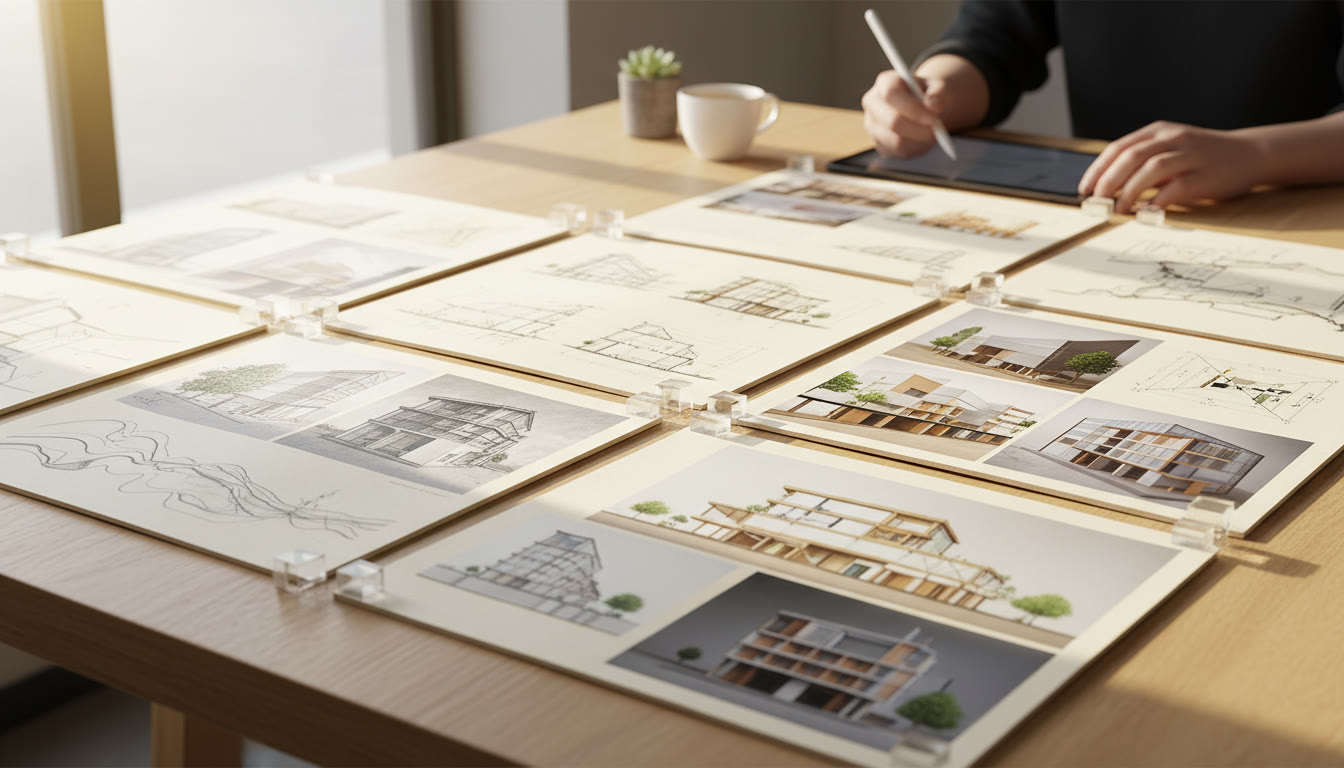
Your portfolio is the storyteller. It must be clear about process as well as the final product. Admissions panels want to see ideas develop: from research and precedent studies, through iterative sketches and models, to a resolved concept. Show concise project statements alongside visuals and include at least one page that explains your personal design philosophy or approach.
Portfolio essentials
- Process documentation: sketches, annotated photos of models, material tests, and development notes.
- Final presentation images: clear photography of models or finished drawings.
- Research and context: short studies of site, user needs and precedents.
- Reflection: a short paragraph per project explaining challenges, learning and next steps.
How to balance portfolio practice with HL study
Break your practice into small, consistent commitments. Daily quick sketching builds fluency; weekly model-making sessions build craft; longer projects should align with IA deadlines so you can reuse process work. Many students find that scheduling two focused portfolio sessions per week plus one longer weekend project slot lets them maintain school performance while growing a meaningful body of work.
Study strategies to master HL subjects without losing creative momentum
Managing HL workloads while building a portfolio is an art. The trick is integration: make your IB assessments feed your design thinking and vice versa. For example, if your Physics IA explores structural behaviour, use the experiments and diagrams in a portfolio project about lightweight structures.
Practical habits that actually help
- Cross-pollination: turn a History essay into contextual notes for a related design project.
- Weekly review: schedule a short reflection that ties school assignments to portfolio progress.
- Use short sprints: 45–60 minute focused blocks, followed by a 10–15 minute break.
- Keep a visual diary: small sketches, material experiments and one-line daily reflections accumulate into meaningful process evidence.
If you’re looking for targeted help with time management, technical feedback on your drawings, or focused HL tutoring, many students pair subject tutoring with portfolio mentorship. Sparkl offers 1-on-1 guidance and tailored study plans that can align subject mastery with portfolio goals, and Sparkl‘s expert tutors often help students translate IA research into portfolio-ready work. Their blend of subject tutoring and AI-driven insights can speed up revision cycles and provide personalised feedback when you need it most.
Assessment strategy: internal assessments, practicals and exam prep
Internal assessments are an opportunity to demonstrate applied learning. Visual Arts and Design Technology portfolios are assessed for process as much as outcome; sciences and maths IAs can be steered to architecture-relevant topics. Start IA work early, iterate with teacher feedback, and keep a clean archive of drafts and experiment photographs.
Exam preparation tips for HL subjects
- Create subject-specific checklists for formulae, key concepts, and common question types.
- Turn exam revision into active practice: sketch diagrams from memory, teach concepts to a friend, or develop short explainer notes that tie theory to design examples.
- Use past papers strategically — focus on question structure and timing rather than memorisation.
- Get targeted help early if you’re struggling with a topic; short, focused tutoring sessions can prevent last-minute panic.
Sample weekly schedule — balancing HL study, portfolio work and wellbeing
| Time | Monday–Friday | Weekend (Saturday) |
|---|---|---|
| Afternoon | School classes, short review (30–45 mins) | Portfolio studio session (2–3 hours) |
| Evening | HL study sprint (45–60 mins) + light sketching (20 mins) | Deep revision block for a single HL subject (2 hours) |
| Weekend (Sunday) | Catch-up reading, EE research, CAS project time | Rest, museum visits or outdoor sketching |
Applying globally: how to align your IB profile with university expectations
Different programmes ask for different things. Some highly selective architecture schools emphasize portfolio quality and may require sketch tests or interviews; others require certain HL subjects (often mathematics). Start by identifying three tiers of programmes — aspirational, target and safety — and map your subject choices and portfolio development to that list. Reach out to admissions early to clarify subject preferences and portfolio deadlines.
Interview and test preparation
- Practice timed sketching: many programmes test rapid observational drawing and spatial thinking.
- Prepare a short verbal presentation of one portfolio project — clear, 2–3 minute explanations are common in interviews.
- Reflect on process: be ready to discuss decisions, failures, and how you adapted your design thinking.
Common pitfalls and how to avoid them
- Overloading HLs without considering portfolio time — balance ambition with realistic scheduling.
- Choosing subjects because of friends — your profile should be your own map to architecture.
- Starting portfolio work too late — process evidence is often more persuasive than polished final images alone.
- Neglecting primary research — site visits, interviews and real-world observation make work feel grounded.
Final checklist before you submit applications or portfolios
- Do you have at least one HL subject that shows analytical strength (often mathematics or design tech)?
- Is your portfolio process clearly documented (research → sketches → models → reflection)?
- Have you aligned your Extended Essay and IAs so they produce usable research or visuals for your portfolio?
- Have you practised interview sketches and concise project presentations?
- Have you sought subject-specific feedback and, where necessary, short targeted tutoring on weak points?
Closing thought
Choosing IB DP subjects for architecture is about building a coherent story: creative exploration grounded by technical understanding, rich process evidence, and reflective research. When your subjects, Extended Essay, CAS projects and portfolio all point toward the same strengths, you present a compelling, authentic application that admissions teams understand and respect.


























No Comments
Leave a comment Cancel