
Self-Study Lessons from NEET Toppers: Practical, Proven and Personal
Preparing for NEET on your own can feel like standing at the foot of a mountain with a single map and a lot of questions. Toppers don’t have a secret ingredient; they have habits. They turn the overwhelming syllabus of Physics, Chemistry and Biology into a sequence of small, testable steps, and they treat every practice session like a micro-exam. In this blog I’ll walk you through the exact self-study habits that consistently show up in toppers’ routines: how they plan, how they revise, how they treat mock tests and OMR discipline, and how they handle the emotional drain of long-term preparation.

Start with the Right Mindset
Before you schedule hours and highlight textbooks, adopt the mindset toppers use: consistency beats intensity. That means smaller daily wins stacked over months instead of one-off marathons. Toppers treat study as skill-building rather than a one-time download of facts. They focus on understanding first, then retention, and finally speed and accuracy under timed conditions.
Key exam realities to keep front and center: NEET is MCQ-based, the full-length simulation should be three hours to match the testing window, incorrect answers carry negative weight so cautious strategies matter, and strict OMR discipline is essential—shade carefully, fill bubbles fully, and avoid stray marks. The test assesses applied knowledge in Physics, Chemistry and Biology; diagrams and derivations are tools for understanding, not partial-credit answers in the exam hall.
How Toppers Plan: Phases, Not Panic
One common pattern among toppers is phase-based planning. Instead of trying to do everything at once, they cycle through building foundations, consolidating concepts, practicing with mocks, and focused revision. A phased plan helps you track progress and avoid last-minute chaos.
Sample Phased Study Table
| Phase | Primary Focus | Weekly Activities | Weekly Hours (example) |
|---|---|---|---|
| Foundation | Concept clarity and basics | Read chapters, solve basic problems, make core notes | 20–30 |
| Consolidation | Application and problem solving | MCQs per topic, past-paper style questions, targeted doubt clearing | 25–35 |
| Mock & Analyze | Timed tests, OMR practice, error analysis | Full-length mocks, topic-wise tests, mistake journals | 15–25 (plus mock hours) |
| Revision | Active recall and spaced repetition | Quick notes review, flashcards, last-pass problems | 12–20 |
This table is a template — adapt hours to your school schedule and energy levels. The important bit is that toppers keep switching focus so that understanding, speed and accuracy improve together.
Daily and Weekly Rhythm
- Morning: Concept study for high-focus subjects (for many, Physics or Physical Chemistry).
- Afternoon: Practice problems or school work—use this as productive consolidation time.
- Evening: Revision, diagrams, and lighter biology reading that benefits from visual memory.
- One day per week: Long mock or a double session dedicated to problem areas and analysis.
Active Learning: What Toppers Actually Do
Re-reading notes is comfortable but inefficient. Toppers actively interrogate material and convert passive content into testable actions. That means:
- Turning headings into questions and answering them aloud.
- Writing one-line summaries for each topic and testing recall after a few days.
- Practicing spaced repetition with flashcards for quick factual recall in Biology and Inorganic Chemistry.
- Solving the concept-level problems before trying long numerical sets; make derivations a rehearsal tool rather than a showpiece.
Example: after reading a chapter on optics, a topper will frame 10 MCQs from the chapter, solve them without notes, analyze mistakes, and add misconceptions to a ‘mistake register’ to avoid repeating them.
Mock Tests and OMR Discipline
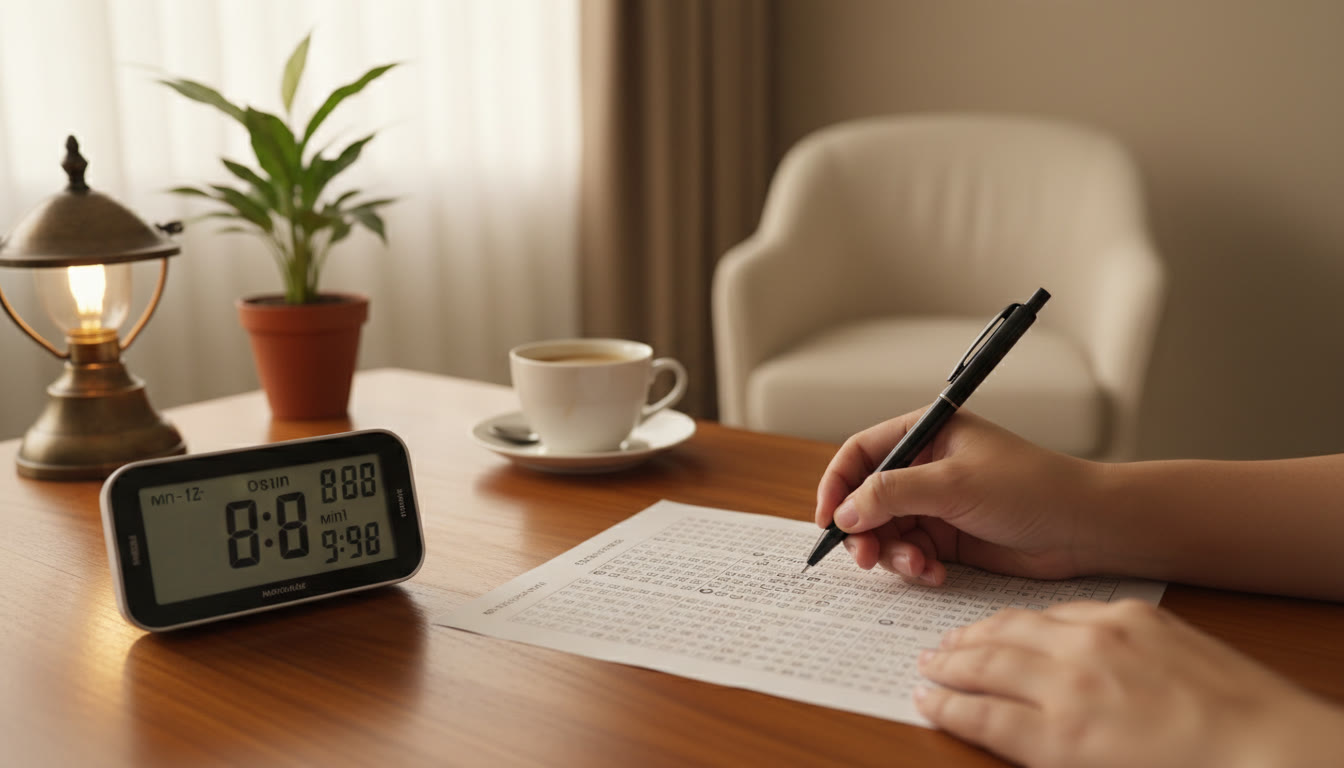
Mock tests are the closest thing to exam-day practice. Top performers don’t just collect mocks; they analyze them. A three-hour full-length mock should be scheduled under simulated exam conditions—no phone, proper breaks, and the same sequence you plan to use on test day.
How to Treat Each Mock
- Attempt it strictly within the three-hour window and use an OMR sheet copy to practice accurate shading and filling.
- Time-block: practise a realistic distribution based on strengths; for instance, tackle a comfortable subject first to build momentum, but practice switching quickly between subjects in later tests.
- Post-mock analysis: identify the top 10 reason-categories for mistakes (calculation error, concept gap, careless reading, time pressure) and address each specifically.
- Track long-term improvement on a mock-score graph — toppers obsess over trends, not a single test score.
Remember: Negative marking penalizes guessing without strategy. Develop an elimination-first approach: cross out options that are clearly wrong and make educated attempts only when necessary. Never assume partial marks for long workings in MCQ exams; the answer in the options is what counts.
Subject-Wise Playbook: Focused Habits That Win Marks
Physics: Build Conceptual Intuition and Solve Regularly
Physics is a discipline of patterns, not brute memorization. Toppers focus on a handful of core principles and practice how those principles are applied in different disguises. Use derivations to understand end-to-end logic, then practice quick numeric setup so that you are fast in the exam.
- Technique: Learn to reduce complex problems into known templates — conservation, Newtonian approach, circuit equivalents, energy methods.
- Practice: Once a concept is clear, solve 10-15 representative MCQs and one advanced problem weekly.
- Common topper trick: Maintain a ‘formula error log’ — every time a formula was misapplied, note why and fix the mental checklist.
Chemistry: Split Strategy by Branch
Chemistry rewards smart division of effort. Physical chemistry needs conceptual clarity and problem speed; organic requires mechanistic patterns and practice writing reaction steps mentally; inorganic depends on memory aided by logical grouping and visual charts.
- Physical: Practice numerical sets until solving time drops and you make fewer arithmetic slips.
- Organic: Build reaction folders by mechanism and create one-sentence summaries for each reaction type.
- Inorganic: Convert lists into structured charts and revisit them with spaced repetition.
Biology: Understand, Visualize, and Retain
Biology has heavy factual load, but toppers connect facts into stories. Instead of rote lists, create concept maps that show cause-effect and process flow. Diagrams are incredibly useful—label them from memory until you can reproduce core structures without peeking.
- Technique: Convert paragraphs into question-answer flashcards and test daily recall (not passive re-reading).
- Retention: Use mnemonics sparingly and rely more on understanding the sequence and logic behind processes.
- Exam trick: Many Biology MCQs test application; practice passage-based questions and interpret diagrams under timed conditions.
Revision, Notes and Memory Systems
Revision is where preparation turns into performance. Toppers keep notes short and layered: long notes for first exposure, condensed one-pagers for quick revisions, and two-line prompts for last-minute passes. The science of learning says active recall and spaced repetition beat passive reading every time.
- Make a one-page summary per chapter with only the must-remember formulas, processes and exceptions.
- Use a ‘mistake register’ where every wrong answer from a mock is recorded with why it happened and how you corrected it.
- Revise using scheduled intervals: 1-day, 3-day, 10-day, and 30-day passes to lock information into long-term memory.
Smart Tools and When to Ask for Help
Self-study is powerful, but targeted help accelerates recovery from persistent weak spots. Many toppers combine independent practice with occasional expert guidance for tricky topics. One-on-one feedback reduces repeated mistakes because an expert can spot a conceptual blind spot in minutes that would take weeks alone.
For example, Sparkl‘s personalized tutoring can provide tailored study plans and focused sessions for stubborn concepts. If you decide to use tutoring, choose support that offers 1-on-1 guidance, targeted practice for your specific weak areas, and helps you convert test mistakes into learning actions. That kind of support, when used sparingly and strategically, complements disciplined self-study rather than replacing it.
Exam-Day and OMR Discipline
Exam-day performance is mostly preparation—by the time you sit in the exam hall you should have rehearsed everything: timing, pacing, OMR handling, and the right strategy for negative marking. Toppers follow a calm, methodical approach on the day:
- Before starting, quickly scan the paper to decide your order of attempt. Don’t waste time hunting for a magical sequence—follow the game plan practiced in mocks.
- OMR discipline: shade bubbles fully and cleanly, avoid stray marks, use the same pen/pencil you practiced with, and double-check identity and roll number fields before starting.
- Triage strategy: First pass for sure-shot and quick-mark questions, second pass for medium-difficulty problems, and final pass for educated guesses after elimination.
- Negative marking rule reminder: avoid blind guessing. Use options elimination; if two choices remain and you can reason one out, attempt with care.
Common Pitfalls Toppers Avoid
- Re-reading without testing. Passive review feels productive but has low retention.
- Chasing perfection on every topic instead of shoring up weaknesses—toppers accept ‘good enough’ on minor topics to keep momentum.
- Overloading on multiple resources. Choose a few reliable sources and use them well rather than fragmenting attention across many books.
- Skipping error analysis. A mock without analysis is a scoreboard, not a lesson.
Putting It Together: A Practical Weekly Template
Here is a simple week structure many toppers find sustainable when balancing school and self-study:
- Monday–Friday: 4 focused blocks per day (two concept blocks, one practice block, one revision block).
- Saturday: Topic-wise test + review of mistakes recorded during the week.
- Sunday: Full-length or sectional mock (alternating) and a light review of the mistake journal.
Keep a measurable goal for each block (e.g., “complete 20 MCQs in Organic Mechanisms” or “master 3 chapters of electrostatics”) and track whether you hit the target. Toppers make small, measurable promises to themselves and keep them.
Final Academic Note
Self-study success is a combination of consistent habits, active testing, disciplined mock practice, and honest analysis of mistakes. Focus on clarity of concepts in Physics, structured memory-building in Chemistry, and story-based understanding in Biology. Use phased planning, enforce OMR discipline, and treat mock tests as the central training ground. Targeted tutoring can help correct persistent errors, but the foundation is your daily discipline: what you do every week determines how you perform on test day.



















No Comments
Leave a comment Cancel