
Complete Guide to Transitioning to Competitive Level
Why this transition matters — and how to feel less overwhelmed
Shifting from school exams to the competitive landscape is less about studying harder and more about studying smarter. The competitive arena rewards clarity, speed, and strategy: conceptual depth in core topics, the ability to apply ideas under time pressure, disciplined practice with multiple-choice format, and a revision cycle that locks knowledge into long-term memory. If you feel overwhelmed right now, that’s normal. Many students stand at this same crossroads. The good news is that with a reliable plan and focus on the right habits, the leap is very achievable.

Understand the exam-style differences at a glance
Before you change your daily habits, accept that competitive exams are different in structure and expectations. The testing format is objective: multiple-choice questions, a strict duration for full-length attempts, and negative marking — which means accuracy matters as much as speed. The paper rewards application of concepts more than verbatim recall. Practicing how to take a three-hour, full-length mock and how to fill the OMR sheet under exam-like discipline is as essential as your subject study.
Core contrasting points
- Question type: application-focused MCQs rather than long-form descriptive answers.
- Time discipline: full-length timed mocks that simulate a continuous three-hour challenge.
- Scoring mindset: accuracy-oriented due to negative marking; blind guessing is risky.
- Syllabus focus: deep mastery of Physics, Chemistry, Biology aligned with the exam syllabus, not peripheral school projects.
Build a rock-solid foundation: content, concepts, and habits
Align with the syllabus and prioritize concept clarity
First, map every chapter you study to the exam syllabus. That ensures you don’t waste energy on topics that won’t be tested. Within each chapter, focus on concept clarity: why a formula works, what assumptions a derivation makes, how a biological process connects to a physiological outcome. Use diagrams, derivations, and crisp notes as learning tools — they help you internalize ideas and recall them quickly during MCQ solving. Remember: diagrams are for you to understand; in an objective exam you won’t be awarded any partial marks for sketches in an answer sheet, so use them purely as study aids.
Active learning beats passive reading
Practice active recall (testing yourself without notes), spaced repetition (revisiting topics at increasing intervals), and problem-based learning (solving progressively challenging MCQs). Convert every study session into a micro-assessment: after reading a section, close the book and attempt a few targeted questions. That tiny habit converts information into usable knowledge.
Sample study-plan framework: the structure that scales
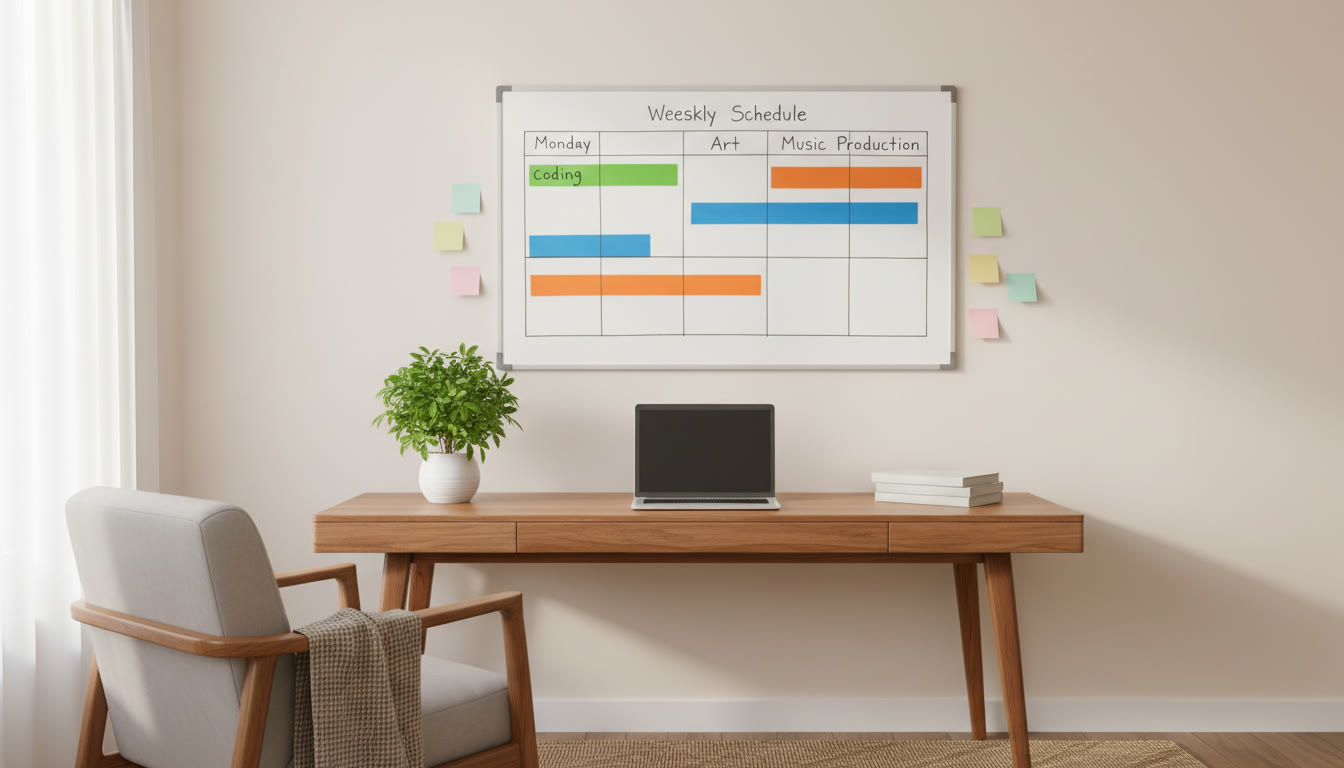
Transitioning successfully requires a plan that scales across months: concept-building phase, integration phase (where you begin timed MCQs), and consolidation phase (intensive mocks and revision). Below is a compact weekly template to move your routine from school-paced to competitive-focused. Tweak time splits based on your strengths, but be disciplined about the categories.
| Focus | Morning (3–4 hours) | Afternoon (2–3 hours) | Evening (2–3 hours) | Weekly hours (example) |
|---|---|---|---|---|
| Concept Building | New chapter study — annotated notes | Worked examples & derivations | Flashcards/mnemonics review | 12–15 |
| Practice & Application | Topic-wise MCQs (timed) | Problem-solving session | Review mistakes & correct approach | 8–10 |
| Revision & Mock Tests | Half-mock / section test | Full-length mock (once/week) | Detailed analysis & error log | 6–8 |
How to use the weekly template
- Keep mornings for heavy cognitive work: new topics and derivations when your focus is highest.
- Use afternoons for applied practice and problem solving — this cements concepts.
- Reserve evenings for active recall and brisk revision; short sessions beat long, passive ones.
- Block at least one full-length, three-hour mock every week in the consolidation phase — simulate exam conditions, including OMR discipline and continuous timing.
Subject-by-subject strategy: where to invest time and how
Physics — think in principles and practice problem sets
Physics rewards understanding core principles and translating them into equations for problem solving. Start every chapter by grasping the physical idea, then derive formulas yourself once or twice. After concept clarity, solve tiered problems: easy for confidence, medium for technique, hard for application. Maintain a formula sheet that you update regularly and practice numerical problems under timed conditions to improve speed. When stuck, trace back to the fundamentals and identify the missing conceptual link rather than memorize steps.
Chemistry — three parts, three approaches
Chemistry splits into physical, organic, and inorganic areas, and each needs a different approach: physical chemistry is problem-driven (practice calculations), organic chemistry is reaction-mechanism and pattern-driven (learn reaction families and typical transformations), and inorganic chemistry is memory-plus-patterns (periodic trends, group properties). Create short, high-value revision notes: a one-page formula sheet for physical chemistry, flowcharts for reaction mechanisms, and tabulated summaries for inorganic facts. Use periodic quick-recall drills to keep memory fresh.
Biology — build story-based recall
Biology is voluminous but often predictable in approach. Convert processes into stories or flowcharts — when you turn a pathway into a narrative, recall becomes easier. Use diagrams liberally while studying, but remember they’re tools for you, not exam answers. Prioritize understanding over rote memorization: if you understand the logic of physiology or the cause-effect chain in ecology, you will be faster and more accurate on MCQs. Regular short quizzes (20–40 questions) help retain large volumes of facts effectively.
Practice, testing, and analyzing: the engine of improvement
The role of mocks and the three-hour simulated test
Mocks are the single-most important bridge between study and performance. A three-hour full-length mock replicates mental endurance, pacing, and exam stress. Treat each mock as both a measurement and a learning opportunity: first, simulate test day strictly (same timing, minimal breaks, OMR discipline), then spend as much time analyzing the mock as you did taking it. Track errors by type: careless, concept gap, or time-pressure mistake. That error log is your roadmap for improvement.
Smart practice guidelines
- Quality over quantity: intense, focused practice sessions beat long unfocused ones.
- Chunk practice by topic: do 20–30 targeted MCQs on a single theme to reinforce patterns.
- Use timed mini-tests to improve speed and decision-making under pressure.
- Respect the negative-marking nature: cultivate risk-assessed guessing only when elimination reduces risk.
Time management and exam-day discipline
Pacing strategies
Divide the three-hour window into manageable chunks and maintain a steady pace. Start with the section or questions you are strongest in to build confidence and accumulate score early, but avoid over-indulging in early time-sinks. If a question is taking too long, mark it, move on, and return at the end. The habit of abandoning a single tough question quickly and returning later differentiates high scorers from average ones.
OMR and test-center habits
Practice OMR discipline in every full mock: filling answers cleanly, avoiding stray marks, and following invigilator instructions precisely. Learn the instructions for marking and erasing if permitted, and rehearse the simple ritual of filling details at the start of your mock so it becomes automatic on test day. Small procedural errors can cost time or create avoidable stress.
Fixing weak areas: micro-actions that lead to macro gains
Diagnose with data
Use your mock-test history and topic-wise scores to identify persistent weaknesses. If a subtopic repeatedly causes errors, break it down: write a one-page summary, teach it aloud to yourself or a peer, and solve ten fresh problems on that subtopic daily for a week. Micro-actions compound: 15 focused minutes daily on a weak patch often yields more improvement than an unfocused three-hour review.
When to get personalized help
Personalized guidance is especially useful when you’ve plateaued despite disciplined self-study, or if you need accountability and a tailored plan to accelerate progress. A one-on-one program that provides tailored study plans, expert subject support, and data-driven feedback can fast-track improvement. For example, Sparkl’s personalized tutoring often combines individual mentorship with structured plans and AI-driven insights to help students identify blind spots and focus effort efficiently.
Revision architecture: how to make knowledge sticky
Layered revision model
Adopt a layered revision model: immediate short recall after first learning, weekly consolidation of recent content, and monthly full-topic sweeps. Use a compact revision kit: one-page concept summaries, annotated diagrams, a small stack of flashcards, and a list of frequently mistaken problems. During the final consolidation phase, aim to convert broad chapters into tiny, high-yield memory units you can review in 15–25 minutes.
Record and reflect
Keep an error log and a short reflection diary after each mock. Note patterns such as recurring time sinks, frequent conceptual errors, or careless mistakes. Reflection turns raw practice into actionable change.
Healthy habits that support competitive study
Small changes that make a big difference
- Sleep: prioritize consistent sleep to consolidate memory — the brain learns during rest.
- Nutrition and movement: short walks or light exercise improve focus and reduce burnout.
- Micro-breaks: use the Pomodoro technique to preserve concentration during long study days.
- Mental balance: schedule short leisure activities so study stays sustainable and effective.
Tracking progress: metrics that actually tell you something
Measure progress with meaningful metrics: accuracy percentage on timed MCQs, time per question, topic-wise mastery score, and mock percentile or rank progression. Weekly graphs or a simple spreadsheet that records these metrics will show trends and motivate needed adjustments. When a metric stalls, change the input: adjust study time, change practice patterns, or seek targeted help.
Putting it all together — a three-step action plan
- Blueprint: map the syllabus and set weekly learning targets that balance concept, practice, and revision.
- Execute: follow the weekly template, commit to one full-length three-hour mock weekly, and keep an error log.
- Refine: use mock analytics and personal metrics to identify weak spots and iterate your plan; consider individualized support when progress plateaus.
When personalized support fits into your plan, it should feel like acceleration rather than a shortcut. Programs that combine one-on-one mentorship, tailored study plans, expert tutors, and AI-driven insights can help you convert practice into performance more efficiently. If you choose to explore such options, ensure the focus remains on concept clarity, regular mocks, and data-driven improvement.
Final academic conclusion
Transitioning to competitive level is a structured process: align study with the exam syllabus, prioritize concept-building and applied practice, use full-length timed mocks to build endurance, and maintain disciplined revision. By measuring progress, addressing weak areas with targeted drills, and cultivating exam habits like OMR discipline and time management, you transform steady effort into exam-ready performance. The core ingredients are consistent practice, reflective analysis of mistakes, and a study architecture that scales from daily tasks to weekly mocks and long-term consolidation.




















No Comments
Leave a comment Cancel