

Why NEET Preparation Causes Stress — And Practical Ways to Handle It
If you’re preparing for NEET, you already know the pressure: a huge syllabus, time-bound multiple-choice tests, the weight of expectations, and the very real sting of negative marking. That mix is a perfect recipe for stress — not because there’s anything wrong with you, but because the exam environment asks a lot of your attention, memory, speed, and nerves all at once. This article breaks down why that stress happens, how it shows up, and—most importantly—what you can do about it with clear, subject-aware steps that fit the NEET format.

Start with the exam realities: what actually raises the stakes
NEET-style preparation has a few core features that shape how students study and how stress builds up. Keep these realities in mind because strategies should match the format:
- MCQ-based testing: answers are chosen from options, not written long-form.
- Three-hour full-length mock practice is the norm for building endurance and timing.
- Negative marking discourages random guessing and rewards careful elimination.
- OMR discipline matters: bubbling answers cleanly and managing time prevents avoidable errors.
- The syllabus is integrated across Physics, Chemistry, and Biology — so consolidation matters more than cramming isolated facts.
- Diagrams, derivations, and notes are learning tools; the exam awards fixed marks per MCQ, not partial credit for partly written answers.
Why those features create stress (and why that’s normal)
When you combine volume, strict timing, and penalties for mistakes, the brain perceives higher stakes. Here are the most common stress drivers and a short note on how each one affects studying:
- Volume of content: The breadth of Physics, Chemistry, and Biology means you constantly juggle topics. That creates the “not-enough-time” feeling.
- Time pressure: Three full hours of concentrated decision-making wears down attention — mental fatigue shows up as careless errors late in the paper.
- Negative marking: Fear of losing marks makes some students freeze on questions they could solve with a simple tactic like option elimination.
- OMR anxiety: The tiny, avoidable mistakes — bubbling the wrong row, misaligning answers — can feel catastrophic and sap confidence.
- High expectations: External pressure and perfectionism push you toward all-or-nothing thinking: one mistake feels like failure.
How stress shows up in your study life
Stress doesn’t always look dramatic. Often it shows as small, steady leaks in performance: slower recall, skipping revision, procrastination, repeated “I’ll start tomorrow,” or panic before mock tests. Recognizing these early is the first step to fixing them.
Quick, practical habits that reduce stress today
Before strategy or schedule talk, here are bite-sized habits you can start using right now. They’re simple, repeatable, and built for exam-style studying.
- Micro-sessions: Study in focused blocks (for example, 25–50 minutes) followed by a 5–15 minute break. Short, intense focus beats marathon sessions that end in fatigue.
- Active recall over rereading: Close the book and ask yourself questions. In Biology, recall the steps of a cycle; in Physics, write the key equation and list where it applies; in Chemistry, redraw a mechanism or name reagent outcomes.
- Space your revision: Revisit a topic several times with increasing intervals. This reduces the cramming rush and builds long-term retention.
- Night-before rules: Avoid new topics the night before a mock or exam. Consolidate and sleep.
- Movement and sleep: Short walks, simple stretches, and 7–8 hours of sleep are non-negotiable performance enhancers.
One breathing exercise for calm focus
When the pre-test jitters hit, try this 4-4-6 breathing: inhale for 4 seconds, hold for 4, exhale for 6. Do it three times. It lowers heart rate and clears attention so you can read questions calmly and avoid careless traps.
Mock tests and OMR discipline: practice with purpose
Mocks are the single best stress-reduction tool because they convert anxiety into experience. But how you practice matters: a mock done casually can increase stress. Done deliberately, it burns it away.
- Simulate exam conditions: Use the full three-hour slot, sit in one place, and exactly follow OMR discipline — bubble answers cleanly and mark responses as you would on test day.
- Time chunks within the mock: Plan how long to spend on each section, but stay flexible; the mock is a learning tool for pacing, not a rigid rule.
- Detailed review: Post-mock, don’t just tally score. Review every wrong answer. Ask: Was it lack of knowledge, misreading, calculation error, or time pressure?
- Quality over quantity: One well-reviewed mock per week is better than many unrevised mocks.
Sample mock-test time allocation and micro-strategies
| Section | Suggested Time (minutes) | Key Strategy | Common Pitfall |
|---|---|---|---|
| Physics | 50–70 | Scan for formulas needed, solve numericals first, mark long reasoning questions to return to. | Getting stuck on lengthy derivations and losing time. |
| Chemistry | 50–70 | Answer straightforward theory and factual Qs first; reserve calculation-heavy problems for a second pass. | Overthinking reagent steps; missing simple elimination cues. |
| Biology | 40–60 | Read options carefully; factual recall is key—use elimination aggressively. | Rushing through long passages and misreading details. |
How to treat negative marking without panic
Negative marking changes the risk calculus: a wild guess hurts, but a calculated guess can be smart. Use option elimination aggressively. If you can confidently remove one or two choices, your probability of a correct guess improves; if you can’t, skip and save time for higher-confidence questions.
Study design that respects the syllabus and your energy
Map your plan to the syllabus rather than to random chapters. That means:
- Create a master checklist of topics across Physics, Chemistry, and Biology and track progress daily.
- Prioritize high-yield topics in each subject, but rotate so weak areas get repeated exposure.
- Use diagrams and derivations as learning aids: draw them, explain them to yourself or a friend, then convert that understanding into multiple-choice readiness.
Remember: in an MCQ exam you don’t need to write long answers — you need clear, retrievable concepts. Diagrams and derivations are for understanding and quick retrieval, not for writing on the paper.
How notes and flashcards can save time
Make concise notes—one page per concept—and turn fact-heavy topics into flashcards. For example, for a biochemical pathway, have one card with the sequence and another with common MCQ traps. Flashcards are fast review between mocks and on commute breaks.
Weekly routine examples that reduce overwhelm
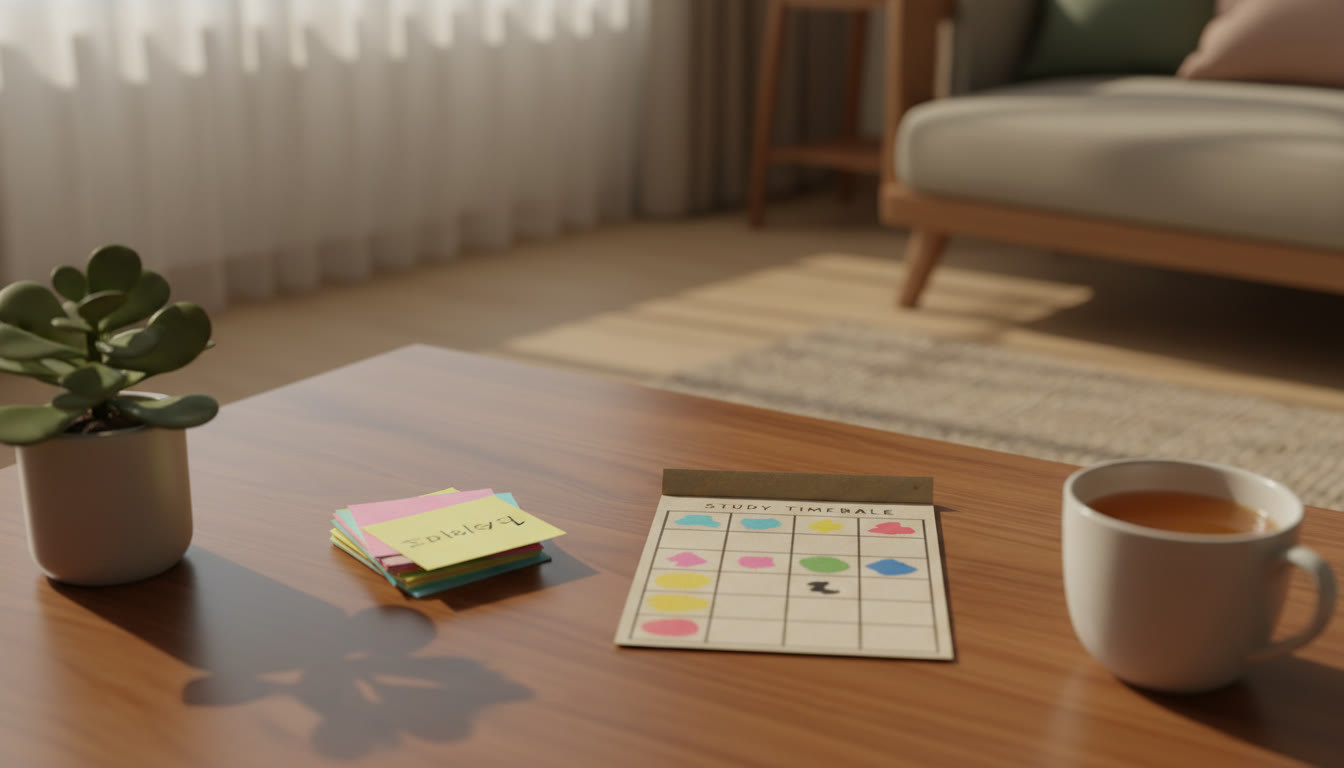
Structure beats panic. Below is a compact weekly cadence balancing learning, practice, and rest. This is a template—adapt it to your rhythm.
| Day | Main Focus | Study Blocks | Extras |
|---|---|---|---|
| Monday | New topic (Physics) | 2 focused blocks + 1 light review | Short walk, 10-minute revision before bed |
| Tuesday | Practice problems (Chemistry) | 2–3 focused problem sessions | Flashcards review |
| Wednesday | Biology revision (diagrams) | 1 learning + 1 recall block | Mock-section timed practice |
| Thursday | Weak area: mixed practice | 3 short blocks | Relaxing activity in evening |
| Friday | Full-length mock or timed sections | 3-hour mock or two section mocks | Detailed review afterward |
| Saturday | Review mock mistakes | Correction + targeted revision | Social time/family time |
| Sunday | Light study and recharge | Short recap, planning for week | Hobby or rest |
Mindset shifts that actually change outcomes
How you think about preparation changes how you perform. Here are mindset adjustments that cut stress and improve learning speed:
- Process over perfection: Focus on daily, measurable habits (10 flashcards, one timed section) rather than one target score. Progress compounds.
- Failure as feedback: A low mock score is information—use it to pivot study focus, don’t let it define you.
- Small wins: Celebrate corrected mistakes, completed topic lists, and improved timing. They matter.
Communication and support: how to get others to help, not add pressure
Friends and family want to help but sometimes increase anxiety. Try these small communication tools:
- Set clear study hours and ask for quiet time during them.
- Share short updates instead of long justifications—this keeps conversations constructive.
- If advice turns into comparison, gently steer the discussion to practical help: “I’d really value help with mock review or quiet time.”
When to consider extra academic support
If you’re consistently making the same avoidable errors, losing time on certain question styles, or your mocks don’t improve despite effort, personalized guidance can speed progress. Tailored one-on-one help can diagnose blind spots, build a study plan that fits your strengths, and reduce wasted study hours.
For students who want such focused help, Sparkl‘s personalized tutoring offers one-on-one guidance, tailored study plans, expert tutors, and AI-driven insights that help you practice smarter rather than longer.
Dealing with mental-health roadblocks: anxiety, sleep, and burnout
When stress turns into persistent anxiety or burnout, practical day-to-day strategies still help but professional support may be necessary. Look out for: persistent insomnia, panic attacks, constant lethargy, or inability to study despite trying. These are signs to speak to a counselor or mental health professional. Self-care and psychotherapy are not “extras”—they’re part of effective exam preparation.
Short daily routines to protect mental energy
- Start with a 5-minute planning ritual: list 3 priorities for the day.
- Do a 10-minute physical activity mid-study to reset attention.
- End with a 10-minute reflection: what went well, what to change tomorrow.
Putting it all together: a realistic example of stress-proof study scaling
Imagine you’re two months into preparation and mocks show time pressure in Physics and careless errors in Biology. A stress-proof plan could be:
- Cut overall daily study time by 10–15% for two weeks to reduce fatigue.
- Swap one long study block for a focused Physics problem-sprint with immediate review.
- Add deliberate Biology flashcard sessions for retrieval practice, not rereading chapters.
- Schedule one full mock under exam conditions each week and spend the next day reviewing errors line-by-line.
Small, targeted changes like these reduce anxiety because they create control: you have a plan, measurable steps, and clear corrections when things go off-track.
Final takeaways — steady, exam-aligned steps to reduce stress
NEET-style preparation is intense because the format demands speed, accuracy, and broad knowledge. That intensity creates stress, but the right habits convert stress into consistent improvement. Practice full-length three-hour mocks under real conditions, build OMR discipline, use option-elimination to manage negative marking, treat diagrams and derivations as learning tools (not partial-mark credit), and design study blocks that respect both the Physics/Chemistry/Biology syllabus and your mental energy. Add simple routines—active recall, spaced repetition, short physical breaks, and focused review of mistakes—and you’ll see steady gains without burning out. With deliberate practice and the right support, the pressure becomes structure instead of paralysis. Stay focused on process, measure small wins, and prioritize sleep and mental recovery as part of your preparation.



















No Comments
Leave a comment Cancel