
How to Improve Your NEET Score from 500 to 650: A Practical Roadmap
Hitting a 500 on a NEET mock is already a strong achievement — it proves you have the stamina and subject knowledge to compete. Going from 500 to 650, though, is a different kind of challenge: it asks for surgical improvements in accuracy, targeted concept polishing, and a testing strategy that eliminates small, repeatable errors. This guide walks you through a calm, actionable plan that balances mindset, analysis, and daily habits so you can convert weak areas into reliable marks.
Quick reality check: what the mock score represents
A NEET mock score is a performance snapshot: a sum of correct answers, penalties for wrong answers, time management, and how well your preparation aligns with the exam’s MCQ format. Treat it like diagnostic data — not as a final verdict on your ability. The mechanics that matter for this jump are clear: sustained accuracy, fewer negative marks, better topic selection during tests, and revision that sticks.

Step 1 — Diagnose the 500: honest, surgical analysis
Before you build new habits, you need to know exactly where marks are leaking. Don’t just look at the final number: break it into patterns and categories.
- Subject split: What were your marks in Physics, Chemistry, and Biology? Write them down as raw numbers and percentages of subject maxima.
- Error types: Classify each wrong answer into: careless/silly mistake, time-pressure guess, conceptual gap, question misread, or knowledge gap (e.g., forgotten formula or reaction).
- Negative marking cost: Count how many marks you lost to wrong answers as opposed to missed opportunities. Reducing avoidable negatives is the fastest way to add marks.
- Time pattern: Which sections did you rush? When did you start guessing? Track time spent per question from the mock timer or watch logs.
- Topic clustering: Do your errors cluster around particular chapters or microtopics (e.g., electrostatics, thermodynamics, plant physiology, organic reaction mechanisms)?
Make a single one-page diagnostic sheet for each mock test you take. That sheet becomes the blueprint for the next 4–6 weeks.
Step 2 — Set realistic micro-targets and a timeline
Jumping 150 marks is possible if you convert weaknesses into dependable marks and preserve accuracy. Instead of a vague “get 650,” break that into subject targets and weekly milestones.
| Subject | Current (example) | Target | Gap | Suggested weekly hours | Primary focus |
|---|---|---|---|---|---|
| Physics | 120 / 180 | 150 / 180 | +30 | 10–12 | Problem accuracy, conceptual clarity |
| Chemistry | 110 / 180 | 140 / 180 | +30 | 10–12 | Reaction mechanisms, physical chemistry numericals |
| Biology | 270 / 360 | 360 / 360 | +80 | 20–25 | High-yield facts, diagram labeling, MCQ practice |
Notes: the sample numbers above illustrate how a 500 might be distributed across subjects. Your real numbers may differ; always use your actual mock breakdown. Biology often offers the largest margin because of the greater total marks available, but it also rewards consistent retention and quick decision making.
Step 3 — Build a focused weekly plan (quality over random volume)
To add 150 marks, you don’t need endless hours — you need smart hours. Structure each week with three pillars: concept repair, targeted practice, and revision.
- Concept repair (30–40% of focused time): Fix the specific conceptual gaps identified in your diagnostic sheet. Use short, active sessions — teach the topic to an imaginary student, derive a formula, or redraw a diagram from memory.
- Targeted practice (40–50%): Practice MCQs by topic, not randomly. For each weak topic, do a 20–30 question sprint until you reach 90%+ accuracy without notes.
- Spaced revision (20–30%): Use the error log and flashcard-style recall to revisit previously studied topics on a fixed schedule (1 day, 4 days, 10 days cadence).
Example week (approximate focused study time: 40–50 hours):
- Mon–Fri: 6–8 focused hours each day — mix concept repair + practice + revision
- Sat: Full-length timed mock (3 hours) + 1.5–2 hours of immediate self-review
- Sun: Deep review of one subject’s weak topics + planning for next week
Why mocks must be weekly (at least)
Weekly full-length mocks build your testing muscles: stamina, OMR discipline, time allocation, and emotional control. Each test is also fresh data for your diagnostic sheet. As you approach target scores, increase the frequency of mocks while keeping the review quality high.
Step 4 — Master the mock test routine (the 3-hour game plan)
NEET-style mocks simulate the real exam: MCQ format, strict time limit (3 hours), and negative marking for incorrect answers. The tiny habits that replicate exam conditions produce outsized gains.
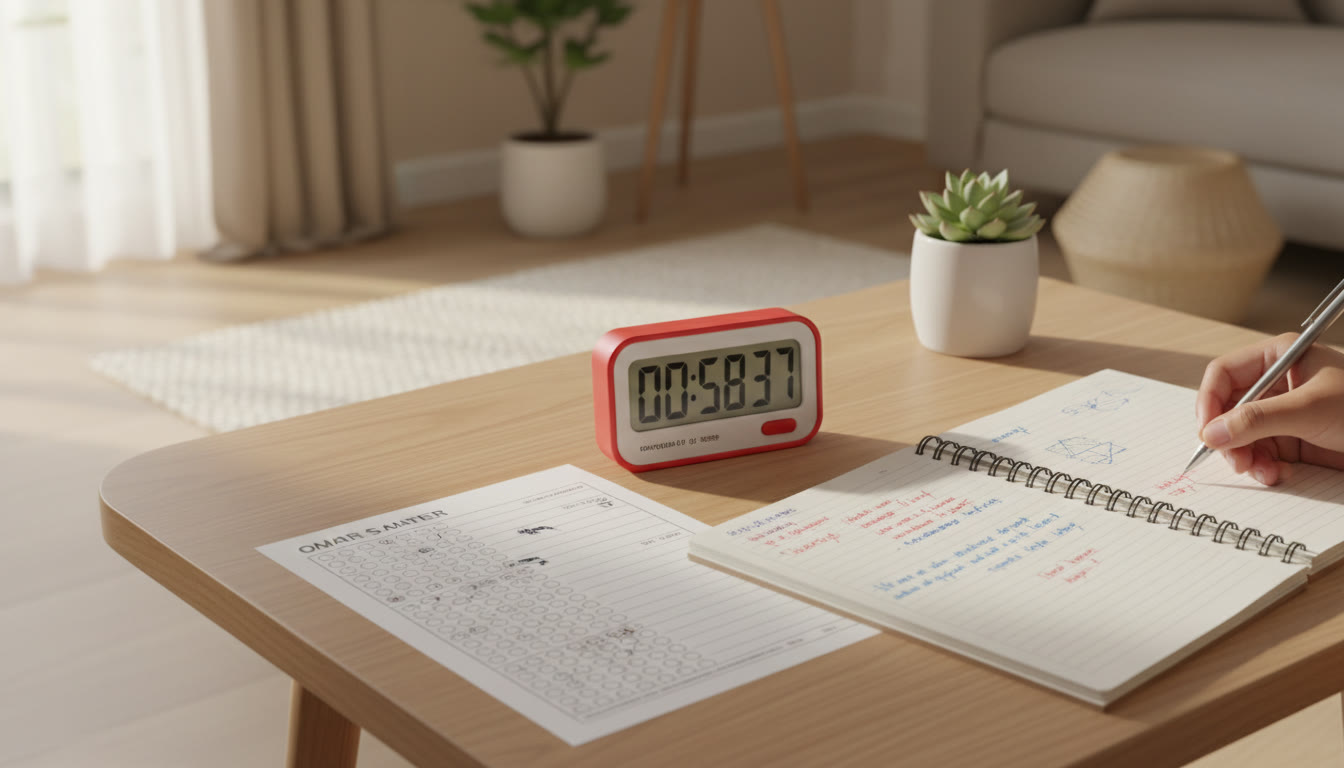
- Simulate OMR discipline: fill an OMR sheet, sit in a quiet place, and avoid digital interruptions. Practicing OMR behavior reduces silly scanning/marking mistakes on exam day.
- Time allocation strategy: have a default plan — e.g., attempt high-confidence Biology items first (if that’s your strength), then Chemistry, then Physics — or follow a physics-first approach if you’re a strong problem-solver. The plan must be practiced so it becomes automatic.
- Smart skipping: don’t get stuck. Mark time-consuming or ambiguous questions and move on. Come back in the final 40–50 minutes with a fresh eye and careful decision rules.
- Negative marking discipline: if you can eliminate two options confidently, a calculated guess may be beneficial. Otherwise, avoid random guessing. Track how many guesses cost you negative marks — reduce that number week by week.
Post-mock analysis: the 20-minute surgical review
Right after each mock, spend 15–20 minutes marking all questions into categories: correct, careless, conceptual error, and unclear. Do not attempt deep fixes immediately — just tag them. Then, within 24–48 hours, do a focused correction session: fix the concept, rewrite a short summary note, and add a one-line lesson to your error log.
Step 5 — Subject-by-subject tactics
Physics: accuracy and controlled practice
Physics rewards formula fluency, unit-checking, and methodical setup. To improve by 30–40 marks:
- Re-derive core formulas and keep a one-page formula sheet with derivations you can recreate mentally.
- Practice numericals in topic blocks: mechanics, electricity & magnetism, optics, modern physics. After each block, do a timed set of mixed problems to simulate exam unpredictability.
- Work on ‘silly mistake’ filters: always check units, sign errors, and final numeric sanity checks.
Chemistry: balance between speed and depth
Chemistry is split into physical, organic, and inorganic. Targeted improvements come from:
- Physical: practice numericals until solving becomes formula-driven and fast. Memorize key formula transforms and conditions for approximations.
- Organic: focus on reaction mechanisms and synthetic steps. Practice mechanism-based MCQs until pattern recognition becomes automatic.
- Inorganic: consolidate periodic trends and important facts via quick flash revision. Create mnemonics for groups and common reactions.
Biology: make recall reliable and efficient
Biology carries high marks; small improvements here yield big returns. Strategies include:
- Active recall: explain a process aloud in 90 seconds — if you can’t, you haven’t mastered it for MCQs.
- Diagram practice: redraw labeled diagrams repeatedly from memory; many MCQs hinge on visual understanding.
- High-yield lists: keep compact notes for core systems (human physiology, genetics, ecology). Daily 20-minute refreshers prevent memory decay.
Step 6 — Error logging and spaced repetition
Your error log is sacred. Every incorrect or uncertain question deserves a 2–4 line entry: what went wrong, the correct idea, and one action (e.g., “re-derive this formula,” “memorize this reaction path,” “practice 10 similar MCQs”).
- Archive errors by topic and by mistake type so you can run weekly drills for the same mistake cluster.
- Use spaced repetition: review errors after 1 day, 4 days, and 10 days. Mark items as mastered only after flawless recall twice in a row.
Step 7 — Build test-day stamina and reduce decision fatigue
Mental energy matters. The last miles of improvement often come from better concentration during the test.
- Simulate full test days: do a full mock, then spend the rest of the day on low-intensity review; avoid heavy new learning immediately after.
- Practice micro-rests: train your brain to refocus with simple breathing or 30-second eyes-closed resets between sections.
- Nutrition and sleep: test performance is sensitive to sleep quality. Prioritize consistent sleep in the weeks you plan to increase test frequency.
Step 8 — When to bring in targeted help
Many students reach a plateau around a solid score — and that plateau is where external help can be catalytic if used wisely. Consider targeted 1-on-1 guidance when:
- Your error log shows repeated conceptual blockages that you can’t fix alone.
- You’re disciplined but need a tailored study plan and accountability.
- You want AI-driven insights to prioritize topics and track weak points efficiently.
For those needs, a combination of expert tutors and personalized study plans shortens the path to 650 because they focus your practice on high-impact gaps and sharpen test strategies without wasting time. For example, Sparkl‘s personalized support pairs focused 1-on-1 guidance with tailored study plans and technology-driven insights to accelerate that gap-closing process. When you choose focused mentoring, insist on short, measurable goals and weekly progress checks rather than vague long-term promises.
Step 9 — Example 8-week sprint template
This is a sample sprint you can adapt. The idea is to alternate learning weeks with consolidation weeks and increase mock frequency closer to targeted test day.
| Weeks | Primary focus | Mock frequency | Key deliverable |
|---|---|---|---|
| 1–2 | Concept repair + error log creation | 1 full mock/week | Complete diagnostic sheet + revise 20 topics |
| 3–4 | Targeted topic sprints + mixed practice | 1 full mock/week | Achieve 80–90% accuracy in 10 weak topics |
| 5–6 | Increase timed practice + OMR drills | 2 mocks/week | Reduce negative marks by 50% |
| 7–8 | Polish high-yield revision + peak mocks | 2–3 mocks/week | Consistent mock scores near target |
Every mock is followed by a short, focused correction session and a specific action item list for the week ahead.
Practical habits that convert into marks
- One-topic focus: For each study session, pick one microtopic and a related MCQ set — depth beats multitasking.
- Two-minute summary: At the end of each day, write a two-minute summary of three things you learned and three mistakes you made.
- Active recall first: Try recall before re-reading notes. If you can reproduce the main idea unaided, you’ve learned it better than passive reading does.
- Keep a test-night checklist: pen, pencils, clip, water bottle, watch, printed mock OMR — practice the ritual so it’s automatic.
How to measure progress beyond raw scores
Raw mock scores are important but also noisy. Add these metrics to track real progress:
- Accuracy percentage (correct answers / attempted answers) — higher accuracy usually leads to better final results because it reduces penalty-driven loss.
- Negative-mark count per mock — track and aim to cut it consistently.
- Time per question distribution — lower the tail of long questions you spend too much time on.
- Mastery list: number of previously weak topics now scoring 90%+ in targeted drills.
Common pitfalls and how to avoid them
- Overloading with new topics: Don’t chase too many new chapters in the last weeks; prioritize consolidation.
- Ignoring mock review: A mock without a correction routine is just practice without learning.
- Chasing perfect study hours: Consistent, high-quality hours beat erratic, marathon sessions.
- Copying someone else’s plan: Adapt successful templates to your own strengths and weaknesses.
Final checklist for each week
- One full-length mock under strict exam conditions.
- Diagnostic sheet completed and updated from that mock.
- At least three targeted topic sprints with 90%+ accuracy achieved on each.
- Error log reviewed with spaced repetition schedule in place.
- One session with a tutor or mentor (when needed) focused on the highest-impact gap.
Conclusion
Moving from a 500 to a 650 on NEET is a realistic and systematic process: diagnose precisely, prioritize high-impact weaknesses, practice with exam-like discipline, and iterate based on accurate feedback. By shrinking avoidable negatives, sharpening concept clarity, and using targeted mock analysis, those 150 marks become an achievable sum of many small, reliable gains.



















No Comments
Leave a comment Cancel