

Turn your NEET mock score into a growth engine: error-tracking that actually helps
There’s a small, confusing moment after every mock: you see the number, you feel something (relief, disappointment, surprise), and then you’re left asking what to do next. Good news: that number is not the finish line — it’s the starting point. A mock score is a compact bundle of actionable signals if you know how to read them. This blog walks you through a friendly, practical, and data-driven way to convert mock-test results into a weekly plan that produces real gains, without burning out or chasing false shortcuts.

Why your mock score is a map, not a verdict
NEET-style tests are multiple-choice, full-length and time-bound. They reward accurate knowledge, disciplined OMR handling, and smart time allocation. Because the test is objective — MCQs, a three-hour duration for the full paper, and a penalty for incorrect answers — your mock score is best treated as diagnostic data. It tells you where your knowledge is working, where habits are failing, and where pacing is costing marks.
Instead of replaying the entire exam in your head, give the score three short, focused readings: emotional (30–60 seconds), factual (note raw numbers and time issues), and analytical (dig into errors). That sequence helps you avoid knee-jerk study decisions and leads to clearer, incremental improvements.
Seven clear steps to turn errors into higher scores
Below is a step-by-step routine you can adopt after every full-length mock. It folds error-tracking into your existing study rhythm so review becomes an engine of continuous progress.
1) Capture the headline metrics — immediately and objectively
As soon as you finish reviewing answers, log the basic numbers: total score, raw correct/incorrect counts, number of unanswered questions, and approximate time per section. Keep this short — don’t rewrite the test. The point is to preserve memory before it fuzzes, and to create a trendline when you compare successive mocks.
- Score and section-wise score (Physics / Chemistry / Biology).
- Number of negative marks (so you know if guess strategy needs correction).
- Time issues: long stalls, quick guesses, last-section rushes.
2) Build an error log — classify every mistake
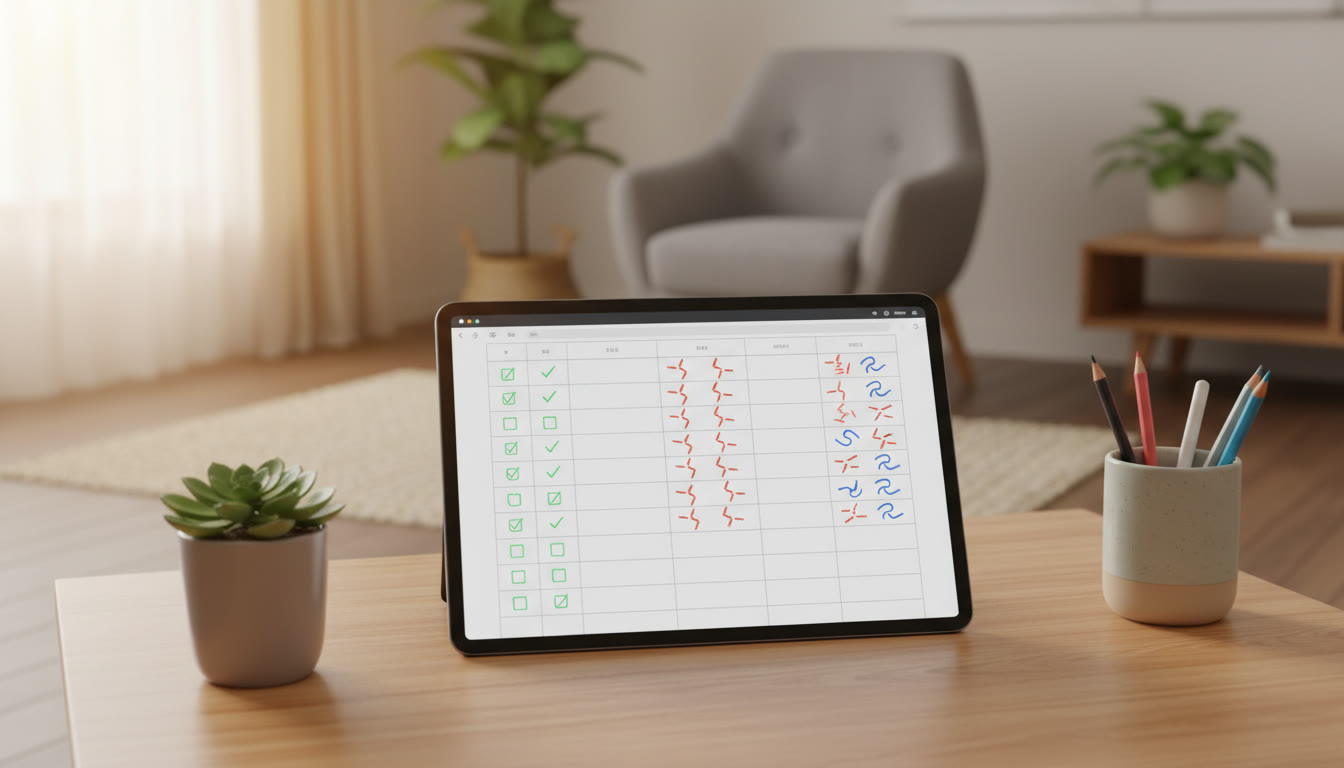
Use a simple spreadsheet or paper table. For each incorrect or uncertain question, record: question number, subject, chapter, mistake type, why it happened, time spent, and a corrective action. The categories make analysis fast and repeatable.
- Common mistake types: conceptual gap, careless slip (calculation or reading), OMR/marking error, misinterpretation of options, formula recall failure, time pressure, and unfamiliar question style.
- Root causes might be: weak concept, poor practice, rushed reading, shaky calculation skills, or panic near the end.
Here is an example table you can copy into a sheet to start logging:
| Q No | Subject | Chapter | Mistake Type | Root Cause | Time Spent (min) | Action | Fixed? |
|---|---|---|---|---|---|---|---|
| 12 | Physics | Mechanics | Conceptual | Misapplied reference frame | 4 | Rework examples; do 5 additional problems | No |
| 27 | Chemistry | Organic | Careless | Missed reagent detail | 2 | Annotate reagents; memorize key patterns | Yes |
| 43 | Biology | Genetics | Calculation | Set-up error in Punnett square | 3 | Practice 10 pedigree/punnett problems | Planned |
3) Prioritize fixes: triage like a clinician
Not all errors are equal. Some are cheap to fix and high-impact (careless slips, OMR mistakes). Others need longer repair (deep conceptual gaps). Use a three-tier priority system:
- Priority A — High impact, quick wins (careless errors, OMR mistakes, recurring reading errors).
- Priority B — Medium impact, moderate work (calculation practice, formula recall, common concept drills).
- Priority C — Low frequency but deep (interleaved revision of tough chapters; concept re-teaching).
Allocate your next week’s study time to these priorities: small daily tasks for A, focused 1–2 sessions for B, and spaced, spaced repetition for C.
4) Convert recurring patterns into micro-goals
If a chapter or mistake type appears multiple times across mocks, it deserves its own micro-goal and quick metric. For example:
- If “diagrams and labels” errors in Biology appear three times: schedule a 45-minute diagram session and aim to reduce diagram errors by 50% in the next mock.
- If “integration of concepts” in Physics is weak: plan interleaved problem sets linking two topics (e.g., kinematics + energy) for three sessions.
Small, measurable micro-goals maintain momentum. Write them down and mark completion — progress is motivating when it is visible.
5) Rehearse exam habits, not just content
Mistakes often come from habits: rushing, mis-bubbling on OMR, poor time checks. Treat mock analysis as an opportunity to rehearse correct exam behavior.
- OMR discipline: practice checking bubbles immediately after each section in mock simulations; train muscle memory for careful marking.
- Time checks: set mini-benchmarks — after 45 minutes, you should be at X questions; after 90 minutes, at Y.
- Guessing strategy: decide beforehand how to handle uncertain answers; be consistent and log outcomes.
Remember: because NEET-style tests penalize wrong answers, random guessing is usually a net negative. Calm, educated guessing with elimination techniques is the safer route.
6) Build a weekly dashboard and track trends
One-off fixes are useful, but real improvement shows up as trends. Every week, summarize what changed: average mock score, accuracy rate, negative marks, and the three chapters with most errors. This is your dashboard for decisions.
| Metric | This Mock | Previous Mock | Trend | Goal |
|---|---|---|---|---|
| Total Score | — | — | Up / Down / Flat | +5–10 |
| Accuracy (%) | — | — | Up / Down / Flat | +2–4% |
| Negative Marks | — | — | Down / Up | Reduce |
| Top 3 Error Chapters | List | List | Track | Eliminate Repeaters |
Use colors or simple arrows to make the dashboard quick to read: green for improvement, yellow for flat, red for regression. If you keep this up for several cycles, you’ll see which fixes actually change scores and which feel productive but don’t move the needle.
7) Get targeted help and use adaptive supports where you need them
Some errors you can fix solo; others accelerate faster with guided intervention. If recurring conceptual gaps or inefficient methods persist, seek focused help for a short period — a tutor, a topic clinic, or a 1-on-1 session that targets the exact root cause. When you do, share your error log so the session is precise and time-efficient.
Modern personalized tutoring platforms can speed this process by combining expert guidance with diagnostic insight. For instance, Sparkl‘s curated 1-on-1 sessions and AI-driven insights compress weeks of scattershot revision into sharply focused, corrective sessions that track the very error patterns you document. If you opt for targeted help, prioritize sessions that give you practice homework and measurable outcomes.
Practical templates and habits for everyday use
Daily 20-minute error maintenance routine
- 0–5 min: Re-open yesterday’s error log and mark any corrected items.
- 5–15 min: Do two focused practice questions that hit priority-A mistakes.
- 15–20 min: Note what changed, update the dashboard, and write a single micro-goal for tomorrow.
Weekly 90-minute mock-review flow
- 0–10 min: Record headline metrics and emotional reaction (one sentence).
- 10–30 min: Fill the error log for each incorrect/uncertain question.
- 30–60 min: Prioritize and assign actions to the top 5 recurring errors.
- 60–90 min: Do one focused practice block and set the week’s micro-goals.
Checklist for common error types and fixes
- Careless reading: practice underlining key phrases and rephrase the stem before answering.
- OMR mistakes: simulate strict OMR rules in all mocks; check bubbles at section end.
- Computation errors: switch to neat scratchwork and use estimation checks when possible.
- Formula memory issues: use weekly flash-drills and a single-page formula sheet for review (do not carry it into test day).
- Concept gaps: teach the topic to a peer or aloud to yourself — if you can explain it, you understand it.
Common pitfalls and how to avoid them
1) Over-focusing on score jumps
Fixing a habit that reduces careless mistakes may show small immediate score gains but larger long-term stability. Don’t chase one big score spike at the expense of fixing the base-level errors that reappear in later mocks.
2) Doing too many mocks without learning from them
Mileage matters more than frequency. Ten mocks with shallow review are less valuable than five mocks with disciplined error-tracking and follow-up. Treat every mock as a mini-experiment: test a hypothesis, measure, adjust, repeat.
3) Ignoring OMR and exam mechanics
It’s surprising how many marks are lost to bubbling mistakes or rushed sections. Practice with strict OMR rules and a timing plan so the mock replicates the exact constraints you will face.
Examples: two quick case studies (compact, realistic)
Case A — The careless-sipper
Situation: Repeatedly misses simple biological facts and makes reading errors in chemistry stems. Action: Adopt a rule to rephrase the stem in two words before answering, log each careless miss in the spreadsheet, and do a daily 10-minute focused practice on factual recall. Result: Careless errors drop and overall accuracy rises even if the total study hours remain the same.
Case B — The concept-chaser
Situation: Solid speed but recurring mistakes in electromagnetism problems due to a missing mental model. Action: One-on-one targeted sessions focusing on conceptual models, plus interleaved problems linking mechanics and electromagnetism. Result: Once the mental model is fixed, previously hard questions become routine and confidence grows.
When you pair short, targeted help with your error log — not just more content — improvement becomes predictable and sustainable. If you use external guidance, choose brief, focused help that explicitly ties back to your error categories and micro-goals. For example, Sparkl‘s tailored study plans and expert tutors can be used to design precise correction sessions that follow directly from your logged mistakes.
Measuring success: what really counts
True progress is multi-dimensional. Beyond the score, look for these durable signs of improvement:
- Reduction in repeat error chapters across three mocks.
- Lower negative marks while keeping or increasing attempts on confident questions.
- Shorter time-to-answer for types of questions that used to stall you.
- Greater psychological steadiness during the final 30 minutes of full-length practice.
These signals tell you your learning is deepening, not just your test-day luck improving.
Final academic point
Mock scores become meaningful only when paired with disciplined error-tracking, prioritized corrective actions, and rehearsal of exam habits. By logging each mistake, classifying its root cause, assigning micro-goals, and tracking trends, you create a feedback loop that converts practice into durable learning; the combined focus on concept repair, practice efficiency, and OMR discipline aligns study time with what the examination format actually rewards. Adopt the routine consistently, and the data in your error log will guide steady, measurable improvement.
























No Comments
Leave a comment Cancel