

How to Prepare for JEE from Class 9: A Step-by-Step Guide
Starting JEE preparation in Class 9 is like laying the foundation of a long bridge: steady, patient work now makes the final crossing far easier. This guide walks you through a clear, humane, and practical path — no jargon, no unrealistic super-schedules, just sensible steps you can begin today. You will find subject strategies, weekly and yearly rhythms, mock-test approaches (including the all-important 3-hour full-length practice), and ways to keep curiosity and motivation alive as you build depth and speed over time.

Why start in Class 9? The advantage of early foundation
Class 9 gives you the gift of time. With two full school years before the intense focus of Class 11–12, you can move from fragile familiarity to genuine mastery. Early starters have the bandwidth to:
- Develop strong conceptual clarity instead of last-minute cramming.
- Build problem-solving habits: accuracy first, then speed.
- Learn to think like a physicist, chemist, and mathematician — not just memorize facts.
- Use mock tests to gradually train exam temperament and OMR discipline.
Understand the exam-style basics you must train for
Keep these exam realities in mind from day one, because your study decisions should reflect the actual test format:
- Questions are largely multiple-choice; thoughtful elimination and accurate marking matter.
- Full-length practice sessions are approximately three hours; training under timed conditions is essential.
- There is negative marking for incorrect answers, so random guessing is costly — learn educated elimination strategies.
- OMR discipline (clean filling, correct marking of bubbles) matters — practice the physical act under timed pressure too.
- Answers are not awarded partial credit for incomplete derivations in MCQ formats; clarity and correctness count.
Designing a progressive roadmap: Year-by-year clarity
Class 9: Concept planting and careful habits
Goal: Understand the language of science and math. In this stage you are not expected to finish advanced topics — you are building a reliable toolkit.
- Focus on fundamentals: vectors of reasoning such as units, dimensional thinking, algebraic fluency, and chemical basics like atomic ideas and reactions as concepts.
- Practice regularly but in short, focused bursts: quality of attention beats quantity at this stage.
- Begin a small notebook for problem techniques — a living notebook you will refine over time.
Class 10: Consolidation and pattern recognition
Goal: Strengthen every concept you saw in Class 9 and learn to apply them to slightly unfamiliar problems.
- Increase problem variety. Work on time-bound practice for small sets of problems (30–45 minutes sessions).
- Start monthly topic-tests. Short tests teach exam focus and reveal weak spots early.
- Align school study with your conceptual notebook; finish school topics with clarity rather than speed.
Class 11: Expansion and systematic practice
Goal: Deepen application and begin bridging school syllabus and competitive-level practice.
- Introduce longer problem sessions. Graduate from simple application to multi-step problems.
- Start full-length 3-hour mock sessions periodically — perhaps once every 4–6 weeks to begin with.
- Maintain an error log: record every mistake, why it happened, and how you fixed it.
Class 12: Consolidation, revision cycles, and exam temperament
Goal: Peak readiness through cycles of disciplined revision, test-taking, and targeted correction.
- Increase the frequency of full-length mocks and timed sectional drills.
- Prioritize weak-topic repair and repeated simulated examinations to polish OMR technique and time distribution.
- Work smarter: strategically select problems that cover multiple concepts in a single exercise.
Daily and weekly rhythms that actually work
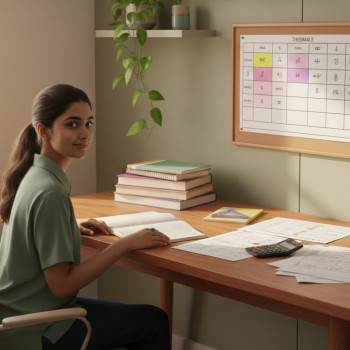
Here is a realistic sample weekly plan you can adapt. The focus is on balance: concept work, practice, revision, and rest. Times are illustrative — substitute what fits your school timetable.
| Day | Morning | Afternoon | Evening | Focus |
|---|---|---|---|---|
| Monday | School + light review | Concept study (Physics) | Problem practice (30–45 mins) | New concept + practice |
| Tuesday | School | Concept study (Mathematics) | Problem set (timed) | Application and speed |
| Wednesday | School | Concept study (Chemistry) | Revision + short test | Retention checks |
| Thursday | School | Mixed practice (Physics/Math) | Project/Experiment reading | Integration |
| Friday | School | Problem practice (topic-specific) | Revision of weekly notes | Consolidation |
| Saturday | Full practice session (2 hrs) | Relaxed study + hobby | Weekly wrap: error log | Reflection |
| Sunday | Mock/test (short or sectional) | Detailed analysis | Rest | Recharge |
How to scale hours across grades
Start with modest daily focused study (1–2 hours outside school) in Class 9, increase to 2–4 hours in Class 10, and then expand to sustained 4–7 hour blocks in Classes 11–12 as school workload and competitive intensity rise. The key is progressive overload: add time gradually while protecting sleep and mental health.
Subject-by-subject playbook
Physics: Learn to ask the right questions
Physics rewards a questioning mind. Start by learning what a problem is really asking — identify knowns, unknowns, and the physical principles in play. Practice sketching simple diagrams and free-body visuals; diagrams are thinking tools, not decorations. When you solve problems, write a concise one-line reasoning before computing — this habit trains clarity.
- Practice: Start with concept-level problems, then move to standard multi-step questions.
- Technique: Dimensional checks and limiting-case thinking (what happens if a parameter goes to zero?) are powerful error-catchers.
Chemistry: Build clarity in every layer
Chemistry is three-fold: conceptual (physical chemistry), factual (inorganic patterns), and organic reaction logic. Treat each layer differently — conceptual parts need reasoning and practice; factual parts need pattern-recognition; reaction logic needs step-by-step practice. Make short summary pages for reaction families and revision cards for periodic patterns.
- Practice: Convert facts into problem scenarios; apply concepts to quantitative questions.
- Technique: Learn to analyze a reaction mechanism in steps rather than memorizing long lists.
Mathematics: Train accuracy, then speed
Mathematics for competitive exams is practice-intensive but also pattern-rich. Start with clear proofs and derivations until the reasoning is effortless. After that, switch to timed problem waves: 20–30 minutes of focused problem-solving sessions that prioritize accuracy. When accuracy is stable, add speed pressure.
- Practice: Daily problem practice, including a mix of routine and creative problems.
- Technique: Maintain a sheet of ‘must-remember’ formulas and standard tricks — but rely on understanding more than memorization.

Mock tests, OMR discipline and analysis: the engine of improvement
Mock tests are not just measurement; they are training sessions for stamina, exam rhythm, and decision-making. Structure your mock regimen around growth, not just score-chasing.
| Test Type | Frequency | Purpose | Follow-up |
|---|---|---|---|
| Short topic test (30–45 min) | Weekly | Check concept retention | Immediate correction + mini revision |
| Sectional timed test (60–90 min) | Biweekly | Improve speed in a single subject | Detailed error log |
| Full-length mock (3 hours) | Monthly → Weekly (later stages) | Train stamina, time allocation, and OMR practice | Full analysis + target revision plan |
Always simulate the full exam environment: silence, uninterrupted time, and OMR-like marking (if you don’t have OMR sheets, mimic bubble-filling on paper). Practicing the physical act of shading bubbles and changing answers reduces avoidable mistakes on the real day.
Smart revision, error logs, and the 80/20 of practice
Not all practice is equal. Focus on high-impact topics where conceptual clarity or repeated mistakes are costing the most marks. Keep an error log organized by topic and mistake type — calculation slip, conceptual gap, misreading the question, or silly mistake — and revisit that log each week.
- Use spaced repetition: revisit tough topics multiple times across several weeks.
- When you solve a mock, spend at least as much time analyzing as you spent taking it.
Healthy habits, mindset and long-term resilience
Preparation is a marathon, not a sprint. Protect your sleep, eat well, and keep pockets of rest and activity. Build rituals: 10-minute warm-up problem before every study session, a short evening review of flashcards, and a weekly reflection on progress. These small rituals compound into reliable momentum.
- Mindset tip: Celebrate steady improvement rather than chasing perfection every day.
- Stress tool: Short breathing or focus exercises before a mock test sharpen concentration.
Mentorship, personalized help and technology
At various points, a friendly tutor or mentor can accelerate learning by identifying blind spots and designing targeted practice. If you are exploring tailored support, Sparkl‘s personalized tutoring offers one-on-one guidance, tailored study plans, expert tutors and AI-driven insights that can help you focus on what matters most in each stage of your journey.
Use technology wisely: spaced-repetition tools, timed quizzes, and digital note systems are helpful — but never replace the muscle work of paper-and-pen problem solving. Keep a mix of digital and physical practice to avoid over-reliance on any one medium.
Common traps and how to avoid them
- Trap: Rereading notes without solving problems. Fix: After every study session, solve 2–3 new problems applying what you learned.
- Trap: Chasing every new resource. Fix: Commit to a small, high-quality set of materials and return to them until you’ve exhausted their learning value.
- Trap: Ignoring weak topics until the last minute. Fix: Use short weekly slots to chip away at weaknesses; micro-progress wins over panic patches.
Sample month-by-month focus (generic, adaptable)
Rotate intense focus between subjects so no single topic goes untouched for too long. For example, in a four-week cycle: Week 1 deep-dive Physics concept, Week 2 Mathematics problem set focus, Week 3 Chemistry consolidation, Week 4 mixed practice plus a full mock. Adjust lengths based on individual needs.
Final checklist for every school year
- Have a living problem notebook and an error log that you revisit weekly.
- Schedule full-length 3-hour practice exams and simulate OMR discipline.
- Create short formula and concept sheets for quick revision sessions.
- Practice elimination and educated-guess strategies to handle negative marking.
- Maintain consistent sleep, nutrition, and short breaks to sustain learning.
Closing academic note
Preparing for competitive exams from Class 9 is a steady process of building conceptual clarity, disciplined practice, and exam-savvy habits. Focus on understanding before speed, make error analysis habitual, and use mock tests to train your exam temperament; over time, these practices convert small daily gains into reliable performance. The journey is cumulative: clear concepts, thoughtful practice, and consistent revision together form the strongest foundation for success.
















No Comments
Leave a comment Cancel