

JEE Main Study Routine for Maximum Retention
Preparing for JEE Main is less about how many hours you squeeze in and more about how those hours stick. You don’t need a motivational poster—you need a routine that helps ideas move from short-term clutter into long-term recall. This article walks you through a practical, evidence-informed study routine that treats time like a tool: measured, intentional, and aimed at maximum retention.
Read this as if you were rearranging your daily toolbox. There are clear sections you can copy into your own plan: daily blueprints, weekly rhythms, mock-test engineering, subject micro-strategies, and revision blocks. Each piece is tuned to the realities of the exam — MCQ-based testing, timed three-hour full-length practice, negative marking caution, and the discipline of marking answers precisely under exam conditions.

Why time management matters more than long hours
Long hours without structure produce fatigue and illusion of progress. Smart time management turns every hour into a deliberate memory-building unit. The trick is to alternate acquisition (learning new ideas), consolidation (doing problems that fuse idea to method), and retrieval (testing yourself under pressure). That three-part loop—learn, practice, test—is the backbone of retention.
Principles that should guide your routine
- Active recall beats passive review: solving problems and quizzing yourself forces retrieval pathways to strengthen.
- Spaced repetition converts fresh learning into durable knowledge by revisiting topics at increasing intervals.
- Interleaving different types of problems prevents narrow memorization and builds adaptable problem-solving skills.
- Simulation matters: full-length timed mocks (three hours) recreate exam pressure and reveal time-management gaps.
Exam reality check: what your routine must train you for
Design your practice to mirror the exam’s demands. That means:
- MCQ-focused accuracy: many answers are all-or-nothing, so aim for clean reasoning that yields the correct option rather than partial written work.
- Negative marking awareness: avoid blind guessing; learn elimination and probability-based guessing when needed.
- Timed three-hour endurance: build stamina with full-length timed mocks and mid-test mini-break strategies.
- OMR-like discipline: whether paper-based or computer-based, practice marking answers carefully and avoid last-minute hurried changes.
- Subject breadth: align study blocks with Physics, Chemistry, and Mathematics and balance conceptual study with problem practice.
Daily routine blueprint: a repeatable, high-retention day
Below is a repeatable template you can adapt to your life. The idea is consistency with deliberate variation: rotate topics so your brain keeps forming new links instead of plateauing on one subject.
Core segments (roughly for an 8–10 hour focused study day)
- Morning (2–3 hours): Fresh learning—difficult concepts, new derivations, theory that needs clear-headed attention.
- Midday (2–3 hours): Intensive problem solving—apply concepts to representative problems and past-paper questions.
- Afternoon (1–2 hours): Targeted practice—topic-wise drills or numerical sequences to build automaticity.
- Evening (1–2 hours): Active revision—flashcards, quick tests, and a short mock or timed section (30–60 minutes).
- Night (20–45 minutes): Low-effort consolidation—light notes review, one-minute recall, sleep-friendly reading of formulas or short summaries.
Sample daily schedule
| Session | Focus | Duration | Example Activity |
|---|---|---|---|
| Morning | New concepts (hard topics) | 2–3 hours | Study a new chapter section, derive formulas, solve 3-5 representative problems |
| Midday | Problem practice | 2 hours | 10–12 varied problems from the chapter, time each set |
| Afternoon | Targeted drills | 1–1.5 hours | Focused question types (e.g., kinematics problems, organic reaction mechanisms) |
| Evening | Revision & mini-test | 1–1.5 hours | Flashcards, 30-min timed quiz, error-log review |
| Night | Light consolidation | 20–45 minutes | One-page summary, spaced-repetition recall |
Weekly rhythm: blocks, rotation, and recovery
Daily templates are important, but weekly structure turns days into a progression. Use a “block week” where each day has a dominant subject but retains cross-subject practice. A typical pattern: two strong Physics days, two Chemistry days, two Math days, and one mixed-test day that includes a short full-length section or a timed mock.
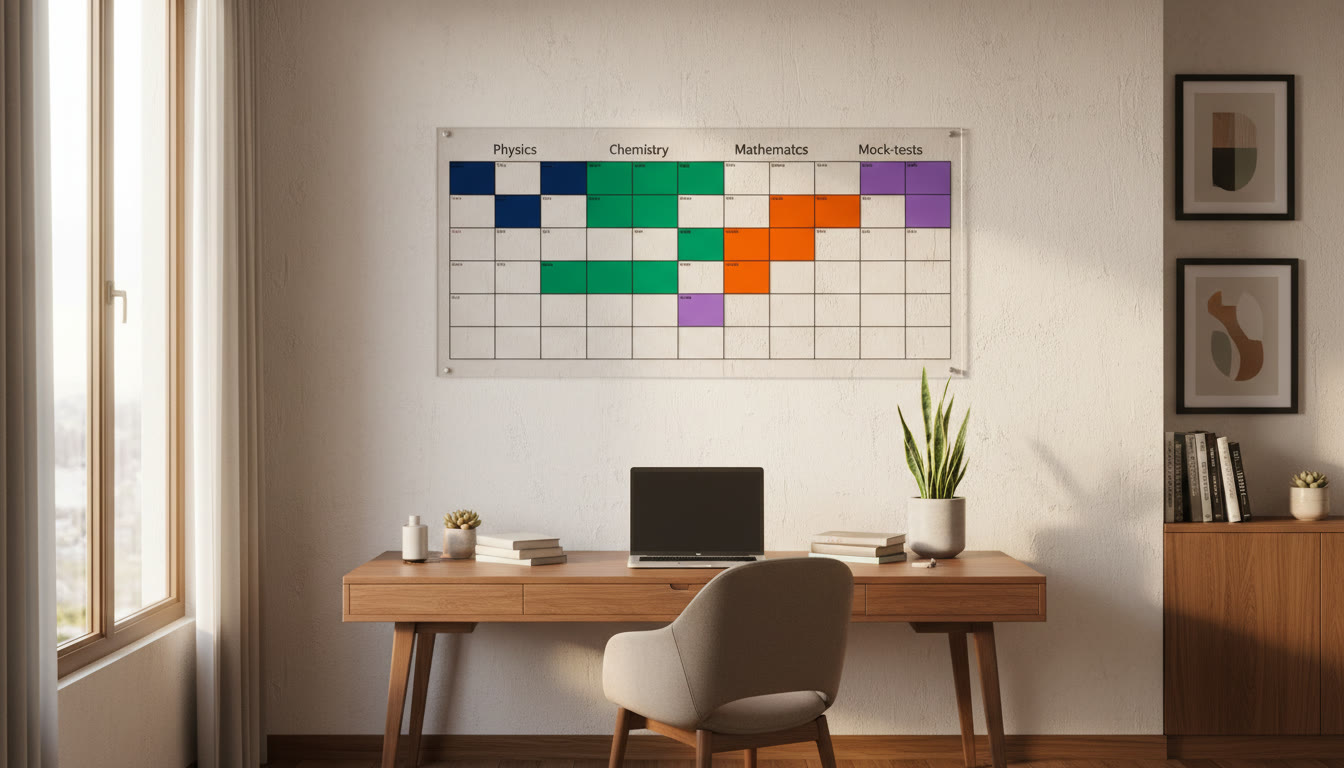
Sample weekly plan (conceptual)
| Day | Morning | Afternoon | Evening |
|---|---|---|---|
| Monday | Physics (concepts) | Physics (problems) | Flashcards + short test |
| Tuesday | Chemistry (theory) | Chemistry (numerical/mech.) | Revision + error log |
| Wednesday | Mathematics (new topics) | Math problem sets | Timed section |
| Thursday | Physics (drills) | Chemistry (drills) | Short mock (1–1.5 hours) |
| Friday | Mathematics (advanced problems) | Mixed practice | Flashcards + light review |
| Saturday | Full-length timed mock (3 hours) | Mock analysis | Relaxed recap |
| Sunday | Target weak areas | Revision cycle: old topics | Rest & sleep |
How to use full-length 3-hour mocks for exponential gains
Mocks are not just diagnosis; they are training. Treat every full-length mock as two activities: the test itself and the rigorous analysis that follows. A mock taken without careful review wastes the time investment.
Mock execution checklist
- Simulate exam conditions: timed, minimal interruptions, identical break schedule.
- Practice OMR discipline: whether physical or digital, mark answers as you would in the exam—don’t rely on memory of question numbers.
- Time-slicing: aim to pass through all questions once, marking easy questions first and flagging others.
- Negative-marking strategy: for questions you can eliminate down to two plausible options, weigh whether the expected value favours a guess.
Post-mock analysis template
| Category | Questions | Root cause | Action |
|---|---|---|---|
| Conceptual gaps | List Q-numbers | Missing theory or incomplete derivation | Re-study concept, solve 5 varied problems |
| Careless mistakes | List Q-numbers | Calculation slip / misread | Slow down on similar items, write intermediate steps |
| Time management | Sections with delays | Poor pacing or deep-dive on single question | Practice sectional slices with timers |
Subject-specific micro-strategies
Physics
Physics rewards conceptual clarity and repeated application. Start each chapter by understanding the underlying assumptions of formulas. Build a small set of “problem archetypes” for each chapter—if you can identify archetypes, you’ll know which method to apply quickly in a timed test. Practice with a mix of straight numerical questions and conceptual MCQs to sharpen both calculation speed and theory recall.
Chemistry
Chemistry divides naturally into subareas. For physical chemistry, practice problem-solving and units; for organic chemistry, learn mechanisms and practice retrosynthetic thinking; for inorganic chemistry, use concise recall devices (tables, mnemonics) to store group behavior and periodic patterns. Schedule quick inorganic recall sessions daily—these are low-effort, high-return memory checks.
Mathematics
Math is pattern recognition and timed execution: categorize problems into techniques (algebraic manipulation, coordinate geometry approach, calculus trick). Drill each technique until the first step becomes automatic, then practice combining techniques under time pressure. Do error analysis on each wrong attempt to avoid repeating the same trap.
Practical learning tools and habits that multiply retention
- Active recall: turn every page of theory into 3–5 questions and quiz yourself the next day.
- Spaced plan: revisit a topic after 1 day, 4 days, 10 days, and 30 days—adjust frequency for topics you find hard.
- Error log: keep a running file of mistakes with cause and corrective exercise—this becomes a targeted revision bank.
- Pomodoro or focused blocks: 50 minutes on, 10 minutes off, or 25/5 for shorter attention spans—choose what keeps you sharp.
- Sleep and breaks: memory consolidation happens during sleep—treat uninterrupted sleep as study currency.
Personalized guidance helps many students stretch study hours into efficient learning. For example, Sparkl‘s 1-on-1 guidance and tailored study plans can align your daily blocks to your retention curves, while expert tutors and AI-driven insights suggest which topics to space or intensify based on mock performance.
Common pitfalls students fall into — and how to fix them
- Pitfall: Marathon sessions with no direction. Fix: Break study into outcome-focused blocks with a clear practice goal for each.
- Pitfall: Neglecting weak topics until late. Fix: Use weekly micro-sessions (30–45 minutes) to keep weak topics warm across the cycle.
- Pitfall: Over-reliance on passive notes. Fix: Convert notes into test questions and problems—if it can’t be questioned, it can’t be retained well.
- Pitfall: Mock fatigue without analysis. Fix: Treat every mock as a two-hour analysis project after the three-hour test—this is where most learning happens.
Sample 8-week revision block to turn practice into long-term memory
This block assumes you have covered most syllabus topics and are now converting practice into deep retention. Adjust intensity to your needs.
| Week | Main focus | Key activities |
|---|---|---|
| Weeks 1–2 | Consolidation | Topic-wise tests, fix conceptual gaps, start weekly full-length mock |
| Weeks 3–4 | Intensive problem practice | High-volume problem sets, timed sections, error-log deep work |
| Weeks 5–6 | Application | Mixed mocks, adaptive revision of weakest topics, emphasize exam tactics |
| Weeks 7–8 | Stabilization | Regular full-length mocks, light review cycles, recovery and sleep optimization |
How to measure progress without panicking
Retention is best measured by the testing effect: your ability to reproduce information under timed, exam-like conditions. Track these metrics weekly:
- Accuracy on timed sectionals (percent correct).
- Time per question category (average minutes per problem type).
- Error-log recurrence rate (how often the same mistake appears).
Use those three measures to decide whether to increase practice intensity, revisit concepts, or slow down and reinforce.
Quick examples: micro-adjustments that yield big returns
- If your calculus accuracy drops late in a mock, swap one evening revision for a short stamina-building timed session focused on calculus to simulate end-of-exam fatigue.
- If inorganic chemistry is slipping, convert a single theory page into a five-question quiz bank and schedule three quick recall sessions across the week.
- If careless arithmetic costs you marks, write a two-line habit: always write intermediate steps for calculations and check the units; practice this for three weeks.
Where targeted support helps most
Guidance that adapts to your performance can shorten the time between mistake and mastery. When properly used, one-on-one coaching helps you prioritize which weak topics to revisit and when to front-load revision or rest. For students who want data-backed pacing, Sparkl‘s tutors and AI-driven insights can suggest a study tempo that fits your mock-test trends, while preserving time for rest and recovery.
Final habits that win the race
Retention is cumulative: a steady cycle of focused learning, targeted practice, and simulated testing builds a reliable memory architecture. Keep an error log, prioritize active recall, use spaced revision, and treat every mock as both assessment and training. Balance hard practice with sleep, short breaks, and a weekly recovery day so your brain consolidates without burnout.
Master the cycle of focused study, deliberate practice, and spaced revision to convert short-term effort into long-term readiness and exam performance.























No Comments
Leave a comment Cancel