

Science Study Tips for Better Understanding
Learn science like it was designed: to explain the world
Science is not a list of facts to memorise; it’s a way of thinking. If you read a chapter and never feel the mechanics click — if formulas, diagrams, and experiments remain separate things — you’re studying, but you’re not understanding. This guide is written for CBSE students who want a clearer, more effective approach: one that blends classroom instructions, board-style preparation, and real curiosity.

Below you’ll find practical routines, study formats, and mindset shifts that work with the CBSE exam style — including how to use full-length mock practice, align with syllabus topics, and treat marking schemes as a tool to sharpen answers. Where relevant, you’ll also see how personalised support can accelerate progress; for example, Sparkl offers 1-on-1 guidance and tailored plans that can plug gaps quickly when needed.
Why understanding beats rote memorisation
When you understand concepts, you can apply them to new situations — exactly what CBSE assessments reward. Rote learning might help you reproduce pages of notes for short-term marks, but deeper comprehension helps you:
- solve unfamiliar problems,
- write clear explanations under exam time pressure, and
- connect concepts across Physics, Chemistry, and Biology.
Understanding reduces anxiety because you stop guessing and start reasoning. It also makes revision efficient: when core ideas are fixed, fewer repeats are needed.
How CBSE-style assessment values understanding
The board’s question papers favour reasoning, application, and clarity. Typical features to keep in mind:
- Marks are awarded for correct method and clear reasoning, not just the final number.
- Diagrams, labeled sketches, and stepwise working attract credit when they aid explanation.
- Practical work and project components test hands-on skills and observation.
- Time-limited, full-length papers test endurance as well as knowledge; mock practice is essential.
Plan your study with these elements in mind: practise long-form answers, present diagrams neatly, and practise time-managed papers that mirror the exam format.
Core habits that build deep understanding
1. Active recall, not passive reading
After you read a section once, close the book and write down what you remember in plain words. Try to reconstruct key definitions, the steps in a derivation, or the logic behind an experiment. This practice — active recall — strengthens memory far more than re-reading.
2. Explain it aloud (the Feynman approach)
Teach the concept to an imaginary class, a sibling, or your phone. If you stumble, that’s the exact point to review. Teaching reveals gaps quickly and forces you to simplify complex ideas into exam-friendly language.
3. Make concept maps rather than long notes
Link ideas visually. For example, map ‘Electric Current’ to ‘Ohm’s law’, ‘resistance’, ‘series-parallel circuits’, and ‘applications’. Concept maps make it easier to trace how topics fit together during revision.
4. Practice with purpose: short sessions, focused goals
Use focused 25–40 minute study blocks with one clear aim — e.g., master one derivation or solve five numerical questions of a certain type. Track progress; small wins add up fast.
Weekly routine: structure that respects the syllabus
Design your week so that every major topic gets exposure, with a heavier focus on weaker areas. The table below shows a sample balanced weekly schedule for one subject.
| Day | Primary focus | Activity | Time (example) |
|---|---|---|---|
| Monday | New concept + guided reading | Read chapter, make one-page concept map | 45–60 min |
| Tuesday | Practice problems | Solve 8–10 graded questions; mark errors | 45–60 min |
| Wednesday | Lab/practical or experiment review | Summarise procedure, analyze results, redraw neat diagrams | 40–50 min |
| Thursday | Revision of past topic | Active recall + short test (closed book) | 30–45 min |
| Friday | Application & mixed drills | Solve mixed problems across sub-topics | 45–60 min |
| Saturday | Full-length practice or timed section | Attempt a timed section or sample paper | 90–120 min |
| Sunday | Reflection & rest | Review mistakes, plan next week, light reading | 30–45 min |
How to attack each science subject (smartly and specifically)
Physics: focus on concepts, diagrams, and units
Physics rewards clarity in logic and step-by-step working. Learn to:
- start solutions with known data and desired quantity, list assumptions explicitly, and keep units visible;
- draw quick, labeled diagrams before calculation — they guide thinking and win marks;
- commit a handful of fundamental derivations to memory by practice, not rote; understand each step’s purpose.
When practicing numericals, vary values and boundary conditions so you can adapt procedures under pressure. Periodically test yourself on orders of magnitude and unit conversions — small slips there can cost marks.
Chemistry: balance theory with frequent writing practice
Chemistry blends conceptual understanding with reaction-writing skill. For better command:
- master core reaction mechanisms and common reaction types by grouping them (e.g., redox, substitution, acid-base);
- practice writing balanced equations and structural formulas neatly — presentation matters;
- learn to interpret and sketch simple laboratory setups and titration curves; describe observations clearly.
Make a one-page summary for every chapter listing key reagents, conditions, and pitfalls for common reactions.
Biology: link facts to processes and diagrams
Biology is memorisation with purpose — it’s easier when you follow processes: how a hormone works, the path of blood flow, or steps in photosynthesis. Use these tactics:
- turn textual descriptions into flow diagrams and labelled sketches;
- use comparison tables to separate similar concepts (e.g., mitosis vs meiosis) so you don’t mix them up;
- practise writing concise answers that include key terms; underline or box those terms in practice to mimic exam presentation.
Practical work and diagrams: win marks with clean presentation
Practical skills are part of the science experience. Treat lab records as stories: setup → observation → reasoning. For diagrams:
- draw with neat labels and proportional shapes;
- use a ruler for axes and tables to present data clearly;
- always write units and significant figures when required.
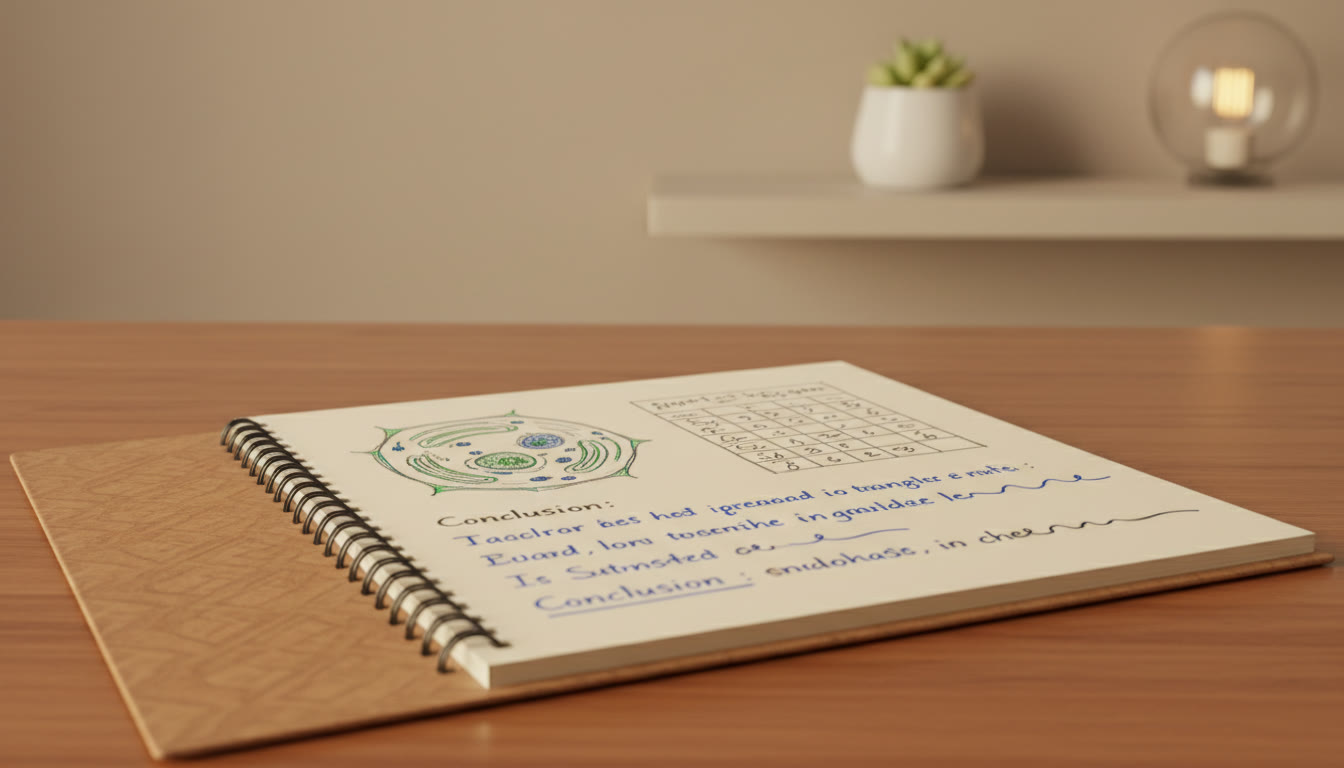
Practice writing short conclusions for experiments that explain what the data shows and why. This helps in both practical exams and theory questions that ask for interpretation.
Mock tests, marking schemes, and how to use them productively
Mocks are not only practice; they are diagnostic tools. Do full-length tests under exam conditions and then spend at least as much time analysing mistakes as you did taking the paper.
- Use marking schemes to see how answers are graded — note where methods and steps earn marks even if the final number is wrong.
- Time your sections so you learn pacing. If a 5-mark question consistently takes too long, isolate the skill involved and practise it until speed improves.
- Keep a ‘mistake log’: list common errors and how you corrected them. Revisit this weekly.
Smart revision techniques
Spaced repetition
Revisit topics at increasing intervals: after 1 day, 3 days, 1 week, 2 weeks. Spaced repetition cements concepts with far fewer total study hours than cramming.
Interleaving
Mix topics during practice (e.g., alternate mechanics and optics problems) so your brain learns to choose the right strategy instead of applying the same method mindlessly.
Active summary cards
Create one or two flashcards per sub-topic: a question on the front, a concise answer with a single example on the back. Flashcards force precision and are quick to review before tests.
When to get personalised help
Some blocks of learning stall because gaps are hidden — you think you understand, but you can’t apply the idea in a new type of question. That’s the right time for targeted help. Personalised tutoring can:
- identify the exact conceptual gap in one session,
- provide a tailored study plan focused on the gap, and
- use data from your mock tests to change practice priorities.
If you explore structured support, look for services that offer 1-on-1 guidance, tailored study plans, and timely feedback. For example, Sparkl provides personalised tutoring and AI-driven insights that can help prioritise weak topics and shape revision efficiently; Sparkl‘s tutors can also model the way answers should be presented for board-style marking.
Common pitfalls and how to avoid them
- Relying only on memorised answers: Convert one memorised solution into a general method you can adapt.
- Neglecting practicals: Even if you’re confident in theory, practise experiment descriptions and data interpretation.
- Ignoring marking schemes: They show examiners’ expectations; practise answers to match those expectations.
- Studying in long, unfocused sessions: Short focused blocks with breaks are more productive.
Quick checklist: a revision recipe you can use
- Day 1: Read + concept map + one quick practice set.
- Day 3: Active recall test (closed book) + flashcards.
- Day 7: Timed section and marking-scheme review.
- Weekly: One full-length mock under exam conditions; analyse errors thoroughly.
- Monthly: Revisit weakest topics with 1-on-1 help if progress stalls.
Using past-paper practice in the right way
Past-paper practice is valuable when used strategically. Don’t just solve paper after paper — rotate between focused practice (repeat a question type until it becomes routine), timed sections, and full papers.
When you mark past papers, annotate answers to record the reasoning that earned marks. Over time you will build a personal bank of model answers and methods tailored to the board’s style.
How to present answers for maximum clarity
Neat presentation is easy to achieve with practice: start each long answer with a one-line introduction, use numbered steps for procedure or calculation, label diagrams, and write a short concluding sentence when asked to interpret results. These small touches make marking faster and can earn you easy points.
Keeping stress manageable
Good study is sustainable study. Schedule short physical breaks, keep a sleep routine, and practise relaxation techniques before mock tests. Confidence comes from repeated, structured practice; when you see consistent improvement in mock scores and fewer repeated errors, stress naturally reduces.
Summary tools: what to carry into every study session
- One-page concept sheets for each chapter (key formulas, exceptions, diagrams)
- A small mistake log or digital note with commonly repeated errors
- Flashcards for quick revision
- Timed past-paper sections for pacing practice
Final word: understanding as an exam strategy and a lifelong skill
Approach science with curiosity and a plan: read deliberately, practise actively, test under timed conditions, and use targeted help when a gap persists. Focus on methods and clear presentation as much as on facts; that combination matches how CBSE assesses and, more importantly, builds a mental toolkit that will serve you beyond exams. Study with purpose, track progress, and let each mock test refine what you practise next. This is how understanding becomes reliable performance in assessments and a lasting skill in science.























No Comments
Leave a comment Cancel