

ICSE vs CBSE: Which Is Better for Building Strong English Skills?
Choosing a board often feels like picking a path that will shape how you read, write and think in English. Students and parents ask whether ICSE’s broad syllabus or CBSE’s focused approach builds better English skills. The honest answer is: it depends on what “better” means for you — depth of literary study, exam-smart writing, speaking confidence, or a balanced set of language abilities. This article walks you through practical differences, how exams shape learning, and a realistic study plan you can apply to whichever board you follow.

Why English skills matter — beyond marks
English is more than a subject on a report card. Strong language skills open doors to clearer thinking, better answers in any subject that requires expression, and real-world communication — interviews, presentations, and teamwork. When you plan your study, aim for a mix: fluent reading, precise grammar, persuasive writing and confident spoken expression. Boards shape the emphasis; your study choices shape the result.
How the two boards typically shape English learning
Curriculum focus and classroom rhythm
ICSE is often described as literature-rich: longer texts, varied prose and poetry, and tasks that ask for deeper literary analysis. CBSE tends to be more streamlined and exam-focused, emphasising clarity of expression, concise writing, and application of grammar rules across sections. Both approaches have strengths — one leans toward interpretative skill and the other toward communication that maps closely to typical board assessments.
Text selection and types of tasks
In many classrooms, ICSE lists a wider variety of stories, essays and poems; teachers and students spend more time on close reading and extended commentary. CBSE selections are chosen with clarity and syllabus alignment in mind, with frequent practice on comprehension, summary, and structured writing tasks. That means CBSE students often get a lot of practice writing responses that map directly to board questions; ICSE students may spend more time rehearsing argument, nuance and critical reading.
Language skills — reading, writing, listening and speaking
Both boards include the core language skills, but emphasis shifts. Reading under ICSE may ask for deeper text-to-theme links; CBSE often tests comprehension strategies and inference within time-bound sections. Writing under CBSE is frequently scaffolded into clear tasks (letters, reports, essays) that reward structure and economy. ICSE writing practice may include longer creative and critical responses that foster stylistic range. Listening and speaking work is usually part of classroom assessment; how much it is formally graded varies with the school and the board’s current guidance.
Exam format and marking — why form shapes skill
What “CBSE-style” testing usually focuses on
CBSE-style papers commonly ask students to demonstrate four things: careful reading, accurate and varied writing, correct grammar, and knowledge of prescribed literature. Because the exams are designed to assess specific competencies, regular timed practice, section-wise drills and full-length mock practice help you align your skills with expectations. Pay attention to the marking rubric that accompanies practice papers — the board’s marking approach rewards clear expression, correct format, and direct answers to the question given.
How marking schemes influence study choices
If an exam awards marks for structured writing and clear points, your study should include planning short outlines, learning paragraphing, and practicing introductions and conclusions under time pressure. If another paper rewards textual interpretation, spend time building evidence-based arguments and connecting quotes to themes. Remember: exam format nudges classroom teaching, and classroom teaching influences what you practise at home.
Side-by-side comparison table (skills-focused)
| Aspect | CBSE — Typical Strengths | ICSE — Typical Strengths | Study approach |
|---|---|---|---|
| Syllabus breadth | Concise, exam-aligned texts and tasks | Wider range of literature and longer extracts | CBSE: targeted practice; ICSE: varied reading |
| Writing style | Clear, structured, purpose-driven | Expressive, descriptive and analytical | Practice both structure and style |
| Grammar focus | Frequent direct testing of grammar rules | Grammar woven into composition and editing | Daily micro-practice + error logs |
| Exam preparation | Mock tests aligned to board patterns | Longer-answer practice and project work | Mix timed mocks and detailed feedback |
| Spoken English | Often taught as skill-based modules | May be integrated in literature and projects | Active class participation + recorded practice |
Practical study plan — build English skills week by week
Here’s a compact, evergreen study plan that works no matter which board you follow. The focus is balanced: comprehension, grammar, writing, literature, and speaking. Adapt the time to match how close you are to exams and how much classroom instruction you already have.
Sample eight-step study cycle (repeat and adapt)
- Step 1 — Reading habit: 20–40 minutes daily of fiction, non-fiction or poems. Annotate main ideas and unfamiliar words.
- Step 2 — Focused grammar: 15–25 minutes daily on a rule, then immediate micro-practice (fill-ups, editing sentences).
- Step 3 — Writing drills: 3 times a week, write a short piece (letter, report, short essay). Time yourself once every week.
- Step 4 — Literature deep-dive: Read one prescribed text extract weekly; practise one long answer and two short notes.
- Step 5 — Listening & speaking: Record a 2–3 minute talk once a week and listen back to correct pronunciation and structure.
- Step 6 — Error log: Keep a notebook of recurring mistakes and re-test them after two weeks.
- Step 7 — Feedback loop: Get at least one full-length marked mock or teacher feedback cycle every three weeks.
- Step 8 — Revision sprint: In the final weeks before an exam, prioritise full-length mock practice and targeted corrections.
Using full-length mock practice effectively
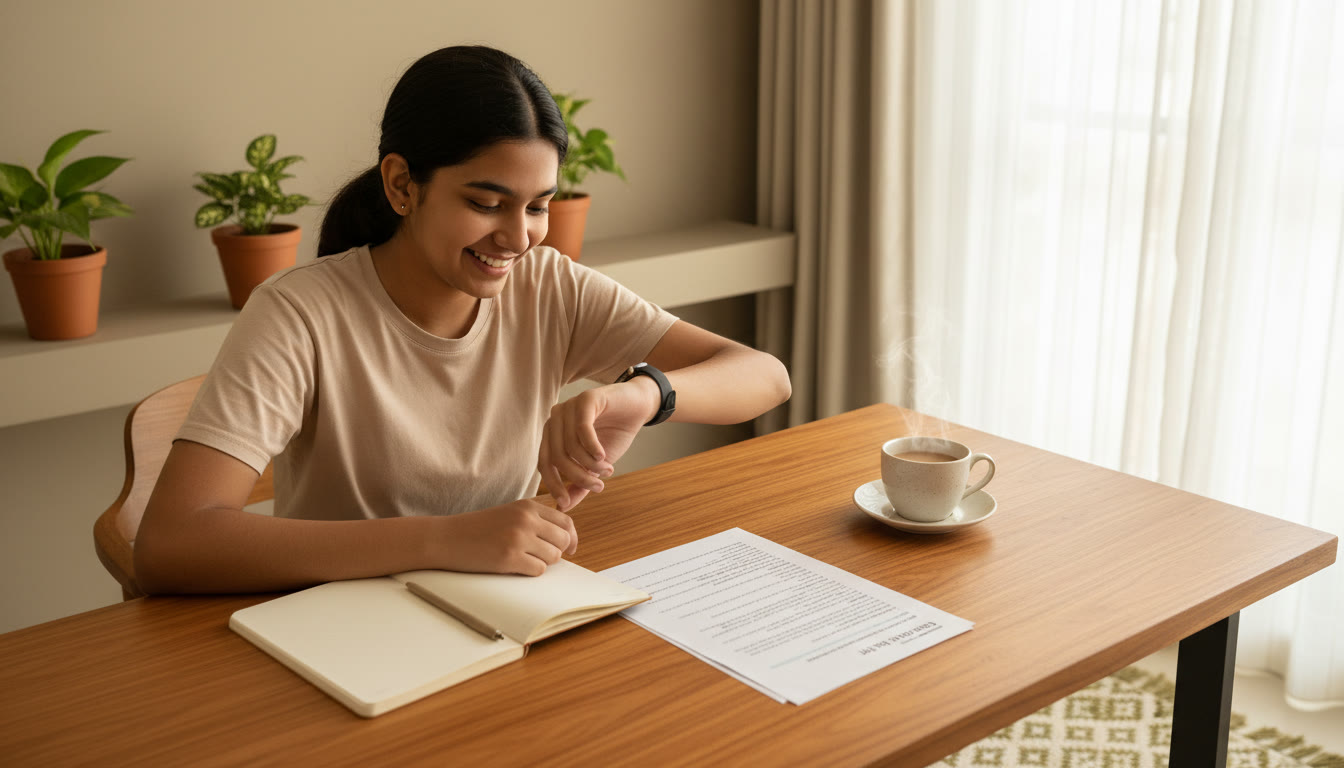
Full-length mock practice is where skills meet stamina. Simulate exam conditions: set a timer, remove distractions, and mark your paper against a model rubric. After marking, spend double the time you spent on the test to analyse errors — not just what went wrong, but why. Correct recurring mistakes through focused drills, then retake a similar paper after one week.
Concrete techniques for each English skill
Reading — move from surface to depth
- First pass: identify main idea and tone in one minute.
- Second pass: annotate evidence and unfamiliar vocabulary.
- Synthesis: write a one-paragraph summary in your own words.
- For literature: practise linking lines or scenes to themes and character motives using short quotations as evidence.
Writing — structure, clarity, and adaptability
Work on clear openings, a logical middle with signposted points, and a concise closing. For descriptive and creative writing, practise sensory detail and controlled pacing. For functional writing (letters, reports), learn formats and useful phrases; then practice adapting tone quickly.
Grammar — think repair, not memorisation
Use an error-log approach: list the exact sentences you get wrong, rewrite them correctly, and create one mini-quiz for yourself weekly. Context-based grammar (fixing errors in a paragraph) is more durable than isolated drills.
Speaking and listening — make them everyday habits
Practice short presentations, peer discussions, and listening tasks. Record and replay to notice filler words and pronunciation. Integrate speaking into study sessions: explain a poem aloud, summarise a paragraph to a friend, or give a two-minute talk on a topic you read about.
How teachers, assessment and extra help fit together
Feedback matters more than volume
Timely, specific feedback (what exactly to fix and how) is the most powerful lever for improvement. Whether your teacher provides it or you seek external help, ask for annotated corrections and a short re-test window so you can see progress.
When personalised support helps — and how to choose it
If you struggle with converting study into higher marks or if you want one-on-one attention on weak areas (like grammar accuracy or essay structure), targeted guidance can speed progress. Sparkl‘s approach to personalised tutoring focuses on diagnostic assessment, tailored study plans and consistent feedback — a good fit when classroom pacing doesn’t match your needs.
Common myths — and the reality
- Myth: ICSE automatically makes you more creative in English. Reality: ICSE exposes you to a wider range of texts, but creativity depends on how much you practise creative writing and how feedback shapes your drafts.
- Myth: CBSE only trains you for exams. Reality: CBSE emphasises clarity and exam skills, which are transferable to academic and professional writing if you expand beyond formulaic responses.
- Myth: Board choice decides your future fluency. Reality: Board shapes exposure; your habits — reading, reflection, practice — determine fluency.
Which board is better for which kind of English skill?
To choose the best fit, map the board’s strengths to your goals. If you love literature and long-form analysis, a syllabus with broader texts can be rewarding. If you prefer structured tasks and want to maximise exam scores through targeted practice, a streamlined syllabus can be efficient. Either board can produce excellent English speakers and writers if you pair classroom learning with deliberate home practice.
Quick guide to match goals with approach
- Goal: Strong analytical writing — favour varied literature study, close reading and long-answer practice.
- Goal: Exam-ready, concise writing — favour timed practice, format drills and grammar precision.
- Goal: Spoken fluency — favour speaking clubs, recorded practice and daily habit-building.
- Goal: Balanced skill set — combine reading variety with CBSE-style drills and regular mocks.
Sample weekly timetable (practical, repeatable)
| Day | Morning (30–45 mins) | Afternoon (30–60 mins) | Evening (20–40 mins) |
|---|---|---|---|
| Mon | Reading: short story or essay + annotate | Grammar target practice | Writing drill: 20-min timed paragraph |
| Tue | Vocabulary + use in sentences | Literature analysis: one extract | Speaking practice: 2-min recorded summary |
| Wed | Comprehension passage practice | Creative writing or descriptive piece | Error-log review |
| Thu | Grammar + editing exercises | Functional writing (letter/report) | Peer review or teacher feedback session |
| Fri | Listening task or spoken drill | Practice long-answer literature question | Flashcard vocabulary review |
| Sat | Full-length practice (alternate weeks) | Mock marking and analysis | Relaxed reading for pleasure |
| Sun | Revision and error correction | Write an improved version of a past weak answer | Plan next week’s focus |
Measuring progress — what to track
- Accuracy rate: percentage of grammar items correct on weekly quizzes.
- Clarity score: teacher or self-rated score for a timed writing (0–10 scale).
- Reading speed + comprehension: pages per hour and summary quality.
- Speaking confidence: length, fluency and error reduction over time.
Tools like short diagnostic tests, weekly annotated corrections, and a persistent error log help you see progress. If you want personalised guidance, targeted programmes can triage weaknesses quickly; for example, Sparkl‘s diagnostic-first model builds a tailored plan and gives regular one-on-one feedback to close specific gaps.
Putting it all together — study choices that actually work
Whichever board you choose, make practice purposeful: set small weekly goals, track errors, and do full-length mock practice at regular intervals. Balance reading for depth with exam-smart drills. Treat feedback as a map rather than a judgement — it tells you exactly where to focus next. Over time, these habits matter far more than which board you study under.
Conclusion
ICSE and CBSE each offer clear routes to strong English skills. ICSE frequently gives broader literature exposure and more opportunities for extended analysis, while CBSE often provides focused, exam-aligned practice that builds clear, efficient writing and accuracy. The best choice depends on your goals and learning style: pair your board’s strengths with deliberate daily practice, full-length mock practice, targeted feedback and a steady error-correction routine to develop lasting English ability.


















No Comments
Leave a comment Cancel