

Why Personalised Learning Matters for CBSE Success
The CBSE exam cycle asks a lot: a wide syllabus, a mix of theory and application, and an expectation that answers are well-structured and mark-focused. Personalised learning is the way to turn that complexity into a clear, steady strategy. Instead of scattering effort across everything equally, a personalised plan helps you invest time where it will turn into marks fastest.
Personalised learning is part planning, part honest feedback and part disciplined practice. It’s not a quick fix; it is a repeatable process: diagnose what’s holding you back, map those issues to the CBSE marking priorities, practise with purpose, and measure progress. When done right, it makes improvement predictable, not accidental.

Step 1 — Diagnose Your Starting Point
Start with data, not assumptions. A short diagnostic—one full-length mock and a couple of topic tests—reveals whether your problems are conceptual gaps, careless mistakes, or time management errors. The key is not to feel defeated by the numbers but to treat them as instructions for the next stage of work.
- Run a timed full-length test to check exam stamina and pacing.
- Do quick 20–30 minute topic quizzes to isolate weak subtopics.
- Log every mistake with a one-line reason: ‘concept’, ‘calculation’, ‘misread’, or ‘time’.
- Convert scores into a simple map: strong, improving, weak — this map guides time allocation.
Step 2 — Set Mark-Aligned Targets
Goals matter only when they are actionable. Translate broad aims like ‘improve in science’ into mark-specific targets: ‘consistently get 7 out of 8 on numerical questions’ or ‘gain 3 marks on diagram-based questions’. These targets should be revisited weekly and adjusted as data comes in.
| Unit / Topic | Indicative CBSE Weightage | Current Level (out of 10) | Target (out of 10) | Key Actions |
|---|---|---|---|---|
| Conceptual Theory | High | 5 | 8 | Create concise notes + active recall |
| Problem Solving | High | 4 | 7 | Daily timed problems + error logs |
| Diagrams/Practical | Medium | 6 | 8 | Practice labelled diagrams and past tasks |
| Language & Writing | Medium | 7 | 8 | Structure templates + timed essays |
Step 3 — Build a Personalised Weekly Plan
Once you know where to invest time, design a weekly plan that balances learning, practice and review. Realistic plans have buffer space for catch-up and recovery. They are specific: each session has an outcome, not just a subject name.
Elements of an effective weekly plan
- Micro-goals for each session (what you’ll accomplish in 30–50 minutes).
- Alternate heavy problem days with theory consolidation days to avoid fatigue.
- Dedicated slots for past paper practice and one weekly full-length mock.
- Short daily review windows (15–30 minutes) for flashcards and formula recall.
Sample Weekly Time-Box (illustrative)
| Day | Morning | Afternoon | Evening |
|---|---|---|---|
| Monday | Learn new topic (2 sessions) | Practice problems (weak points) | Active recall + flashcards |
| Tuesday | Revision of previous topic | Timed short-answer drills | School homework integration |
| Saturday | Full-length mock (timed) | Detailed mock analysis | Targeted correction exercises |
Practice Strategy — Full-Length Mocks and Targeted Drills
Mocks replicate pressure and expose weaknesses. But the magic happens in the after-work: a systematic mock analysis and a targeted drill plan. Think of a mock as a diagnostic tool that updates your study map.
- Perform mocks in exam-like conditions: timed, quiet and without notes.
- Create a mock-analysis checklist: time used per section, careless errors, unresolved concepts, presentation issues.
- Convert the biggest three problems into a 7-day corrective routine.
Mock Analysis Workflow
- Step 1 — Score it honestly and write down lost marks with exact reasons.
- Step 2 — Find patterns across the last three mocks.
- Step 3 — Make a 7-item action plan based on frequency and impact.
- Step 4 — Re-test that focus area in small timed sessions.
| Mock # | Score | Time Management | Main Error Types | Action Plan |
|---|---|---|---|---|
| 1 | 62 | 6/10 | Calculation errors, skipped 2 long questions | Daily calculation drills; sectional timing practice |
| 2 | 70 | 7/10 | Better pacing; still losing marks to explanation depth | Practice writing crisp, mark-aligned points |
Answering for Marks — Simple Structures That Work
Every CBSE question implicitly shows how marks will be given. Your job is to structure the answer so the examiner can award marks easily. Use short headers, numbered points and clear steps.
- For 1–2 mark questions: give a precise, one-line answer with keywords.
- For 3–5 mark questions: write 2–4 numbered points, each with a short explanation or a mini-example.
- For long answers: open with a concise statement that answers the prompt, follow with well-structured paragraphs or numbered steps, include a labelled diagram if helpful and finish with a brief concluding line.
Answer Template — 8 Mark Science Question (example)
- Opening (1 sentence): direct response to the question.
- Body (3–4 points): each point begins with the key phrase and follows with a short explanation or a step.
- Diagram (if applicable): labelled and referenced within the answer.
- Closing (1 line): summarize in one clear line to reinforce the answer.
Active Revision Techniques That Stick
Revision should force you to retrieve, not to re-read. Retrieval-based activities strengthen memory and make recall under exam pressure easier.
- Spaced repetition: revisit topics at increasing intervals based on difficulty.
- Active recall: close notes and write or speak the topic from memory.
- Interleaving: mix problems from different chapters to train recognition and strategy selection.
- Self-explanation: after solving, explain why each step was taken.
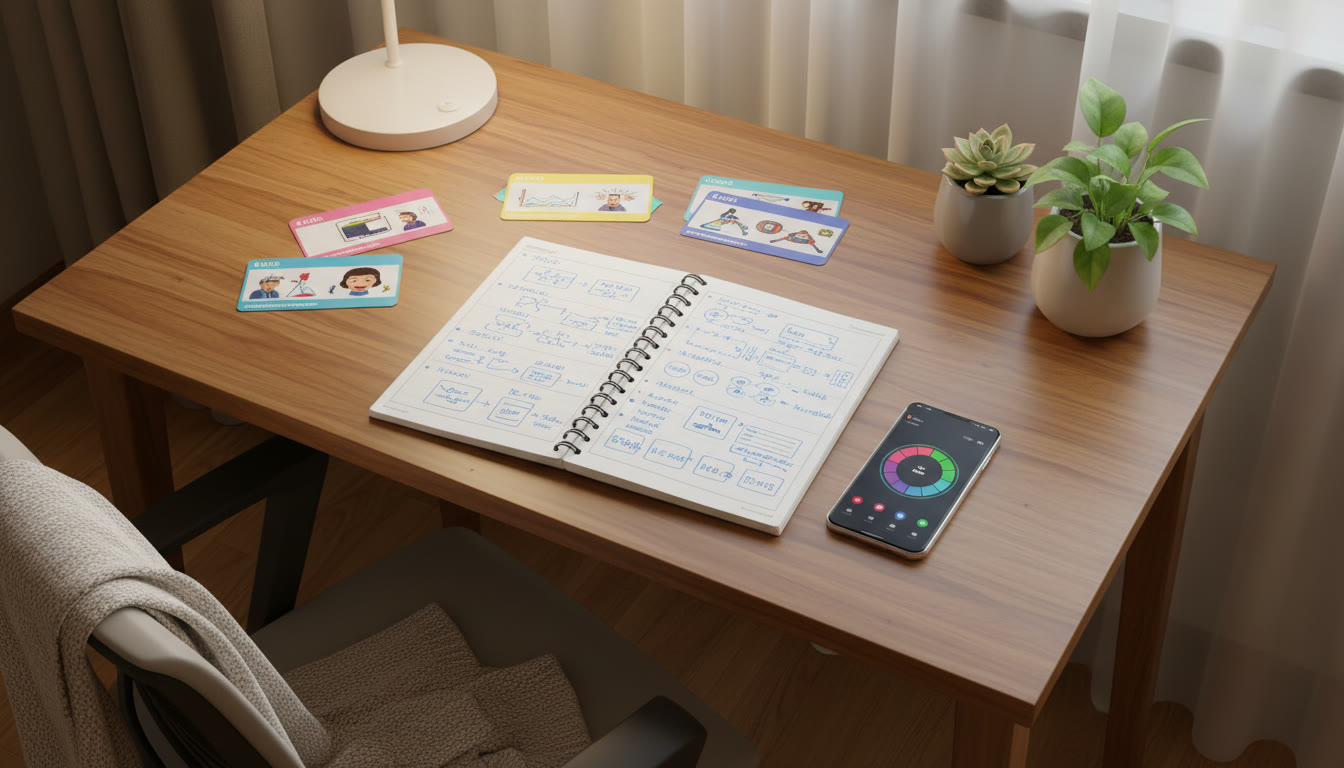
Notes, Diagrams and Derivations — Tools, Not Tricks
Create short, exam-purpose notes: one-page cheat-sheets for each chapter (for revision only). Diagrams should be practised and reproduced under time pressure until they become quick and accurate. Treat derivations as a process: understand the ‘why’ and then practise the ‘how’ to reproduce clearly in the exam.
- One-page chapter summaries with 6–8 key points and 4 to 6 must-remember formulas.
- Practice 3–5 labelled diagrams per topic; your goal: draw and label within two minutes.
- For derivations, memorize the logical flow, not blind steps — understand each transition.
Time Management During the Paper
Use the first 10–15 minutes to scan the paper and mentally allocate time by marks and difficulty. Starting with confident questions secures marks early and builds momentum.
- Plan time per question in advance — allocate minutes proportional to marks.
- Mark questions to revisit and move on; don’t get stuck on a single question early on.
- Reserve time to check calculations and neatness; small presentation errors can cost marks.
| Section | Marks | Suggested Time |
|---|---|---|
| Short answers (section A) | 30 | 40 minutes |
| Long answers (section B) | 40 | 80 minutes |
| Optional / revision buffer | 30 | 30 minutes |
Physical and Mental Wellbeing — Small Habits, Big Returns
Consistent sleep, short exercise and regulating screen time before bed support concentration and memory. During intense preparation phases, prioritize quality sleep over extra late-night study marathons. Small wellness routines protect the brain’s capacity to learn and recall.
- Sleep cycles: strive for consistent sleep and wake times to keep cognitive function steady.
- Micro-activity: five- to ten-minute movement breaks every 60 minutes refresh focus.
- Nutrition: balanced meals and regular hydration support attention and stamina.
How One-on-One Guidance and AI Insights Fit In
Personalised help pairs human insight with data. One-on-one coaching helps diagnose why mistakes happen, provides accountability and models effective answer-writing. Technology can amplify that by crunching mock-test data and recommending the exact topics and question types to prioritise next.
For tailored 1-on-1 guidance that combines expert feedback with data-driven focus, Sparkl’s model blends customised study plans, expert tutors and AI-driven insights so practice becomes concentrated and measurable. This approach helps ensure that each hour spent aligns directly with your improvement targets.
Subject-wise Micro-Strategies
Mathematics
- Practice varied problems: build procedural fluency and concept maps.
- Maintain a formula sheet for revision (not for the exam) and practice derivations regularly.
- Run timed sets focusing on typical mistakes: sign errors, miscopying, method confusion.
Sciences (Physics, Chemistry, Biology)
- Physics: show step-by-step work, include units and box the final answer.
- Chemistry: focus on reaction mechanisms, balanced equations and numerical practice.
- Biology: clear, labelled diagrams and concise examples strengthen descriptive answers.
Languages and Social Sciences
- Languages: practice comprehension strategies, learn templates for summaries and essays.
- Social sciences: practise timelines, link facts to concepts and drill map/case-based answers.
Measurement — Track What Matters
A simple tracker converts effort into evidence. Track hours, number of questions attempted, mock scores and frequent error types. Weekly reviews of this tracker help you decide whether to keep the same plan or pivot.
| Week | Planned Hours | Completed Hours | Mock Score | Top Improvement Area |
|---|---|---|---|---|
| 1 | 15 | 13 | 58 | Computation speed |
| 2 | 15 | 15 | 66 | Clarity in short answers |
| 3 | 15 | 14 | 71 | Time allocation |
Checklist for the Final Revision Phase
- Prioritize topics by projected marks and current proficiency.
- Do at least two full-length mocks per week and analyze them thoroughly.
- Turn repeated errors into daily micro-tasks of 15–30 minutes each.
- Practice answer presentation: headings, numbered points and boxed final answers.
- Simulate exam conditions regularly to build confidence and speed.
Keeping Motivation and Momentum
Improvement is a series of small wins. Track them visually: a board, a chart or a simple digital tracker makes progress visible. When you plateau, switch the practice mode — from volume to targeted corrections — to restart gains. Peer accountability and short, regular reviews keep the routine honest and sustainable.
Final Thoughts
Personalised learning turns vague effort into a clear, repeatable plan that maps directly to CBSE marks. Diagnose honestly, set mark-aligned targets, practise deliberately with mocks and targeted drills, and measure the results weekly. Follow the cycle of diagnose, plan, practise and review until the plan consistently produces the mark improvements you want.



















No Comments
Leave a comment Cancel