

Why this conversation matters: AI is a tool, not a shortcut
Walk into almost any study space these days and you’ll see a laptop, a smartphone, and an app that promises to make studying faster, smarter, or more personalized. For SAT prep specifically, artificial intelligence can feel like a superpower: it can generate practice questions, explain tricky grammar rules, create study schedules, and analyze practice-test results in minutes.
But superpowers come with responsibility. The SAT still rewards deliberate practice, careful reasoning, and test-day stamina. AI should amplify those things—not replace them. This post is a practical guide: how to use AI tools wisely for SAT prep, how to avoid common traps, how to verify what AI gives you, and how to blend AI with human support—like 1-on-1 guidance from Sparkl’s tutors—so your study time actually turns into score gains.
Start with a clear goal and a baseline
Before you bring AI into your study routine, know two things: your target score and your starting point. Take a timed practice test under realistic conditions (quiet room, no phone, full timing). Use official College Board practice tests as your baseline because they most closely mirror the real SAT.
Once you have a baseline score, AI becomes most useful because it can analyze patterns. For example, if 60% of your incorrect Math questions are geometry, that’s a concrete insight that an AI tool can turn into a prioritized practice plan.
How AI helps at this stage
- Quick score breakdowns by question type and difficulty.
- Identification of patterns across multiple tests (e.g., frequent mistakes with passive voice vs. subject-verb agreement).
- Generation of a focused practice plan based on weak areas.
Practical ways to use AI during day-to-day study
Let’s break this into bite-sized, actionable tactics you can use immediately.
1. Turn weak areas into targeted drills
AI tools are great at generating tailored practice. If you miss questions on function notation or coordinate geometry, ask the AI to create 10 practice problems that escalate in difficulty. When you solve them, request step-by-step feedback on each answer so you can learn the pattern rather than memorize solutions.
Sample prompt: “Create 8 coordinate geometry questions that focus on slope-intercept form and parallel lines. Provide answers and show step-by-step solutions for each.”
2. Use AI as a tutor for explanations—not as the final authority
AI can explain a solution in several ways: visual, verbal, or symbolic. If an explanation clicks, try to restate it out loud or write it in your own words. That active retrieval is what cements understanding.
But AI systems can hallucinate or present a plausible-sounding but incorrect step. So always verify solutions by:
- Re-running the problem independently.
- Checking against an official solution when possible.
- Asking the AI to explain a different way—if the second explanation differs drastically, treat both with caution and seek human verification.
3. Make edits and get feedback on writing and clarity
Even though the SAT Essay is discontinued for most administrations, strong writing skills matter for college applications and subject tests. Ask AI to critique clarity, structure, and word choice in a short essay or personal statement. Then, revise and ask for another round of feedback—this iterative loop helps you improve faster than a single pass.
4. Practice pacing and mental strategies
Timing is a huge part of SAT success. Use AI to create mini-timed sections (10, 20, or 25 minutes) focused on specific question types. After each mini-section, have the AI analyze your timing across questions and suggest where you should slow down or speed up.
Sample prompts that get useful, testable results
How you ask matters. Here are prompts that lead to helpful answers rather than vague advice:
- “Create five official-style SAT math questions on systems of equations. Include difficulty labels and full solutions, showing alternative approaches where relevant.”
- “Analyze these ten Reading questions I got wrong (I’ll paste them). Identify common errors and recommend three specific practice drills.”
- “Edit this paragraph for clarity and SAT-style formal tone. Keep the meaning and suggest two transition sentences to connect it to the next paragraph.”
What AI does best (and what it struggles with)
It’s useful to separate the strengths from the limitations so you can deploy AI where it helps most.
Strengths
- Generating many practice problems quickly and adapting difficulty.
- Explaining procedures step-by-step in multiple ways.
- Analyzing and visualizing patterns in large datasets—like dozens of practice tests.
- Providing quick grammar and clarity edits for writing practice.
Limitations and risks
- Hallucinations: AI sometimes fabricates steps, references, or solutions that look convincing but are wrong.
- Over-reliance: If you accept every explanation without verifying, you might strengthen incorrect methods.
- Surface-level learning: AI can give answers, but it won’t force productive struggle, which is essential for deeper learning.
- Privacy and data security: Be cautious about uploading personal information or real test content.
Practical verification checklist
Make this quick checklist a habit after every AI interaction related to test content:
- Does the answer match official materials if available?
- Can I explain the solution myself in two sentences?
- Is there an alternative method that gives the same result?
- Do the units and edge cases make sense (for math and data problems)?
How to combine AI with human tutoring for the best results
AI is powerful for scale and speed; human tutors bring judgment, motivation, and nuance. A great study loop looks like this:
- Use AI to generate a focused practice set or to analyze a full practice test.
- Work through problems independently, then use AI for hints and targeted explanations.
- Bring the toughest problems and confusing AI explanations to a human tutor for deeper discussion.
For many students, pairing AI-driven insights with 1-on-1 guidance is the sweet spot. Tutors—like those available at Sparkl—can turn AI’s generalized feedback into personalized strategies: they help you build a tailored study plan, correct misconceptions AI missed, and keep you accountable. When AI suggests an area of weakness, a human tutor helps you understand why that weakness exists and how to fix it in practice, not just in theory.
How to structure a week of SAT prep using AI
Here’s a realistic example of a weekly study plan that balances AI use, independent practice, and human feedback. Adjust the hours to fit your schedule, but keep the ratio of independent work, AI use, and human review.
| Activity | With AI (hours) | Without AI (hours) | Why it helps |
|---|---|---|---|
| Timed full practice test (Saturday) | 4 | 4 | Baseline and stamina check; AI used afterwards for analysis |
| Review incorrect answers | 2 (AI breakdown + verification) | 3 (manual review) | AI quickly finds patterns; manual review deepens understanding |
| Targeted drills (math/grammar) | 3 (AI-generated sets) | 3 (prep book problems) | AI supplies variety and incremental difficulty |
| Writing practice & feedback | 1 (AI editing + tutor review) | 1 (self-editing) | AI speeds up iterations; tutor refines voice and strategy |
| Tutor session / review | 1 (human interprets AI data) | 1 (traditional tutoring) | Tutor personalizes insights from AI and sets next steps |
Note: the hours are illustrative. The key idea is to use AI for fast analysis and practice generation, then apply human judgment to interpret and refine the learning plan.
Examples: A math pitfall and how to fix it with AI + tutor
Imagine you consistently miss algebra word problems. An AI analysis of three practice tests shows most errors appear when students set up the equation incorrectly, not when they solve it.
Here’s a study loop:
- Ask the AI to generate 12 word problems focused on setup and to include step-by-step setup strategies.
- Solve them without algebraic manipulation first—just write the relationships in words and convert to equations.
- Use AI to check your setup. If AI flags an error, note the pattern (e.g., misinterpreting “more than” vs. “less than”).
- Bring three of the trickiest problems to a tutor (for example, a Sparkl tutor) to discuss the language triggers that cause setup mistakes and practice targeted rewrites.
The combination—volume from AI, careful self-explanation, and targeted human coaching—pushes conceptual change. You stop making the same mistake because you’ve practiced recognizing the language patterns that lead to it.
Ethics, test rules, and the line you shouldn’t cross
AI is exceptional for practice and learning. But during the official SAT, you can’t use it. That’s obvious—but there are ethical gray zones in preparation that deserve attention:
- Do not use AI to generate answers during a proctored practice test meant to simulate test conditions. Practice integrity builds testing stamina and honest feedback.
- Don’t submit AI-generated essays as your own on college applications. Admissions officers value authentic voice; use AI only for editing or feedback with clear disclosure if asked.
- Be cautious about sharing full practice tests with AI tools that might retain or reproduce copyrighted test content. Prefer official College Board resources and anonymized question extracts when possible.
Privacy, subscriptions, and practical considerations
Many AI tools are free or freemium. They may save prompts, tweak models with user data, or require payment for advanced features. Think about these questions before you subscribe or upload documents:
- What data does the service retain, and for how long?
- Do you need to pay for advanced features (like batch test analysis)?
- Are there limits on how many practice problems you can generate or how many tests you can analyze?
Measuring progress: what really indicates improvement
Score jumps are the obvious signal, but smaller qualitative changes matter too:
- Fewer careless errors on repeated topics.
- Faster, more confident set-up of word problems.
- Stronger ability to explain answers—if you can teach a concept, your mastery is solid.
Use AI to track trends—average time per question, types of mistakes, and how quickly you improve after targeted practice. Then review those trends with a human tutor to make sure they reflect real learning and not just short-term familiarity.
When to back away from AI and return to fundamentals
If your study feels like chasing AI-generated variations without deeper understanding, pause. Go back to basics: foundational concepts in algebra, grammar rules, and reading strategies. There’s no substitute for a mind that can reason without leaning on an answer suggestion. A tutor can help diagnose when you’re ready to move on and when you need to rebuild a concept from the ground up.
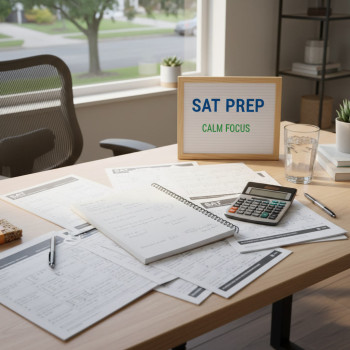
Image ideas to enhance a study blog


Final checklist: a smart AI-assisted SAT study session
Before you log off for the day, run through this short checklist:
- I timed at least one active practice task (mini-section or problem set).
- I asked AI for explanations and verified at least two answers independently.
- I recorded patterns the AI flagged and turned them into specific drills.
- I scheduled a human check-in for ambiguous explanations or persistent errors.
- I preserved academic integrity by treating AI as a study aid, not a shortcut.
A quick closing thought
AI can accelerate SAT prep when used with intention. Think of it like a versatile study partner: it can generate practice, point out patterns, and give instant feedback. But it’s at its best when paired with active learning and human judgment. Tutors—especially those who provide personalized tutoring, tailored study plans, and experience interpreting AI-driven insights, such as Sparkl—help you turn raw data into a plan you can stick to and a score you can trust.
Use AI to practice harder, not just faster. Lean on human coaches to practice smarter. When those pieces click, your preparation becomes efficient, sustainable, and deeply effective—exactly what you want on the way to your SAT test day.



















No Comments
Leave a comment Cancel