

Walk It Off: Why a Simple Walk Can Be Your Best Study Tool
When you’re deep in SAT prep — tackling math problem sets, untangling dense reading passages, or memorizing grammar rules — it’s easy to think the answer is always “one more hour.” But sometimes the most effective thing you can do is stand up, step outside, and walk. Not a random scroll-through-your-phone break, but a purposeful walk designed to clear your head, move your body, and reset your focus.
This blog is a friendly, practical guide for students who want to turn walks into a study superpower. You’ll find science-grounded reasons why walking helps, concrete walk recipes (what to do on a 5-, 15-, or 30-minute walk), how to schedule walks around study sessions, and a simple table to match walk length to benefit. Along the way I’ll share examples, small experiments you can try, and natural ways to use walk breaks alongside targeted support like Sparkl’s personalized tutoring — for instance, pausing a tutoring session to walk through a tricky concept or using a tutor’s tailored study plan to time your breaks effectively.
Why walking actually helps your brain
There’s something surprisingly efficient about changing your environment: movement boosts circulation, lifting oxygen to the brain; it triggers neurotransmitters like dopamine and serotonin that improve mood and motivation; and it gives working memory a moment to offload clutter so new information can stick. Researchers have found that short bouts of aerobic activity — even a brisk 10-minute walk — can enhance aspects of executive function like attention, processing speed, and working memory. That’s exactly what you need during SAT prep.
But the benefits aren’t only physiological. A walk provides a cognitive break that allows your brain to shift from focused problem solving to a looser, more associative mode. That’s where insight lives: after a period of wandering attention, students often return to a problem with a fresh angle or a sudden “aha.”
How to think about walks: reset, consolidate, or strategize
Not all walks are created equal. When planning study breaks, consider the walk’s goal:
- Reset — short walks (5–10 minutes) to reduce frustration and restore focus mid-session.
- Consolidate — moderate walks (15–25 minutes) to help memory consolidation after a study block.
- Strategize — longer walks (30+ minutes) for planning, problem incubation, or mental rehearsal before a timed section.
Each type has a place in a balanced preparation routine. Using them thoughtfully helps you avoid the trap of using “breaks” that amount to mental junk food (endless social feeds) and instead turns breaks into a high-return investment in your focus.
Practical Walk Recipes: What to Do on Each Type of Walk
5–10 minute reset walk: The micro-walk
Perfect when you hit a wall in a practice section or a practice test. Step outside or pace around a hallway. The goal is to change posture, breathe, and move your legs.
- Walk at a comfortable pace for 5–10 minutes.
- Do a quick mental checklist: relax your shoulders, inhale deeply for 3–4 counts, exhale for 4–6 counts.
- Give your eyes a break from close-up work — focus on a distant object for 10–20 seconds.
- Avoid checking notifications. If you need music, choose instrumental tracks that don’t pull your attention into lyrics.
Example: You’ve been grinding Reading passages and your accuracy is dipping. Walk for 7 minutes, breathe, and come back ready to re-read passages with cleaner attention.
15–25 minute consolidation walk: The memory-builder
This is the sweet spot for many students. After a structured study block (e.g., 50–60 minutes of focused practice), take a 15–25 minute walk to help cement what you learned.
- Keep your pace brisk but conversational.
- Mull over one or two key ideas rather than replaying everything. For example: “What was the key step in solving quadratic word problems?” or “What strategy worked for that passage?”
- If you like, do a quick verbal recap out loud — teaching a concept briefly to yourself is a strong memory technique.
Example: After a focused session on geometry proofs, use a 20-minute walk to silently rehearse the core proof steps or explain them to yourself in plain language.
30–60 minute strategizing walk: The incubator
When you’re planning study blocks, trying to break a plateau, or before a full-length practice test, a longer walk gives your brain the time to reorganize information and surface insights.
- Set a loose intention: “During this walk I’ll plan my next week of study around my weakest sections.”
- Alternate walking with short stops to jot quick notes if an idea emerges.
- Use this time for mental rehearsal: visualize confidently answering a section, timing yourself, and applying techniques like process-of-elimination on reading questions.
Example: You’ve been scoring inconsistently on the Math section. Take a 45-minute walk to sketch a targeted plan: identify the problem types that cause errors, allocate practice resources, and schedule checkpoints with a tutor or study partner.
Timing Your Walks: Simple Schedules That Work
Pairing walks with structured study techniques makes them more powerful. Here are a few practical frameworks students use successfully.
Pomodoro + micro-walks
Study 25 minutes, walk 5–10 minutes. Repeat. This keeps you from burning out and gives your attention small resets. If you’re in the zone, you can extend focused time to 50 minutes and use a 15–20 minute consolidation walk.
Block scheduling
Study a single subject for a focused 60–90 minute block, then take a 20–30 minute walk. This helps your brain consolidate the whole session rather than fragmenting learning across too many quick switches.
Pre-test walks
Before a practice test or the real SAT, a 20–30 minute brisk walk 45–60 minutes before the test can lower anxiety and prime focus. Avoid heavy exercise immediately before the test if it leaves you panting or jittery; you want steady energy.
What to Say to Yourself on a Walk: Short Scripts That Work
Walking isn’t just physical; it’s also an opportunity to direct your inner voice. Try these short scripts depending on your goal:
- Reset: “I’ll let this go for a moment. One step at a time.”
- Consolidate: “What was the trick for Data Interpretation problems? Step 1… Step 2…”
- Strategize: “If I cut one activity this week, what should I replace it with to improve my reading score?”
- Motivation: “Little daily progress beats last-minute panic. I’m building skills.”
These scripts are short cues you can repeat silently. They anchor your walk and help your brain shift modes from frantic multitasking to purposeful reflection.
One-Page Table: Pick the Right Walk for the Moment
| Walk Duration | Suggested Use | Primary Benefits | When to Schedule |
|---|---|---|---|
| 5–10 minutes | Quick reset between problems or sections | Reduces frustration, restores attention | After 25–40 minutes of focused work or when stuck |
| 15–25 minutes | Consolidation after a study block | Memory reinforcement, mood boost | After 50–90 minute session, or mid-study day |
| 30–60 minutes | Strategy, incubation, pre-test calm | Deep reflection, planning, reduced test anxiety | Weekly planning, before full-length practice tests |
How to Combine Walks with Targeted Support (Like Sparkl’s Personalized Tutoring)
A smart study routine blends solo practice, restorative breaks, and targeted help. If you work with a tutor — for example, Sparkl’s personalized tutoring — you can use walks to amplify what you get from 1-on-1 guidance. A few ideas:
- After a tutoring session, take a 15–20 minute consolidation walk to verbally rehearse the tutor’s key strategies. That quick self-teaching helps cement new techniques.
- If Sparkl provides a tailored study plan, slot walk breaks into that plan as active components, not optional fluff. The plan can recommend walk timing around your hardest subjects.
- When a tough concept comes up in a session, pause and take a short walk to incubate the problem; sometimes your tutor’s hints click into a clear method after a quiet mind reset.
Using walk breaks deliberately alongside expert tutoring and AI-driven insights from a platform like Sparkl turns small movements into measurable gains.
Making Walks Work in the Real World: Logistics and Habits
Where to walk
Any place that’s safe and comfortable works. Campus paths, neighborhood sidewalks, quiet parks, or even large indoor hallways can be good. If noise or weather is an issue, find a predictable indoor route: a looped hallway, a stairwell (use caution), or a treadmill if you have access.
What to bring (or not)
- Comfortable shoes and a light jacket if needed.
- Phone on silent for short walks; use a simple timer to keep it intentional.
- Optional small notebook for jotting breakthrough ideas on longer walks.
Safety and courtesy
Stay visible, especially if walking early or late. Keep volume low with headphones so you can hear traffic. Respect others’ space and local rules about masks or distancing if relevant.
When Walks Aren’t the Answer
Walking is powerful, but it’s not a magic fix. If you’re exhausted from lack of sleep, or physically drained after illness, prioritize rest and medical care over a walk. Also, if you find walking becomes an avoidance habit (constant walking to dodge practice), use structure: set a maximum number of walks per study block and schedule them into your plan.
Quick Experiments to Try This Week
Pick one or two of these low-effort experiments to see how walking changes your prep:
- Experiment 1: For two days, do 25-minute study blocks followed by 10-minute walks. Track perceived focus and number of problems completed.
- Experiment 2: On a practice test day, take a 30-minute brisk walk 45 minutes before the test and note changes in calmness and concentration.
- Experiment 3: After a Sparkl tutoring session, take a 15-minute consolidation walk and then try to teach one concept to a friend or aloud to yourself.
Record quick notes in a journal: what time you walked, how long, and how your next study block felt. Small data like this helps you refine a routine that fits your natural rhythms.
Real Student Example
Ella, a junior aiming to raise her Reading score, used to grind for hours and end up burned out. She tried structured walks as part of a new routine: 50 minutes of focused close-reading practice, a 20-minute consolidation walk, then a 40-minute vocabulary session. After two weeks, she noticed she was less irritable, her recall of passage detail improved, and practice test timing felt easier. When she paired this with a Sparkl tutor’s tailored plan that focused her walks around the hardest sections, she reported clearer strategies for passage mapping and improved confidence on timed sections.

Putting It All Together: A Sample Week
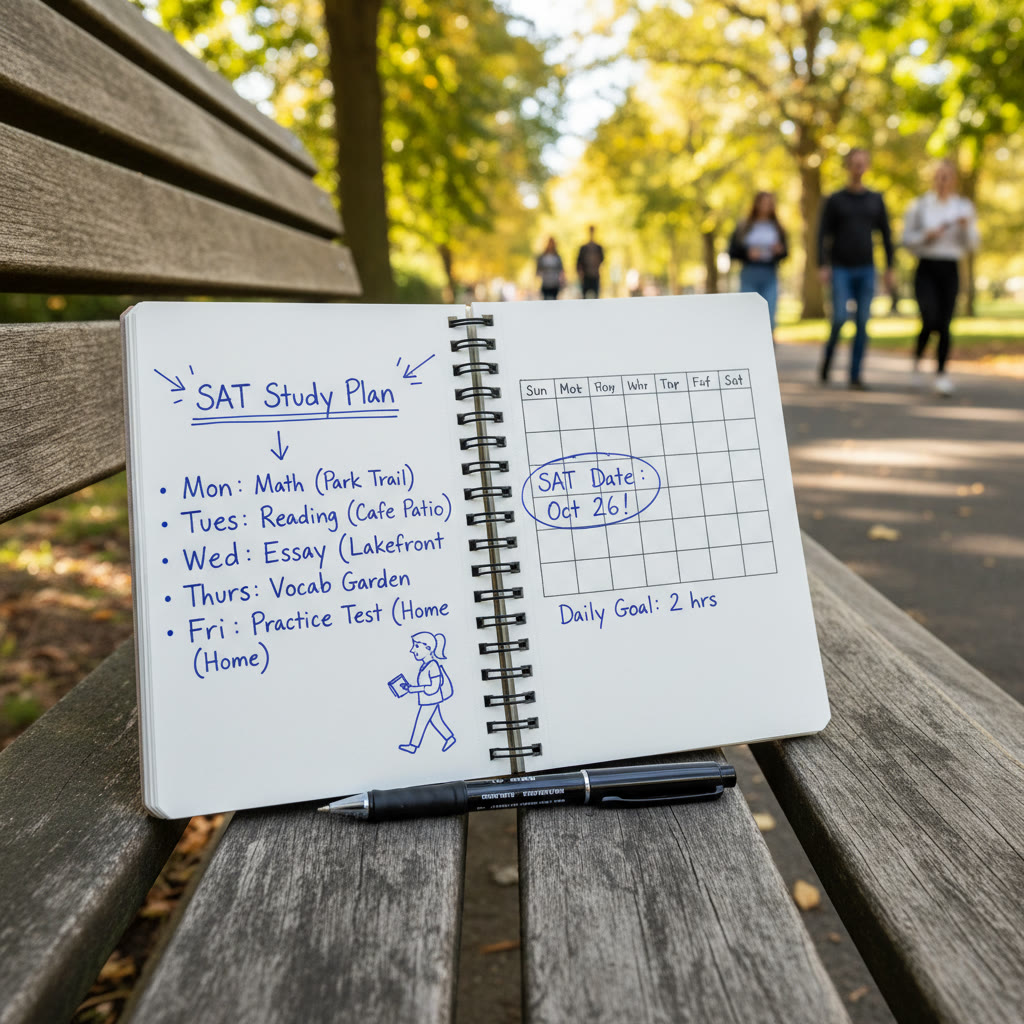
Here’s a realistic week that balances content, practice tests, and walks (modify for your own schedule):
- Monday: 2 x 50-minute study blocks (Math and Reading), each followed by a 15-minute walk.
- Tuesday: Full-length practice section in the morning; 45-minute strategic walk afterwards to review mistakes and plan targeted drills.
- Wednesday: Review errors with a tutor; take a 10–15 minute consolidation walk after the session.
- Thursday: Timed practice sets with Pomodoro (25/5) and micro-walks between sets.
- Friday: Light content review and a 30-minute evening walk to clear the week’s mental clutter.
- Weekend: Full practice test with a 20–30 minute pre-test walk the morning of the test.
Final Notes: Tiny Moves, Big Returns
Walking is a deeply human, low-cost tool for improving focus, reducing anxiety, and helping new information take root. It’s not a replacement for disciplined practice or targeted tutoring, but when used deliberately it amplifies those efforts. Treat walks like study tools — schedule them, give them a clear purpose, and reflect on their effects.
If you use personalized tutoring like Sparkl’s, integrate walks with your tutor’s plan and use them to consolidate lessons, incubate hard problems, and come back to sessions with fresher attention. The next time you’re stuck on a tricky passage or feel the stress rising before a practice test, step outside. One well-timed walk could be the small change that unlocks bigger progress.
Action Steps (Start Tomorrow)
- Pick one of the walk experiments above and try it for three days.
- Plan one timed walk before your next practice test.
- If you have a tutor, ask them to help you slot walks into your personalized plan for the week.
Small, consistent habits win the SAT race. A purposeful walk is a tiny habit with outsized returns—more clarity, steadier focus, and a calmer way to learn. Lace up and walk your way to better prep.
























No Comments
Leave a comment Cancel