

Why free resources can be your best study partner
Let’s start with something honest: money helps—but it isn’t the only route to an excellent SAT score. What matters more is strategy, consistency, and targeted practice. The internet is full of high-quality free tools—from official practice tests to adaptive practice platforms—and when you stack them thoughtfully, they can deliver big gains. This post walks you through how to use those freebies the right way, so you spend less time guessing and more time improving.
The underlying idea: intentional practice beats random studying
Free content is plentiful, but raw quantity can feel overwhelming. The trick is to use free resources in a deliberate sequence: diagnose weak spots, focus practice on those areas, simulate test conditions, and analyze mistakes. That cycle—diagnose, practice, simulate, review—turns fragments of free content into a cohesive, high-impact plan.
What you’ll gain from using free materials well
- Access to authentic practice questions and realistic timing.
- Plenty of material for targeted drills without breaking the bank.
- A chance to experiment with strategies before committing to a paid program.
- Flexible ways to build endurance for full-length tests.
Common free SAT resources and what they’re best for
Before we get tactical, here’s a quick map of the most useful free resources and how they fit into your plan. Think of each one as a tool in a well-stocked kit—use the right tool for the right job.
- Official practice tests from the test maker: best for full-length, realistic practice and familiarizing yourself with question style and timing.
- Khan Academy free SAT practice: excellent for personalized practice sessions and targeted drill exercises tied to your diagnostic performance.
- Public library materials and test-prep books on loan: good for structured content review and quieter study time.
- Educational video channels and short-topic explainers: perfect for concept refreshers (grammar rules, math techniques) and alternate explanations when a concept won’t click.
- Flashcard apps and SRS (spaced repetition) platforms: ideal for vocabulary, math formulas, and error patterns you keep repeating.
- Peer study groups and free online forums: helpful for motivation, explaining concepts to others, and discovering new practice problems or test-taking tips.
A step-by-step plan to leverage free resources
This plan assumes you have roughly 6–10 weeks before your test date. If you have more time, stretch the schedule; if you have less, compress it while keeping the same phases.
Step 1 — Start with a real diagnostic
Take a full-length, timed practice test from an official source. Do it in one sitting with strict timing. Why? It tells you three things at once: your baseline score, timing weaknesses, and the types of questions that cause the most trouble.
- What to record: raw score, converted score if available, section times, and categories of errors (e.g., algebra, data analysis, command of evidence, punctuation).
- How to interpret the results: don’t obsess over the score yet—look for patterns. Are you losing points on careless mistakes or on entire question types you can’t solve?
Step 2 — Build a targeted study plan
Use your diagnostic to set priorities. If geometry is a mess, dedicate a solid block each week to it. If you lose time in reading, practice pacing and active passage strategies.
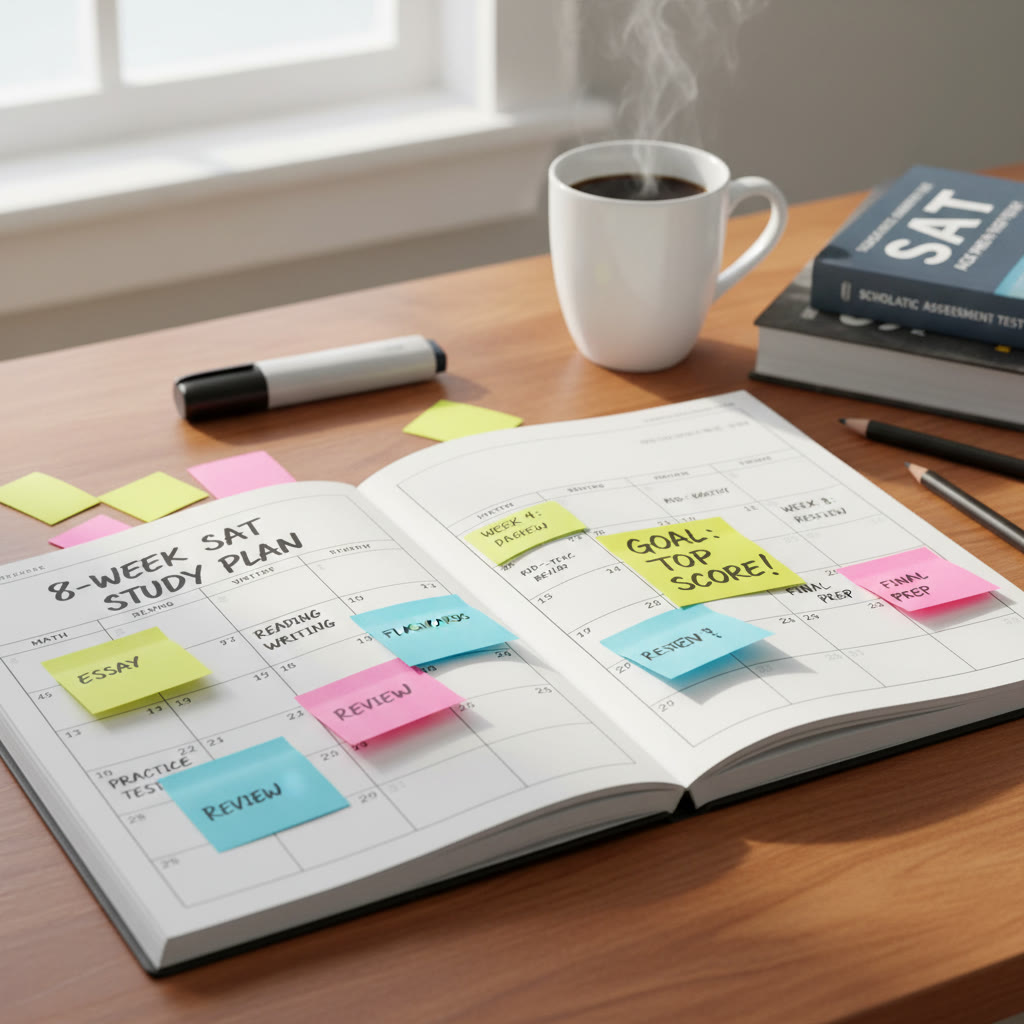
| Week | Main Focus | Free Resources to Use |
|---|---|---|
| 1 | Diagnostic + core review (math fundamentals, grammar rules) | Official practice test, Khan Academy topic modules, library books |
| 2 | Targeted practice on weakest math areas | Khan Academy drills, practice problem sets, flashcards |
| 3 | Reading strategies and passage timing | Official section practice, timed passages, video strategies |
| 4 | Mixed practice and error analysis | Mixed official practice sets, spaced repetition review |
| 5 | Full-length practice under test conditions | Official full test, quiet location, strict timing |
| 6 | Fine-tuning and pacing | Khan Academy targeted quizzes, timed sections, flashcards |
| 7 | Final full tests and review | Official practice tests, review notes, light practice |
| 8 | Rest, light review, and logistics | Light practice, sleep, test-day checklist |
This sample plan is flexible—move weeks around depending on your diagnostic. The important part is focusing on weaknesses and using official practice for realism.
Step 3 — Practice deliberately, not endlessly
Deliberate practice means working on the exact skill you can’t do, with immediate feedback and repetition. Use targeted problem sets, time yourself on short blocks, and always review mistakes deeply. A useful mini-cycle: pick a small skill (e.g., interpreting data in graphs), do 10–15 focused problems, analyze each error, make a 1–2 item flashcard for recurring traps, and retest in a week.
- Example: If you miss data interpretation questions, write a short checklist: read axes first, note units, estimate before calculating. Practice with 10 graphs in 30 minutes, then review errors and drill.
- Example: For grammar, compile a list of 10 recurring rules—subject-verb agreement, pronoun reference—and drill with short sentence sets.
Step 4 — Time your practice and simulate pressure
Timing is a big part of the SAT. Mix focused drills with full-length, timed sections. At least every 1–2 weeks, simulate a real test: start on time, take breaks exactly as scheduled, and avoid checking your phone. After the test, spend double the time you spent answering reviewing your answers—understand why each wrong answer was tempting.
Step 5 — Use analytics and feedback loops
Free platforms often include progress tracking. Use them to identify which question types still defeat you after several weeks. Keep a concise error log: question type, mistake type, and correction strategy. That log becomes your most valuable study artifact because it tells you what to practice next.
Comparing free resources by role
Here’s a simple table to match resources to common study tasks so you can pick the right free tool for each job.
| Task | Best Free Resource | Why it works |
|---|---|---|
| Realistic full practice | Official practice tests | Authentic question style and timing |
| Personalized practice and drills | Khan Academy | Adaptive practice and targeted skills |
| Concept refreshers | Short videos and explainers | Quick, clear explanations and examples |
| Memorization and recall | Flashcards / SRS apps | Spaced repetition helps retention |
| Motivation and accountability | Study groups / local workshops | Social support and shared goals |
Practical techniques that amplify free resources
Active review—don’t passively re-read
When you review an incorrect math problem, don’t just read the correct solution. Rework the problem without looking. Write down the smallest step where you went wrong. If your error was careless, ask: what can I change in my process to catch that next time?
Chunk study sessions into sprints
Use 25–50 minute focused sprints with a short break. During each sprint, have one clear goal: 20 reading questions, 15 algebra problems, or a grammar rule set. This structure makes free resources feel manageable and reduces burnout.
Batch similar tasks
Group similar problems together—do a batch of grid-in math questions, then a batch of data analysis. Batching builds pattern recognition faster than jumping between wildly different topics.
Keep a living error log
Create a simple two-column log: problem type and the fix. Review the log weekly. Many students see the same three traps pop up; once those are fixed, scores jump quickly.
Staying consistent: routines, accountability, and momentum
Build a realistic weekly routine
Map study blocks to weekly obligations. Even five high-quality sessions of 45 minutes are better than one panicked all-day cram. Use quiet morning hours or after-school blocks where distractions are minimal.
Use peers or a study coach for accountability
Study groups force you to show up. A 50-minute weekly check-in with a friend can be enough to keep momentum. If you need a more structured push, consider periodic one-on-one mentoring. For example, Sparkl’s personalized tutoring offers flexible 1-on-1 guidance and tailored study plans so you don’t reinvent your schedule alone. Their expert tutors and AI-driven insights can pinpoint stubborn gaps and accelerate progress—useful if you hit a plateau despite diligent free-practice work.
When to consider supplementing free resources
Free resources will take you far, but there are moments where focused help pays off quickly. Consider paid or 1-on-1 help when:
- You’ve consistently plateaued despite weeks of targeted practice.
- You need a customized plan because of a specific goal or limited time.
- You struggle with test anxiety and need strategies practiced under simulated pressure.
In those cases, a short run of personalized tutoring can be efficient. Personalized tutoring can translate your free-practice gains into reliable test-day performance by offering tailored study plans, expert tutors providing actionable feedback, and tools—like AI-driven diagnostics—to highlight subtle patterns in your mistakes.
Common pitfalls and how to avoid them
- Pitfall: Doing lots of problems without reviewing mistakes. Fix: Spend more time reviewing than answering; analyze every error.
- Pitfall: Treating free practice as low-stakes fun. Fix: Simulate test conditions regularly to build endurance and discipline.
- Pitfall: Chasing every new tip or trick. Fix: Stick to a core set of strategies and refine them.
- Pitfall: Ignoring weaker sections until the end. Fix: Prioritize weaknesses early, then maintain strengths with light practice.
Real-world example: how a student raised a 1100 to 1320 using free resources
Here’s a condensed and anonymized story you might relate to. A student began with an 1100 after a diagnostic. They identified three recurring problems: slow reading, weak algebra skills, and careless arithmetic in multi-step problems.
- Week 1–2: Focused grammar and algebra review using Khan Academy modules and library textbooks. They made a short list of 12 grammar rules and practiced 60 questions a week in a sprint format.
- Week 3–4: Timed reading sections twice weekly and a weekly full-length official practice test. After each test, they spent 1.5× the test time reviewing every wrong answer and noting patterns.
- Week 5–7: Introduced error log and spaced repetition flashcards for formulas and sentence rules. Joined a local study group for accountability and regularly practiced grid-in problems.
- Final weeks: Two full official tests under test-day conditions and light review leading up to the test day.
Between targeted practice, disciplined review, and using the official tests for realism, the student improved both speed and accuracy and reached a 1320. When progress stalled briefly, a few sessions of personalized tutoring with a coach who provided detailed feedback and a tailored study plan helped break through stubborn errors.
Quick checklist: Making free resources work for you
- Start with a timed official diagnostic test.
- Prioritize weaknesses, not the most popular topics.
- Use short focused sprints and batch similar problems.
- Keep an error log and review weekly.
- Simulate full tests regularly and analyze every mistake.
- Use accountability—peers or occasional personalized coaching—when needed.
Final thoughts: resourcefulness beats resource abundance
Free resources are powerful when you use them with intention. The biggest gaps are rarely the absence of material; they’re inconsistent practice, lack of review, and unfocused effort. If you pair the authenticity of official practice with the personalization of adaptive free platforms and the discipline of a structured plan, you’ll be surprised by how far you can go.
And remember: if you ever feel stuck, there’s a middle path between doing everything alone and committing to a long paid program. Short runs of personalized tutoring—where tutors offer 1-on-1 guidance, tailored study plans, and expert feedback—can turn weeks of effort into real score improvements. Blending smart use of free resources with occasional, targeted guidance gives you both independence and effectiveness.
You’ve got this. Start with one official practice test, make a simple plan, and show up consistently. Improvement isn’t magic; it’s a series of honest, deliberate steps—each one getting you a little closer to the score you want.
























No Comments
Leave a comment Cancel