

Understanding the SAT Writing & Language Section
If the SAT feels like a long conversation with a stickler English teacher, welcome — you are in good company. The Writing & Language section is short, sharp, and very focused: 35 minutes to answer 44 multiple-choice questions based on four passages. The questions are passage-based — you don’t answer isolated grammar drills; instead, you edit and improve real short passages. That makes this section as much about reading for purpose and clarity as it is about grammar rules.
What the test measures
The College Board frames the Writing & Language section around two broad skill sets:
- Standard English Conventions: grammar, usage, and punctuation — the nuts and bolts that keep sentences correct and readable.
- Expression of Ideas (rhetoric): organization, strategy, and effective use of evidence — the higher-level choices that make a passage clear, coherent, and persuasive.
Questions often ask you to improve sentence clarity, fix errors, choose better transitions, streamline awkward wording, and interpret or revise parts of a passage to achieve a specific rhetorical aim. Some passages include charts, graphs, or tables to interpret; those are fair game too.
Format and practical facts
It helps to know the rules of the exam before you play the game. Here are the key facts:
- Timing: 35 minutes for 44 questions — that’s roughly 48 seconds per question on average.
- Question type: multiple-choice, typically four answer options each.
- Passages: four passages, each around 400–450 words, often drawn from careers, history/social studies, science, and literature/humanities.
- Graphics: 1 or 2 passages may include charts, graphs, or tables; you will be asked to revise or interpret them.
- Scoring: there’s no penalty for guessing, so answer every question.
How this section connects to your overall SAT score
The Writing & Language section, together with the Reading section, forms the Evidence-Based Reading and Writing score. Your raw correct answers are converted, scaled, and combined. In practice, stronger performance here moves your EBRW score up; improving even a few questions can shift you several points on the composite scale.
Common grammar and usage rules you must master
There are dozens of small rules that show up regularly. Focus on the high-frequency ones first — they’ll buy you more points per minute of study. Below is a compact table you can return to while practicing.
| Error type | What to look for | Quick fix | Example (before → after) |
|---|---|---|---|
| Subject-verb agreement | Look for the true subject, not a nearby noun | Match singular/plural | The list of items was long → The list of items was long (note: list singular) |
| Pronoun clarity | Ambiguous antecedents | Replace pronoun with a noun or reword | When Mike spoke to Tom, he nodded → When Mike spoke to Tom, Mike nodded |
| Verb tense and form | Consistency across timeline | Keep tense consistent or clearly indicate shift | She walks to work and ate lunch → She walked to work and ate lunch |
| Parallelism | Elements in a series or comparison should match | Match grammatical forms | He likes hiking, to swim, and biking → He likes hiking, swimming, and biking |
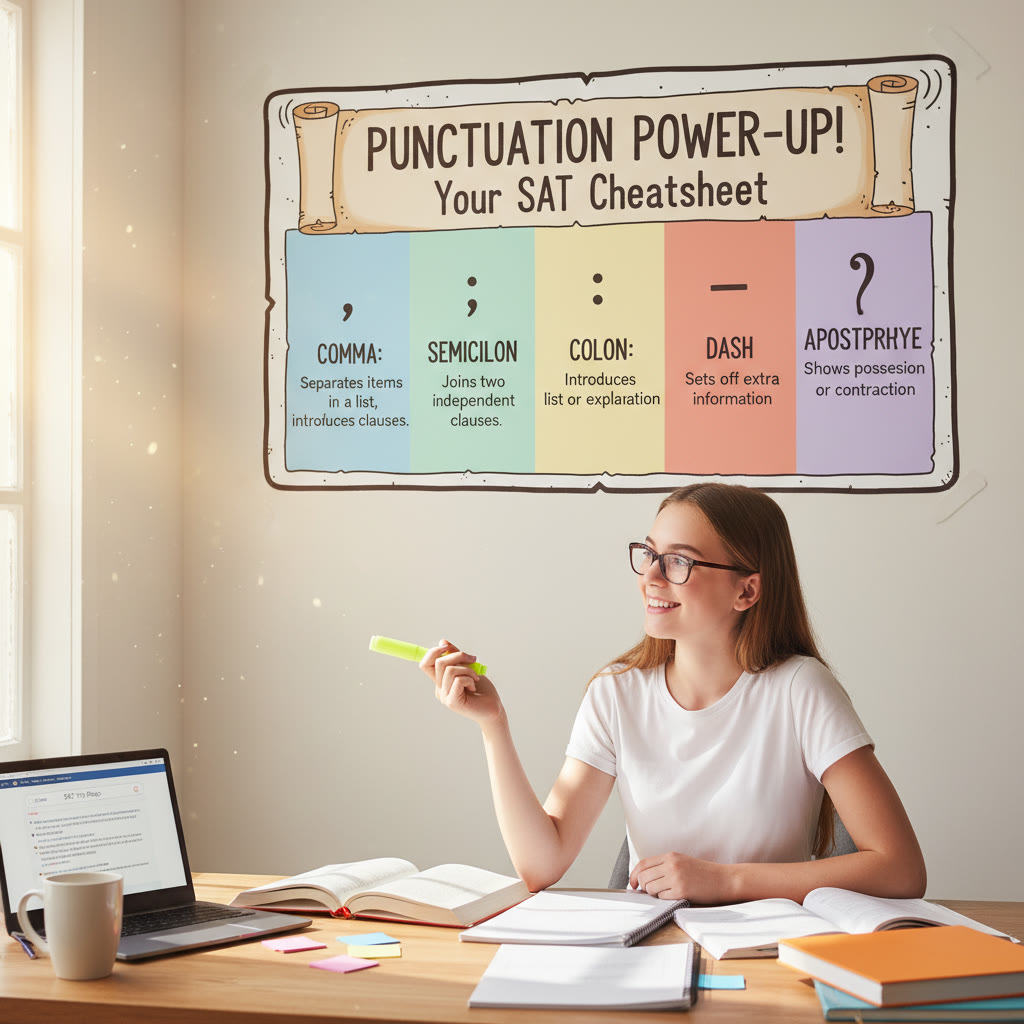
| Punctuation (commas, semicolons, colons, dashes) | Sentence boundaries and clause separation | Use comma for clauses, semicolon between independent clauses | She went to the store she bought milk → She went to the store; she bought milk |
Short rule reminders that save time
- Comma vs. semicolon: use a comma with coordinating conjunctions (and, but, or, so) to join independent clauses; use a semicolon when no conjunction is present.
- Its vs. it’s: its is possessive; it’s means it is or it has.
- Affect vs. effect: affect is usually a verb; effect is usually a noun, though there are exceptions.
- Parallel structure: in lists or comparisons, mirror grammatical form (verb → verb, noun → noun).
- Modifier placement: place descriptive phrases next to what they modify to avoid dangling/awkward modifiers.
Rhetorical skills: the higher-level moves
The Writing & Language test asks more than “What’s the right comma?” It asks, “Does this sentence best serve the author’s purpose here?” That means you need rhetorical instincts: organization, tone, emphasis, and concision.
Key rhetorical question types
- Context and purpose: Should this sentence be added, deleted, or moved for clarity or emphasis?
- Strategy: Which choice best strengthens the argument or improves development?
- Transitions: What word or phrase best connects ideas or signals contrast, cause, or elaboration?
- Conciseness: Which answer makes the sentence more direct without losing meaning?
Practice reading with a purpose: as you scan a passage, ask what the paragraph contributes. If a sentence feels off — either redundant or out of place — the test may ask you to fix it. Keep the author’s voice in mind: the SAT rarely asks you to change tone drastically.
Worked examples: how to approach a question
Seeing an example is the quickest way to internalize strategy. Here are two sample questions (wording simplified for clarity) with thinking-out-loud answers.
Example 1 — Grammar
Passage sentence: “Each of the researchers have a different method for analyzing data.”
- Question: Which choice corrects the error?
- Choices might be: (A) have, (B) has, (C) had, (D) having
Quick analysis: The subject is “each,” which is singular. So the verb must be singular: “has.” Correct answer: (B).
Example 2 — Rhetoric/conciseness
Passage sentence: “Due to the fact that the study was limited in scope, the researchers were unable to draw broad conclusions about the population as a whole.”
- Question: Which choice improves concision?
- Choices might include: (A) Due to the fact that, (B) Because, (C) Since, (D) No change
Quick analysis: “Due to the fact that” is wordy; “Because” is concise and correct. Choose (B). Also note the phrase “population as a whole” could be redundant, so sometimes a second revision might tighten further.
Pacing and time-management strategies
With about 48 seconds per question, pacing matters. Here are practical ways to keep your momentum without losing accuracy.
- Skim the passage for purpose first: Spend 20–30 seconds scanning each passage to identify tone and main idea. That makes rhetorical questions faster to answer.
- Answer line-focused grammar first: If a question targets a single sentence’s grammar, there’s usually a quick rule-based fix.
- Tackle harder questions last: Mark difficult questions and return if time allows. Because there’s no penalty for wrong answers, fill in answers for skipped questions before time ends.
- Use elimination aggressively: Even if you’re unsure, cross out two bad choices and make an educated guess from the remaining two.
- Practice with timed mini-sessions: Do one passage at a time under a strict time limit until your speed feels natural.
Practice habits that build real improvement
You can’t learn all the rules the night before, but consistent, focused practice will transform weak areas into strengths. Here’s a plan that balances rules, strategy, and simulation.
- Daily micro-drills: Spend 15–20 minutes on specific grammar rules (commas, subject-verb agreement, pronouns) with immediate feedback.
- Weekly passage practice: Do full Writing & Language passages under timed conditions to practice transitions, rhetorical choices, and pacing.
- Review mistakes carefully: Don’t just mark answers wrong — write a one-line explanation so the error becomes sticky knowledge.
- Mixed practice: Occasionally combine Writing & Language practice with Reading sections so you build endurance for the full test.
How targeted tutoring accelerates progress
Self-study works, but targeted help can shortcut the learning curve. Personalized tutoring — for example, Sparkl’s personalized tutoring — pairs you with expert tutors who create tailored study plans, provide 1-on-1 guidance, and use AI-driven insights to track weaknesses. That combination can turn slow, piecemeal practice into focused, efficient improvement, especially when you need help identifying recurring error patterns or developing stronger rhetorical instincts.
Common traps and how to avoid them
The SAT loves predictable traps. Recognizing them saves time and prevents careless errors.
- Choice similarity: Two choices might look almost identical. Read them carefully; sometimes a single word change flips correctness.
- Context matters: Don’t correct a sentence in isolation. The right answer must fit the passage’s tone and purpose.
- Watch for double negatives and awkward antonyms: Test-writers sometimes create technically correct but awkward answers to trick you. Favor clarity.
- Graphics questions: Read the question first, then scan the graphic. Don’t assume the graphic repeats passage info; sometimes it introduces new data.
Sample study schedule for 6 weeks
Consistency beats intensity. Below is a compact weekly plan that balances rule learning, passage practice, and review.
- Weeks 1–2: Rule focus — 30 minutes daily on grammar basics (punctuation, agreement, pronouns). 2 passages per week.
- Weeks 3–4: Strategy focus — 30 minutes daily on rhetorical moves and concision. 3 passages per week under timed conditions.
- Weeks 5–6: Simulation and refinement — 2 full-length practice tests that include Reading & Writing. Analyze every Writing & Language mistake deeply.
Tracking progress
Keep a simple log: rule practiced, time spent, error types, and one goal for the next session. If you’re working with a tutor, ask them to help prioritize your weakest patterns and to use AI-driven diagnostics to track trends; that way, you target the mistakes that cost you the most points.
Real-world connections: why these skills matter beyond the SAT
Getting good at the Writing & Language section isn’t just about test scores. The same skills — clear sentence structure, precise punctuation, logical organization, and concise phrasing — make your school essays, college applications, and future workplace writing far better. Employers and professors notice clarity; mastering these moves now gives you an advantage in classes, scholarship essays, and professional emails.

Final checklist for test day
- Bring an approved calculator for the Math sections (not needed for Writing & Language but helpful overall).
- Practice pacing before the test; know that rotating through passages quickly is better than getting stuck.
- Answer every question — guessing has no penalty.
- When in doubt, choose the option that is concise and matches the author’s tone.
- Trust your training: if a rule feels right after practice and explanation, go with it.
Where to go from here
Start small: choose one grammar rule and one rhetorical skill to focus on this week. Use a mix of micro-drills and full passages. If you want a faster, more personalized path, consider pairing practice with a tutor: Sparkl’s personalized tutoring offers 1-on-1 guidance, tailored study plans, expert tutors, and AI-driven insights that identify your error patterns so every minute of practice counts. Tutors can model thought processes aloud, help you move from guessing to strategy, and keep you accountable.
A closing thought
The SAT Writing & Language section rewards steady, thoughtful practice more than raw memory. Treat passages like conversations with an author: ask what each sentence does and whether it serves the whole. Learn the high-frequency grammar rules well, practice rhetorical choices with real passages, and keep your practice timed. Over weeks, not hours, you’ll notice the difference — clearer reading, sharper writing, and a quieter test day because you know what to expect.
Good luck — take it one passage at a time, and celebrate small victories. A single clean, confident edit can become the habit that lifts your score.




















No Comments
Leave a comment Cancel