

Why a Wrong Answer Can Feel Like the Right One
Raise your hand if you have ever picked an answer on the SAT, paused, and felt sure you nailed it — only to find out later it was wrong. You are not alone. The SAT is designed to assess reasoning and knowledge, but it also relies on carefully chosen distractors: wrong answers that sound logical, familiar, or just plain persuasive. Understanding why these distractors work is one of the fastest ways to stop falling into the same traps.
The test maker’s subtle art
College Board question writers aren’t trying to trick you for the fun of it. They want to measure nuanced skills: careful reading, attention to detail, command of grammar rules, and precise mathematical reasoning. To do that, they craft answer choices that are plausible to someone who made a common, understandable slip — a calculation error, a partial reading, a grammatical half-truth, or a misapplied strategy.
Why the wrong answer sounds right
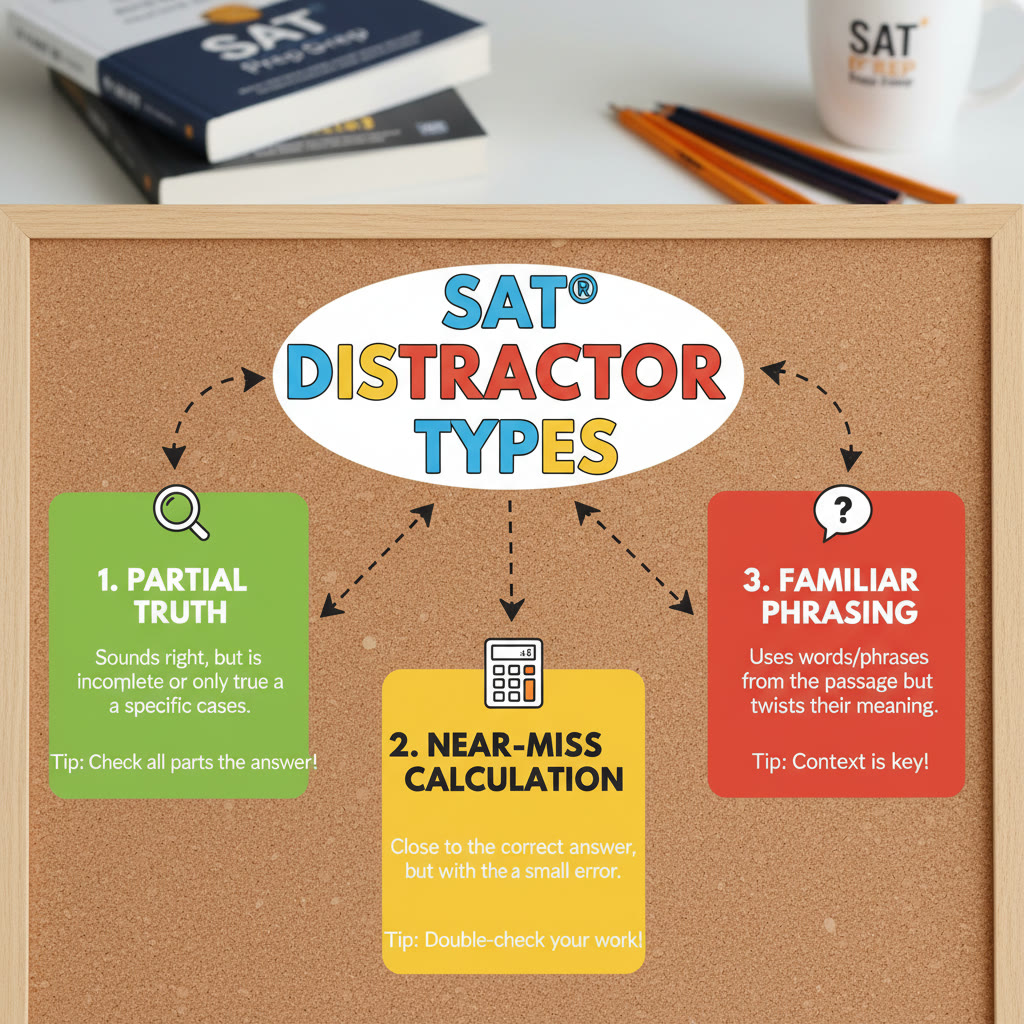
- Familiar wording creates comfort: an option may contain common phrases or textbook language, so it feels authoritative.
- Partial accuracy fools you: an answer that gets part of the problem right but misses a key constraint is convincing.
- Overgeneralization hides mistakes: a rule applied too broadly produces an appealing but incorrect choice.
- Cognitive biases play a role: confirmation bias, anchoring, and the availability heuristic push you toward familiar or recently seen solutions.
Spotlight on Each SAT Section: How Distractors Work
Reading — the lure of plausible inference
In the Reading section, wrong answers often rely on inferences that sound reasonable but go beyond what the passage actually supports. The SAT doesn’t ask you to read the author’s mind. It asks you to choose answers supported by evidence in the passage.
Example pitfall:
Passage describes a scientist who was disappointed with early results, then persisted and later succeeded. A question asks about the scientist’s attitude toward failure. One answer choice: “The scientist hated failure and avoided risks.” Another: “The scientist accepted failure as a natural part of the process and refined methods accordingly.” The wrong choice sounds plausible because the scientist initially disliked failure, but the passage emphasizes persistence and refinement — so the second choice is the supported answer. Picking the first one shows you focused on one detail instead of the whole.
Writing & Language — the siren song of near-correct grammar
Grammar distractors are famous for sounding right. They may match everyday speech, which makes them feel acceptable, but formal standard English rules tested on the SAT can differ from casual usage.
Common traps:
- Comma misuse that mirrors conversational pauses
- Pronoun ambiguity that looks reasonable but lacks a clear antecedent
- Parallelism errors where two items look similar but aren’t structured identically
Example pitfall:
Sentence: “She enjoys hiking, to bike, and swimming.” A choice that changes it to “She enjoys hiking, to bike, and to swim” might seem to fix parallelism, but the correct parallel structure is “She enjoys hiking, biking, and swimming.” The intermediate option sounds closer to the original and tempts the careless reader.
Math — the myth of the neat number
Math trap options often include arithmetic slips or answers that arise from common misunderstandings. They might result from misreading the problem, dropping a negative sign, or misapplying algebraic rules. Distractors are typically results of logical mistakes students actually make.
Example pitfall:
Question: “If 3x + 5 = 2x – 1, what is x?” A quick, sloppy subtraction might give x = -6, while the correct solution is x = -6 after proper isolation? Wait — this is a teachable moment: mistakes in sign handling, or subtracting incorrectly, are the exact types of errors distractors exploit. Working step by step avoids them.
Common Cognitive Reasons You Choose the Wrong Answer
1. Confirmation bias
Once you form a tentative answer, your brain looks for reasons to confirm it. That inner cheerleader points you to language that supports the choice and ignores contrary evidence in the passage or problem.
2. Familiarity and fluency
We tend to prefer answers that read smoothly or use familiar turns of phrase. Fluency creates a false sense of correctness. Test writers intentionally use familiar language in distractors so students who skim are lured in.
3. Anchoring
Early thoughts anchor subsequent thinking. If the first line of a passage suggests a tone or perspective, you might anchor to that and miss nuances introduced later.
4. The partial-solution trap
Sometimes an option correctly addresses part of the question. Partial correctness is persuasive. If you don’t check the full scope, you might confidently pick a choice that’s only half right.
Practical Strategies to Outsmart “Right-Sounding” Wrong Answers
Active reading and evidence-first answering
Make evidence your compass. For Reading and Writing, underline or note the specific sentence or phrase that supports your answer. If you can’t point to concrete lines, the choice is likely a distractor.
Always ask: What’s missing?
For any plausible answer, ask yourself what it leaves out. If an option ignores a condition in the question or a qualifier in the passage, it’s probably wrong. Great answers address the full question.
Backsolve and plug in numbers for Math
When variables make the problem abstract, pick a convenient number and test answer choices. This reveals distractors that match a partial pattern but fail under substitution. Also consider units and extreme values: if an answer behaves oddly with x = 0 or x = 1, that’s a red flag.
Use process of elimination aggressively
Eliminating two bad options is often easier than proving one correct. Remove choices that are clearly off-base and then focus your energy on distinguishing the remaining ones.
Read for the question the test asks, not the question you expect
Students sometimes answer a familiar question instead of the one on the paper. Slow down on the first read to ensure your mental model matches the prompt. Rephrase the question in your own words before scanning answers.
Turn answer choices into mini true/false checks
For each choice, ask a quick testable question. For reading: “Does the passage explicitly support this claim?” For math: “Is this consistent with a simple substitution?” For grammar: “Does this preserve the sentence structure and meaning?”
A Handy Table of Distractors and How to Be Skeptical
| Type of Distractor | Why It Sounds Right | How to Check It |
|---|---|---|
| Partial Truth | Contains an element from the passage or problem | Look for the missing piece or qualifier |
| Near-Miss Calculation | Matches a common arithmetic slip | Recompute step-by-step or test with an easy number |
| Familiar Phrase | Reads like natural speech or textbook language | Ask for direct textual support or grammatical correctness |
| Overgeneralization | Applies a rule broadly in an appealing way | Check qualifiers like “always” or “never” and search for exceptions |
| Ambiguous Antecedent | Pronoun seems to point to a clear noun at first glance | Identify the exact antecedent and test clarity |
Examples You Can Practice Right Now
Reading example
Passage snippet: “Although the artist received little recognition in his lifetime, his sketches circulated among a small circle of peers who admired the economy of his line work.” Question: “What is the main point about the artist’s early reputation?” Options might include:
- He was completely unknown and had no influence.
- He was not widely recognized but did influence a small group of peers.
- He was famous for his line work during his life.
The first choice sounds plausible if you focus only on the phrase “little recognition,” but the correct choice is the second: the passage mentions peers who admired and shared his work. Evidence-first reading makes this clear.
Writing & Language example
Original: “The committee reviewed the applications, and after deliberation was praised for their transparency.” Question: “Choose the best revision to correct the sentence.” One tempting answer might preserve the casual structure but leave a pronoun mismatch. The correct revision fixes agreement: “The committee reviewed the applications, and after deliberation it was praised for its transparency.” Here a distractor might sound smoother but fails subject-verb or pronoun agreement under scrutiny.
Math example
Problem: “If f(x) = 2x – 3 and f(a) = 7, what is a?” Typical student slip: substitute poorly and choose a wrong numeric answer that matches a common arithmetic error. The correct approach: set 2a – 3 = 7, add 3 to get 2a = 10, so a = 5. If you see a tempting wrong answer like 2 or 4, ask yourself which arithmetic step would produce that result and recompute to catch the error.
How Practice Changes Your Gut
Part of why distractors work is that your brain builds shortcuts. Consistent, focused practice reshapes those shortcuts. When you practice with attention to the exact kinds of mistakes that produce distractors, your intuition starts to favor correct, evidence-backed answers.
Deliberate practice beats blind repetition
Instead of timing yourself through random problem sets, take sessions where you intentionally analyze every mistake. Ask: why did that wrong answer feel right? Was it a reading slip, a grammar blind spot, or a calculation error? Logging this pattern helps you predict and avoid similar traps.
How personalized help accelerates this process
This is where targeted guidance can make a huge difference. Working 1-on-1 with a tutor speeds up pattern recognition because a tutor can pinpoint recurring missteps and offer tailored drills. For instance, Sparkl’s personalized tutoring offers tailored study plans and expert tutors who can identify whether your mistakes are rooted in comprehension gaps, rule confusion, or careless errors. Their AI-driven insights can highlight which distractor types trip you up most and recommend practice that attacks those exact weaknesses.
Mental Habits That Protect Against Plausible Wrong Answers
Slow down selectively
There is a balance between speed and accuracy. For questions that feel instantly easy, give yourself a micro-check: a 10-second verification to find missing qualifiers or misread numbers. For tougher questions, deliberately slow down and map out the evidence or steps.
Keep a mistake journal
After practice tests, record each wrong answer along with why it seemed right at the time. Over weeks you will see patterns, and that pattern recognition is more valuable than raw practice volume.
Learn the common distractors by section
Train your radar for the kinds of wrong answers that appear most often in each section. Make quick reference lists: for Reading, watch for overgeneralization and inference without support; for Writing, watch pronoun and parallelism traps; for Math, watch sign errors and dropped constraints.
Final Thoughts: From Feeling Fooled to Feeling Confident
It is normal to feel fooled sometimes. The SAT is intentionally tricky in ways that are fair and measurable. If you approach the test with humility and strategy, you can convert that feeling of being misled into an advantage. Each distractor you learn to spot becomes one fewer reason to waste time guessing and one more reason to trust your corrected instincts.
Remember: the goal is not to become suspicious of every answer, but to become selectively skeptical. Build evidence-first habits, practice deliberately, and use smart supports when you need them. Personalized help, like Sparkl’s 1-on-1 guidance, tailored study plans, expert tutors, and AI-driven insights, can accelerate your learning curve and sharpen the exact mental checks that catch those seductive wrong answers. With training, practice, and the right strategies, the answers that once sounded right will start to sound obvious for the right reasons.

A quick checklist to use during practice tests
- Did I find direct evidence in the passage or problem? If not, re-evaluate.
- Is the answer fully addressing the question including qualifiers? If not, eliminate it.
- For math, can I plug in a number or backsolve to confirm? If not, test one.
- Have I fallen for a familiar-sounding phrasing or casual grammar that isn’t formal? Revise accordingly.
- After choosing an answer, can I state the specific reason it is correct in one sentence? If not, reconsider.
Stop telling yourself you “got fooled.” Tell yourself you learned something. Every wrong answer that once sounded right is an opportunity to build a new, stronger instinct. Stay curious, practice smart, and let your confidence grow from evidence, not assumption.























No Comments
Leave a comment Cancel