

The Balance of Skills Tested Across SAT Sections
Think of the SAT as a three-act play: each act has its own tone, its own objectives, and its own tricks — but the whole performance is judged on cohesion and endurance. Understanding how skills are balanced across the sections (Evidence-Based Reading and Writing, and Math) is the fastest route to studying smarter. This post walks you through what each section really measures, how they overlap, and how to build a balanced practice plan that targets content, strategy, and stamina. Along the way, you’ll see clear examples, realistic scheduling, and where personalized help — like Sparkl’s 1-on-1 guidance, tailored study plans, expert tutors, and AI-driven insights — can fit naturally into your preparation.
Quick SAT anatomy: what you’re actually being tested on
Before we dig into balance, let’s be explicit about the layout so you know what to prioritize. The current SAT is divided into two major domains: Evidence-Based Reading and Writing (EBRW) and Math. The Essay is no longer administered as part of the standard test. Scores range from 400 to 1600, with EBRW and Math each scored from 200 to 800.
Official timing and question counts:
- Reading: 65 minutes, 52 questions
- Writing & Language: 35 minutes, 44 questions
- Math: 80 minutes total — 25 minutes (No Calculator, 20 questions) + 55 minutes (Calculator allowed, 38 questions) = 58 questions
- Total questions: 154; total testing time: 180 minutes (3 hours)
Those numbers are more than administrative details — they reveal the test’s emphasis. For instance, Reading and Writing together make up half the score, so strong evidence-based reading and clear grammar/usage command are essential. Math commands the other half, but the Math section is split into discrete “calculator” and “no-calculator” modes that test different kinds of fluency.
What each section truly measures
Reading: comprehension, evidence, and reasoning
The Reading section is less about remembering facts and more about extracting meaning, evaluating arguments, and using textual evidence. Typical skills include:
- Identifying central ideas and themes
- Interpreting explicit and implicit meaning
- Using evidence from the passage to support answers
- Analyzing authors’ tone, purpose, and rhetorical choices
Example: You’ll often see questions that point to two lines and ask which statement best explains how the second supports the first. That’s testing your ability to read across sentences and connect claims to evidence — a skill useful not only for the SAT but for college reading in general.
Writing & Language: clarity, structure, and effective expression
This section measures editing and revising skills. You’ll see short passages with underlined portions and asked to choose the best revision. It tests:
- Grammar and usage (punctuation, subject-verb agreement, verb tense consistency)
- Conciseness and precision in expression
- Logical organization within and between paragraphs
- Appropriate tone and word choice
Think of Writing & Language as the test’s “clear communicator” check — can you pick the version of a sentence that says the same thing more precisely and appropriately?
Math: conceptual fluency, modeling, and accurate computation
Math on the SAT is divided into three knowledge categories that roughly correspond to the College Board’s blueprint:
- Algebra (including linear equations, systems)
- Problem Solving & Data Analysis (ratios, percentages, interpreting graphs/tables)
- Advanced Math (functions, manipulating polynomials, more complex equations)
Geometry and trigonometry appear but are a smaller slice. Importantly, the two math modules (no-calculator and calculator) test slightly different strengths: quick, accurate numerical thinking without technology, and more multi-step modeling and calculation with a calculator’s help.
Overlap and interplay: why the sections aren’t isolated islands
Although Reading, Writing & Language, and Math have their own content, the SAT values cross-cutting skills. Here’s how they connect:
- Evidence and reasoning: Both Reading and Writing demand evidence-based choices — the difference is one uses textual evidence and the other uses sentence- or paragraph-level logic.
- Data interpretation: Math frequently presents graphs and tables; Reading can include passages with charts. Interpreting visual data benefits both domains.
- Pacing and stamina: The cognitive load of focused reading mirrors the concentration required for multi-step math problems; practice in one reinforces endurance in the other.
- Vocabulary in context: Word meaning matters in Reading, but it also affects choices in Writing & Language; precise vocabulary reduces ambiguity across the test.
Therefore, a smart study plan targets these common denominators as much as it targets isolated content areas.
How to interpret balance in terms of time and effort
Not all sections need equal hours. Instead, you should allocate effort based on your baseline strengths, official weighting, and the kinds of skills each section demands. Below is a practical study-allocation table to guide average students preparing for a 12-week plan. Adjust numbers if you’re starting exceptionally above or below target.
| Section/Skill | Percent of Weekly Study Time (baseline) | Focus Areas |
|---|---|---|
| Reading | 30% | Active reading, evidence questions, passage mapping, vocabulary in context |
| Writing & Language | 15% | Grammar rules, sentence clarity, organization, editing practice |
| Math (No Calculator) | 15% | Arithmetic fluency, algebra basics, mental math |
| Math (Calculator) | 20% | Multi-step problems, modeling, functions, interpreting data |
| Test Strategy & Full-Length Practice | 20% | Timed sections, pacing, error logs, stamina building |
That table is a baseline: if you’re a strong math student but struggle with reading, flip the percentages to spend more time on Reading. The point is to be strategic, not uniform. Also keep at least one blocked, full-length practice test every 7–10 days in the later weeks; that pulls the skills together under test conditions.
Concrete strategies for balancing skills
1. Build conceptual depth first, speed and accuracy second
Start by ensuring you understand core concepts: algebraic manipulation, main idea vs. detail, and the essential grammar rules. Once conceptually solid, deliberately practice under time pressure. Concept without speed is incomplete; speed without concept is fragile.
2. Use error logs to spot cross-sectional weaknesses
Keep a simple error log: record the question type, the mistake (content mistake, careless error, timing issue, misreading), and corrective action. Over time, patterns will emerge — for instance, confusing “evidence-support” questions in Reading and choosing answers that merely restate a detail rather than showing why it supports a claim.
3. Practice integrated tasks to transfer skills
Schedule mixed practice sessions that mirror the test’s shifts: do a 25-minute reading passage followed by a 20-minute math set. That trains mental flexibility and keeps your brain ready to switch between verbal and quantitative reasoning without losing focus.
4. Prioritize modeling and interpretation
Math problems often reward the student who can translate words into equations. Likewise, Reading and Writing reward precise interpretation of author intent and structure. Practice converting word problems into equations and annotating passages to make the author’s line of reasoning explicit — these habits produce gains across sections.
5. Train active reading, not passive skimming
Active reading means underlining (or marking) key claims, noting the author’s purpose, and paraphrasing complex sentences. This reduces time wasted rereading and improves accuracy on evidence-based questions.
Sample day-to-day micro-plan (for a busy week)
Not everyone has long, distraction-free study days. Here’s a compact plan you can do in three focused one-hour blocks across a weeknight.
- Hour 1 (Reading focus): 1 passage (25–30 minutes timed) + 15 minutes reviewing mistakes and writing a one-sentence takeaway.
- Hour 2 (Math focus): 6–8 mixed math problems (25–30 minutes) + 15 minutes reviewing error log and technique.
- Hour 3 (Writing & Strategy): 20–25 minutes of grammar passage practice + 20–25 minutes reviewing pacing and quick strategy drills (e.g., how to eliminate wrong answers fast).
Keep one weekend block for a full practice section: a timed Reading or Math section each Saturday, rotating so you face each under realistic conditions.
Examples and mini-explanations that reveal the balance
Two short examples show why cross-training matters:
Reading evidence question (mini-example)
Passage line: “Despite the author’s enthusiastic descriptions of the device, a pattern of small failures suggests that the machine’s long-term viability could be in doubt.”
Question (paraphrased): Which choice best explains how the following sentence supports the author’s claim that the device may not be viable?
- Answer idea A: It lists the device’s benefits. (Wrong: supporting the opposite claim.)
- Answer idea B: It gives examples of repeated failure modes suggesting unreliability. (Right: connects the specific evidence to the broader claim.)
Takeaway: Reading questions often hinge on cause-and-effect or support relationships. This is the same logical mapping you use when editing a sentence in Writing & Language: does the change preserve the intended relationship?
Math modeling question (mini-example)
Scenario: A bakery sells muffins in boxes. If 3 boxes contain 18 muffins, and the bakery sells 2/3 of its muffins on Saturday, how many muffins remain if they originally had 180?
Work: 3 boxes = 18 muffins → 1 box = 6 muffins. But the faster approach is noticing ratios: if 3 boxes → 18 muffins, that’s a 1:6 ratio baked-in; however, with 180 muffins originally and selling 2/3, remaining = 1/3 of 180 = 60. No heavy algebra needed.
Takeaway: Translating text to ratio logic is a cross-cutting skill useful for data questions on both Math and Reading passages that include numerical information.
Measuring progress and what to expect
Progress often looks non-linear. You’ll have weeks where your math score jumps and reading plateaus. That’s normal. Key milestones should be:
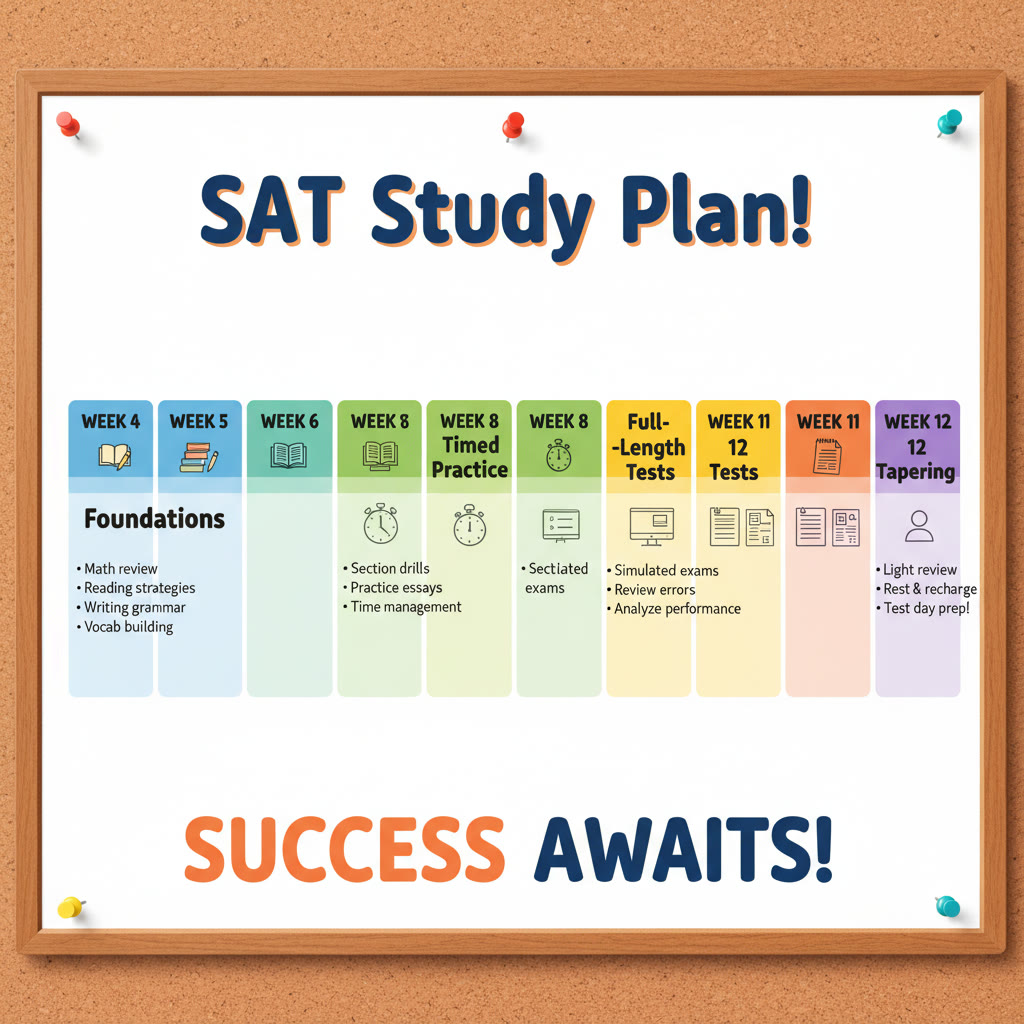
- Weeks 1–4: Build foundations — learn or review major concepts and start error logging.
- Weeks 5–8: Increase timed practice and begin simulating sections under pressure.
- Weeks 9–12: Full practice tests, targeted drills for weak points, and tapering before the test (less new content, more review and strategy).
Scores improve most rapidly when focused drilling corrects persistent error types (for example, consistently missing evidence-support questions in Reading or sign errors in math). That’s where tailored feedback really speeds things up.
Where personalized tutoring fits naturally
Balancing skills is not only about putting in time — it’s about targeted, intelligent practice. That’s why many students find personalized tutoring valuable. One-on-one tutoring helps you:
- Build a tailored study plan based on your diagnostic results
- Get immediate feedback on persistent error types
- Use AI-driven insights to prioritize the exact skills that will move your score the most
- Have an expert tutor model the thought process for complex passage analysis or multi-step math modeling
For example, Sparkl’s personalized tutoring blends expert human coaching with AI-driven insights to identify which question types you miss most, then creates a plan that focuses effort where it matters. In practice, that might mean extra sessions on interpreting primary sources for someone struggling with evidence-based questions, or focused timing drills for a student whose raw ability is strong but who loses points from pacing issues.
Practical checklist to keep balance in your study
- Take a timed diagnostic to know your baseline across each section.
- Create a weekly plan weighted by weakness and official section weighting.
- Do mixed-section practice to develop mental flexibility.
- Use error logs and review every incorrect question carefully.
- Schedule regular full-length practice tests under test-like conditions.
- Allow time for light tapering and confidence-building in the last week.
Final thoughts: balance is a practice, not a destination
Balancing the skills tested across SAT sections is about shaping how you learn, not just what you memorize. It’s about recognizing overlaps — evidence-based reasoning shows up everywhere, as does careful interpretation of numbers; pacing and attention underpin every section. Use focused content work to shore up weaknesses, but don’t forget strategy practice, mixed drills, and full-length simulations.
If you find it hard to convert diagnostics into an efficient plan, a personalized approach can make that process far simpler. Sparkl’s 1-on-1 guidance, tailored study plans, expert tutors, and AI-driven insights are tools that many students use to make their study time more efficient — especially when they’re trying to balance skills and make steady, measurable progress.
At the end of the day, the most successful test-takers are those who think of preparation as a balanced program: content knowledge + reasoning skills + stamina + strategy. Practice thoughtfully, review ruthlessly, and keep the bigger picture in mind: building the reasoning habits that will serve you well in college and beyond.


























No Comments
Leave a comment Cancel