

Why Strong Readers Consistently Excel on the SAT
If you ask top scorers what helped them most on the SAT, many will point to one clear advantage: strong reading skills. That doesn’t mean they’re word nerds who have memorized every obscure vocabulary word. It means they can read clearly, think critically, and translate passages into smart answers under time pressure. In this post we’ll unpack why reading strength maps so directly to SAT performance, show concrete examples, and give a practical plan you can use to get better—faster. Along the way you’ll see where Sparkl’s personalized tutoring and benefits like 1-on-1 guidance, tailored study plans, expert tutors, and AI-driven insights naturally fit into a smart prep strategy.
The SAT is, at its core, a reading and reasoning test
Think of the SAT as a test of how well you can use words to reason. Even on the Math section, word problems and multi-step reasoning require clear comprehension. But the Evidence-Based Reading and Writing (EBRW) section is the clearest place where reading matters. The EBRW asks you to:
- Understand the main idea and structure of passages.
- Interpret the author s tone, purpose, and assumptions.
- Identify evidence that supports specific claims.
- Edit and improve sentences and paragraphs using context and logic.
Those are fundamentally reading skills. When you are practiced at identifying main ideas, spotting implied meaning, and skimming for structure, you convert tricky passages into straightforward tasks.
Reading skills map directly to the SAT question types
On the SAT, reading skills aren t an abstract concept—they show up as distinct question types. For example:
- Main idea questions ask you to summarize the passage in one sentence.
- Detail questions ask you to find and interpret specific lines or data.
- Inference questions require reading between the lines.
- Function questions ask why the author included a sentence or example.
- Vocabulary-in-context items test your ability to choose meanings from surrounding text.
When you practice the underlying skill—summarizing, tracking arguments, or inferring tone—the question type becomes predictable. That predictability is what strong readers exploit to raise scores consistently.
Why strong readers outperform others: four core advantages
1. Faster comprehension + better accuracy
Good readers don t just read faster; they read smarter. They can identify topic sentences, follow transitions, and skip irrelevant details. On the SAT, where you might have only 13 minutes for a passage with several questions, speed without loss of comprehension is gold. That combination reduces careless errors and prevents the need for wild guessing.
2. Clearer mental models of structure and argument
A strong reader constructs a mental outline as they go: premise, evidence, counterargument, conclusion. That makes it easier to answer function and evidence questions because the test relies heavily on structural cues. If you can label sentences as “claim” or “support,” you turn a messy paragraph into an organized map.
3. Better control of nuance and inference
Many SAT wrong choices look right at first glance because they capture part of the passage or an appealing idea. Strong readers are trained to look for nuance: subtle qualifiers, contrasts, and hedging language like “may,” “some,” “often,” or “while.” Catching those qualifiers helps you choose precise answers instead of broad, tempting ones.
4. Cross-section benefits (reading helps math too)
Don t ignore the indirect benefit: reading skills help you interpret complex word problems on the Math section. A student who struggles to parse a 4-line word problem will lose math points even with solid computation skills. Reading proficiency turns language into usable equations quickly, saving time and avoiding misinterpretation.
Concrete examples: how reading practice turns confusion into clarity
Example 1: Main idea vs. tempting detail
Imagine a passage about urban transportation. The author describes buses, bike lanes, and rideshare apps, then argues that cities should prioritize infrastructure for walking. A typical wrong answer might highlight the lengthy discussion of rideshare growth (a tempting detail) instead of the final argument about walking. Strong readers note the thesis sentence and the author s closing emphasis; they choose the answer that captures the argument, not the most memorable example.
Example 2: Inference with qualifiers
Consider a line: “While some studies link screen time to attention problems, the evidence is inconsistent and often limited by short-term designs.” A weak reading would infer that screen time definitely causes attention problems. A strong reader recognizes the hedging: the author is skeptical about causation. That nuance flips the correct answer on an inference question.
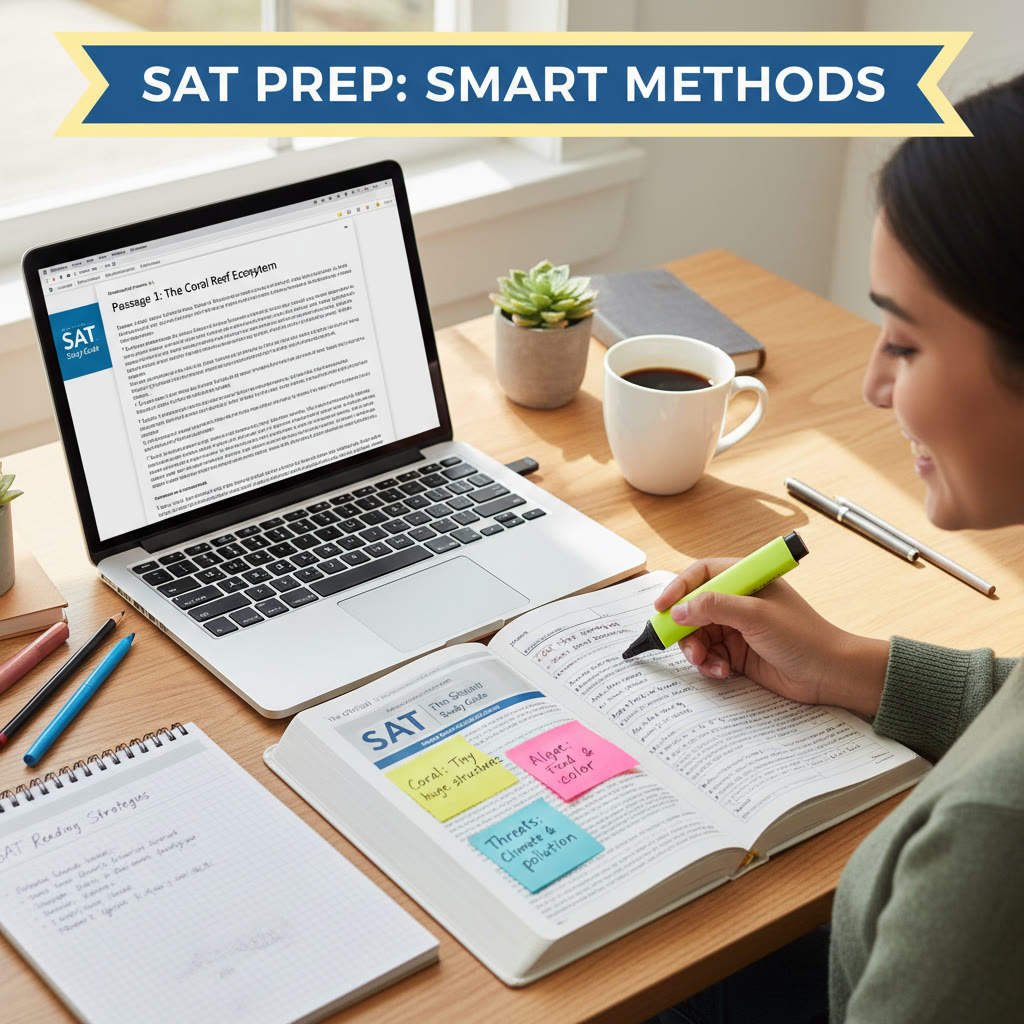
Quick strategy: label as you read
- Main idea: underline or note one sentence that captures the thesis.
- Paragraph function: jot a one-word summary (e.g., ‘evidence’, ‘counter’, ‘example’).
- Transitional signals: circle words like ‘however’, ‘therefore’, ‘nevertheless’.
Small, invisible marks and a consistent mental routine reduce the cognitive load when questions arrive.
How reading skill-building improves the Writing & Language section
Context-driven grammar and sentence choices
The Writing & Language section isn t just grammar—it’s grammar inside a context. You must choose sentence edits that maintain tone, pace, and logical flow. Strong readers are already comfortable with tone and author intent; they can spot when an edit shifts meaning or introduces an awkward emphasis.
Example: choosing clarity over correctness
Sometimes two options are both grammatically correct, but one preserves the author s intent and rhythm better. A reader who senses the passage s voice will pick the choice that fits the context, not the one that merely looks clean on paper.
Practical habits that make you a stronger SAT reader
Daily reading that trains your brain, not just your eyes
Volume matters, but variety matters more. Reading diverse, high-quality material teaches you different rhetorical moves and vocabulary in context. Try a mix of:
- One short science or social science article (500 900 words)
- One opinion or editorial piece
- A passage of classic or modern literature (a short story or excerpt)
Spend 20 30 minutes daily. But don t speed-read—practice active reading: label, summarize in one sentence, and explain the argument to yourself or out loud.
Targeted SAT passage practice
Mix untimed careful reading with timed sections. Untimed, you learn the scaffolding; timed, you learn pacing. Alternate weeks where you focus on depth (annotating every paragraph) with weeks of speed and review. Accuracy should improve first; speed will follow.
Develop a short pre-question routine
Before you look at the questions, spend 20 30 seconds doing a quick mental snapshot:
- What’s the main idea in one sentence?
- Which paragraph likely holds evidence for the argument?
- What tone does the author use (neutral, critical, celebratory)?
That initial frame cuts time spent flipping through the passage when a question asks for evidence.
Study plan example: 8-week schedule to build reading strength
Below is a compact 8-week plan you can tailor. The right side shows weekly tasks and target focus areas. If you use Sparkl s personalized tutoring, a tutor can adapt this plan to your baseline and goals, integrating 1-on-1 guidance and AI-driven insights to speed progress.
| Week | Focus | Weekly Tasks |
|---|---|---|
| 1 | Baseline & routine | Take a diagnostic SAT Reading; begin daily 20 30 minute diverse reading; practice one untimed passage |
| 2 | Main ideas & structure | Annotate passages, label paragraph functions, review missed questions with error log |
| 3 | Inference & nuance | Practice inference-heavy passages; write one-sentence summaries for each passage |
| 4 | Evidence & paired questions | Do evidence-based question sets; practice justifying answers with direct passage lines |
| 5 | Writing & Language context | Daily grammar in context drills; practice editing for tone and logic |
| 6 | Timed sections | Complete timed Reading sections twice; review mistakes deeply |
| 7 | Target weaknesses | Personalized practice (vocab-in-context, science passages, etc.); consider tutoring sessions for tricky items |
| 8 | Full practice & review | Take a full practice test under real conditions; review and plan final week |
Why tracking and an error log matter
It s not enough to do passages; you must understand why you missed a question. An error log forces you to record the type of mistake (timing, misread, wrong inference, vocabulary) and the fix. This targeted reflection is what turns practice into improvement. Tutors—especially with a platform like Sparkl s personalized tutoring—can accelerate this by customizing study plans and using AI-driven insights to find patterns in your errors.
Quick strategies to use on test day
1. Skim smart, not fast
Don t try to memorize details. Skim for structure and tone, then let the questions anchor you to specific lines when needed.
2. Always find evidence
Even if an answer feels right, look back and find lines that justify it. Many SAT questions have “evidence” counterparts; if you can cite a line, you re usually correct.
3. Watch for extreme answer choices
Answer choices that use absolute words like “always” or “never” are often traps. The SAT loves subtlety; pick the answer that best matches the passage s nuance.
4. Use the process of elimination
Cross out choices that are clearly off (wrong tone, irrelevant detail, contradiction). Even if you re down to two, you re in a much better position to choose accurately.
How Sparkl s personalized tutoring complements self-study
Self-study builds habits, but targeted, individualized help makes those habits efficient. Sparkl s personalized tutoring can plug into each step of your plan. Here s how a tutoring approach adds value:
- 1-on-1 guidance: a tutor observes your answer patterns and corrects misconceptions in real time.
- Tailored study plans: instead of generic suggestions, your plan focuses on the precise reading skills you need most.
- Expert tutors: tutors model annotation, pacing, and answer justification strategies you can replicate on test day.
- AI-driven insights: tools highlight question patterns and predict fatigue points, helping you prioritize practice.
When you pair your daily reading and timed practice with occasional sessions that correct bad habits, your score trajectory becomes smoother and faster.
Common pitfalls and how to avoid them
Pitfall 1: Memorizing vocabulary lists without context
Rote vocabulary study helps a little, but the SAT uses vocabulary in context. Instead of memorizing definitions, learn how words change meaning with different sentences. Practice with vocabulary-in-context questions and note how roots and tone influence meaning.
Pitfall 2: Over-annotating every passage
Annotation is helpful, but too much note-taking wastes time. Train a compact routine: one-sentence summary, paragraph function, and a couple of marks for transitions. Efficiency beats exhaustive notes on test day.
Pitfall 3: Ignoring weak passage types
If you hate science passages, you re not alone—but avoiding them will hurt your score. Intentionally practice the types you resist because the SAT rotates passage genres; balance matters.
Putting it together: practice, feedback, and small habits
Strong reading on the SAT is the product of three things: consistent practice, honest feedback, and tiny daily habits. Practice helps you build pattern recognition; feedback corrects misunderstandings; habits make your performance stable under pressure. The difference between a mid-range and a top-range SAT reader is often less about raw intelligence and more about how well those three elements are combined.

A simple daily checklist
- 20 minutes of diverse reading with one-sentence summaries
- One untimed SAT passage with full annotation
- One timed passage or set of Reading questions
- Update error log for any missed question
Do this five days a week and you ll see steady gains in accuracy and confidence.
Final thoughts: reading skill is the SAT s multiplier
Strong readers don t just do better on reading questions; they approach the whole test with clearer thinking and less second-guessing. The skills are transferable, measurable, and trainable. You don t need to read everything in the world to improve dramatically—focused, varied practice and frequent feedback are enough.
If you want to accelerate your improvement, consider mixing guided tutoring sessions with disciplined self-study. Sparkl s personalized tutoring model—combining 1-on-1 guidance, tailored study plans, expert tutors, and AI-driven insights—fits naturally into a plan that emphasizes small, repeatable habits and precise error correction. The result is not just a higher SAT score but a stronger, more confident reader for college and beyond.
Reading well will serve you long after the SAT. It s how you make clearer arguments, learn faster in classes, and think with more precision. Start today with one focused passage, one honest error log entry, and one small habit. The compound effect will surprise you.


















No Comments
Leave a comment Cancel