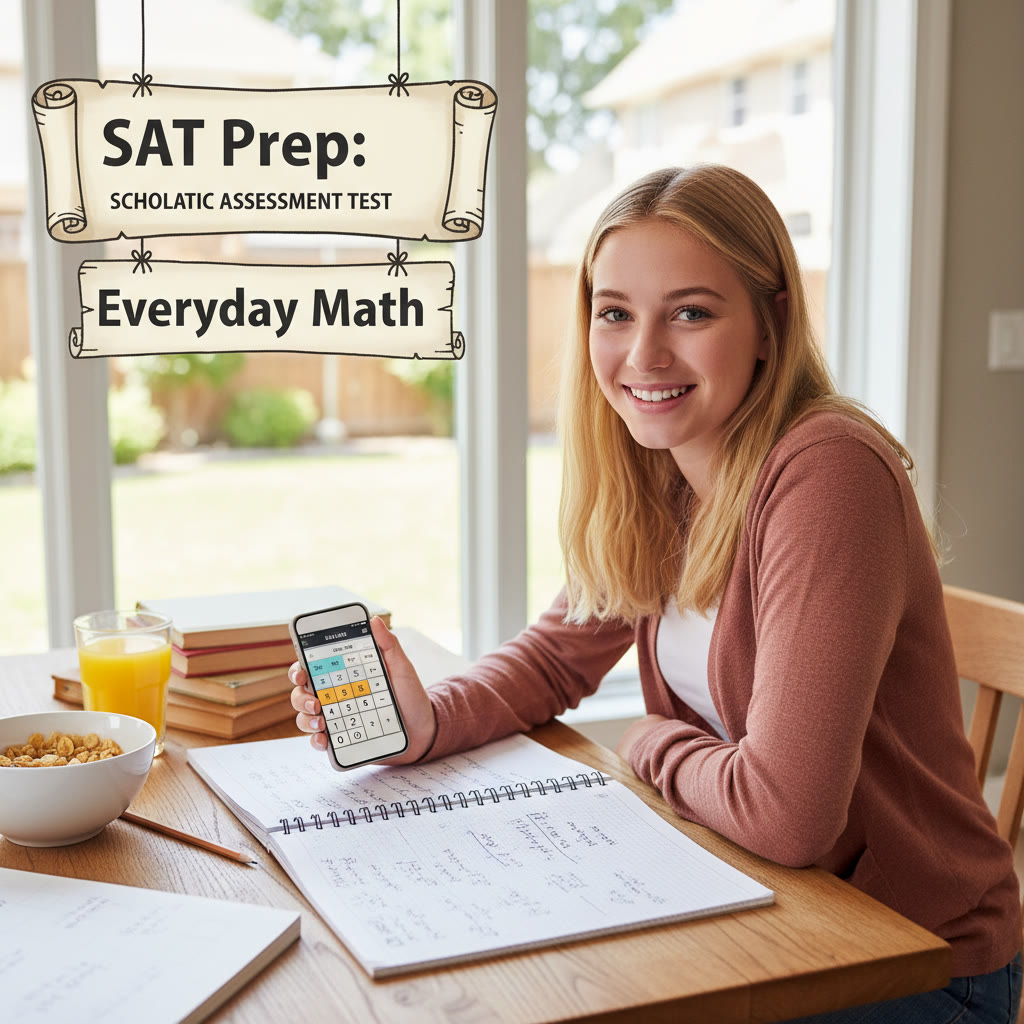

Why the SAT Is More Than a Test
When most students hear the word SAT they picture bubble sheets, timed sections, and a score that opens or closes doors to colleges. That is true, but it is only part of the story. The SAT is designed to measure skills that go far beyond the exam room: clear reasoning, efficient computation, careful reading, and the ability to make sound decisions under pressure. These are exactly the abilities we use every day when balancing a budget, interpreting a chart, reading a contract, or deciding how long a commute will take.
The practical value of exam skills
Think of the SAT as a concentrated training ground. The problems are crafted to test habits—like defining the question clearly, breaking a problem into manageable pieces, checking for assumptions, and picking the fastest route to an answer. Those habits transfer directly to ordinary life. If you know how to eliminate implausible choices on a multiple-choice question, you can also quickly weigh options when planning a trip or choosing the best phone plan.
The two sides of the SAT and their everyday parallels
The current SAT has two main sections: Evidence-Based Reading and Writing (EBRW) and Math. The optional essay was discontinued. Scores range from 400 to 1600. Each section emphasizes a set of cognitive skills that show up in daily tasks.
Evidence-Based Reading and Writing
This section measures comprehension, synthesis of information, and command of evidence. In life, these map to:
- Evaluating news articles and spotting bias
- Reading contracts, instructions, or recipes carefully
- Synthesizing data from multiple sources to make a decision
Math
The SAT math section focuses on algebra, problem solving, data analysis, and some advanced topics. Beyond formulas, it rewards number sense, proportional reasoning, and the habit of checking work. Everyday parallels include:
- Estimating total cost while shopping
- Adjusting a recipe for more or fewer servings
- Interpreting graphs and statistics in news and studies
Mapping SAT skills to real-world tasks
Here is a simple, practical map that connects a few SAT skills to everyday tasks and how to practice them outside the classroom.
| SAT Skill | Everyday Example | How to Practice |
|---|---|---|
| Critical reading and inference | Deciding whether a news story’s claim is supported by evidence | Read articles; annotate claims and evidence, ask what is assumed |
| Quantitative reasoning | Calculating a tip or prorating a bill | Practice quick mental math and check with a calculator |
| Data interpretation | Evaluating a chart about local weather trends or test scores | Translate charts into sentences, notice axes and units |
| Algebraic modeling | Figuring out the break-even point for a small side business | Set up equations from words, solve, and interpret results |
| Time management under pressure | Meeting multiple deadlines and prioritizing tasks | Simulate timed work blocks and practice quick triage |
Concrete examples: From test question to grocery cart
Sometimes the best way to see a connection is through a worked example. Below are two parallel problems: one framed like an SAT question and one like a real-world task. The approach to solving each is nearly identical.
Example 1: Ratios and proportions
SAT-style prompt: A recipe that serves 8 calls for 3 cups of flour. A baker wants to make enough to serve 20. How many cups of flour are required?
Everyday scenario: You are doubling orders at a bake sale. You need quick scaling for ingredients.
How to think it through:
- Identify the ratio: 3 cups per 8 servings
- Find the unit rate: 3/8 cups per serving
- Multiply by 20 servings: (3/8) × 20 = 7.5 cups
Same algebra: let x = cups for 20 servings, 3/8 = x/20, so x = 20 × 3/8 = 7.5. This is the kind of tidy algebra the SAT rewards and the kind you use when life asks you to scale quantities.
Example 2: Interpreting graphs
SAT-style prompt: A line graph shows the monthly sales of a coffee shop. From March to June sales increase steadily from 4000 to 5200. What is the average monthly increase?
Everyday scenario: You want to know how quickly a savings account is growing to plan a purchase.
How to approach:
- Compute the difference: 5200 minus 4000 = 1200
- Divide by the number of intervals (March to June is three intervals: March–April, April–May, May–June): 1200 / 3 = 400
- Average monthly increase is 400
Whether it is sales or savings, you are translating a visual into a simple rate—again, the same core skill.
Strategies that build both SAT success and life-ready skills
Preparing for the SAT offers a chance to cultivate habits that pay off in college and beyond. Here are strategies that serve both tests and daily life.
1. Read with intention, annotate like a detective
On the SAT, annotation helps you find evidence quickly. In the real world, the same habit prevents misunderstandings. When you read a policy, an article, or a contract, underline claims, note counterpoints, and write a one-sentence summary in the margin. This small habit saves time and reduces errors.
2. Break complex problems into steps
Big problems are intimidating. The SAT trains you to parse questions: list what you know, what you need, and the path between them. Apply this everywhere. When planning a road trip, break it into budget, schedule, navigation, and packing. For math problems, write a quick plan before you crunch numbers.
3. Develop number sense
Number sense is the intuition that tells you when an answer is reasonable. Practice estimation: round numbers in shopping, check whether a percent seems plausible, or guess totals before calculating. Over time, you’ll catch silly mistakes quickly—on a test and in life.
4. Practice time management with purpose
Timed practice sessions build the habit of prioritizing high-yield tasks. Learn to scan a section, decide which questions to answer first, and when to flag a problem for later. This triage skill is useful when juggling homework, part-time work, and social life.
5. Reflect on mistakes—emphasize understanding over memorization
Correcting a mistake once is not enough. Write down why you missed a problem and what rule or assumption led you astray. This reflection deepens understanding and prevents repeat errors, whether the mistake was a misplaced comma on a reading passage or a misapplied formula in algebra.
Study routines that mirror real-life problem solving
Good practice is deliberate and varied. Below is a sample weekly routine that strengthens SAT skills while building everyday cognitive resilience.
- Monday: 45 minutes of targeted math—focus on weak areas. Spend 10 minutes estimating answers mentally before solving.
- Tuesday: Reading practice—one long passage, annotate and write a 2-sentence summary. Discuss main ideas aloud to practice synthesis.
- Wednesday: Timed mixed set—50 minutes, simulate exam pacing. After, review errors and write a short correction log.
- Thursday: Practical application—translate a real-world problem (budgeting, recipes, travel time) into an equation and solve.
- Friday: Vocabulary and grammar—study 10 words in context, write sentences that use them correctly.
- Weekend: Full-length practice test every other week, with post-test review focusing on patterns of mistakes.
Sample mini-practice: A real-world SAT drill
Try this short drill to see the overlap between SAT-style thinking and everyday tasks.
Scenario: You have $150 to spend on three textbooks. Book A costs $34, Book B is 1.5 times Book A, and Book C is $20 less than Book B. Can you buy one copy of each and stay within budget?
Approach:
- Identify variables or compute directly from relations
- Book A = 34
- Book B = 1.5 × 34 = 51
- Book C = 51 − 20 = 31
- Total = 34 + 51 + 31 = 116
Result: Yes, you can buy all three and still have $34 left. This simple chain of reasoning mirrors many daily financial choices students face.
How tutoring and feedback accelerate transfer of skills
Self-study is powerful, but targeted guidance speeds progress. That is where personalized tutoring shines. A good tutor translates mistakes into strategy changes: they show you not just what went wrong but how to think differently next time. For many students a service like Sparkl’s personalized tutoring helps bridge the gap between practicing problems and applying the same thinking to life. Benefits that matter include 1-on-1 guidance, tailored study plans, expert tutors who diagnose patterns, and AI-driven insights that highlight which skills to prioritize. When a tutor models the thinking process, you internalize habits you can use long after the score report arrives.
Measuring progress: smart metrics that reflect real learning
Don’t obsess only over raw practice test scores. Measure the habits you want to build. Useful metrics include:
- Reduction in repeated mistake types (for example, less frequent careless arithmetic errors)
- Improved pacing—more questions completed with high accuracy
- Better annotation and evidence citation on reading passages
- The ability to solve a real-world problem by modeling it mathematically
These metrics show that your skills are portable—useful in life, not just on Saturday morning.
A note on scores and context
Of course scores are important for college admissions. The SAT score range is 400 to 1600. Yet the habits that raise that number are the true payoff: reasoning clearly, making quick estimates, reading closely, and checking answers. If you focus on the underlying skills, the score becomes a byproduct of better thinking.
Common pitfalls and how to avoid them
Even good practice can misfire if you fall into predictable traps. Here are common pitfalls and practical fixes.
- Trap: Rote memorization without understanding. Fix: After memorizing a method, explain it in your own words and apply it to a new scenario.
- Trap: Ignoring weak areas. Fix: Rotate practice so you deliberately spend time on your most stubborn problem types.
- Trap: Doing endless questions without review. Fix: Spend at least as much time reviewing wrong answers as doing new problems.
- Trap: Overreliance on calculators. Fix: Practice estimation and mental math to build number sense.
Final thoughts: The long game of thinking well
Preparing for the SAT is an investment in how you think rather than only what you know. The discipline you build—analyzing claims, modeling problems, managing time, and reflecting on mistakes—translates into everyday advantages: better budgeting, clearer writing, smarter choices, and greater confidence when new problems arise. When you practice with purpose, each page of prep material becomes a rehearsal for real life.
If you want acceleration that respects your unique starting point, consider pairing deliberate practice with personalized guidance. Sparkl’s personalized tutoring can provide 1-on-1 attention, tailored study plans, and data-driven insights so your practice is efficient and focused. The result is not just a higher score, but a set of thinking skills you will use long after the test.
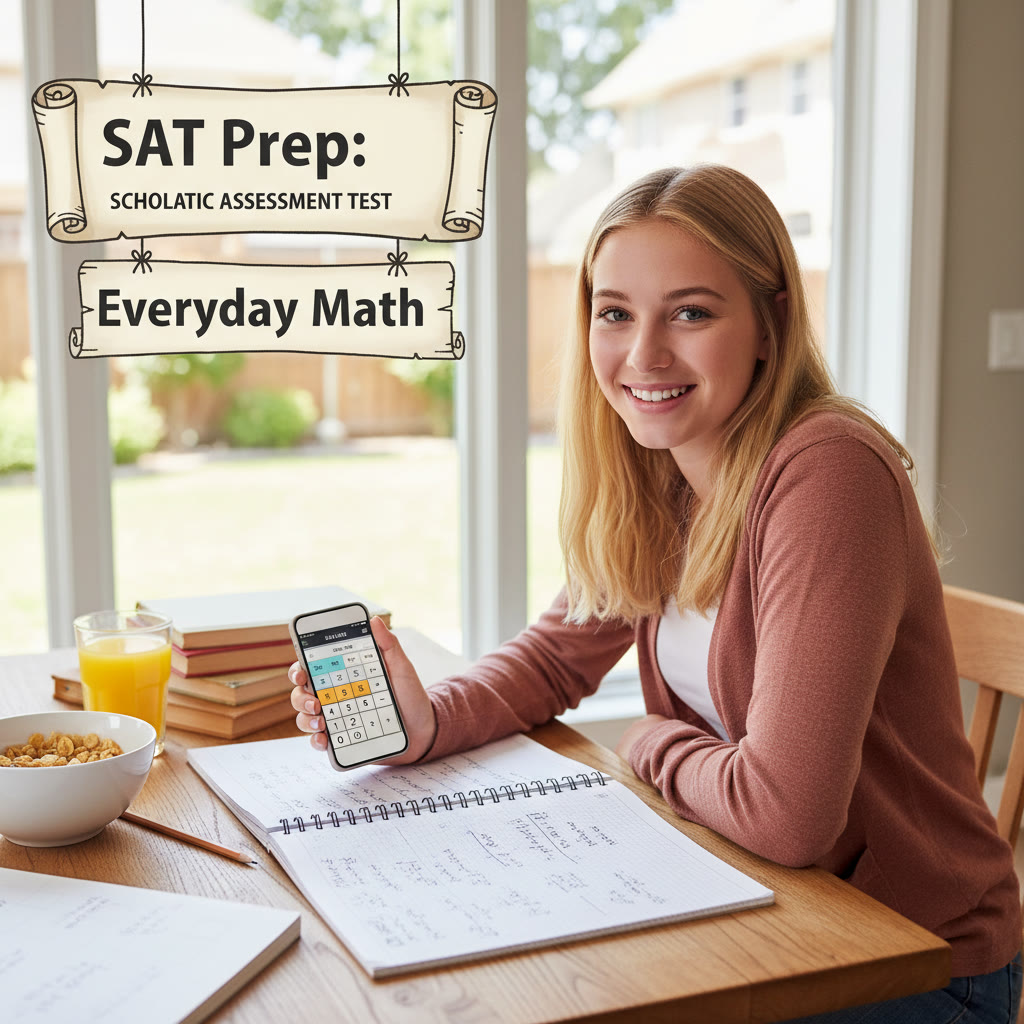

Quick checklist: Practice habits that boost both SAT scores and daily problem solving
- Annotate while you read: mark claims, evidence, and tone
- Estimate before you calculate: trust your number sense
- Break hard problems into steps and label each step
- Review errors to extract a rule to remember
- Simulate timed conditions but also practice untimed depth work
- Translate a real-world situation into math at least once a week
Ready to practice differently?
Start small: pick one habit to work on this week. Maybe it is annotating every article you read or estimating totals before checking a calculator. Track your progress and reflect after each practice session. Over time these small improvements compound into real thinking power—on test day and in life. When you pair intentional habits with targeted guidance, like 1-on-1 tutoring or tailored study plans, you speed up that growth and get feedback that matters. That combination is the secret to turning SAT preparation into a lifelong toolkit for solving problems that actually matter.
Good luck, and enjoy the process. The skills you build while preparing for the SAT are tools you will use for the rest of your life.
























No Comments
Leave a comment Cancel