

The Student Mindset Shift After First SAT Attempt
Walking out of the testing center for the first time can feel like stepping off a roller coaster. Some students are elated; others are quietly deflated. And many of you land somewhere in that awkward middle — relieved it’s over, but unsure what the score actually means for your college goals. That moment, right after your first SAT, is a pivot point. How you respond—emotionally and strategically—will often matter more than the raw number on the report.
Why your first SAT is not the final verdict
Let’s get one thing out of the way: the first SAT you take is not the last word on your abilities. Think of that first attempt as a diagnostic run. It reveals strengths, highlights surprises, and surfaces test-taking habits you didn’t know you had. The score is data, and data only becomes useful when you interpret it thoughtfully and act on it.
Many colleges look at your highest superscored composite, and admissions officers understand that students grow. What matters now is turning that growth into a predictable plan. That’s where a mindset shift happens—from letting the number define you, to letting the number inform your next steps.
From shock to strategy: the three emotional stages after your first SAT
Students often move through three common emotional stages after seeing their first SAT score. Recognizing these stages helps you avoid reactive decisions and build forward momentum.
- Stunned or discouraged: You studied, you practiced, and the result still stings. This is normal—your brain is processing a mismatch between expectation and outcome.
- Analytical curiosity: Once the initial emotion fades, the best students begin to ask precise questions: Which section cost me the most points? Did timing trip me up? Which question types were surprising?
- Purposeful planning: This is the sweet spot. You convert the data into a plan: targeted practice, schedule tweaks, and refined strategies for test day.
Example: Maya’s first SAT snapshot
Maya walked into her first SAT confident in reading but uncertain about Math. When scores arrived, she saw a 610 in Evidence-Based Reading and Writing (EBRW) and a 620 in Math, for a 1230 total. Her initial reaction: disappointment. But when she dug into the score report, she found that almost all her missed math problems were from one subtopic—algebraic functions—and that her reading errors were heavily weighted in sentence completion questions. Armed with that insight, she made a focused plan and raised her composite to 1390 on the next sitting.
How to read your score report like a detective
The SAT score report gives more than just a number. Learn to extract the clues.
- Section scores: 200–800 for EBRW and Math. Start here to see which section needs the most attention.
- Test scores and subscores: These break sections into content areas (e.g., Command of Evidence, Heart of Algebra). Subscores point to precise skills to target.
- Question type analysis: If your testing service provides question-level feedback, map wrong answers to topics and to timing lapses.
- Percentiles: These show how you stack up relative to other test takers. Use them as context, not as a judgment.
Carefully review wrong answers and do not rush past them. Ask: Was this a concept I didn’t know, or did I know it and make a careless error? Was it a timing-related omission? A single type of recurring mistake is often easier to fix than a long list of little things.
Quick exercise: create an error log
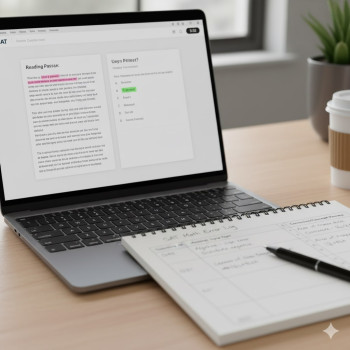
Start a simple two-column error log. Column A: Question description and type. Column B: Why I missed it (content gap, careless mistake, timing, misread question). After 50 problems, patterns will appear.
Shift your identity: from “I’m bad at this” to “I can get better”
Mindset is more than motivational poster copy. It changes behavior. Students who tell themselves, “I’m just not a math person,” tend to give up when they hit a bump. The alternative, a growth mindset, translates into concrete actions: asking for help, trying different practice methods, and embracing structured repetition.
Here’s how to make that shift without sounding cheesy:
- Replace labels with observations: instead of “I’m bad at reading,” say “I struggle most with inference questions under time pressure.”
- Set process goals, not outcome-only goals: aim to complete three targeted practice sets per week rather than focusing only on an arbitrary score.
- Celebrate small improvements: a few fewer careless errors or a full section completed within time are wins that compound.
How Sparkl’s personalized tutoring fits naturally
For many students, the fastest way to reframe and accelerate progress is guided support. Sparkl’s personalized tutoring provides one-on-one guidance, tailored study plans, expert tutors, and AI-driven insights that spotlight the exact topics and habits to work on. When the first score highlights a few clear weaknesses, a tutor can help you convert insight into a targeted routine—without wasting time on what you already know.
Designing a study plan that respects your life
After your first SAT, you need a study plan that’s smart and sustainable. Here’s a flexible framework that scales whether you have 4 weeks or 4 months before your next test.
Core elements of an effective plan
- Diagnostic-driven focus: Target the two or three subscores where you lost the most points.
- Deliberate practice: Aim for smaller, high-quality practice sessions (25–50 minutes) that include focused review.
- Timed full sections: Regularly simulate timing to build pace and stamina.
- Review routine: Every wrong problem gets a written explanation of why you missed it and the correct method.
- Mock exam cadence: Take a full, timed practice test every 2–3 weeks to measure progress and tweak strategy.
Sample 8-week plan
This plan assumes you take a follow-up SAT at the end of eight weeks. Modify the cadence depending on your schedule and goals.
| Week | Focus | Weekly Targets |
|---|---|---|
| 1 | Diagnostics & baseline | Full practice test; create error log; identify 2–3 target subscores |
| 2 | Targeted skill-building | 3 focused practice sets on weak topics; 2 timed sections; 2 review sessions |
| 3 | Pacing & strategy | Work on timing strategies; practice skipping and returning; 1 full practice test |
| 4 | Consolidation | Mixed practice; review all error log entries; adjust study plan |
| 5 | Advanced problem types | Tackle higher-difficulty questions; timed practice sets; 1 full test |
| 6 | Simulated conditions | 2 full timed tests under test-day conditions; practice sleep and nutrition plan |
| 7 | Final polish | Review common error themes; light practice; targeted concept refresh |
| 8 | Taper & test | One light practice test early in the week; rest and focus; test day |
Study tactics that actually move the needle
Not all practice is created equal. Here are specific tactics that produce reliable gains.
- Active review: Don’t just read solutions—re-solve the problem without looking. Recreate the approach from memory.
- Spaced repetition: Revisit tough concepts at increasing intervals. It beats cramming every time.
- Interleaving: Mix question types in practice sessions to simulate the surprise of the real test.
- Timing drills: Practice small clusters of questions under a strict time limit to build accurate pacing.
- Teach it back: Explain a solved problem out loud to someone else or record yourself. Teaching reveals gaps you didn’t notice.
Real-world comparison: training like an athlete
Athletes don’t run race-day speed until they’ve done months of pace training, technique work, and recovery. SAT prep is similar. Build skill first (the equivalent of strength training), then build speed. Rest and recovery—good sleep, regular meals, stress breaks—are part of the training plan, not optional extras.
Test day resets and psychological habits
The way you treat the first test experience mentally matters. Test anxiety can turn small errors into a cascade. Here are practical routines to reset your mindset for the next attempt.
- Debrief within 48 hours: Record emotions and major takeaways while memories are fresh, then put them away. Turn data into action items, not guilt.
- Practice under low-stakes pressure: Do timed sections with a short ritual (same snacks, same warm-up) to normalize conditions.
- Focus on routines, not luck: Replace superstitions with reliable pre-test rituals: hydration, short light review, and a quick breathing exercise.
- Simulate logistics: Know the route to the test center, what identification to bring, and the timing—reduce uncertainty so you can focus on performance.
A short breathing sequence to diffuse test-day jitters
Try this 90-second routine before a section: inhale for 4 counts, hold 4, exhale 6. Repeat three times. It’s simple, quick, and proven to reduce acute anxiety.
Using data and tech wisely
After your first SAT, you’ll likely be tempted to chase the latest app or load up on practice tests. Technology is a force multiplier when it’s used intentionally.
- Quality over quantity: One well-reviewed practice test with careful review beats five half-hearted ones.
- Leverage analytics: Use score trends and question analytics to refine the plan. AI-driven insights can highlight recurring error patterns and ideal practice recommendations.
- Mix manual and digital: Handwriting notes on mistakes can solidify memory in ways pure screen review sometimes doesn’t.
Sparkl’s personalized tutoring combines expert tutors with AI-driven insights to pinpoint where practice will be most effective—saving time and focusing effort on the highest-leverage changes. When you’re juggling school and extracurriculars, that efficiency can be a game changer.
When to consider extra help
Not everyone needs a tutor, but if any of the following apply, targeted support can accelerate progress:
- You have a narrow window to improve before college deadlines.
- You struggle to turn practice into measurable progress despite hours of study.
- Your error log reveals recurrent conceptual gaps that self-study hasn’t fixed.
- You want structured accountability and personalized feedback.
One-on-one tutoring can compress months of progress into weeks by focusing on exactly what will raise your score, and by holding you accountable to the plan you create together.
Common pitfalls and how to avoid them
- Every-question obsession: You don’t need to master every obscure question. Prioritize high-frequency concepts first.
- Ignoring timing: A perfect conceptual understanding without pacing practice can still lead to an underwhelming score.
- Blame and burnout: Don’t punish yourself into burnout. Short, focused sessions with recovery days beat marathon study binges.
- Skipping full tests: They inform pacing, endurance, and the mental pattern of the exam—skip them at your own risk.
From plan to action: your 10-day reset after the first SAT
If you have limited time before a retest, here’s a compact, ten-day reset to convert insight into momentum.
- Day 1: Full review of the score report and creation of an error log.
- Day 2–3: Two focused study blocks on priority topics; brief timed drills.
- Day 4: Timed full Reading section; detailed review of every incorrect answer.
- Day 5: Focused Math practice on the single weakest subtopic revealed by the report.
- Day 6: Rest or light review; active recall of formulas and vocab.
- Day 7: Timed full Math section; walk through timing strategies and skipping rules.
- Day 8: Mixed practice and simulation of test-day routine (wake time, nutrition, warm-up).
- Day 9: Light review and confidence-boosting practice (targeted quick wins).
- Day 10: Rest, mental prep, and light review. Visualization and breathing practice.
Wrapping up: the score is a starting line, not a finish line
Your first SAT score tells a story. If you listen closely—separating emotions from data—you’ll discover where to focus, how to train, and how to build confidence that lasts. The most successful students view this first attempt as feedback, not fate. They use diagnostics to craft a plan, apply deliberate practice, and make psychological shifts to manage pressure.
If you want guided support, Sparkl’s personalized tutoring can help translate that plan into a manageable schedule, providing 1-on-1 guidance, tailored study plans, expert tutors, and AI-driven insights. But whether you go it alone or with help, the key is the same: be intentional, be kind to yourself, and be persistent.


Take a breath. The number you saw today is information—powerful information. Now convert it into your roadmap. Small, consistent improvements add up quickly. The next time you open an SAT score report, you’ll be reading a different kind of story—one of growth, strategy, and earned confidence.



















No Comments
Leave a comment Cancel