

Why Resilience Is Key to SAT Score Growth
When students ask me what separates those who make steady SAT gains from those who stall, the answer rarely has to do with a secret trick or a shortcut. It’s resilience. Not sheer willpower in a theatrical sense, but the calm, steady ability to learn from mistakes, adjust practice, and keep moving forward when scores wobble. Resilience is the muscle you build over months of deliberate practice—and it’s often the most reliable predictor of score growth.
What I mean by resilience (and why it’s not just discipline)
Resilience, in the context of SAT prep, is the combination of three things: a realistic attitude toward setbacks, structured recovery strategies after an off day, and a long-term focus on incremental improvement. Discipline gets you to the desk. Resilience keeps you at the desk with purpose after a disappointing practice test.
Think about two students. One studies hard for a month, takes a practice test, sees a low score, and panics—then either doubles down on hours without changing strategy or gives up. The other student sees the same low score, examines the error types, tweaks the plan, repairs weak habits, and repeats. Over six months, the second student usually ends up ahead. That’s resilience in action.
Why resilience matters more than ‘talent’ for the SAT
The SAT tests a specific set of skills: reading comprehension, contextual vocabulary, grammar and usage, math fundamentals, and a handful of problem-solving strategies. Many students who label themselves “not a test person” simply haven’t practiced the right skills enough or haven’t recovered well from setbacks. Because the SAT is a learned exam, sustained, targeted practice—tempered by resilience—trumps raw talent.
How resilience shows up in effective SAT preparation
Resilience takes many forms during SAT prep. Here are practical behaviors that resilient students adopt:
- They keep an error log and revisit mistakes until they become rare.
- They simulate test conditions regularly, so nerves on test day are lower.
- They vary practice—mixing full-length tests, timed sections, and focused review—to avoid burnout.
- They set process-focused goals (e.g., “master quadratic equations”), not just outcome goals (“get a 1400”).
- They seek targeted help when stuck—whether from a teacher, a tutor, or a well-structured program—rather than flailing alone.
Real-life example: Maya’s steady progress
Maya began prep with a realistic set of strengths and gaps—solid reading but shaky algebra. After a practice test gave her a disappointing 1090, she could have panicked. Instead she did three things that exemplified resilience: she logged each mistake, scheduled focused algebra sessions, and ran timed reading passages twice weekly. She also booked occasional one-on-one reviews to clarify persistent errors. After six months, Maya’s official scores rose to the 1260s—an improvement driven less by cramming and more by steady course correction and persistence.
That story isn’t unique. Small, consistent adjustments compound into meaningful score gains.
Practical resilience-building strategies you can start this week
Below are specific habits to cultivate resilience. They’re simple, repeatable, and designed to create momentum instead of anxiety.
1. Keep an error log and review it weekly
Every practice test or timed section should yield at least a short list of errors. Record:
- The question type (e.g., algebra, data interpretation, sentence correction).
- Why the error happened (e.g., careless mistake, misread, knowledge gap, timing).
- The corrective action (e.g., re-learn a rule, timed practice, precision exercises).
Weekly reviews of this log prevent the same mistakes from recurring. The log is also a resilience tracker: when you glance back at week one versus week eight, you’ll see patterns shift—and that visible progress fuels persistence.
2. Use simulated tests to practice recovery, not to punish yourself
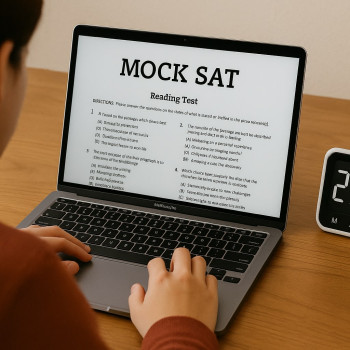
Taking full-length tests under realistic conditions is crucial. But the value isn’t the single score. It’s the post-test routine: review, identify 10 to 15 targeted problems to rework, and schedule follow-up practice. If a test score is lower than expected, treat it as diagnostic data, not a verdict on your ability.
3. Build a feedback loop
Effective feedback speeds improvement. Pair practice with at least one of these feedback sources:
- Self-review using official answer explanations and error logs.
- Peer review—explain a problem to a friend to test understanding.
- Targeted tutoring to accelerate correction of persistent errors.
Programs like Sparkl’s personalized tutoring can fit naturally here: targeted 1-on-1 guidance and tailored study plans help accelerate the corrective loop, and AI-driven insights can highlight recurring mistakes faster than manual review alone.
4. Set process goals with checkpoints
Process goals keep the focus on what you control—study habits—rather than just the final score. Example process goals:
- Complete three timed math sections per week.
- Log errors for every practice test and reduce repeated error types by half in six weeks.
- Review two grammar rules daily for 15 minutes.
Pair these with checkpoints—mini-assessments that tell you whether the process is working. If checkpoints fail, adjust the process rather than blame yourself.
Small recovery rituals that prevent long setbacks
Setbacks become setbacks in a real way when they lead to avoidance. Rescue rituals are quick actions you take immediately after a bad test day to stop downward spirals.
- Take a short break—an hour of walk or music—then tackle a single error you can correct within 20 minutes.
- Write down three specific, actionable improvements from the practice session.
- Schedule the next practice test within one week—frequency beats perfection.
These rituals prevent an off day from turning into a losing streak. Over time they strengthen the psychological habit of recovery—an essential resilience skill.
How to measure resilience-related growth: practical metrics
Instead of obsessing over raw score every week, track resilience-friendly metrics that predict steady improvement. Here are sensible, measurable indicators:
- Consistency: number of study sessions completed vs planned per week.
- Error reduction: percentage decrease in repeated mistake types over six weeks.
- Simulation frequency: number of full-length tests taken under timed conditions per month.
- Response time to setbacks: hours until the next corrective action after a low score.
| Metric | Why it matters | Target (6 weeks) |
|---|---|---|
| Study session consistency | Reflects discipline and momentum | 80% of planned sessions |
| Error repetition rate | Measures learning effectiveness | 50% reduction in repeated errors |
| Full-length test frequency | Builds stamina and realistic pacing | 2–4 per month |
| Time-to-corrective-action | Shows resilience and recovery habit | <48 hours after a low score |
These targets are conservative and designed to be achievable. Hitting them reliably often correlates with steady score growth over months.
Sample weekly plan that builds resilience (and results)
Below is a sample week that balances deliberate practice, rest, and recovery rituals. It’s not an exhaustive schedule; adapt it to your life.
| Day | Focus | Duration | Resilience action |
|---|---|---|---|
| Monday | Targeted math practice (algebra fundamentals) | 60–90 minutes | Log errors; schedule correction session |
| Tuesday | Reading passages (timed) | 45–60 minutes | Review misreads; note patterns in error log |
| Wednesday | Grammar and writing drills | 30–45 minutes | Explain a problem to a peer or tutor |
| Thursday | Full practice section (Math or Reading) | 60 minutes | Immediate 20-minute review of missed questions |
| Friday | Rest or light review (flashcards) | 20–30 minutes | Short recovery ritual if the week felt heavy |
| Saturday | Full-length practice test (every other week) | 3–4 hours | Post-test error analysis session |
| Sunday | Targeted catch-up (troublesome topics) | 60 minutes | Plan next week’s process goals |
This plan intentionally balances challenge with rest. Resilience isn’t about relentless work; it’s about sustainable, adaptive practice.
Mindset shifts that support resilience
Attitude matters. Here are short reframes that help when frustration sets in:
- From “I failed” to “I collected useful data.”
- From “I should be perfect” to “I will reduce these errors over time.”
- From “I need to study more” to “I need to study differently.”
Those seemingly small language changes change behavior. They turn blame into curiosity—and curiosity drives actionable change.
When to bring in outside help
Everyone hits a plateau. The right time to get help is when your error log shows the same patterns after multiple attempts to self-correct. A tutor or mentor can provide fresh perspective, targeted explanations, and accountability. If you’re overwhelmed by organization, a tailored study plan—like one provided through Sparkl’s personalized tutoring—can free you to focus on learning while the plan adapts to your growth using expert input and AI-driven insights.
Common resilience pitfalls—and how to avoid them
Students often confuse busyness with progress. Here are traps and quick fixes:
- Trap: Doing endless untargeted practice. Fix: Use error logs to guide practice.
- Trap: Reacting emotionally to one bad test. Fix: Implement a rescue ritual and schedule a specific corrective step.
- Trap: Ignoring physical health. Fix: Prioritize sleep and short exercise to maintain cognitive stamina.
Why sleep, nutrition, and movement matter for resilience
Resilience isn’t purely psychological. Poor sleep undermines memory consolidation and attention; hunger and dehydration sap focus. Students who maintain regular sleep schedules, balanced meals, and short daily movement sessions recover faster from setbacks and learn more efficiently. Treat your brain like an athlete’s body—fuel it and rest it—and it will bounce back faster after hard practice.
How long does it take to see real score growth?
There’s no one-size-fits-all timeline, but here are reasonable expectations based on focused, resilient practice:
- 4–6 weeks: Reduced careless errors, clearer study habits, slight improvements on sectional practice.
- 8–12 weeks: Noticeable shifts in recurring error types and better timing on sections.
- 3–6 months: Meaningful score gains for most students who practice consistently with targeted feedback.
These timelines assume steady effort and adaptation. The key is not speed but sustainability—resilience turns months of smart work into lasting gains.
Final thoughts: resilience as a skill you’ll use beyond the SAT
Perhaps the best part about building resilience for the SAT is that it transfers. The same habits—learning from mistakes, designing corrective practice, and recovering quickly from setbacks—help in college classes, internships, and any long-term goal. A student who learns to look at a low score and ask, “What next?” has built a lifelong advantage.
If you want a practical way to accelerate this process, consider pairing your personal effort with targeted support. Sparkl’s personalized tutoring offers 1-on-1 guidance, tailored study plans, expert tutors, and AI-driven insights that surface recurring blind spots. That kind of help can make your resilience-building more efficient—without taking away the essential ownership you develop by practicing and recovering on your own.
A short checklist to build resilience starting today
- Start an error log and review it tonight.
- Schedule one timed section this week and plan a 20-minute review immediately afterward.
- Set two process goals for the next six weeks (e.g., consistent sessions, error reduction).
- Pick one rescue ritual for low-score days (short walk, one corrective problem, and scheduling the next practice).


Resilience is ordinary in its components but extraordinary in its results. It’s the sum of small recoveries, honest reviews, and steady adjustments. If you practice like you mean it, respond to setbacks like curious investigators, and keep your goals process-focused, your SAT score growth will follow. And when you need a partner to accelerate that growth, targeted help—like tailored plans and expert tutors through Sparkl—can amplify the work you’re already doing.
Go forward with patience and a plan
Take a breath. Set a small, specific goal for the next week. Build one recovery ritual. Track one metric. Those modest moves add up. Over time, resilience turns uncomfortable practice into dependable progress—and that’s how you raise your SAT score for good.



















No Comments
Leave a comment Cancel