
Why celebrating progress matters more than you think
When you’re preparing for the SAT, it’s easy to treat practice tests like verdicts and every mistake like a setback. That mentality drains energy. Instead, imagine treating each practice session as a step forward — a data point on a path. Celebrating progress isn’t about throwing a party for every right answer; it’s about noticing growth, reinforcing effective study habits, and using wins (big and small) to power the next step. In short: celebration is fuel for sustained improvement.

Progress vs perfection: the mindset that wins
Perfection is a mirage. SAT content is large and varied: vocabulary in context, passage analysis, algebra, geometry, and multistep problem solving. If you wait to feel “ready,” you may never move. Celebrating progress helps you build a growth mindset — the belief that abilities develop through effort and strategy. This mindset turns frustration into curiosity: Why did I miss that question? How can I avoid similar mistakes? Celebrations make that loop emotionally sustainable.
What “progress” looks like in SAT prep
Progress can take many forms. Some improvements are numeric and obvious; others are subtle but powerful. Here are common indicators that you are moving forward:
- Higher scores on full-length practice tests (even if small, consistent increases).
- Fewer careless errors — fewer arithmetic slip-ups, better time checks.
- Improved accuracy on specific question types (e.g., data interpretation, sentence structure).
- Reduced time per question without a loss of accuracy.
- Stronger stamina for long tests and less mental fatigue.
- Better confidence and less test anxiety on practice test days.
How to measure progress: practical metrics that tell the truth
Measuring progress requires clear metrics. Emotions are useful, but numbers help you make decisions. Use a combination of macro data (full-length practice tests) and micro data (question-type accuracy, timing). Below is a sample 8-week progress table showing how a student’s metrics might evolve when they track the right things.
| Week | Practice Test Score (400–1600) | EBRW | Math | Average Accuracy (%) | Timed Sections On Target (yes/no) | Study Hours | Mini-goal | Reward |
|---|---|---|---|---|---|---|---|---|
| 1 (Baseline) | 980 | 490 | 490 | 68 | No | 6 | Diagnostic & identify weak topics | Small treat |
| 3 | 1030 | 520 | 510 | 72 | Partial | 10 | Master 2 question types | New practice book |
| 5 | 1090 | 560 | 530 | 77 | Yes | 14 | Consistent timing & fewer careless errors | Weekend outing |
| 8 (Near Test) | 1150 | 590 | 560 | 82 | Yes | 18 | Full-length practice test with target pacing | Major celebration |
This table illustrates a steady climb. Notice how tracking multiple dimensions (not just total score) gives a richer story: timing, accuracy, and study hours all matter. Small week-to-week gains compound into meaningful score increases.
Why small wins compound into big results
Two reasons. First, confidence matters. When you see real data that you improved, you show up to practice with more energy and less anxiety. Second, skill acquisition follows a cumulative pattern: mastering a subset of question types frees up cognitive space to tackle more complex tasks. For example, if you solve algebraic manipulation more quickly, you can focus mental energy on reading-comprehension strategy during the test.
Celebration ideas that actually help learning
Not all celebrations are created equal. The best ones reinforce the behavior you want to repeat. Here are celebration ideas that support learning — and a few to avoid:
- Meaningful micro-celebrations: a 20-minute break to read for fun after achieving a timing goal.
- Accountability celebrations: report progress to your tutor or a study buddy (this strengthens social motivation).
- Reflection rituals: write a quick three-sentence note about what you improved and what you’ll practice next. Reflection turns celebration into strategy.
- Non-food rewards: new stationery, a short hike, a favorite song playlist — things that signal progress without creating a guilt loop.
- Group celebrations: small study-group rituals after a shared milestone (e.g., all members complete a week without missing a practice session).
Avoid celebrations that break momentum: binge-watching a show for hours right after a productive session, or skipping scheduled practice for an indulgent reward that undermines your next goal.
How to set meaningful mini-goals
Mini-goals should be specific, measurable, achievable, relevant, and time-bound (SMART). Examples:
- “Improve accuracy on algebra II questions from 60% to 75% over two weeks by practicing 30 targeted problems per day.”
- “Finish one full timed Reading section under target time without losing accuracy by next weekend.”
- “Cut careless errors in Math by creating a two-minute error-check checklist and applying it for each practice section this week.”
These goals connect action (practice) to outcome (accuracy, timing) and make celebrations meaningful because they are tied directly to improvement.
Examples from real prep journeys
Maya started at 980 and felt discouraged after two months of inconsistent practice. Her tutor suggested celebrating the first week she completed four focused study sessions. That small win built momentum. She then tracked question-type accuracy and celebrated each time a category improved by 10 percentage points. By month three, Maya’s mindset had shifted: she saw practice as a sequence of solvable tasks and her score rose steadily.
Liam focused on timing. He used timers and recorded whether he met pacing targets. When he hit three timed sections in a row, he and his tutor paused to review what went right — and rewarded themselves with a one-hour break. The celebration reinforced the pacing techniques that had worked.
Using data, not just feelings: what to track
Track both outcome metrics (scores) and process metrics (hours, questions solved, timing). Key items to record:
- Full-length practice test score and section breakdown.
- Accuracy by question type (geometry, algebra, command of evidence, vocabulary-in-context, data interpretation).
- Timing per question and per section.
- Number of practice problems completed and targeted review sessions.
- Mental state/energy level during the test (fatigued, focused, anxious).
When progress stalls, these data points tell you where to change strategy. For instance, if accuracy improves but timing lags, focus on pacing techniques. If timing improves but accuracy falls, slow down and review error patterns.
How personalized tutoring (like Sparkl) helps you celebrate better
Personalized tutoring amplifies celebrations because it tunes both the goals and the feedback. A one-on-one tutor identifies the right mini-goals, spotlights the wins you might overlook, and designs study plans that make improvement visible. Sparkl’s personalized tutoring combines expert tutors, tailored study plans, and AI-driven insights to highlight progress that matters — whether it’s a timing breakthrough or a jump in question-type accuracy. Tutors can also help you design celebration rituals that reinforce learning rather than distract from it.
For example, if your AI-driven performance dashboard shows steady improvement in data interpretation, your tutor can create a short “wins” summary that you read each week. That summary becomes a concrete celebration — and a reminder of effective strategies to keep using.
Balancing celebration and discipline
Celebration should not be an excuse to slack off. The trick is to make rewards contingent on progress and aligned with study goals. A few guardrails:
- Scale rewards to the achievement. Small checkpoint = small reward; major milestones = something meaningful.
- Preserve momentum: schedule celebrations that don’t disrupt the next study block (e.g., an hour-long reward after a productive afternoon, not the night before a mock test).
- Use celebrations to reinforce habits: reward the behavior (daily review, consistent timed practice), not merely the outcome.
- Reflect before rewarding: take 3–5 minutes to note what worked and what you’ll do next, so celebration ties into continuous improvement.
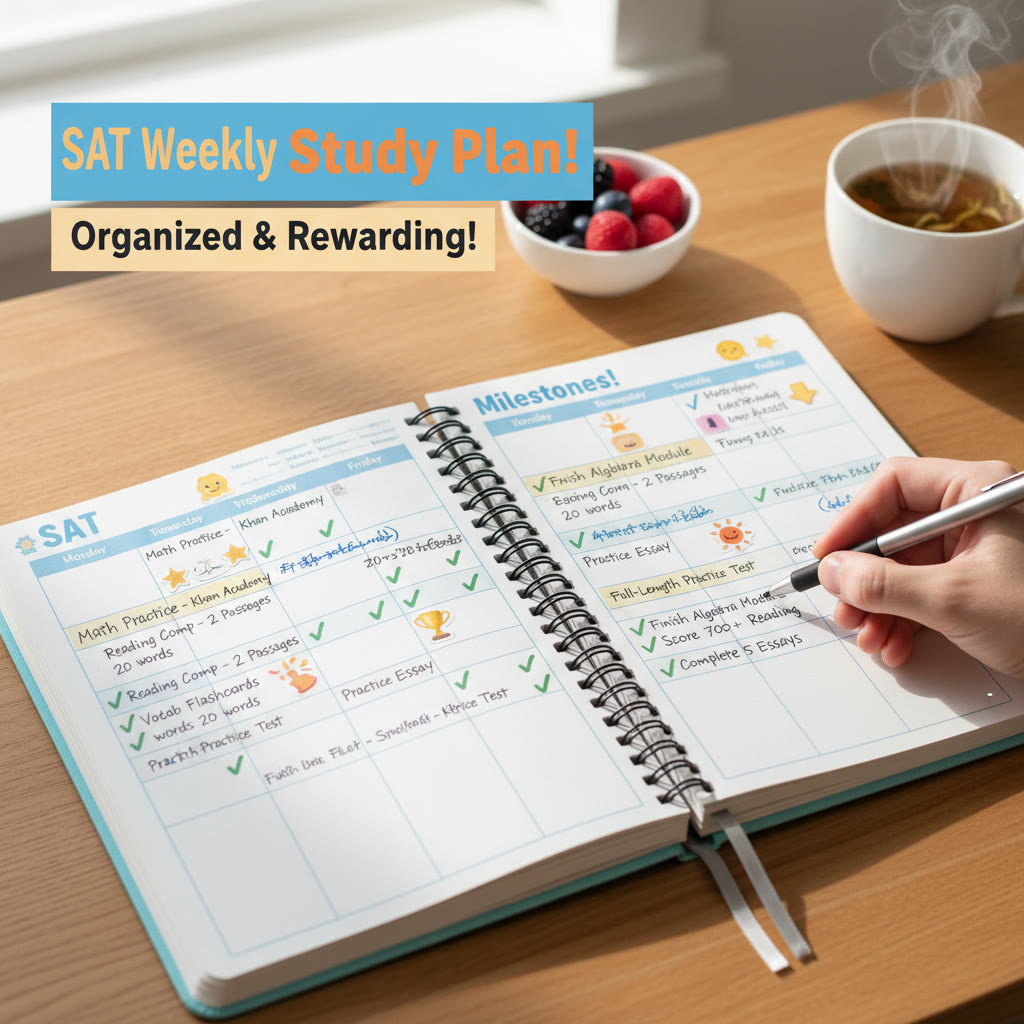
Weekly routine: celebrate the week, plan the week
A simple weekly routine makes celebration automatic and productive. Try this template:
- Sunday evening: review the week’s practice tests and data (30 minutes). Highlight two wins and one area to target next week.
- Monday: set three mini-goals for the week and decide on a small end-of-week reward if you meet them.
- Midweek check: 15-minute quick review to adjust tactics if needed.
- Friday: complete a timed section and compare to Sunday’s baseline. If you met targets, apply the agreed reward.
- Saturday: relaxed reflection and a longer practice test every 2–3 weeks.
When you use this routine, progress is both measured and celebrated regularly — a powerful cyclical loop.
When to reach out for extra help
Celebration is great, but sometimes progress plateaus. Signs it might be time for extra support:
- Your practice-test score hasn’t budged in several weeks despite consistent effort.
- Your accuracy improves in isolated areas but not on full-length tests.
- You find yourself demotivated or anxious before every practice session.
- Your timing improves but accuracy falls off, or vice versa, and you can’t identify why.
Working with a tutor — especially one who offers tailored study plans and data-driven insights — can recalibrate your approach. If you already have a tutor, ask them to help you design specific goals that lead to celebratable wins rather than vague aims.
Practical tips to make celebrating part of your study system
- Keep a visible progress board: numbers, checkmarks, and a small trophy icon for major milestones.
- Log one-line reflections after every practice: what you learned, what you’ll change next time.
- Pair rewards with study rituals: a victory walk after a successful test simulation helps your brain link practice to positive emotion.
- Share milestones with a tutor or study partner — social recognition is a powerful motivator.
- Use short, frequent celebrations to avoid all-or-nothing thinking. Multiple small wins beat one big, delayed payout.
Final pep talk: your SAT is a journey, not a single event
Your SAT score will reflect weeks or months of steady work, not a single day of brilliance. Celebrate progress because it keeps you on the path: every correct strategy you lock into, every timing trick you master, every reduction in careless errors — they accumulate. If you feel stuck, remember that small changes in accuracy and pacing compound into meaningful scaled score changes over time. Use data to recognize those changes, celebrate them in ways that strengthen your study habits, and adjust your plan when needed.
One last thought: studying is as much about training your brain to handle pressure as it is about mastering content. Celebrations train your brain to associate effort with reward, making the grind feel purposeful instead of punishing. Combine focused practice, honest tracking, and smart celebrations — and you’ll find the journey to your target score far more manageable and a lot more enjoyable.
If you want help designing mini-goals, tracking the right metrics, or creating celebration rituals that strengthen learning, consider connecting with a personalized tutor who can tailor the plan to you. With one-on-one guidance, tailored study plans, and AI-driven insights, you can highlight the progress that matters and celebrate it in ways that move your score forward.
Quick checklist to start celebrating progress today
- Take a diagnostic practice test and record baseline metrics.
- Set one clear mini-goal for the week and pick a small reward.
- Track accuracy by question type and timing for each practice.
- Reflect briefly after each session and note one improvement to celebrate.
- Share a weekly summary with a tutor or study buddy to reinforce progress socially.
Celebrate the climb. The SAT is a long staircase, and each step you take deserves recognition. When you mark progress properly, you build momentum, preserve motivation, and give your best self a chance to show up on test day.






















No Comments
Leave a comment Cancel