

Why a Crash Course Can Work — and When It’s a Bad Idea
Let’s start with the obvious: cramming for the SAT isn’t ideal. The best score gains come from months of steady practice. Still, life often throws tight timelines at us—college deadlines, late decisions to test, or semester schedules that don’t cooperate. A well-designed crash course can produce meaningful improvements in a short window if it’s realistic, focused, and strategic.
This guide is for students who have 2–8 weeks to prepare and want a high-return plan. You’ll get an approachable routine, sample schedules, concrete tactics for each section, and ideas for squeezing the most out of limited time. If you have the chance, combine this with personalized help—Sparkl’s personalized tutoring (1-on-1 guidance, tailored study plans, expert tutors and AI-driven insights) can slot into any crash plan to accelerate progress where it matters most.
How to Begin: The First 48 Hours
1. Do a realistic diagnostic
Before you build a routine, you need to know two things: where you stand and what’s most worth fixing. Take one full, timed practice test on the digital platform (use an official digital practice test or the test-preview app). Treat it like test day: set up your device, use the digital testing app, and stick to breaks the way the real exam does.
Why a timed diagnostic? It reveals the biggest score-levering weaknesses—those are what you attack first. Resist the temptation to immediately start drilling vocabulary or trivia; test-smart practice beats random study.
2. Analyze the results efficiently
After the test, spend one session (60–90 minutes) analyzing the score report. Look for:
- Which section lost you the most points (Reading & Writing vs Math)?
- Question types you missed repeatedly (command of evidence, data interpretation, algebraic manipulation, geometry basics, sentence logic, etc.).
- Timing errors vs content errors—were you answering wrong, or not answering at all?
Make a short list (3–5 priorities). This will keep your crash course targeted.
Designing Your Crash-Course Routine
Core principles
- Work backward from test day. Put your full practice tests on the calendar first; these are your checkpoints.
- Mix active practice with review. Doing problems without reviewing mistakes wastes time.
- Target the high-value question types first—those that are common and correctable quickly.
- Preserve your stamina: prioritize sleep and midday breaks. Intense studying with little rest usually backfires.
Weekly template for a 4-week crash course (adaptable up or down)
Below is a compact weekly plan you can stretch to 6–8 weeks or compress into 2–3 if necessary. The idea is to keep a steady mix of practice tests, targeted drills, timed sections, and review.
| Day | Primary Focus | Time | Notes |
|---|---|---|---|
| Monday | Timed Reading & Writing sections | 1.5–2 hours | Drill 2 sets of reading passages and 1 grammar set; review mistakes |
| Tuesday | Math practice (focus on weakest domain) | 1.5–2 hours | Mix calculator and no-calculator practice; review solution logic |
| Wednesday | Targeted review & mixed problem set | 1–1.5 hours | Circulate between topics; short drills and flashcards |
| Thursday | Full timed section (alternate Math/Reading) | 1.5–2 hours | Simulate pace—no interruptions |
| Friday | Full-length practice test | 3–3.5 hours (including breaks) | Review the test after a short break—focus on high-impact errors |
| Saturday | Deep review & weak-topic workshop | 2 hours | Go step-by-step through every missed problem |
| Sunday | Rest, light review, and planning | 30–60 minutes | Active rest—light reading, vocabulary, or an untimed practice passage |
This plan balances deliberate practice with full test simulations—both are essential. If you only drill and never simulate, you’ll be surprised on test day by pacing and fatigue issues. If you only simulate and never review, the same mistakes repeat.
Section-by-Section Crash Strategies
Reading & Writing: Move from speed to surgical accuracy
Common issue: panic on long passages and sticky wording. Fix it with micro-skills.
- Skim smart: read the passage’s intro and conclusion and the first sentence of each paragraph; then refer back to details when the question demands it.
- Question triage: do line-reference and main-idea questions first, then inference and evidence questions. Those are faster and more reliable.
- Evidence chaining: for evidence questions, find the exact sentence(s) in the passage that support your answer—this habit cuts wrong guesses.
- Grammar pattern practice: spend short, focused drills on punctuation, modifiers, and concision rules—these yield quick gains in the Writing section.
Math: Repair conceptual gaps and memorize strategies
In a crash course, math gains come from two sources: fixing recurring conceptual errors and learning go-to strategies for common question types.
- Prioritize algebra and problem-solving questions; they are the largest share of math points.
- Learn the most-tested formulas and keep a short formula sheet in your notes (mental or written) for linear equations, systems, quadratics, algebraic manipulation, and basic geometry facts.
- Use back-solving and plugging-in strategies when algebra looks messy: substituting answer choices or numbers into the problem can save time.
- Practice mental organization for multi-step problems: write a one-line plan before calculating (e.g., “isolate x, substitute, simplify”).
Timing and pacing drills
Timing is a frequent blind spot. Use sectional timed drills to internalize pace. If a section has 44 questions and 64 minutes, you don’t need to hit every question in the same way—some require 30 seconds, others 3–4 minutes. Learn to identify which is which by practicing a variety of question types under time pressure.
Daily Micro-Routines: What to Do in 30–90 Minutes
If you’re building a crash course around limited daily time, these short routines are high-value and easy to schedule.
- 30 minutes (commute or break): Quick mixed drill—10 reading questions or 8 math questions; review missed items for 10 minutes.
- 60 minutes (after school): One timed section or two focused topic drills + 15-minute review of mistakes.
- 90 minutes (evening deep work): One full timed section + error analysis and a 10-minute targeted lesson (grammar rule, algebra trick, data interpretation).
Review Like a Pro: Turning Mistakes into Gains
Most score improvement comes from how you review—not how many problems you do. A disciplined, consistent review method triples the value of practice problems.
5-step review method
- Identify: Mark whether the error was content, careless, or timing-related.
- Explain: Write, in two sentences, why the correct answer is right and why you picked the wrong one.
- Generalize: Note the rule or strategy that applies (e.g., “when modifiers are separated from nouns, watch for meaning changes”).
- Practice: Do two similar questions to confirm you’ve fixed the mistake.
- Track: Keep a running list of recurring mistakes. If a pattern appears, schedule a focused session to attack it.
Simulated Tests: When and How to Run Them
Full practice tests are your compass. Schedule one every 7–10 days in a four-week plan, more often if you have fewer weeks. After each test, take at least one day for deep review—do not rush this step. The score change between tests tells you if your routine is working.
Tools & Resources That Fit a Crash Course
Quality over quantity: choose a few trusted resources and use them well. Official digital practice materials are essential because they mirror the testing environment. Pair official practice with targeted drills from a tutoring plan or a curated workbook.
Personalized help can compress learning time. If you can, add 1-on-1 sessions with an experienced tutor—Sparkl’s personalized tutoring offers tailored study plans, expert tutors, and AI-driven insights that help you focus on what will raise your score fastest. A tutor can also simulate test-day pressure and give immediate correction to bad habits.
Sample Crash-Course Calendars (Pick the One That Matches Your Time)
2-week sprint (very aggressive)
Best for students who are already near their target and need last-minute polishing.
- Day 1: Diagnostic test + analysis
- Days 2–3: Reading & Writing sprint (timed sections + targeted grammar drills)
- Days 4–5: Math sprint (targeted algebra and data-practice)
- Day 6: Full practice test
- Day 7: Deep review
- Repeat week 2 with adjustments; final day rest and light review
4-week plan (balanced)
The balanced approach gives room for solid review and two full test simulations. Use the weekly template above. Insert at least two 1-on-1 tutoring sessions early to shape the study plan and another in week 3 for pre-test tuning.
6-week plan (best for larger gains)
This plan is slower, letting you build skills and confidence while still prioritizing test simulations. Weekly full tests, two to four tutoring sessions, and steady, short daily practice are the core features.
Nutrition, Sleep, and Mental Prep — Small Habits, Big Effects
Your brain is a timing device: late nights and skipped meals slow it down. In a crash course, the difference between a good and a great test day often comes down to sleep, hydration, and a calm routine.
- Get 7–9 hours of sleep in the week leading up to the test.
- Practice the morning routine you’ll use on test day (what you eat, when you leave, how you set up your device).
- Use short relaxation routines before and during breaks—box breathing or a quick two-minute stretch will keep stress from snowballing.
What to Do the Week Before and the Day Before
Week before
- Reduce study volume but keep intensity in short sessions.
- Finish at least one full practice test with realistic timing and device setup.
- Fix any last-minute tech or administrative details—download the test app, confirm ID requirements, and plan travel time.
Day before
- Review a short list of your most important formulas, grammar rules, and strategies—don’t learn anything new.
- Lay out everything you’ll need for test day: charger, approved ID, snacks, and a backup plan for tech issues.
- Do something that relaxes you—watch a show, take a walk, or chat with a friend.
Test Day: A Simple Routine to Reduce Surprise
Keep the morning simple. Eat a balanced breakfast, arrive early, and set up your device exactly as practiced. When you encounter a tough question, use a consistent decision rule: if it will take you longer than two minutes and there are easier questions left, mark it and move on. Then return with fresh energy after finishing the rest.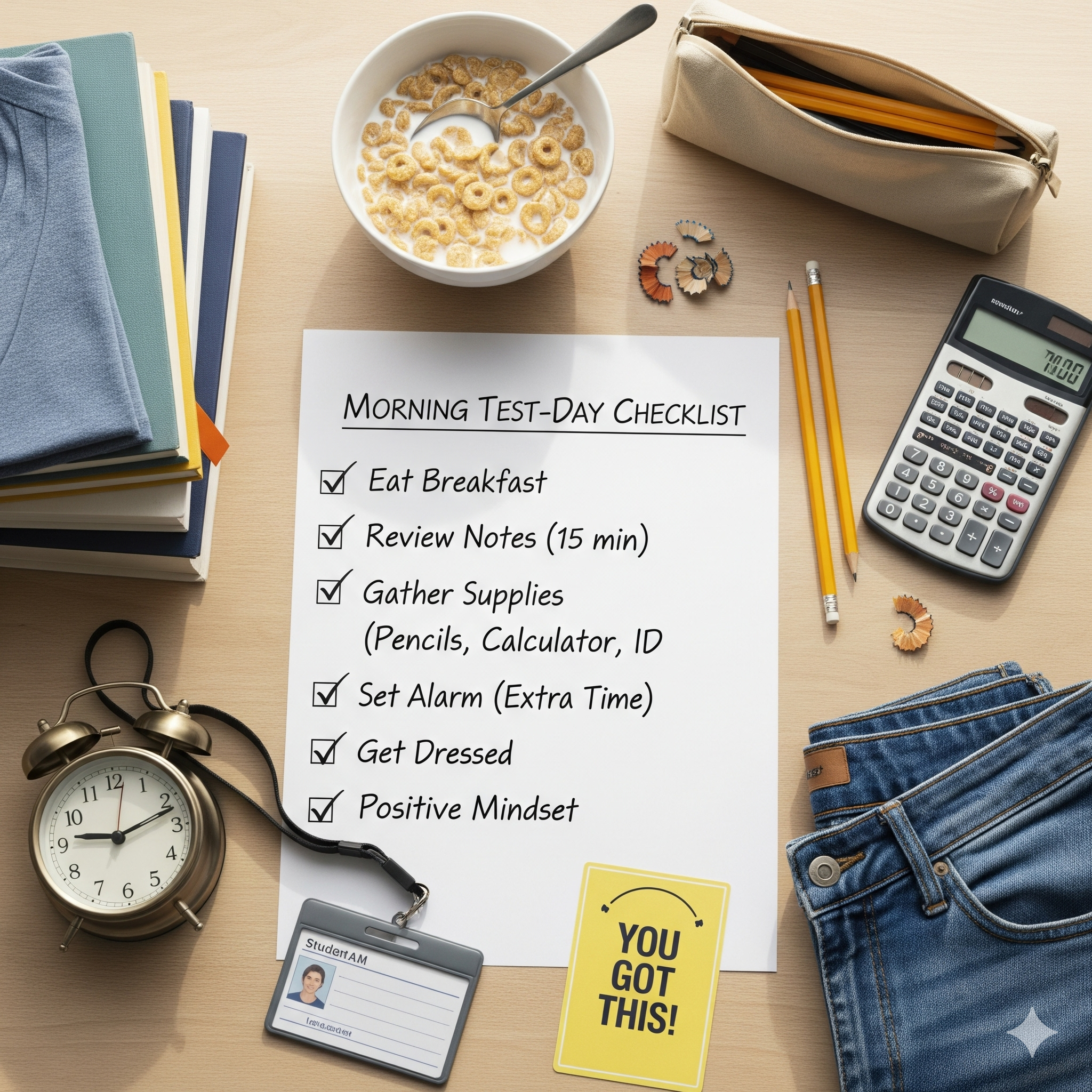
Tracking Progress: How to Know If Your Crash Plan Works
Don’t obsess over small daily swings. Look for patterns across practice tests and weekly diagnostics:
- Are you reducing careless errors?
- Are timing problems diminishing?
- Are the same concepts repeatedly tripping you up? If so, adjust the plan to focus more on that area.
Keep a short log: date, practice-test score (section breakdown), three things you did well, and three things to fix next. This record helps you iterate efficiently.
Common Pitfalls and How to Avoid Them
- Pitfall: Doing too many untimed problems. Fix: Always include timed practice and timed review sessions.
- Pitfall: Skipping error analysis. Fix: Adopt the 5-step review method and stick to it.
- Pitfall: Trying to learn everything. Fix: Focus on high-frequency topics and your individual weakness list.
- Pitfall: Ignoring mental prep. Fix: Practice full tests including breaks to simulate endurance.
When to Get Help (and How to Use It Well)
Getting expert help is not a sign of weakness—it’s an efficiency multiplier. If you’re stuck on a pattern of errors, if you’ve plateaued despite consistent practice, or if you only have weeks to prepare, a tutor can identify and fix the bottleneck faster than solo study.
If you work with a tutor (or a service like Sparkl that offers personalized tutoring, tailored study plans, and AI-driven insights), use the sessions to:
- Go deep on your recurring error types.
- Simulate test conditions and practice pacing under pressure.
- Get a second opinion on your study plan and accountability to stick with it.


Example: A 4-Week Personalized Crash Plan (Practical)
Below is a realistic four-week schedule for a student aiming for a moderate score increase (40–120 points depending on starting level). The plan assumes about 10–12 hours of focused study per week and one weekly tutoring or coaching check-in.
| Week | Focus | Key Activities |
|---|---|---|
| Week 1 | Baseline & fundamentals | Diagnostic test, analysis, core grammar and algebra drills, 2 timed sections |
| Week 2 | Targeted skill building | Deep practice on two weakest domains, one full practice test, tutoring session for strategy |
| Week 3 | Pacing & accuracy | Timed mixed sections, error-log cleanup, full practice test, review weak-topic workshop |
| Week 4 | Sharpen & rest | Final full practice test, light targeted practice, pre-test routine rehearsal, rest |
Quick Reference: High-Impact Tactics You Can Use Today
- After any practice test, fix two mistakes immediately and two later in the day—this spaced repetition helps retention.
- Use the process of elimination aggressively on multiple-choice math and writing questions; even narrowing options raises your odds.
- Practice guessing strategies: if you can eliminate one or two answers, guessing becomes worthwhile—don’t leave blanks.
- Keep a single one-page sheet of the rules you frequently forget (comma usage, modifier placement, common algebra transformations).
Final Notes: Be Strategic, Not Sorry
A crash course is about trade-offs. You can’t perfect everything in a short time, but you can improve where it most affects your score. Use diagnostic-driven focus, short high-quality practice sessions, disciplined error review, and at least one high-fidelity test simulation per week. If you add a few personalized tutoring sessions—targeting your highest-leverage weaknesses—you’ll amplify every hour you spend studying.
Remember: calm, consistent practice beats frantic, scattered effort. Build a plan that fits your life, keep it flexible, and measure progress honestly. When you treat each practice test as information rather than judgment, you’ll stay motivated and keep improving. Good luck—study smart, rest well, and go show what you know.





















No Comments
Leave a comment Cancel