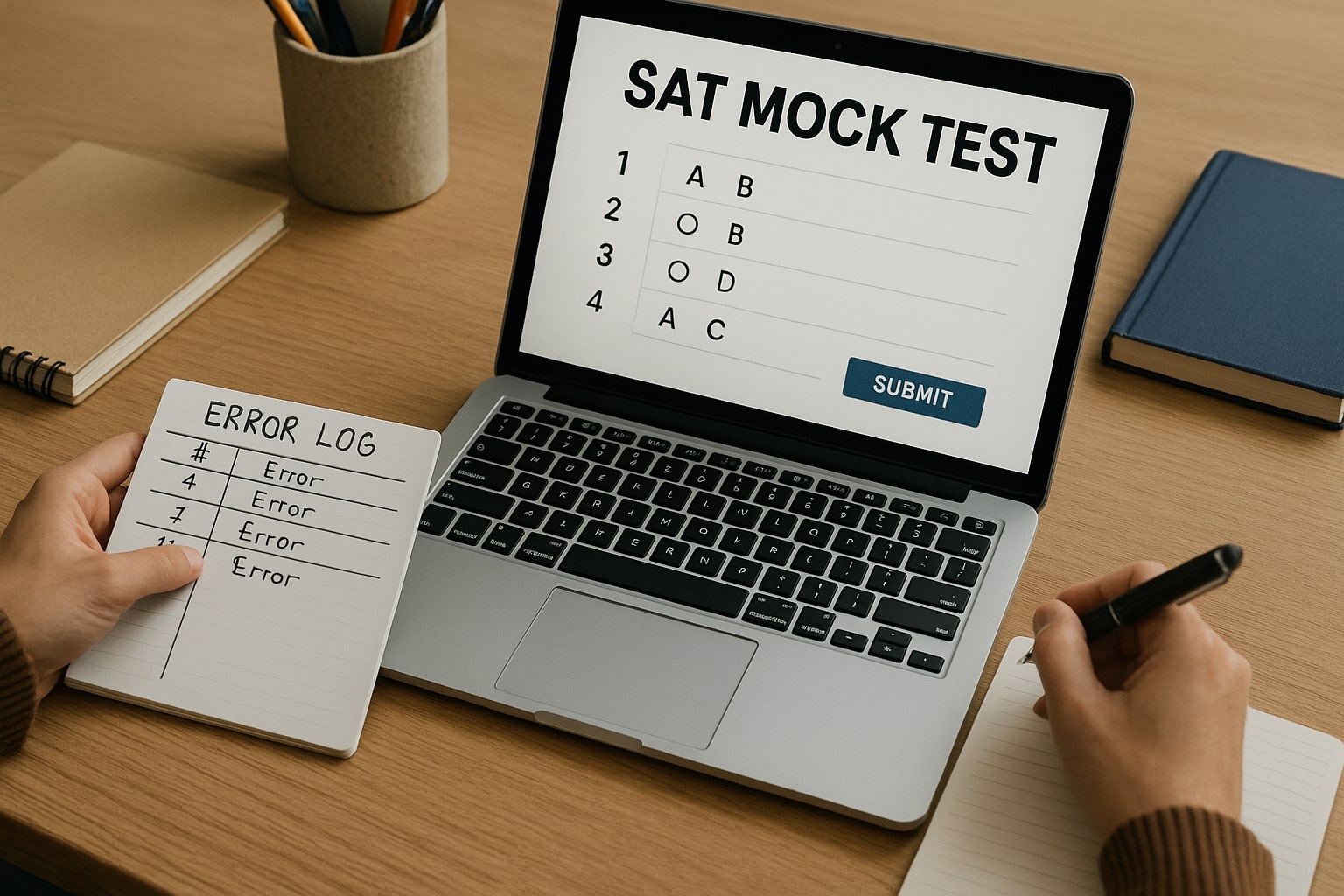

Why tracking mistakes is more powerful than taking more practice tests
If you’ve ever taken a full-length Digital SAT practice test and felt both proud and defeated at the same time, you are not alone. Practice exams are essential, but they’re only half the equation. The students who leap forward—often dramatically—are the ones who go beyond raw scores and start asking: what kinds of mistakes am I making, and why?
This blog is a friendly, practical guide for turning the inevitable mistakes you make on practice tests into a deliberate engine for improvement. We’ll break down exactly how to track error patterns, how to interpret them, and how to build a study routine that fixes root problems, not just symptoms.
Start with the right mindset: mistakes are data, not defeat
First, a mindset shift. A wrong answer isn’t a personal failure—it’s a piece of information. Each mistake tells you something: about gaps in content knowledge, habits under time pressure, or test-taking tactics that need fine-tuning. Treat mistakes like clues in a mystery novel. The better you get at reading them, the faster you’ll solve the case: a higher score.
Make a pact with curiosity
After every practice test, instead of dwelling on the number, ask yourself three curiosity-driven questions:
- Which types of questions did I miss?
- Was the error due to concept, execution, or time pressure?
- Is this error a one-off, or part of a recurring pattern?
These questions set you up to turn one-off feedback into deep, systematic improvement.
How to build a mistake-tracking system that actually gets used
Tracking can sound like extra work, but when done right it saves time. The goal is to create a simple, repeatable system so you’ll actually do it after every practice test.
Simple mistake log — your most valuable study tool
Use a spreadsheet, a notebook, or an app—whatever you’ll stick with. Capture the essentials:
- Test name and date
- Question number and section (Reading, Writing & Language, Math)
- Correct answer vs. your answer
- Error type (e.g., “algebra setup”, “vocabulary in context”, “misread question”, “calculator misuse”, “timing”)
- Why it happened (brief note)
- Plan to fix it (practice, rule review, flashcard)
Do this consistently for even 6–8 tests and patterns will start to pop out. You’ll stop relying on intuition and start relying on clean, objective evidence.
Example mistake log entries
Here are a few realistic entries to show how details pay off later when you analyze patterns.
| Test & Date | Section | Q# | Your Answer / Correct | Error Type | Why | Fix |
|---|---|---|---|---|---|---|
| Bluebook Test 4 — Jul 7 | Math (No Calculator) | 12 | 6 / 9 | Algebra setup | Mis-set equation for rate problem | Review rate problems; 10 targeted practice Qs |
| Bluebook Test 6 — Jul 21 | Reading | 18 | B / D | Evidence mismatch | Chose answer that felt right but lacked textual support | Practice evidence-based pairing; underline support |
| Bluebook Test 7 — Aug 5 | Writing & Language | 9 | C / B | Punctuation rule | Comma splice confusion | Make a one-page punctuation cheat sheet |
How to classify mistakes so you’re diagnosing, not just tallying
There are three high-impact categories that help you decide where to focus study energy:
- Content error: You didn’t know or couldn’t recall the underlying concept (e.g., factoring, grammar rule, vocabulary meaning).
- Execution error: You knew the concept but made an arithmetic slip, misread, or incorrect algebra manipulation.
- Strategy/timing error: You ran out of time, misallocated attention, or picked the wrong approach to the question type.
Assign each wrong answer one of these categories (you can add sub-tags like “careless arithmetic” or “dense passage fatigue”). This classification determines the fix.
Fix examples by category
- Content: Create a 20-minute focused review on the concept and do 12 targeted problems.
- Execution: Slow down and use a mini-checklist on calculation steps; practice accuracy under time-limited conditions.
- Strategy/timing: Practice with section-timed drills and learn when to skip and return to questions.
Spotting patterns: the three levels of analysis
Don’t stop at single-question fixes. Patterns appear on three levels, and each requires a different response.
Micro-level: repeated question types
Maybe you notice a string of missed algebra set-ups, comma questions, or inference-based reading items. That’s a clear signal to schedule targeted practice blocks and quick rule-sheets.
Mid-level: section habits and timing
Are most of your mistakes clustered in Reading after passage 2? Are you more error-prone in Math (No Calculator) than Math (Calculator)? These mid-level patterns tell you whether to rework pacing, to practice stamina, or to adjust the order in which you tackle sections during the test.
Macro-level: test-wide tendencies
Macro patterns are the big-picture issues that slow progress: overconfidence on easy questions, consistent misinterpretation of question wording, or stress-induced errors late in test sections. Fixes here involve broader changes like an improved sleep schedule, timed full-section practice, or coaching to change test-day routines.
Design a weekly study routine around your patterns
Once you have patterns, build a study plan that targets them directly. Here’s a flexible four-week cycle you can adapt based on your test date and available time.
4-week pattern-focused study cycle
| Week | Primary Goal | Actions | Assessment |
|---|---|---|---|
| 1 | Diagnose | Take a Bluebook practice test; log every error; classify by type | Finish a completed error log |
| 2 | Targeted content work | 3 focused 45–60 min sessions on top 2 content weaknesses; 30 targeted questions | Accuracy improvement in targeted drills |
| 3 | Execution & Timing | Timed mini-sections; technique drills (e.g., underlining, scratch paper checklist) | Fewer careless slips on similar items |
| 4 | Full test reset | Full practice test in Bluebook; review every mistake and update log | Compare pattern shift vs. Week 1 |
Practical tips for reviewing mistakes efficiently
Not all review is equally valuable. Here are techniques that give the highest ROI.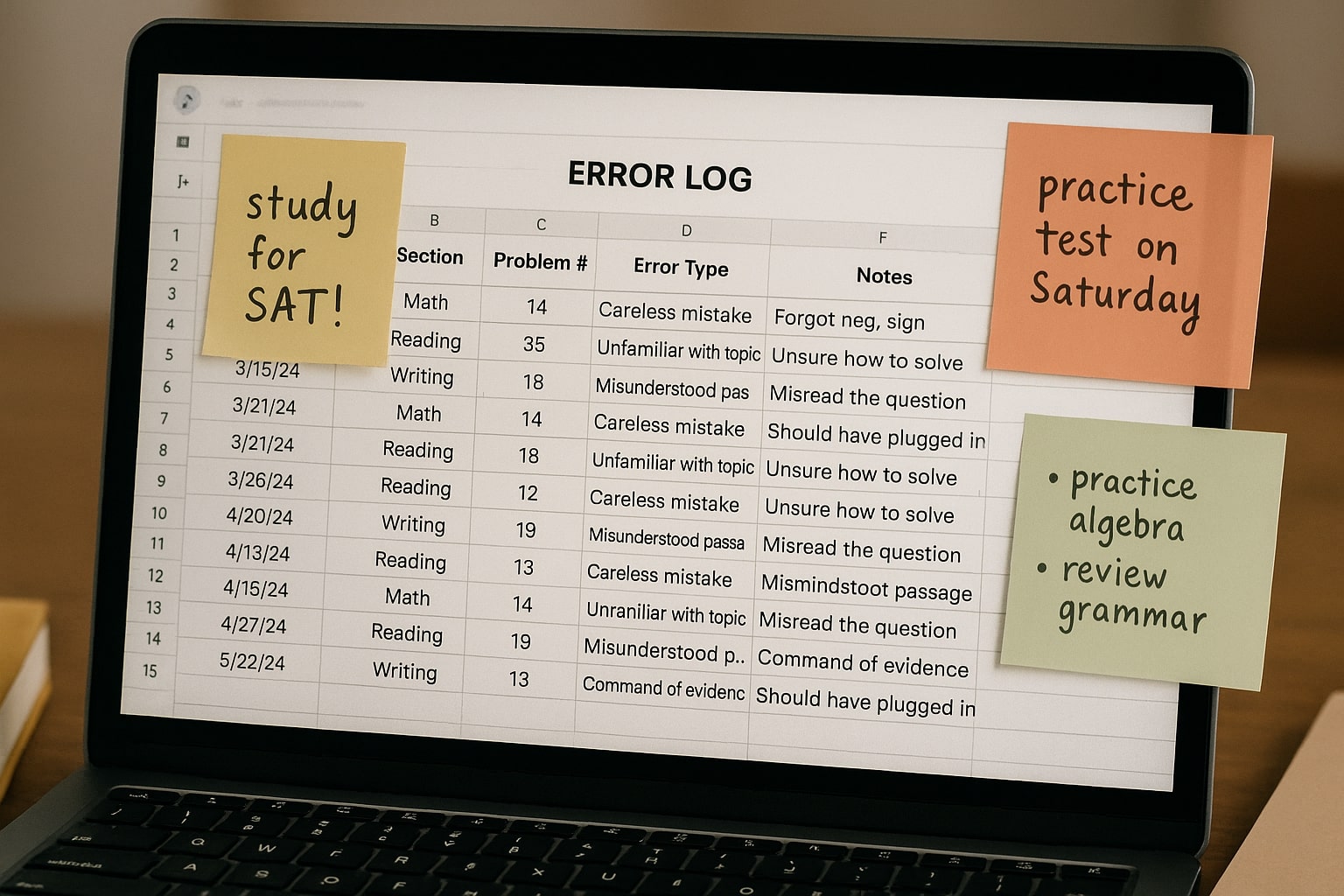
Use active error review
Don’t just re-read correct answers. Re-solve the problem from scratch without looking at the explanation. Then, compare your approach to the official solution. Doing this strengthens retrieval and helps you internalize correct processes.
Create short, specific flash routines
Convert recurring errors into micro-practices. For example:
- If you mix up semicolons and commas, spend 10 minutes daily on five focused sentence edits.
- If you fumble exponential notation, do a 12-question algebra session once every two days.
Small, consistent repetitions beat massive, unfocused review sessions.
Practice under the same conditions
Use Bluebook full-length digital tests to mirror the testing environment. If you’ll take the real exam on a laptop via the Bluebook app, practice there. Familiarity with the format, tools, and navigation reduces strategy and timing errors on test day.
When patterns say “it’s deeper” — what to do next
Sometimes the same error keeps coming back despite drilling. That’s a signal to change tactics, not to work harder. Consider these escalation steps:
- Switch resource style: video explanation instead of reading the rule may help certain learners.
- Break the concept into micro-steps and master each—often a multi-step algebra mistake is due to missing a foundational detail.
- Get personalized help: a tutor can observe your approach and identify hidden habits you can’t see alone.
That last point is important. Many students find that a few sessions of targeted, 1-on-1 tutoring—where an expert watches you work through problems—exposes subtle errors and speeds progress. Sparkl’s personalized tutoring, for example, offers 1-on-1 guidance, tailored study plans, and AI-driven insights that can help you isolate stubborn patterns and build a focused plan for elimination. When a tutor helps translate your error log into a coached plan, improvements often follow faster than solo study.
How to measure success: what improvement looks like
Improvement isn’t always a neat jump in a single test score. Look for the following evidence that your pattern-based approach is working:
- Fewer repeats of the same error type across multiple tests.
- Faster correction time—what used to take you 3 minutes now takes 60–90 seconds.
- Higher accuracy on targeted drill sets (aim for 80–90% on practiced items).
- Improved stamina—fewer late-section mistakes due to fatigue or rushing.
Celebrate these wins. They predict long-term score gains even if a single practice test doesn’t show a massive jump right away.
Common student questions about pattern tracking
Q: How many practice tests should I take before analyzing patterns?
A: Take at least two full-length tests to start seeing trends, but after 4–6 tests the patterns become much clearer. The goal is breadth (to catch varied question types) and repetition (to confirm a true pattern versus a random fluke).
Q: Isn’t tracking too time-consuming?
A: It’s an investment. A focused 20–30 minute review after each practice test repays itself because it prevents you from repeatedly practicing the same mistakes. Over time you’ll spend less time on unfocused review and more on high-impact fixes.
Q: Should I track correct answers too?
A: Yes—especially for questions that felt hard but you solved cleanly. Record the strategy or trick that made it easy so you can replicate it. Building a “what works” list is as useful as the error log.
Quick checklist: What to do after every practice test
- Record each wrong answer in your mistake log with the error type and brief why.
- Classify the mistake as content, execution, or strategy/timing.
- Schedule 2–3 targeted practice blocks for the week addressing your top two recurring error types.
- Re-solve each missed question actively (don’t just read the explanation).
- Update your plan: if patterns persist for more than two tests, consider a tutor for focused coaching.
Final thoughts: make pattern tracking your competitive edge
In a pool of students prepping for the Digital SAT, many will take lots of practice tests. Fewer will analyze them. If you commit to tracking your mistakes and building targeted fixes, you’re not just practicing—you’re engineering improvement. That difference is where big score gains come from.
Remember: it’s not about being perfect; it’s about being purposeful. Each logged error is an opportunity—an invitation to learn something you didn’t know before. Over weeks and months, those small corrections compound into confidence, speed, and better choices under pressure.
If you ever feel stuck, consider blending your self-driven pattern work with personalized support. Targeted 1-on-1 tutoring—like the tailored plans and AI-driven insights Sparkl offers—can accelerate the pattern-identification process and help convert persistent weaknesses into mastered skills. With a coach who understands your unique error signature, you’ll keep your autonomy while getting sharper, faster feedback.
Start small: take one practice test this week, log every mistake, and commit to a 30-minute targeted fix. Two months from now you won’t just see fewer mistakes—you’ll understand why you stopped making them. And that understanding is the real score booster.
Ready to turn mistakes into momentum?
Set aside time right after your next practice test to create or update your mistake log. If you want help building a personalized study plan from the patterns you discover, a short 1-on-1 session with a qualified tutor can make that translation faster and more precise. Keep tracking, keep curious, and watch your score climb. You’ve got this.
























No Comments
Leave a comment Cancel