

Why sleep matters more than you think for the Digital SAT
You’ve probably heard it before: “Get a good night’s sleep before the SAT.” It sounds like a simple rule, almost obvious — but sleep isn’t just a checkbox on your test-day checklist. It’s a high-leverage habit that changes how you learn, how you think under pressure, and how your brain recovers between practice sessions. For students studying for the Digital SAT, understanding sleep quality (not just quantity) can be the difference between guessing through a math grid-in and confidently solving a multi-step problem.
What do we mean by “sleep quality”?
When most people talk about sleep, they talk about hours: eight is good, six is bad. Sleep quality is richer than that. Quality includes how fast you fall asleep, how often you wake up during the night, whether you move through deep restorative sleep and REM sleep naturally, and how refreshed you feel when you wake up. Two students can both sleep seven hours — one wakes restored, the other wakes groggy after tossing and turning. For SAT performance, the restored student almost always has the advantage.
How sleep actually influences the brain that takes the SAT
Sleep affects cognitive systems that the Digital SAT relies on: attention, working memory, long-term memory consolidation, processing speed, and emotional regulation. Here’s how each plays a role:
- Attention and focus: Sleep deprivation narrows attention and makes it harder to sustain focus through long reading passages or extended math sections.
- Working memory: The SAT asks you to hold numbers, relationships, or parts of an argument in your head while you manipulate them. Poor sleep reduces working memory capacity, making multi-step problems harder.
- Memory consolidation: New vocabulary, problem-solving strategies, and math formulas aren’t fully useful until they’re consolidated into long-term memory—sleep does that heavy lifting.
- Processing speed: Slower mental processing means you read more slowly, calculate more slowly, and may run out of time on sections designed to reward efficient reasoning.
- Emotional regulation: Test-day anxiety is real. Sleep helps manage stress responses, so you’re less likely to panic when a question looks unfamiliar.
Real-world example: two students, same prep, different sleep
Imagine two students, Maya and Jordan. Both put in the same 50 hours of SAT practice over the month before the exam. Maya keeps a regular sleep schedule and averages 7.5 hours of high-quality sleep. Jordan pulls late-night study sessions, sleeps 5–6 hours, and naps inconsistently. On test day, Maya breezes through reading passages, remembers a geometry trick learned a week prior, and finishes the calculator section with time to spare. Jordan finds attention slipping during long passages, misremembers the steps in an algebraic manipulation, and feels a mounting sense of panic in Section 3. The difference is not practice hours — it’s sleep quality turning practice into performance.
What the Digital SAT demands from your brain
The Digital SAT is adaptive, faster-paced in structure, and requires sustained concentration across discrete, timed blocks. It rewards not only knowledge but also cognitive agility — switching between topics, spotting small errors, and making quick, accurate judgments. Sleep optimizes the neural networks that support these exact skills.
How adaptation and timing on the Digital SAT interacts with sleep
Adaptive sections may adjust difficulty based on your answers; when cognitive resources are depleted (because of poor sleep), you’re more likely to make small mistakes early, and the adaptive logic compounds that by presenting more challenging follow-ups. Conversely, going into the test well-rested helps you maintain consistent accuracy, which stabilizes the test’s adaptive flow in your favor.
Concrete ways better sleep boosts your SAT score
Let’s translate theory into outcomes. Here are clear, test-related benefits you get from improving sleep quality:
- Fewer careless mistakes on algebraic manipulations and grammar editing.
- Faster, steadier reading speed and comprehension for dense passages.
- More reliable recall of formulas and vocabulary during high-pressure moments.
- Better stamina in later sections — the last things on the test day count.
- Reduced test anxiety that otherwise saps working memory and attention.
Simple study-session trick: sleep to solidify the last thing you learned
Schedule a light, focused study session on the topic you struggled with that day (e.g., right triangles or comma rules) and then go to bed within a few hours. Sleep helps consolidate what you just practiced. This is not magic — it’s how memory consolidation works. The habit of “study, then sleep” can turn fragile understanding into knowledge you can reliably use under pressure.
Practical sleep strategies for SAT prep (what to do in the 6 weeks before the test)
Improving sleep quality is a practice itself — and it’s worth investing at the same time you invest in math drills and reading passages. Here’s a practical, science-informed plan you can follow.
Weekly rhythm: the scaffolding
- Aim for consistent wake times: Fix your wake-up time even on weekends. Consistency anchors your circadian rhythm, improving sleep quality.
- Set a wind-down window: Begin a 60–90 minute pre-sleep routine: low-light activities, light review of flashcards (not intense problem sets), and avoid screens or use blue-light filters.
- Use naps strategically: Short naps (20–30 minutes) after a tiring afternoon practice can boost focus. Avoid long naps late in the day.
- Match study intensity to time of day: Use morning or early afternoon for your most cognitively demanding practice when sleep benefits are maximized.
Night-before and week-of-test rules
- Night before: prioritize sleep over cramming. A shaky seven hours on the night before is worth far more than an extra two hours of late-night cramming.
- Week of test: keep your schedule consistent. Small deviations (an extra hour or two) are okay, but avoid drastic shifts.
- Test morning: have a balanced breakfast, stay hydrated, and avoid excessive caffeine late in the morning — you want calm focus, not jittery spikes.
Quick checklist: nightly sleep hygiene for SAT readiness
| Action | Why it helps | How to do it |
|---|---|---|
| Consistent wake time | Improves circadian stability | Set an alarm for the same time daily; avoid sleeping in more than 1 hour on weekends |
| 60–90 minute wind-down | Signals your brain to transition to sleep mode | Read light material, gentle stretches, avoid screens or use blue-light filters |
| Short afternoon nap (optional) | Restores alertness without interfering with night sleep | 20–30 minutes early afternoon nap; set an alarm |
| Bedtime routine (same sequence) | Creates a Pavlovian sleep cue | Brush teeth, prepare materials, do 5 minutes of mindful breathing |
| Limit late caffeine | Caffeine can disrupt sleep architecture | Avoid caffeine after 2–3 PM (or earlier if you’re sensitive) |
How to measure sleep quality without fancy gadgets
You don’t need an expensive sleep tracker to know if you’re sleeping well. Look for simple signals:
- How long it takes to fall asleep (ideally under 30 minutes).
- How often you wake up during the night and whether you return to sleep quickly.
- How refreshed you feel on waking — are you alert, or foggy?
- Your daytime energy: do you need constant caffeine to stay awake?
If you’re curious and have access to a wearable, use it as a coach, not a judge — focus on trends over time rather than obsessing about one night.
Study planning with sleep in mind: smarter, not harder
Study plans that ignore sleep are incomplete. Here’s a sample weekly structure that balances focused practice and restorative sleep:
| Day | Morning | Afternoon | Evening |
|---|---|---|---|
| Monday | Hard math practice (60–90 min) | Mixed reading practice (45 min) | Light review, wind-down |
| Tuesday | Practice test section (timed) | Targeted error review (short nap if needed) | Vocabulary or formula flashcards, sleep early |
| Wednesday | Reading passages, active annotation | Essay-style or synthesis practice (if applicable) | Restorative activity, light study only |
| Thursday | Math speed drills | Adaptive practice on digital platform | Plan next day; early to bed |
| Friday | Short practice section | Relaxed review and reflection | Social time and a consistent bedtime |
| Saturday | Full-length practice test (mimic test timing) | Review practice test errors | Recovery sleep, calm evening |
| Sunday | Light review | Prep week schedule | Set sleep schedule for the week |
When to get extra help: combine sleep strategy with smarter tutoring
Sometimes sleep and study intersect in complicated ways: stress-related insomnia, irregular schedules from sports or work, or the last-mile problem of turning practice into better scores. That’s where tailored support helps. Personalized tutors — for example, Sparkl’s 1-on-1 guidance — can build a study plan that respects your sleep needs, recommend practice timing aligned with your peak mental hours, and help you practice strategies that stick without forcing late-night cram sessions. Tutors can also use AI-driven insights to spot when fatigue is affecting your practice quality and adjust the plan accordingly.
What to ask a tutor about sleep-aware prep
- Can we schedule my hardest practice for the time of day I’m most alert?
- How can we reduce ineffective late-night studying without sacrificing progress?
- Can you help me make a review plan that leverages sleep for consolidation?
Test-day sleep and morning routine: a calm, confident run-up
On test day itself, treat sleep and routine like part of the exam. The night before, keep things familiar: normal bedtime, normal breakfast, and a clear plan for getting to the test center. If you’re using a digital test app on a device, make sure device setup has been completed earlier so you don’t add late-night stress. If there’s a wrinkle — you woke up restless or got less than your target sleep — use specific coping strategies: a short pre-test walk, deep breathing for two minutes, and slow, deliberate reading for the first passage to anchor attention.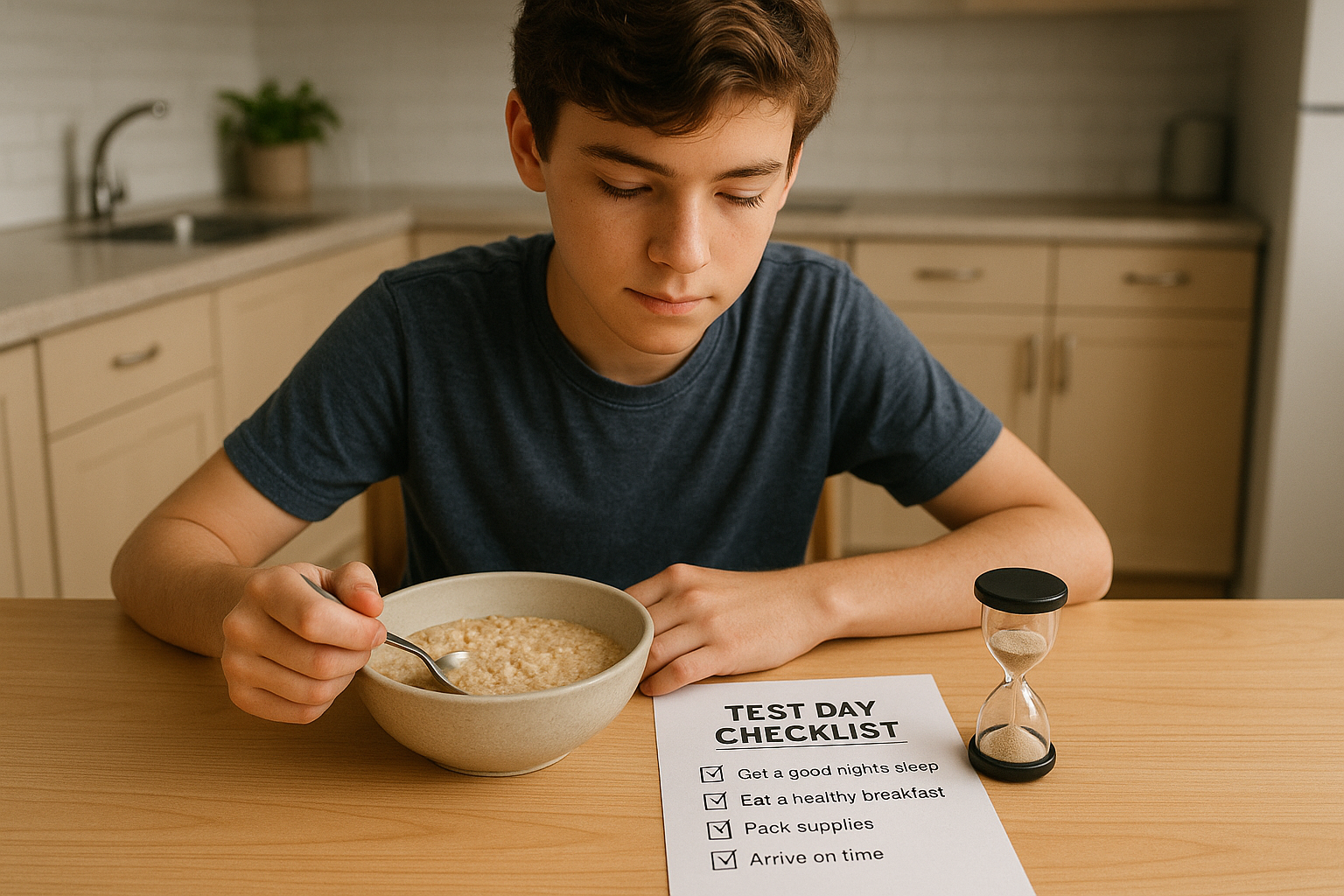
Common myths and clear truths
Let’s clear up a few persistent misconceptions:
- Myth: “Cram all night and rest the day of the test.” Truth: Cramming undermines sleep and retention. You’ll be sharper if you review lightly and sleep well.
- Myth: “If I’ve practiced enough, sleep doesn’t matter.” Truth: Practice is necessary but not sufficient — sleep is the glue that turns practice into durable performance.
- Myth: “I function fine on 5–6 hours.” Truth: Most teens need 7–9 hours for optimal cognitive performance; chronic short sleep erodes attention and memory.
Quick troubleshooting: what if sleep problems persist?
If you’re struggling with chronic poor sleep — frequent awakenings, trouble falling asleep, or daytime sleepiness that doesn’t respond to hygiene changes — consider talking to a school counselor, family doctor, or sleep specialist. Addressing underlying issues (anxiety, irregular schedule, or a medical condition) will pay dividends in SAT readiness and in daily life.
Bringing it all together: study smart, sleep smarter
Preparing for the Digital SAT is about alignment: aligning practice with how memory and attention work, and aligning your schedule so your brain can perform at its best. Sleep quality is not a luxury; it’s a strategy. When you pair consistent, restorative sleep with focused practice, you’ll notice sharper reading, fewer careless errors, and steadier nerves on test day.
If you want support designing a sleep-aware study plan or need help turning practice time into measurable improvement, consider working with a personalized tutor. Services like Sparkl offer tailored study plans, expert tutors who can adjust pacing based on your energy patterns, and AI-driven insights to help you study at the right time for your brain. That combination — smart practice plus good sleep — is how students consistently get their best digital SAT performance.
Final practical takeaway
Two nights matter most: the weeks leading into the test build consistency, and the night before seals the deal. Prioritize regular sleep, pick a predictable morning routine, and treat rest as a study tool as important as any practice test. When you do, your Digital SAT score becomes not just a measure of what you know, but of how well you learned it — and how well you rested to show it.
Good luck. Sleep well, practice smart, and go into test day calm, confident, and ready to show what you’ve built.
























No Comments
Leave a comment Cancel