

Why Deadlines Matter: The Big Picture for Students and Parents
There’s a lot of anxiety wrapped up in those little calendar boxes marked “AP” — not just on test day but long afterwards, when scores, registrations, and college deadlines collide. Understanding when your AP scores arrive compared with when you need to register, confirm your exam, or complete orientation tasks is the difference between calm confidence and last-minute scrambling.

This guide walks you through the timeline logic used by College Board and typical high schools, explains common deadlines, and gives practical strategies so scores, registrations, and college office expectations line up seamlessly. I’ll use clear examples, sample timelines, and a handy table you can screenshot for planning. I’ll also point out where Sparkl’s personalized tutoring and planning support can naturally save time and reduce stress — real help when it matters.
Key Concepts — Score Arrival, Registration, and Orientation: What Each Term Means
AP Score Arrival
“Score arrival” refers to two things: when students see their scores online and when colleges or scholarship programs receive those scores. Students typically get online access to their AP scores on the College Board score release date each summer (dates vary by year and exam administration). Colleges receive scores through the College Board’s delivery systems — during the free score-send window or via paid reports — and institutions have internal processing timelines after receipt.
Registration (Test Ordering and Student Registration)
Registration has two layers. First, your high school or test center places orders for exams with College Board by a school deadline (usually an ordering deadline in the fall). Second, students confirm registration in My AP or through their AP coordinator by certain local deadlines. There are also late-order and late-testing windows with extra fees or special justification.
Orientation and Administrative Deadlines
Orientation covers the logistical tasks that precede testing: joining a class section in My AP, attending pre-exam briefings, completing digital exam account setup (for digital AP exams), and meeting school-specific paperwork and fee deadlines. Orientation tasks often have local deadlines set by the school or district but can also be tied to College Board timelines (for example, submitting accommodations requests through SSD).
Typical Timeline — From Registration to Score Delivery
Below is a representative timeline built from College Board practices and usual school calendars. Exact dates vary by year and by school, so treat this as a reproducible template you can customize.
| Timeframe | What Happens | Action for Students/Parents |
|---|---|---|
| Early Fall (Aug–Oct) | Schools set up AP Registration and Ordering; students join class sections in My AP. | Confirm your My AP account, join sections, and check local school ordering deadlines. Talk to your AP coordinator early. |
| Oct–Nov | Preferred and final ordering deadlines for schools (schools place exam orders with College Board). | Make sure your intent to take exams is recorded; pay local fees. If you’re testing off-site, contact a host school early. |
| Spring (May) | AP exams administered (regular and late-testing windows). | Arrive early, follow cell-phone and calculator rules, and complete any digital submission steps within allotted windows. |
| Late May–June | Post-exam processing; schools return materials; College Board grades and prepares reports. | Check your email for score release windows and ensure your free score sends are set before the free-send deadline. |
| Summer (June–July) | Students access scores online on release date; colleges receive free sends by a College Board deadline (commonly a mid/late June free-send cutoff) and process them in early July. | Designate colleges before the free-send cutoff if you want them to receive scores at no cost. If you miss the deadline, paid sends are available. |
Important Practical Deadlines You Should Bookmark
Every year the College Board publishes specific ordering, registration, and score-send deadlines. Schools have slightly different local deadlines for payment and registration confirmation. Here are the typical calendar anchors you must know and act on:
- School Ordering Deadline: Schools must submit their exam orders to College Board by a final ordering date in the fall. If you’re an outside student, find a host school before this date.
- Student Registration/Confirmation: Schools may require students to indicate exam intent earlier; always confirm with your AP coordinator.
- Free Score-Designate Cutoff (mid/late June): If you want colleges to receive scores at no cost, add your colleges to your free score-send list before the College Board cutoff. Afterward, sending scores costs a fee per recipient.
- Score Release Dates (summer): Scores are released on scheduled dates in the summer; your colleges will generally receive free-sent scores in early July if you configured sends before the cutoff.
- Late Orders and Late Testing: There are defined late-order and late-testing windows; some reasons waive extra fees, but you need documentation or coordinator approval.
Real-World Example: How a Senior Should Coordinate Deadlines
Imagine Maya, a senior applying to early-action programs and hoping for AP credit at her top-choice university. Maya takes three AP exams in May. Here’s what she should do:
- By the school ordering deadline (fall of senior year), ensure her intent to test is recorded.
- After testing, check College Board score-release dates and add her colleges to the free-score send list before the June cutoff.
- If she’s applying early-action in November, verify with her colleges whether they want scores by specific fall deadlines (some will accept summer deliveries, others may ask for official reports by admission application date).
- If time is tight or she missed the free-send cutoff, order paid score reports; paid sends usually process faster (a few days) than mail-based sends.
How Colleges Receive and Process AP Scores
Understanding when colleges actually see your score is crucial. There are two timing pieces: the College Board’s delivery time and the college’s internal processing time. Even if the College Board delivers scores in early July, a college’s admissions or registrar office may take additional days or weeks to post that document to your application file or credit evaluation. If an admissions deadline is near, treat the College Board’s free-send window as your earliest reliable delivery and confirm college preferences directly with admissions offices when deadlines approach.
Common Pain Points and How to Avoid Them
Pain Point 1: Missing the Free-Score Deadline
Why it happens: Busy seniors postpone adding colleges, or they’re unsure about where they’ll apply. The result: paid sends, extra cost, or delayed delivery.
How to avoid: Decide on at least a core list of colleges by late spring and add them before the free-send cutoff. If you’re unsure, add likely-match schools first; you can always send additional reports later.
Pain Point 2: School-Level Registration Confusion
Why it happens: Some schools require local forms, fees, or written consent. If those don’t reach the AP coordinator, the school may not order the exam on your behalf.
How to avoid: Put deadlines in your calendar, follow up with the AP coordinator, and keep receipts for payments. If your school doesn’t offer an AP course, identify a nearby host school early.
Pain Point 3: Waiting for Scores to Post to College Applications
Why it happens: Admissions offices often receive scores but must match them to application records, which takes time.
How to avoid: For critical deadlines, communicate proactively with admissions. If you used an early notification program (early action, early decision), check admissions instructions — some schools will accept unofficial scores first, but official reports must follow.
Checklist: A Practical To-Do Before and After AP Exams
- Before fall ordering deadline: Join your My AP class section and confirm with your AP coordinator that you’ll test.
- Before testing: Complete any digital-account setup and practice submitting responses if your exam is digital.
- Immediately after exams: Note College Board score release windows and add colleges for free score sends before the cutoff.
- If you need faster delivery: Be ready to order paid reports (allow a few business days for processing).
- For colleges: Ask admissions offices about how they prefer to receive AP scores and internal deadlines for granting credit.
Where Sparkl’s Personalized Tutoring Helps — Without the Hype
Planning test logistics can be oddly time-consuming on top of studying. Sparkl’s personalized tutoring and planning support can fit naturally here in two ways:
- Academic readiness: A Sparkl tutor can create a tailored study timeline so you’re confident on test day — reducing the temptation to register late or scramble for retakes.
- Administrative coaching: Sparkl’s advisors can remind families about ordering and score-send deadlines, help you prepare documentation for late testing or accommodations, and walk you through paid score-sending when needed.
Think of Sparkl not as an extra vendor but as a human teammate who keeps your academic timeline aligned with administrative deadlines so nothing falls through the cracks.
Tables and Timelines: Quick Reference
Below is a printable reference you can adapt to your school year. Replace the example dates with the specific ones your school or College Board year assigns.
| Milestone | Example Date (Sample) | Your Action |
|---|---|---|
| My AP Class Section Join | September 1 | Join your class; confirm contact details |
| School Ordering Deadline | November 14 | Confirm exam orders and pay local fees |
| AP Exam Administration | May 5–16 | Take your exams; follow directions |
| Free Score-Designate Cutoff | June 20 (sample) | Add colleges to free-score send list |
| Score Release | Late June (varies) | View scores in My AP; confirm college deliveries |
Frequently Asked Questions
Q: If I miss the free score-send cutoff, how long will it take to get a paid score report to a college?
A: Paid score reports typically process quicker than mail-based archival requests; in most cases they can be sent electronically within a few business days. If your timing is tight, order the paid report and then contact the admissions office to confirm receipt.
Q: Do I need to send scores to every college I apply to?
A: Not necessarily. Some colleges allow you to report self-reported scores on applications and request official reports later only if you matriculate. Others require official scores with the application. Always check each college’s instructions. Adding a core set of colleges to your free-score sends early is a good default strategy.
Q: What if I need late testing because of a conflict or emergency?
A: Late testing is permitted for many valid reasons and may be permitted without additional fee. Your AP coordinator submits the late-testing request; documentation or specific reason categories typically apply. Start this conversation early if you anticipate a conflict.
Final Thoughts: Treat Deadlines as Your Planning Ally
Deadlines aren’t obstacles — they’re scaffolding that keeps your journey toward college organized. When you understand the rhythm — school ordering deadlines in the fall, exams in May, score-release and free-send windows in the summer — you can make strategic choices about where to send scores, when to retake exams, and how to communicate with colleges.
If planning and timing feel overwhelming while you’re also juggling classwork and college applications, bring someone along: an AP coordinator, a trusted teacher, or a Sparkl tutor who can craft a study plan and send reminders for those administrative milestones. That small investment in coordination frees you up to focus on what matters most — mastering the material and presenting your best self to colleges.
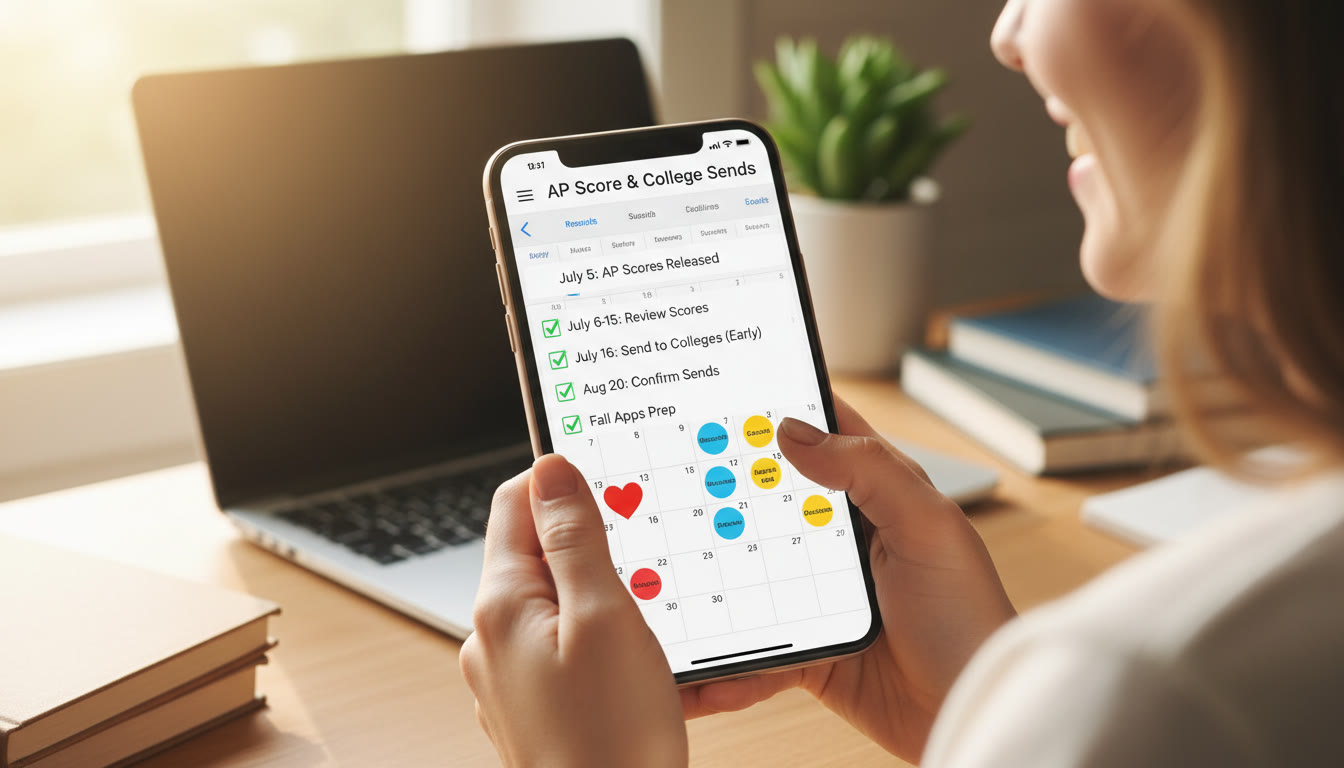
Start today: put your school’s ordering deadline and the College Board’s free-score-send cutoff on a shared family calendar, decide on three colleges you’ll definitely send scores to, and set a reminder one week before each key date to confirm everything’s on track. With a calm calendar, good study habits, and the right support, AP deadlines become a predictable part of your success story rather than a source of stress.
Good luck — you’ve got this. And if you want help building a study and scheduling plan that fits your life, consider a short planning session with a Sparkl tutor; the combination of one-on-one guidance, tailored study plans, and workflow reminders could be the nudge that turns overwhelm into momentum.





























No Comments
Leave a comment Cancel