

Why Passage-Based Writing Matters: A Bridge from A Level to AP Lit
If you’re coming from A Level English Literature or preparing students who have, you already know the delight—and the puzzle—of close reading. AP English Literature’s passage-based writing transforms that delight into a high-stakes skill: tight, evidence-rich analysis written under time pressure. This post is for students and parents who want a practical, humane roadmap: clear strategies, realistic practice, and ways to personalize study so the leap from A Level approaches to AP-style passages feels like an upgrade rather than a shock.
What Makes Passage-Based Writing Different?
A Level tasks often invite you to explore a text’s broader themes, place works in historical contexts, or compare whole texts across a course. AP passage-based writing, by contrast, asks you to compress precision into a narrow space: analyze a single passage (sometimes unfamiliar), explain how language and structure produce meaning, and support claims with closely focused evidence—often within 40–55 minutes. The skills overlap deeply with A Level study—but the emphasis on economy, structural clarity, and explicit textual evidence is intensified.

Core Skills to Practice (and Why They Work)
Think of passage-based writing as a three-part engine: Close Reading, Thesis & Organization, and Evidence Integration. Train each part on its own, then run them together in timed drills.
- Close Reading: Notice diction, imagery, syntax, tone shifts, repetition, and structural moves. A Level study gives you big-picture sensitivity—AP demands you translate that sensitivity into micro-observations that can be quoted and explained.
- Thesis & Organization: A precise thesis that answers the prompt is your compass. Organize paragraphs by rhetorical move (e.g., imagery, syntax, narrative stance), not by line numbers. Each paragraph should make one clear analytical claim and show how the passage creates it.
- Evidence Integration: Short, well-chosen quotations—embedded naturally—are stronger than long block quotes. Explain, don’t assume: every quote needs an interpretation that ties back to the thesis.
Practice Habit: Micro-Annotations
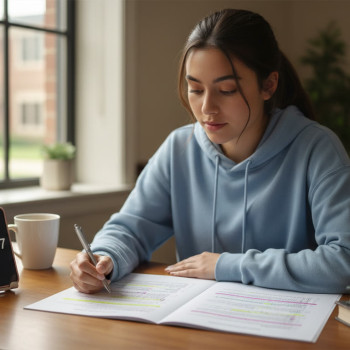
Annotating a 200–400 word passage in 8–10 minutes is a high-yield habit. Circle striking words, label images, note sentence-level shifts (e.g., hypotaxis to parataxis), and write a one-sentence summary of the passage’s rhetorical move. This mini-routine gives you reliable material to build a focused essay under time pressure.
Step-by-Step Strategy for the Exam
Below is a pragmatic, timed strategy you can practice until it becomes second nature. Think of this as a template that you will adapt to different prompts and genres.
| Stage | Time | What to Do |
|---|---|---|
| Read & Annotate | 8–10 minutes | Read passage twice: first for gist, second to mark words/lines that seem rhetorically charged. Note tone shifts and a potential thesis. |
| Make a Quick Plan | 4–5 minutes | Write a one-sentence thesis and sketch paragraph claims (3 body paragraphs). Choose 2–3 short quotations for each paragraph. |
| Write | 25–35 minutes | Follow your plan. Keep introductions brief; reserve time to conclude. Use tight topic sentences and integrate quotes smoothly. |
| Proof & Polish | 2–3 minutes | Fix glaring grammar, ensure quotation punctuation is correct, and confirm the conclusion ties back to thesis. |
Why This Timing Works
The breakdown balances careful reading with the need to produce a polished argument. Students from A Level backgrounds may want to spend a little longer on annotations—fine during practice—but in the exam, discipline matters. Timeboxing preserves the clarity and cohesion exam readers reward.
How to Build an Effective Thesis (Without Overgeneralizing)
A strong thesis in passage-based writing does three things: it addresses the prompt, makes an interpretive claim about the passage’s method or effect, and previews the rhetorical/directional moves you’ll analyze. Avoid vague statements like “the speaker feels sad”—instead, specify how sadness is produced.
- Weak thesis: “The passage shows the speaker is sad about the past.”
- Stronger thesis: “Through restrained diction, anaphoric repetition, and compressed syntax, the speaker transforms private grief into a controlled public reflection that both contains and exposes loss.”
Notice how the stronger thesis names techniques and an effect. That lets every paragraph be a clear demonstration rather than a general meditation.
Paragraph-Level Moves: Structure That Scores
Each body paragraph should be a miniature argument. Aim for the following internal structure:
- Topic Sentence: A claim tied to the thesis.
- Context/Signal: One brief sentence that orients the reader to where the evidence comes from.
- Evidence: Short, embedded quote(s) with line numbers if relevant (brief is better).
- Explanation: Two to four sentences unpacking how the evidence works—focus on language, imagery, tone, sound, syntax, or narrative stance.
- Link Back: A final line that ties the analysis to the thesis and the paragraph’s contribution to the whole essay.
A Model Paragraph (Compact)
Suppose your thesis claims that a passage’s “staccato sentences produce a sense of urgent isolation.” A model paragraph might look like this in effect:
Topic: The abrupt clauses in lines 4–7 collapse the narrative distance. Evidence: “I turned. I heard. I did not answer.” Explanation: The short, clipped clauses mimic the speaker’s breathless movement and create a rhythm that foregrounds isolation—there is no subordinate expansion, no connective cushioning. The succession of independent clauses imitates a heart that refuses narrative smoothing, so the reader experiences the speaker’s solitude as immediate and kinetic. Link back: By compressing action into terse syntax, the passage makes solitude feel not like a retrospective observation but like a lived, present condition.
Choosing and Using Quotations
The best quotations are specific and economical: single words, striking phrases, short clauses. Long quotations often signal lack of selectivity and eat valuable space. Make the quote work: introduce it, embed it, and then analyze it with fearless specificity.
- Tip: Use no more than 3–6 lines of quoted text total in an essay. Most body paragraphs are stronger with 1–2 short quotations.
- Tip: Avoid dropping quotes in without commentary. Every quote should be followed by analysis explaining its function (sound, connotation, imagery, or structural role).
Handling Different Genres: Poetry vs. Prose Passages
AP passages are often poetry, fiction, or drama excerpts. Your approach should adjust subtly:
Poetry
- Pay attention to line breaks, stanza shifts, rhyme, meter, and enjambment.
- Consider how form shapes meaning: a caesura, for example, creates hesitation; an end-stopped line can create closure.
- Sound matters: alliteration, assonance, and consonance can reinforce theme and tone.
Prose (Fiction or Drama)
- Focus on narrative perspective, syntax, paragraphing, and dialogue cues.
- Consider pacing and how sentence length manipulates tension.
- Characterization may be suggested indirectly through focalization rather than explicit authorial comment.
Common Pitfalls and How to Avoid Them
- Over-generalization: “The speaker is angry” without showing how. Remedy: name the rhetorical device that produces anger (sharp monosyllables, scathing metaphors, abrupt clauses).
- Plot summary: Don’t retell the passage. Remedy: restrict plot mention to one line of context and focus on analysis.
- Quoting without comment: Always follow a quote with an explanation of its mechanics and effects.
- Poor structure: Avoid wandering paragraphs. Remedy: use the mini-argument template above.
Practice Plan: A 6-Week Routine
Consistency beats intensity. Below is a practice plan that balances skill-building with realistic time commitments. Parents can use this to support, encourage, and monitor progress without micromanaging.
| Week | Focus | Daily Tasks (approx.) |
|---|---|---|
| 1 | Annotation & Diction | 10–15 min: annotate a short passage; 20 min: write a 20–30 min mini-essay. |
| 2 | Syntax & Sentence-level Analysis | 15 min: mark sentence types and punctuation; 30 min: practice paragraph focusing on syntax. |
| 3 | Form & Structure | 20 min: compare two short passages (poem and prose); 30 min: timed essay on one passage. |
| 4 | Evidence Integration | 10 min: identify best 3 quotes per passage; 40 min: full timed practice with review. |
| 5 | Timed Full Practice | Once or twice: full AP free-response practice under test timing; detailed feedback session. |
| 6 | Polish & Confidence | Short drills, review past essays, and simulate test conditions once. Final week: light practice to stay sharp. |
Feedback and Revision
Practice without feedback is like reading without discussion. Use model essays, tutor comments, or peer review to pinpoint recurring problems. That’s where personalized tutoring helps: Sparkl’s 1-on-1 guidance and tailored study plans can focus on student-specific weaknesses—whether it’s integrating evidence, tightening thesis statements, or improving pacing. Small, targeted improvements yield big score gains.

Scoring Insight: What Readers Are Looking For
Exam readers evaluate three broad qualities: how well you understand the passage, the persuasiveness of your argument, and the control of language. Excellence means precision in all three. A distinct, text-focused thesis, tight organization, and lucid prose will frequently outperform grand generalizations paired with florid language.
Rubric-Friendly Checklist
- Does the essay respond directly to the prompt?
- Is there a defensible thesis that makes an interpretive claim?
- Are quotations integrated and explained?
- Do body paragraphs each have a clear claim and evidence?
- Is language clear, varied, and mostly error-free?
Real-World Examples and Mini-Exercises
Here’s a short set of drills you can use during a fifteen-minute study block. They force you to translate impressions into analytical moves.
- Drill 1 (5 minutes): Pick a striking adjective from a passage. List three connotations and explain how each could alter a reader’s response.
- Drill 2 (5 minutes): Rewrite a long sentence from the passage as two short ones. How does the rhythm change the meaning?
- Drill 3 (5 minutes): Choose one short quote and write two different topic sentences that could introduce analysis of it—one focusing on sound, another on imagery.
Balancing A Level Habits with AP Expectations
Students who come from A Level programs often excel at thematic depth and historical or theoretical context. To translate that advantage into AP success, practice condensing: make thematic insight compact and directly anchored to immediate textual evidence. Parents can remind students that big ideas are valuable only when enacted through line-level analysis in a timed setting.
When Personalized Help Makes a Difference
Not all students progress at the same pace. Someone may grasp close reading but struggle with timed writing, or vice versa. That’s where a thoughtful tutor can accelerate learning. Sparkl’s expert tutors combine 1-on-1 guidance with AI-driven insights to identify weak points—maybe the student under-uses syntactic analysis or quotes too liberally—and then build a targeted plan. The goal is always to convert natural curiosity into reliable exam skills.
Final Tips for Parents and Students
- Practice like you play: use timed, realistic drills to build automaticity.
- Keep a notebook of “go-to moves”—phrases and techniques you can reliably analyze under stress.
- Read widely: short fiction and contemporary poetry sharpen instincts for modern diction and syntax.
- Reflect after each practice essay: what one thing would you change next time? Small, actionable goals compound quickly.
- Use targeted tutoring when progress stalls. Personalized study plans focus effort where it matters most, keeping practice efficient and confidence high.
Closing: Confidence Through Craft
Passage-based writing is less about innate talent and more about habits: how attentively you read, how precisely you argue, and how clearly you write. Students transitioning from A Level to AP already have a lens for literature—what they need now are the habits that convert that lens into succinct, persuasive essays under time constraints. Practice micro-annotations, build a disciplined timing strategy, and seek targeted feedback when necessary. With steady work, the mechanical demands of the exam yield to the deeper pleasure of analysis: discovering how a few well-chosen words on a page can carry an entire world of meaning.
For families looking for guided practice, Sparkl’s tailored tutoring—offering one-on-one coaching, customized study plans, and data-informed insights—can make study time more effective and less stressful. The right coach helps students see which study moves will produce the biggest improvement and how to build confidence so exam day reveals preparation, not panic.
Good luck—and remember: mastery grows from small, thoughtful repetitions. Start with the passage in front of you, and let precision become your habit.



























No Comments
Leave a comment Cancel