

Why Families in Europe Mix IB or A-Levels with AP — And Why It Works
International schools across Europe are increasingly offering creative combinations of curricula: the International Baccalaureate (IB) Diploma, British A-Levels, and selected Advanced Placement (AP) courses. If you’re a student or a parent trying to make sense of this academic buffet, breathe easy. This article is your friendly, practical guide to understanding the why, the how, and the what of blending these programs — plus real-world tips for planning a schedule that keeps stress manageable and keeps doors open for top universities worldwide.

Big Picture: What Each Path Brings to the Table
Think of IB, A-Levels, and AP as three different tools in a student’s toolbox. Each has clear strengths:
- IB Diploma: Broad, skills-focused, and emphasizes critical thinking, research, and interdisciplinary work.
- A-Levels: Deep, specialized study in a small number of subjects — excellent for students with clear academic focus.
- AP Courses: College-style, modular courses that are flexible and can be taken alongside other curricula to demonstrate subject mastery.
Combining them can be smart: APs add subject-specific rigor and standardized evidence of readiness for U.S. colleges, while IB or A-Levels provide the structured diploma many universities, especially in Europe and the UK, value highly.
Common Blends You’ll See in European International Schools
Schools don’t mix arbitrarily. The choices are strategic and driven by student goals, university targets, and resource constraints. Here are common approaches:
- IB Diploma + AP Electives: Students pursue the full IB Diploma and take 1–3 AP exams in subjects where they want to show extra rigor or pursue university credit (e.g., AP Calculus, AP Physics, AP Biology).
- A-Levels + APs: A-Levels form the core deep study while APs can round out the transcript — useful for students applying to U.S. colleges that recognize AP exams.
- IB Courses (Certificate) + APs: For students who want IB-style inquiry but not the full Diploma, schools may offer IB certificates plus AP classes.
Who Should Consider a Mixed Path?
This isn’t for every student, but it’s attractive if:
- You want to keep options open between European/UK universities and U.S. colleges.
- You have strong interest or aptitude in a few subjects where APs offer university credit or advanced placement.
- You want a transcript that shows both breadth (IB) and demonstrable college-level knowledge (AP).
How to Build a Balanced Two-Year Plan
Here’s a practical approach to designing a two-year upper-secondary plan (Years 11–12 or equivalent). The goal is academic strength without burnout.
Step 1: Define University Targets and Admissions Requirements
Start with aspiration, not timetable. Are you aiming for the UK, continental Europe, the U.S., or a mix? Different systems value different evidence. If the U.S. is a serious option, APs are helpful; the UK and many EU programs highly value A-Levels or IB scores. Document exact requirements early — this clarifies the ideal combination of courses and exams.
Step 2: Choose Core Curriculum (IB Diploma or A-Levels)
Decide whether the student will pursue:
- Full IB Diploma: Six subjects, Theory of Knowledge (TOK), Extended Essay (EE), plus CAS (Creativity, Activity, Service).
- A-Levels: Typically three or four subjects at depth, sometimes with AS-level modules.
Both systems are rigorous; the choice should reflect learning style. If you want breadth and interdisciplinary skills, IB is great. If you prefer subject depth and specialization, A-Levels are ideal.
Step 3: Add APs Strategically
APs should be added where they strengthen the application or offer credit. Typical pairings:
- AP Calculus AB/BC for students taking higher-level mathematics in IB or A-Level Math.
- AP Biology or AP Chemistry to complement IB HL sciences or A-Level science subjects for students aiming at STEM degrees.
- AP Literature or AP Language and Composition for students who want additional evidence of readiness for humanities programs in the U.S.
Most students take 1–3 AP exams — more than that risks overloading.
Sample Two-Year Schedules
Below are sample schedules to illustrate realistic workload and choices. Use these as templates, not prescriptions — personalize by interest and school offerings.
| Path | Year 1 (Age 16–17) | Year 2 (Age 17–18) | AP Exams |
|---|---|---|---|
| IB Diploma + AP Elective | IB SL/HL subjects, TOK, start EE research, CAS activities | IB HL exams, complete EE, CAS, final TOK | AP Calculus AB (May Year 2), AP Physics 1 (optional) |
| A-Levels + AP | A-Level year 1 (AS modules), A-Level coursework, extracurricular projects | A-Level year 2 (A2), final exams, university applications | AP Chemistry (May Year 2) for AP credit at certain US colleges |
| IB Courses (Certificates) + APs | IB course certificates in 3–4 subjects, AP prep in stronger subjects | Finish certificates, sit AP exams, send AP scores with applications | AP Biology, AP Statistics (chosen based on interest) |
What This Table Shows
Balanced planning helps students avoid a cram-heavy final year. AP exams are typically taken in May; plan school pacing so AP study can be built into Year 2 rather than piled on at the end.
How APs Complement IB and A-Levels — Specific Benefits
Mixing APs with IB or A-Levels is more than curriculum layering. Each brings concrete advantages:
- Demonstrable College-Level Achievement: AP scores are widely recognized by U.S. colleges as evidence of readiness.
- Potential University Credit or Placement: High AP scores can translate into credit or placement at many institutions, allowing for cost/time savings and earlier specialization.
- Flexibility: APs can be taken as single exams without committing to full AP curricula — useful for students who want to highlight specific strengths.
- Admissions Strategy: APs diversify an application for students primarily in IB/A-Levels by signaling compatibility with the U.S. system.
Practical Tips for Success — Study, Balance, and Well-Being
Academic strategy without study strategy is just wishful thinking. Here are practical habits that work in mixed curricula settings.
1. Plan Backwards from Key Deadlines
Work back from exam dates (APs in May; IB and A-Level timelines vary) to set milestones: syllabus completion, past-paper practice, and mock exams. Build in buffer weeks for catching up or consolidating difficult topics.
2. Use Targeted Practice, Not Just Hours
Effective study is focused. For APs, past free-response questions and scoring rubrics from the College Board are invaluable practice tools. For IB and A-Levels, past papers and examiner reports reveal the style of questioning and mark schemes. Regular timed practice beats marathon, unfocused sessions.
3. Keep Mental Health in View
Mixed programs can feel relentless. Schedule breaks, maintain hobbies, ensure sleep routines, and set realistic targets. Schools and tutors should build workload pacing into the plan so students excel sustainably.
4. Make Use of Personalized Tutoring
Personalized tutoring can be a game-changer. Tailored 1-on-1 guidance helps students focus on the exact skills they need — whether that’s AP free-response technique, IB internal assessment strategy, or A-Level problem solving. Tools like Sparkl provide tailored study plans, expert tutors, and AI-driven insights that can pinpoint weaknesses, sequence topics efficiently, and reduce wasted study time.
How Universities View Mixed Transcripts
Admissions officers like evidence of ability — particularly if it’s consistent and rigorous. A transcript showing deep A-Level performance plus one or two AP exam scores can demonstrate both specialization and readiness for U.S.-style classes. Similarly, an IB Diploma complemented by a targeted AP exam can reassure U.S. admissions teams that the student has experience with college-level exams.
When APs Matter Most
APs tend to matter more when applying to U.S. colleges or when a student wants to secure credit. For the UK and many European programs, A-Levels or IB scores often remain the primary selection metric. Make choices aligned to your primary targets, but keep second-choice options in mind.
Cost, Logistics, and Exam Access
One practical reality is logistics. Not all schools offer AP classes; some only facilitate AP exam registration. AP exams have fees and specific registration deadlines, while IB and A-Level exams are administered through school-certified boards. Families should assess the school’s capacity to support AP registrations and the availability of qualified teachers. Where schools can’t offer certain classes, consider blended strategies like private tutoring or online AP course options.
Frequently Asked Questions (Practical Answers)
Can I take APs without taking an AP class?
Yes. Students can self-study and register for AP exams where their school is an exam center or through approved testing arrangements. Self-study demands disciplined planning and testing practice; targeted tutoring is often beneficial.
How many APs are too many?
There’s no one-size-fits-all number, but 1–3 AP exams paired with IB or A-Levels is a reasonable sweet spot for most students. More than that risks overload unless the student is exceptionally organized and motivated.
Will AP scores earn European university credit?
Sometimes, but policies vary widely. In the U.S., AP credit is common. In Europe, some universities recognize APs for placement or course exemptions, but you must check specific institutional policies early in the application process.
Checklist: Planning Your Mixed-Curriculum Path
Use this compact checklist to guide early decisions and keep your plan on track.
- Decide primary university targets (U.S., UK, Europe) — put exact dates on a calendar.
- Choose core path: IB Diploma, A-Levels, or IB Certificates.
- Select 1–3 AP subjects strategically to strengthen applications or earn credit.
- Create a backwards study timeline from exam dates with weekly milestones.
- Arrange mock exams and past-paper practice dates every term.
- Plan for wellbeing: schedule weekly downtime and maintain sleep/exercise habits.
- Consider personalized tutoring for targeted gaps — e.g., Sparkl’s 1-on-1 tutors and AI-driven planning to maximize efficiency.
Real-World Example: From Confusion to Clarity
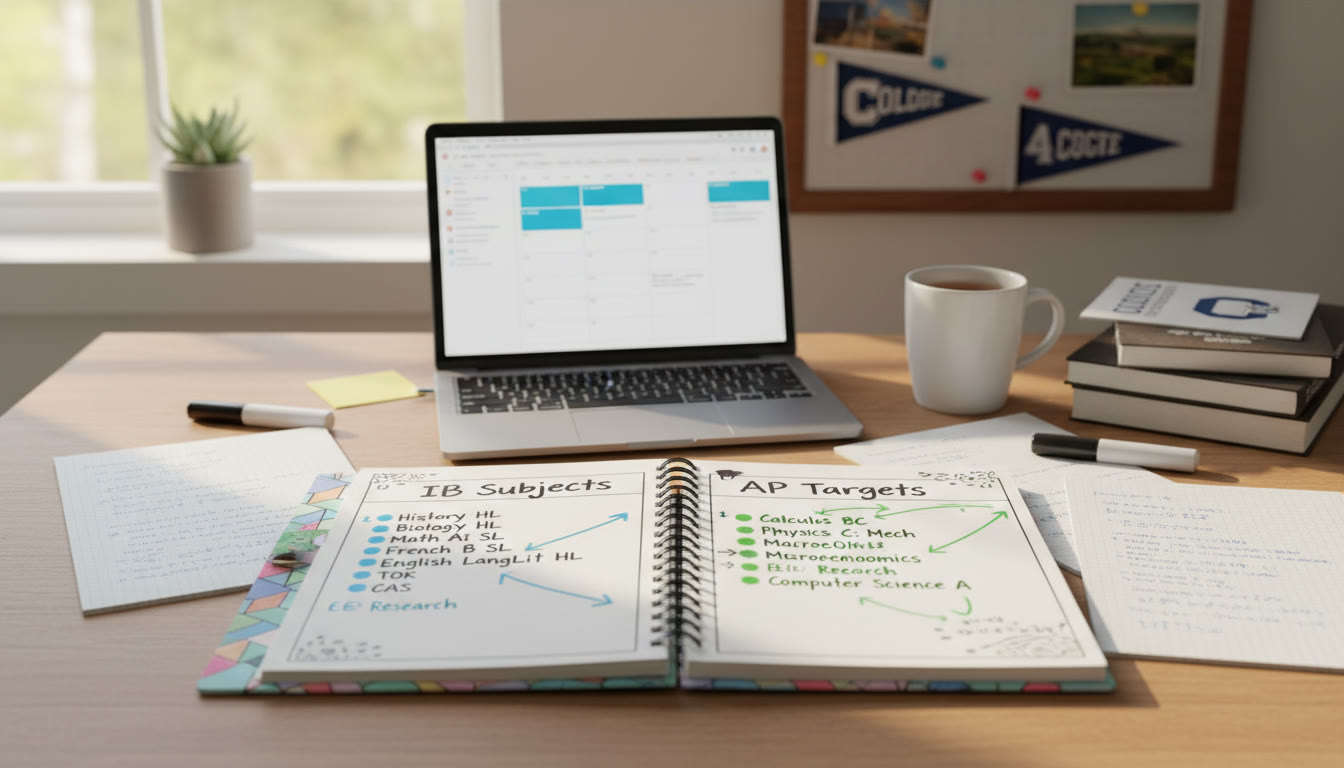
Meet Anna, a hypothetical student at an international school in Amsterdam. She loves biology and mathematics, dreams of studying Biomedical Engineering in the U.S., but also wants a UK backup. Her school offers the IB Diploma and can facilitate AP exam registration.
Smart plan for Anna:
- Pursue the IB Diploma with HL Biology and HL Mathematics.
- Take AP Calculus BC (self-study with focused tutor support) to demonstrate U.S. readiness and possibly gain credit.
- Use the Extended Essay to research a biomedical topic, strengthening both U.S. and UK applications.
- Use Sparkl’s personalized tutoring to fill calculus technique gaps and to structure AP free-response practice into a weekly plan.
Outcome: Anna submits a balanced application showing both IB breadth and AP-specific readiness for the U.S., while her IB scores make her competitive for the UK.
Final Thought: Keep Options Open — But Stay Intentional
Blending IB or A-Levels with APs is an intentionally strategic move for students in European international schools. When done thoughtfully, it gives young people the best of both worlds: the rigorous, holistic learning of IB or the focused mastery of A-Levels, plus the standardized, college-style evidence APs provide. The key is not to stack credentials indiscriminately but to choose a small set of APs that complement your core diploma and support your university goals.
And remember: planning and preparation matter as much as raw talent. Tailored, 1-on-1 guidance — whether through your school, a dedicated tutor, or services like Sparkl that offer expert tutors and AI-driven study plans — can convert confusion into clarity and potential into results.
Quick Resources for Next Steps
Start with three practical actions:
- List your top three university destinations and check their admission preferences and AP/AP-equivalency policies.
- Map out your two-year course plan with clear milestones and mock exam dates.
- Book a short diagnostic tutoring session to identify gaps — targeted coaching (for example Sparkl’s 1-on-1 sessions) can create a high-leverage plan in weeks.
Good luck — and remember that a thoughtful, balanced approach beats a frantic one. With the right plan and targeted support, a smart mix of IB or A-Levels and APs can open doors to universities across the globe while keeping the student’s curiosity and wellbeing front and center.
Parting Line
Education is not a sprint; it’s a journey where intentional choices, steady effort, and the right support make all the difference. Mix curricula with purpose, study with strategy, and ask for help when you need it — that’s how students turn options into outcomes.




























No Comments
Leave a comment Cancel