

Dead Week Design: What NOT to Cram
Dead week. The name alone conjures fluorescent-lit study sessions, stacks of color-coded notes, and the irresistible itch to try to learn entire semesters overnight. If you’re prepping for AP exams, this week can feel make-or-break. But here’s a radical idea: what you DON’T do during dead week matters as much as what you do. In this piece I’ll walk you through the things to avoid cramming, the smarter moves that actually improve performance, and a practical, humane plan you can use that respects both your brain and your life.

Why dead week should be about strategy, not panic
Dead week is tempting because it feels like a concentrated opportunity to fix everything: missed units, shaky essays, or shaky problem sets. But human memory, attention, and test performance don’t respond well to frantic massed cramming. The brain needs spaced practice, targeted review, and the right conditions to consolidate difficult material. In other words: a four-hour blast of everything is less effective than a series of focused, well-placed, and restful study sessions.
Beyond cognitive science, there are practical realities: AP exams are administered on fixed dates in May and many resources—like AP Classroom and AP Daily videos—are designed to help you review in a targeted way. Knowing how the system works and what the exam expects lets you study smarter, not longer.
What NOT to cram: the short list (and why)
Here are the study categories that consistently produce diminishing returns when crammed during dead week. Avoid these, and you’ll save mental energy for higher-impact activities.
- Entire new units or foundational concepts — Trying to learn large, unfamiliar topics from scratch is inefficient. Foundational knowledge needs repeated exposure over time to form robust connections.
- Hours of passive rereading — Re-reading notes end-to-end feels productive, but passive review rarely creates recall or problem-solving skills.
- Last-minute format learning — Spending dead week trying to master a new essay structure or lab technique from scratch is risky; instead, refine and practice what you already understand.
- Low-value minutiae — Tiny facts (dates, isolated vocabulary items) that won’t be high-yield on the exam shouldn’t take prime study time if they’re not sticking.
- All-night study marathons — Sacrificing sleep will sabotage memory consolidation and test performance; your brain needs REM and slow-wave sleep to lock in learning.
Why these are traps
When you cram new units, you give your brain exposure without consolidation. Passive rereading and marathon sessions give the illusion of mastery but rarely transfer to test conditions. The result? You feel busy but remain fragile when a real AP question requires synthesis, not just recall.
What to focus on instead: high-impact Dead Week moves
Swap the traps above for these higher-ROI strategies that align with how the AP exams are scored and how the human brain learns.
- Active recall practice — Use flashcards, practice prompts, and retrieval-based strategies. Try to answer questions from memory before checking notes.
- Past free-response practice — Timed FRQs (or equivalent problem sets) help with pacing and the specific rubrics used by AP graders.
- Exam-style mixed practice — Do sections in exam order and simulate timing; alternating subjects and question types strengthens transfer.
- Targeted weak-point drills — Identify the 2–3 topics that have tripped you up all semester and drill those deliberately.
- Practice under realistic conditions — Use a quiet room, timed sections, and only allowed materials so you habituate to testing conditions.
- Recovery and sleep — Prioritize sleep and short, restorative breaks; your brain consolidates learning during rest.
A sample priority checklist for the last seven days
Think of this as a template you shape to your schedule and subjects. The idea is to keep your days predictable and recovery-focused.
| Day | Focus | Daily Habit | Time Budget |
|---|---|---|---|
| Day 7 | Identify weak topics & plan | Create a 3-topic target list; assemble practice materials | 1–2 hours |
| Day 6 | Active recall & flashcards | 20–30 minute retrieval sessions, 3x/day | 2 hours |
| Day 5 | Timed practice section | Full multiple-choice or problem section, timed | 2–3 hours |
| Day 4 | Targeted FRQ practice | 1–2 FRQs with rubric-based scoring | 2 hours |
| Day 3 | Mixed review & correction | Review mistakes, create quick correction notes | 2 hours |
| Day 2 | Light practice & logistics | Short practice, pack supplies, confirm exam logistics | 1–1.5 hours |
| Day 1 | Rest & brief warm-up | 30-minute gentle review; sleep early | 30–60 minutes |
How to pick the 2–3 topics that deserve dead-week focus
Not all weaknesses are equal. The right targets are those that:
- Appear frequently on past exams or in the course outline.
- Support multiple question types (e.g., a concept used in both MC and FRQ).
- Can be improved with focused practice in a few sessions.
Start by scanning your past tests, AP Classroom progress checks, or teacher feedback. If you’ve been using AP Classroom resources, AP Daily videos, or topic question sets, they help you find which standards or learning objectives are still shaky. Spend your dead week time closing those specific gaps rather than re-covering everything superficially.
Example: AP Biology student
Rather than cramming the whole immune system and genetics the night before, identify the two areas that cause the most points loss—say, interpreting gel electrophoresis and predicting outcomes of genetic crosses. Then: do targeted practice problems, review a short rubric-based anchor response for FRQs that require data analysis, and simulate one timed data-analysis FRQ. That concentrated approach will usually return more points than a last-minute marathon on new content.
Practical study techniques that actually work in Dead Week
Here are methods that are compact, evidence-aligned, and realistic for the week before exams.
- Retrieval practice — Close your notes and write what you can recall. Grading your own recall and then re-studying the gaps is gold.
- Interleaving — Mix different types of problems rather than doing a block of the same kind. This improves discrimination and application skills.
- Spaced repetition — Use short, spaced sessions rather than a single long cram. Even brief revisits strengthen memory.
- Self-explanation — Teach a friend or explain a problem aloud. Articulating reasoning reveals weak spots and cements understanding.
- Rubric-driven practice — Especially for AP FRQs, study sample high-scoring responses so you know what graders value.
How to practice essays and FRQs in a time-starved week
Two targeted FRQs with rubric-guided review beats four half-hearted essays. Here’s a simple FRQ routine:
- Pick one prompt at exam-like timing.
- Write with a clear plan: thesis, two to three supporting points, and a quick conclusion.
- Score against the rubric or have a peer/tutor give feedback.
- Rewrite the answer in 15 minutes focusing on clarity and evidence use.
If you have access to 1-on-1 guidance—like Sparkl’s personalized tutoring—use one of those sessions for rubric review and targeted feedback; an expert tutor can point out small structural tweaks that add real points on the exam.
Logistics and exam-day preparation you must not ignore
Dead week is also the time to lock down logistics. Small administrative mistakes are surprisingly common and stressful.
- Confirm your AP exam schedule and mode (digital or paper), and know the allowed materials for each exam.
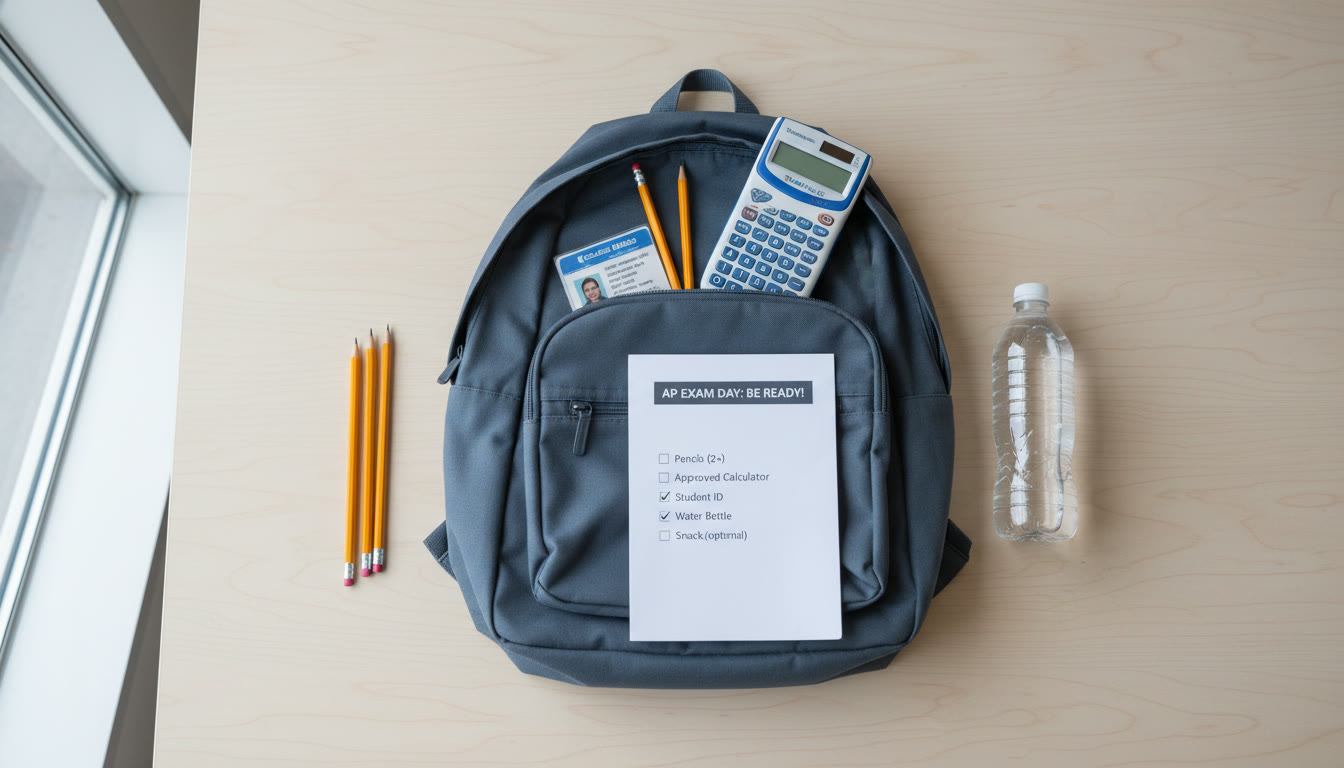
- Pack your bag the night before: pencils, approved calculator, photo ID, water, and snacks allowed by your school.
- Know your testing location and travel time; account for traffic, check-in policies, and what to do if you’re running late.
- Check any digital exam setups in advance if your exam is administered on an app or laptop—practice the format.
These small actions prevent last-minute panic and free cognitive bandwidth to focus on the exam itself.
Quick checklist
- Confirm exam date, start time, and testing mode.
- Prepare allowed materials and backup batteries or chargers.
- Have a healthy sleep schedule for the last three nights before the exam.
- Plan simple, familiar meals on exam day to avoid stomach issues.
The science of sleep, nutrition, and stress in the final week
Sleep is not optional. Memory consolidation—transforming short-term recall into durable knowledge—happens during sleep. Pulling two all-nighters to “cover” more content typically backfires. Aim for consistent sleep of 7–9 hours in the final week and prioritize naps of 20–30 minutes if fatigue hits.
Nutrition matters too: steady, balanced meals fuel sustained attention. Avoid heavy new foods that might upset your stomach on test day. Hydration and steady blood sugar (protein + complex carbs) support cognitive stamina.
For stress, use short, practical techniques you can deploy anywhere: box breathing (4-4-4-4), focused 5-minute walks, and quick micro-breaks every 45–60 minutes to reset attention. These tiny habits keep cortisol from hijacking your memory and focus.
When to get targeted help: tutors, teachers, and tech
Dead week is an excellent time to use targeted help, but be mindful how you use it. One or two well-placed tutoring sessions can clarify rubrics, correct persistent errors, and give you confidence. If you’re working with a program that offers personalized tutoring—like Sparkl—you can get 1-on-1 guidance, tailored study plans, and AI-driven insights that prioritize your weak points. Make those sessions action-oriented: go in with a specific FRQ or topic, execute the practice during the session, and leave with a short revision plan.
Ask your teacher for high-yield advice too: which topics historically appear often, or common traps students fall into on the course’s exam. Teachers can also provide targeted progress checks or pinpointed feedback on your practice FRQs.
A realistic sample timeline for two subjects
Below are two sample day plans you can adapt for your schedule. Each balances focused practice, rest, and light review.
| Time | AP Literature (Example) | AP Calculus (Example) |
|---|---|---|
| 8:00–9:00 AM | Light review: annotated poem notes and thesis templates | Active recall: derivative rules and key forms |
| 10:00–12:00 PM | Timed practice: one prose FRQ with rubric review | Timed practice: mixed MC section or 2 FRQs |
| 1:00–2:00 PM | Lunch and 20-minute walk | Lunch and 20-minute walk |
| 3:00–4:00 PM | Targeted drill: thesis clarity and paragraph structure | Targeted drill: integration techniques and L’Hospital lots |
| 7:00–8:00 PM | Flashcard retrieval for key authors and devices | Flashcard retrieval for derivative and integral rules |
| 9:30 PM | Wind down and sleep prep | Wind down and sleep prep |
Common dead-week mistakes and how to avoid them
- Mistake: Starting brand-new content. Fix: Convert new content into short retrieval sessions or postpone until after the exam.
- Mistake: Overestimating passive reading. Fix: Replace with active practice and brief self-tests.
- Mistake: Ignoring logistics. Fix: Confirm test dates, allowed materials, and travel plan now.
- Mistake: Using tutoring as a last-minute dump. Fix: Use tutoring for targeted feedback, rubric review, and practice under timed conditions.
How to measure progress in dead week
Progress isn’t hours logged; it’s demonstrable improvement on the specific tasks you’ll face on exam day. Use these simple metrics:
- Fewer conceptual errors in timed sections.
- Improved rubric scores on FRQs (even +1 point matters).
- Faster, accurate pacing through practice sections.
- Consistent sleep and stress metrics (subjective calm, steady sleep hours).
Celebrate small wins. A single polished FRQ or a clean, timed multiple-choice section is evidence that your approach is working.
Final 48 hours: what to do (and what to skip)
In the last two days before the exam, the goal shifts from learning to maintenance. Keep sessions short and focused. Avoid introducing new topics or last-minute ‘secret’ strategies. Instead, do a short warm-up that mimics the exam format, make sure your supplies and logistics are set, and prioritize sleep, hydration, and calm.
Parting advice: build habits that outlast dead week
Dead week reveals habits—some helpful, some harmful. Use what you learn this week to shape future semester strategies: spaced practice, routine short retrieval sessions, and targeted use of tutoring or teacher feedback are investments that reduce the need for future panics. If you find targeted 1-on-1 help useful, make it a part of regular preparation; a few focused tutoring sessions early on can prevent wide gaps later. Programs that offer personalized tutoring, such as Sparkl, can fit naturally into this approach by creating tailored study plans, providing expert tutors, and supplementing with AI-driven insights to show what to practice next.
One-sentence mantra for exam week
Study smart, practice under real conditions, and protect your sleep—confidence is the product of strategy and rest, not panic.
Quick resources checklist (things to have ready now)
- Official AP practice materials or teacher-provided practice sets.
- Rubrics and sample high-scoring responses for your subject.
- Timer or stopwatch for simulated sections.
- Exam logistics: start time, testing mode, location, and allowed items.
- One or two targeted tutoring sessions for final feedback if you need them.
Dead week doesn’t have to be a battlefield. With a small number of careful choices—what to ignore, what to reinforce, and how to manage your energy—you can walk into your AP exam calm, prepared, and ready to show what you know. Good luck: you’ve got this.




























No Comments
Leave a comment Cancel