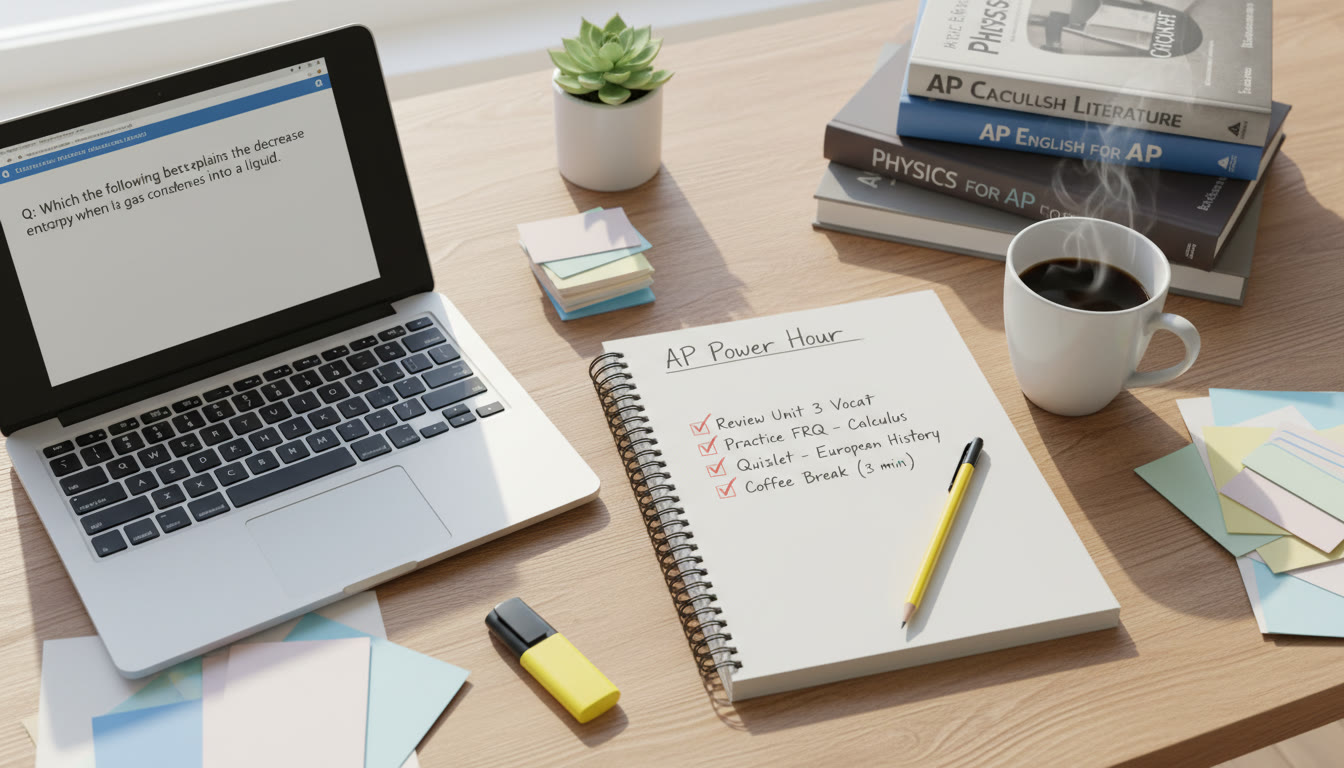

Power Hour Template: Daily AP Focus
There’s something quietly powerful about one focused hour. For AP students juggling school, activities, and life, a daily “Power Hour” can be the small, repeatable action that turns confusion into clarity and panic into steady confidence. This guide gives you a polished, practical Power Hour template you can start using tonight — complete with a sample weekly plan, a table-based tracker, micro-tasks, and real-world tips that make studying feel less like a grind and more like progress.
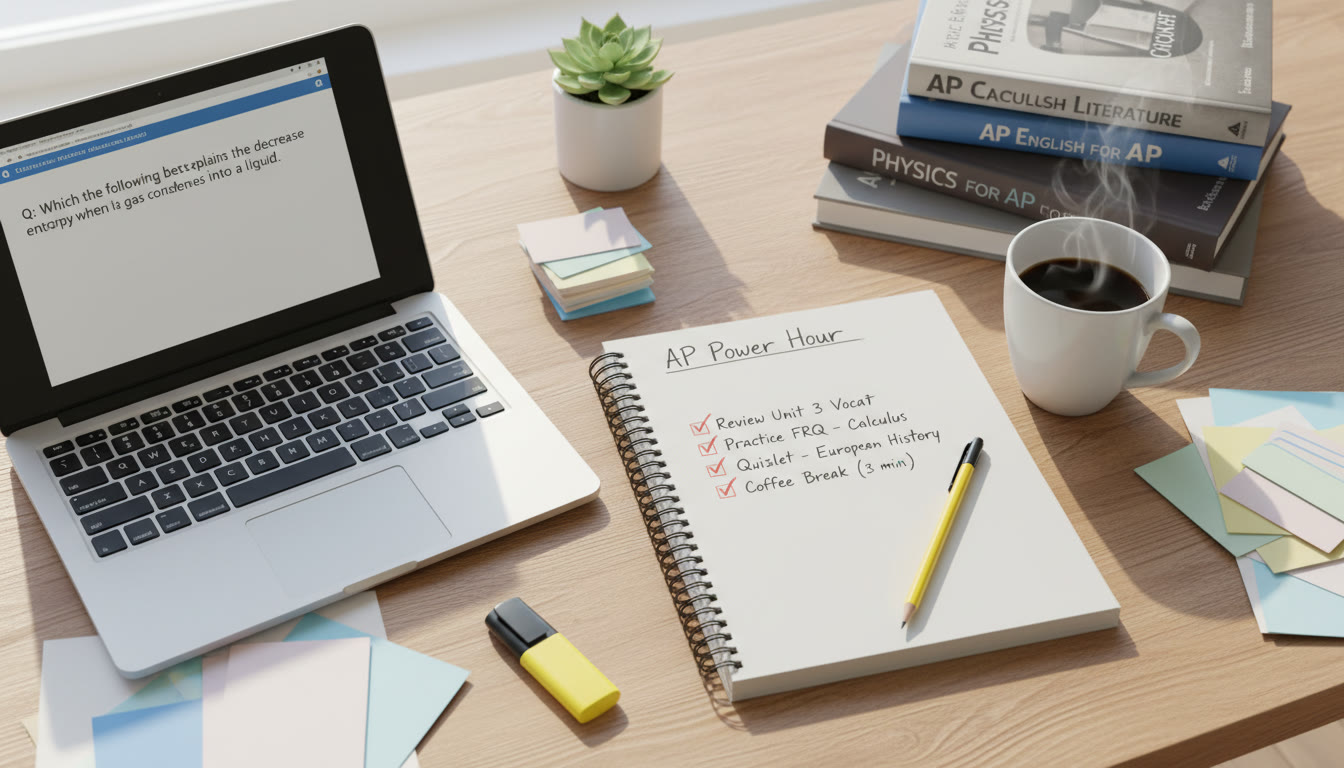
Why a Power Hour works for AP students
Most students think they need marathon study sessions to get ahead. But concentrated, deliberate practice—especially when focused on one small goal—beats scattered effort. The Power Hour is effective because it:
- Creates daily momentum so studying becomes habit, not panic.
- Limits burnout by keeping sessions short and intentional.
- Targets high-impact tasks (practice questions, FRQs, formulas, and targeted review).
- Makes progress measurable: one hour a day × 6 months = mastery.
How to use this template (quick start)
Decide on a consistent time (after school, before dinner, or early morning). Choose one AP subject per Power Hour or split the hour into two focused 30-minute segments if you’re balancing multiple APs. Stick with the structure below for at least two weeks and then adjust based on what sticks.
Power Hour Structure (60 minutes)
Every Power Hour follows a predictable rhythm. Predictability reduces decision fatigue—so you spend energy on learning, not on planning.
- 5 minutes — Setup & Goal: Open materials, write the single goal for this session (example: finish 2 AP Bio FRQs or master 5 stoichiometry problems).
- 20 minutes — Focused Practice: Timed practice questions or active problem solving. Use an exam-like timer for sections that are time-pressured.
- 10 minutes — Mini-Review: Check answers, annotate mistakes, and summarize one key takeaway on an index card or digital note.
- 20 minutes — Targeted Learning: Short lesson/review on the exact concept you missed (video, textbook, or tutor explanation). Apply immediately with 2 quick practice items.
- 5 minutes — Plan & Log: Record what you did, what improved, and the next micro-task for tomorrow.
Why this breakdown?
The 20/10/20 blocks enforce active retrieval and immediate correction—two evidence-based learning strategies. Quick logging at the end keeps you accountable and builds a database of weak spots to revisit. If you use an external mentor or tutor, these logs become ammo for targeted 1-on-1 guidance.
Weekly Power Hour Calendar (Sample)
Switching focus each day helps you cover multiple subjects without overwhelming yourself. Below is a sample weekly rotation for a student taking three AP classes (AP Calculus AB, AP Biology, AP U.S. History).
| Day | Primary Focus (1 Hour) | Secondary (Optional 30 min) | Goal Example |
|---|---|---|---|
| Monday | AP Calculus AB | Review previous week’s mistakes | Solve 6 practice derivatives, correct errors |
| Tuesday | AP Biology | Flashcard review (20 min) | Complete 2 FRQs on cell communication |
| Wednesday | AP U.S. History | DBQ outline practice | Write thesis and outline for 1 DBQ prompt |
| Thursday | AP Calculus AB | Timed multiple-choice set | Practice definite integrals (MCQ set) |
| Friday | AP Biology | Group study or quiz | Concept map respiration processes |
| Saturday | Mixed Practice (45 min each) | Catch-up review | Mixed set: 10 Q from each AP |
| Sunday | Rest or light review | Reflect & plan | Log achievements & set next week’s goals |
Customizing the calendar
Swap more days for your hardest subject, or condense two short Power Hours on days with heavier course loads. The key is frequency and quality—daily consistency matters more than occasional marathons.
Micro-Tasks: The Building Blocks of Mastery
Break bigger topics into tiny, measurable micro-tasks. Here are examples tailored to common AP subjects:
- AP Calculus: Derivative shortcuts, 5-limit proofs, definite integral area interpretations.
- AP Biology: One FRQ passage, one concept map (e.g., cellular respiration), 10 flashcards for vocabulary.
- AP U.S. History: One DBQ thesis + 3 evidence bullets, timeline of key events for an era, compare/contrast pairs.
- AP Chemistry: 3 stoichiometry problems, one conceptual explanation (ideal gas law), practice graph analysis.
- AP English: One timed rhetorical analysis paragraph, 2 close-reading annotations, vocabulary in context.
Example micro-task progression for an FRQ
- Day 1: Read prompt and annotate; outline thesis.
- Day 2: Draft response under time pressure.
- Day 3: Review scored rubric and re-write for clarity.
Tracking Progress: Simple Table You Can Copy
Track daily tasks and reflections so patterns become obvious. Put a copy of this table in a notebook or on a shared doc with a tutor.
| Date | Subject | Power Hour Goal | What I Did | Mistakes Noted | Next Micro-Task |
|---|---|---|---|---|---|
| 2025-10-08 | AP Biology | 2 FRQs on cell signaling | Completed both; timed one | Confused paracrine vs autocrine | Create 5 flashcards; re-do FRQ |
| 2025-10-09 | AP Calculus AB | Practice 6 derivative problems | 4 correct, 2 sign errors | Chain rule sign slip | 3 targeted chain rule problems |
How to read the tracker
At the end of each week, scan the “Mistakes Noted” column. If the same concept repeats, bump it to a daily micro-task until it stops appearing. That repetition is your most efficient path forward.
Active Strategies to Use During the Power Hour
Make these habits part of your 60-minute routine.
- Active Recall: Instead of rereading notes, close the book and write what you remember. Then check and correct.
- Interleaving: Mix problem types to improve transfer (e.g., alternate FRQ practice with MCQs).
- Spacing: Cycle back to topics rather than cramming them in one week.
- Error Analysis: For each wrong answer, write a one-sentence explanation of the mistake.
- Teaching: Explain a tricky concept out loud for two minutes as if teaching a friend—this reveals gaps fast.
Using practice tests strategically
Full practice exams are essential, but reserve them for scheduled weeks (e.g., once per month during early prep, then once weekly as the exam approaches). Use Power Hours to work the painful parts those tests uncovered, not to re-take full tests every day.
When to Bring in a Tutor (or Sparkl’s Personalized Help)
Not every mistake needs a tutor. But targeted 1-on-1 help is high-leverage when:
- You repeatedly miss the same subtopic despite practice.
- You need help turning raw knowledge into exam-style answers (e.g., DBQs, FRQs).
- You want a tailored study plan that fits your school schedule and strengths.
Personalized tutoring—like Sparkl’s approach—can accelerate progress by translating your daily tracker into a dynamic plan, offering focused 1-on-1 explanations, and using AI-driven insights to spot what you’ll likely miss next. If you’re short on time, a few targeted sessions can save weeks of inefficient study.
How to get the most from tutoring sessions
- Bring your Power Hour logs and a list of three specific goals.
- Ask for worked examples that mirror exam rubrics.
- Request follow-up micro-tasks you can finish in one Power Hour.
Sample Power Hour Scripts (by subject)
These scripts are copy-paste ready. Treat them like playlists for the hour.
AP Biology — Cellular Processes
- 5 min: Quick read of an FRQ prompt and annotate keywords.
- 20 min: Timed attempt at FRQ #1.
- 10 min: Compare to model answer; write one-paragraph correction.
- 20 min: Watch a 10–12 minute targeted explainer (video) on the concept and do 2 practice MCQs.
- 5 min: Log error pattern and plan flashcards.
AP Calculus AB — Integrals and Areas
- 5 min: Setup and goal: 6 practice problems.
- 20 min: Timed problem set (use exam pacing).
- 10 min: Reverse-engineer any incorrect answers.
- 20 min: Quick review of a proof or concept; apply with 2 new problems.
- 5 min: Note next micro-task (e.g., practice substitution method).
AP U.S. History — Document-Based Questions
- 5 min: Skim DBQ documents and jot initial thesis ideas.
- 20 min: Draft a thesis and outline with evidence mapping.
- 10 min: Reorganize for stronger evidence flow.
- 20 min: Write a timed body paragraph and get feedback from a peer or tutor later.
- 5 min: Log rubric points missed and plan a rewrite.
Dealing with Off Days and Burnout
Even the best routines will hit a lull. Use these small resets when motivation is low:
- Switch to passive but productive tasks: flashcards, light reading, or listening to a summary podcast.
- Reduce the Power Hour to 30 minutes of gentle review—consistency beats intensity on tired days.
- Plan a reward: short walk, favorite snack, or a 20-minute break to decompress.
When to pause the plan
If you’re genuinely exhausted, allow one full rest day per week. Mental recovery fuels better long-term learning than pushing through every single night.
Measuring Success: Metrics That Matter
Forget vague goals like “study more.” Use clear metrics:
- Average score on timed practice sets (track weekly).
- Number of repeated mistakes dropped (counted from your tracker).
- Time to complete rubric-level FRQ responses.
- Confidence rating: a 1–5 scale after each Power Hour (note trends).
Every two weeks, spend one Power Hour reviewing these metrics and adjusting the schedule. If your practice scores plateau, reallocate more Power Hours to the weakest subject or bring in targeted tutoring to break through.
Final Tips — Short, Actionable, and Honest
- Be rigid about the hour’s structure but flexible about the content: swap tasks when needed.
- Use a timer and put your phone away—out of sight often means fewer distractions.
- Celebrate small wins: nailing a type of FRQ or finally understanding a tough proof is progress.
- Keep one place (not multiple apps) for your logs—simplicity beats fragmentation.
- Consider periodic 1-on-1 sessions with an expert tutor to convert daily progress into exam-ready performance; targeted guidance can make your Power Hour exponentially more efficient.

Wrap-Up: The Long Game
The Power Hour is not a quick fix. It’s a disciplined, humane way to turn small daily actions into major test-day advantages. If you commit to an hour a day, use error analysis, and periodically recalibrate with metrics and targeted tutoring, your knowledge will compound. You’ll not only improve scores—you’ll build confidence, reduce panic, and arrive on exam day ready to show what you know.
Start tonight: set a 60-minute block, pick one subject, write one clear goal, and begin. When you’ve tried the routine for two weeks, adapt it to you. The template is a skeleton—your daily choices make it a success story.
Note: If you want a personalized Power Hour plan tailored to your exact AP roster, weak topics, and weekly schedule, consider trying Sparkl’s personalized tutoring. With focused 1-on-1 guidance, tailored study plans, and AI-driven insights, they can translate your daily logs into high-impact study sessions that fit your life.
Go practice—one hour at a time.

























No Comments
Leave a comment Cancel