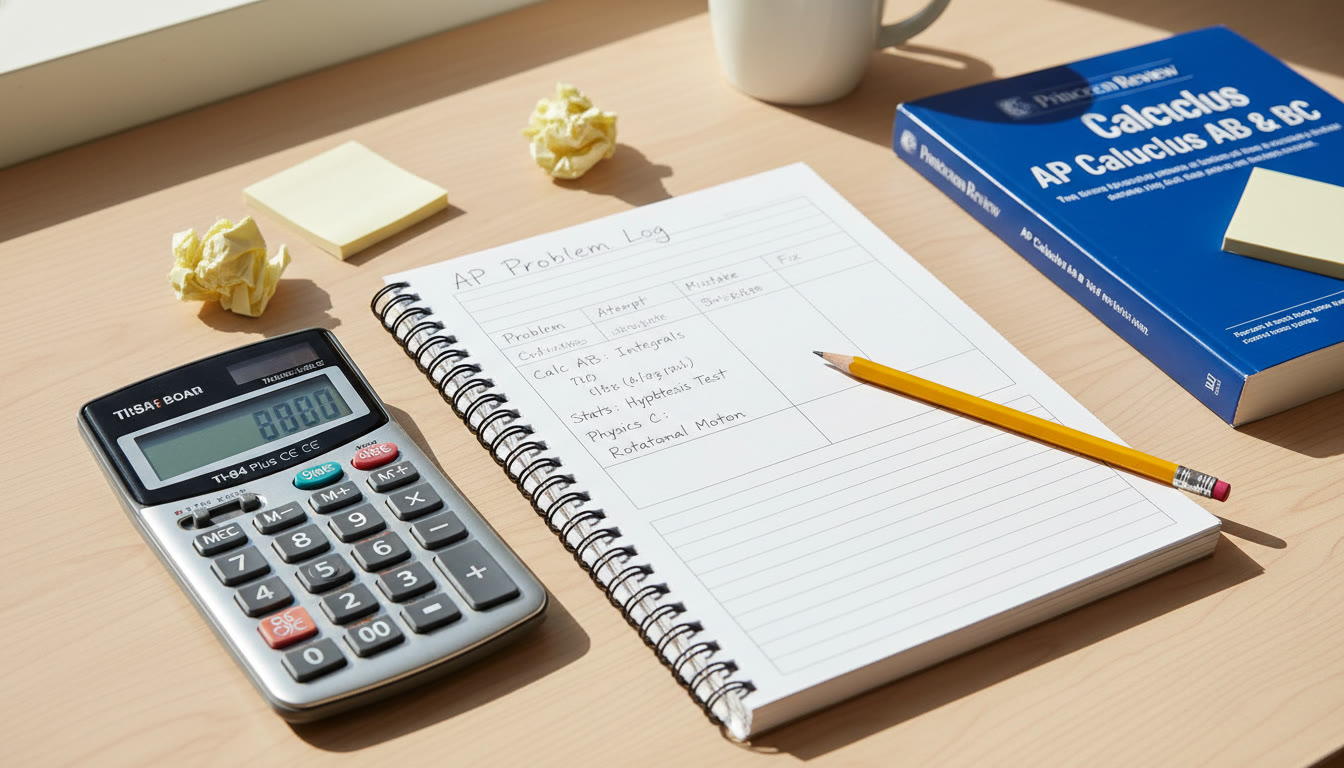

Why a Structured Problem Log Beats Cramming
There’s a big difference between doing problems and learning from them. You can grind through pages of practice problems for AP Calculus or AP Physics and still be surprised by what shows up on test day. A structured problem log changes that because it turns each practice problem into a learning artifact you can revisit, analyze, and improve on. Instead of ephemeral practice, you create a living map of your progress.
Think of a problem log like a lab notebook for your thinking. Scientists don’t just run experiments once and forget the results — they record setup, observations, errors, and next steps. You should treat your math and physics practice the same way.
What a Problem Log Actually Does
- Captures the problem statement and key givens so you can reconstruct the thinking later.
- Records your first attempt, the mistakes you made, and why they happened.
- Tracks correction attempts and the final correct solution with clear reasoning.
- Provides time-stamped evidence of how your understanding changes over weeks.
- Helps tutors or teachers give targeted feedback because they can see your process, not just a final answer.
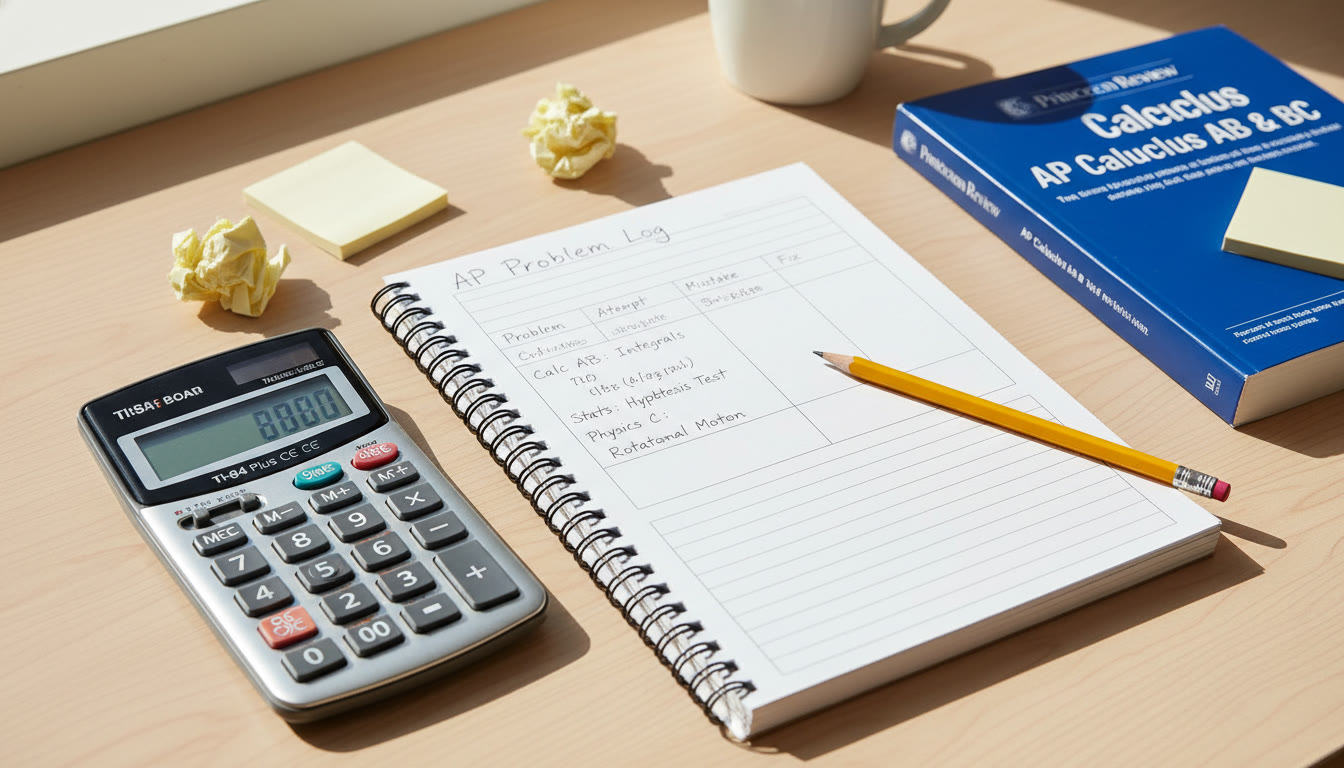
Core Structure: The Template You’ll Use Every Day
Below is a simple template that fits both AP Math (Calculus, Statistics) and AP Physics (1, 2, C). You can keep this in a physical notebook, a Google Doc, or a note-taking app. The key is consistency — use the same fields each time so your brain learns to record useful data automatically.
Problem Log Template
- Date: When you attempted the problem.
- Source: Where the problem came from (practice test, textbook, teacher handout). If you’re prepping for College Board AP exams, note the question ID or page.
- Topic/Concept: e.g., Integration by Parts, Kinematics, Electric Fields, Probability Distributions.
- Difficulty (1–5): Self-rated difficulty to help prioritize review.
- Problem Statement (short): Concise rewrite of the prompt — just the essentials.
- First Attempt (work): Where you show your initial approach — don’t skip steps.
- Mistake(s) and Why: Be honest. Calculation slip? Wrong principle? Misread the question?
- Correct Solution (clean): A tidy final solution with reasoning and key formulas highlighted.
- Generalized Lesson: What broader rule or strategy you’ll carry forward.
- Review Date: Schedule when you’ll revisit this problem (spaced repetition).
Why Each Field Matters
Short answer: memory and transfer. Writing the first attempt forces you to see the exact step where your thinking diverged from the correct path. Recording the “why” of the mistake trains you to notice root causes (misconception vs. careless error) so you don’t just fix a single problem but the underlying habit.
How to Use the Log: A Practical Weekly Workflow
Having a template is useful, but habits matter. Below is a weekly routine that turns a problem log into a high-impact study system.
Weekly Plan (Example)
- Monday: Take a timed set of 6–8 AP-style problems from a practice test or textbook. Log each problem using the template.
- Tuesday: Rework the logged problems you got wrong; try at least one new problem on each concept you struggled with.
- Wednesday: Meet with a tutor or study partner to review 3–4 logged problems (use your logs as the agenda).
- Thursday: Drill quick concept checks (10–15 min) for topics flagged as difficulty 4–5 in your log.
- Friday: Take one new full-length section (e.g., AP Physics multiple-choice block or AP Calculus FRQ) and log the toughest 6 problems.
- Weekend: Review logs from earlier in the week and schedule spaced-review dates for next month.
This cadence balances problem exposure, correction, and spaced review. If you work with a tutor (for example, Sparkl’s personalized tutoring), bring your logs to the session — it makes 1-on-1 guidance far more targeted because the tutor can see patterns across problems and tailor a study plan to plug real gaps.
Example Problem Log Entry (AP Calculus)
Seeing a real example will make the template click. Here’s a compact entry you might write after attempting an AP Calculus free-response question.
| Field | Entry |
|---|---|
| Date | September 12, 2025 |
| Source | Collegeboard Practice FRQ, 2019 Calculus AB, Q3 |
| Topic | Mean Value Theorem; Rolle’s Theorem |
| Difficulty | 4 |
| Problem (short) | Show existence of a c in (a,b) satisfying f'(c)=k, given boundary rates. |
| First Attempt | Applied MVT to f(x) directly but forgot to verify continuity endpoints. Sketched derivative incorrectly. |
| Mistake(s) & Why | Assumed differentiability over closed interval without checking endpoint continuity. Concept confusion between MVT prerequisites and conclusion. |
| Correct Solution | Verified continuity on [a,b] and differentiability on (a,b). Constructed g(x)=f(x)-kx, applied Rolle’s Theorem to g, concluded g'(c)=0 => f'(c)=k. |
| Generalized Lesson | Always confirm MVT conditions; when asked for existence, consider constructing auxiliary functions. |
| Review Date | October 12, 2025 (spaced review) |
How to Diagnose Mistakes: A Mini Taxonomy
Not all mistakes are equal. Once you can label the type of mistake reliably, you can more effectively target study time. Use these categories in your log under “Mistake(s) and Why.”
- Conceptual: Misunderstanding the underlying principle (e.g., confusing conservation laws in physics).
- Procedural: You know the concept but don’t know the standard steps (e.g., correctly setting up separation of variables).
- Calculation: Arithmetic or algebra slips that happen during manipulation.
- Interpretation: Misreading the question or mixing up units and conditions.
- Time Management: Running out of time, leaving steps out, or not checking units or significant figures.
Annotate your log with one of these tags. Over time, you’ll see which category dominates—and that’s the category to prioritize with targeted practice or tutoring.
Using Data to Guide Study: What to Track Over Time
A log is qualitative by nature, but adding a little structure makes it a dataset you can use. Track the following numbers weekly and put them in a simple table or spreadsheet.
| Metric | What It Shows | How Often to Update |
|---|---|---|
| Problems Attempted | Volume of practice | Weekly |
| Problems Correct on First Try | Initial accuracy | Weekly |
| Problems Correct After Review | Learning from mistakes | Weekly |
| Fraction of Conceptual Errors | Concept gaps to close | Biweekly |
| Average Time Per Problem | Time management trends | Weekly |
Even simple charts of these metrics will reveal trends: maybe your initial accuracy improves but conceptual errors remain—meaning you need fewer drills and more focused conceptual review. This is exactly the kind of insight a personalized tutor or an AI-driven study planner can use to create a tailored study plan that accelerates improvement.
Examples: Short Walkthroughs for AP Physics and AP Math Problems
AP Physics — Kinematics Problem (Example)
Problem (short): A ball is thrown upward from a platform; determine maximum height and time to land a distance from the platform. First attempt: used constant-acceleration equations but mixed up initial position sign conventions. Mistake: sign error and forgetting relative displacement. Fix: redraw coordinate axes, solve in two steps (time to peak, then descent from peak to landing), check units and sign conventions. Generalized lesson: Always choose and record a coordinate system at the top of your log entry.
AP Math — Probability / Combinatorics (Example)
Problem (short): Probability that a randomly chosen integer from 1 to N is divisible by 2 or 3. First attempt: added probabilities of divisibility by 2 and 3 without subtracting overlap. Mistake: Inclusion-exclusion omitted. Fix: Apply P(A or B) = P(A) + P(B) − P(A and B), compute floor counts carefully. Generalized lesson: For union events, always check overlap; record counts for each set in the log.
How to Make Your Logs Study-Friendly (and Tutor-Friendly)
One of the biggest benefits of a problem log is that it makes tutoring sessions exponentially more effective. Instead of saying “help me with integrals,” you can say “on these seven logged problems I consistently misapplied substitution — here are my entries.” A good tutor will spot patterns quickly and give targeted drills. Sparkl’s personalized tutoring emphasizes 1-on-1 guidance and tailored study plans, and logs like these are the perfect bridge between independent practice and high-value tutoring time.
Tips for Sharing Logs With a Tutor
- Highlight 3–5 entries that best represent recurring issues.
- Bring recent logs and older ones so the tutor can see growth over time.
- Ask the tutor to write back into your log — record their corrections or suggestions directly in the entry.
Spaced Review: Scheduling Your Return Visits
Logging is most powerful when combined with spaced repetition. Mark each logged problem with a Review Date. Here’s a simple spaced schedule you can use:
- First review: 7 days after initial attempt
- Second review: 1 month after initial attempt
- Third review: 3 months after initial attempt
If you’re moving quickly through units, accelerate the first review to 3–4 days. The aim is to force recall before the memory fades completely, then to stretch the interval as recall strengthens.
Digital vs. Paper Logs: Which Is Better?
Both have strengths. Paper logs are fast and tactile, which helps with memory formation. Digital logs make searching, sorting, and analyzing easier. Here’s a quick comparison table to help you choose.
| Feature | Paper | Digital |
|---|---|---|
| Speed of capture | High — quick jotting | Moderate — requires opening files or apps |
| Search/Filter | Low — manual | High — tag and search capability |
| Shareability | Low — need to scan or photograph | High — easy to share with tutors |
| Analysis | Manual | Easy to export to spreadsheets and track metrics |
Pro tip: Use a hybrid approach. Do quick captures on paper during practice, then transcribe the key fields into a digital log at the end of the study session. That gives you the best of both worlds — speed and analyzability.
How to Keep the Habit: Small Wins and Accountability
Consistency beats intensity. Instead of promising yourself three-hour sessions every day, aim for a 30–45 minute daily problem-log habit. Celebrate small wins: fewer conceptual errors, faster time-per-problem, or a streak of daily logs. If you work with personalized tutoring, ask your tutor to set micro-goals using your logs — e.g., “reduce conceptual errors on kinematics from 40% to 20% in four sessions.”
Accountability Tricks
- Set a calendar reminder for your daily log time.
- Use a habit tracker app and mark each completed log entry.
- Share weekly summary screenshots with a study partner or tutor (Sparkl’s sessions can integrate these summaries for a more structured plan).
When to Stop Logging Every Problem
At some point your logs should evolve. When a topic consistently shows low difficulty ratings (1–2) with near-perfect recall, shift from logging every problem to logging only the tricky or novel ones. The goal is to spend less time on things you’ve mastered and more on gaps that persist.
Final Notes: Turn Practice Into Durable Understanding
Structured problem logs are not homework busywork. They are an investment in meta-cognition — your ability to think about your thinking. For AP Math and AP Physics, where the College Board prizes clear reasoning and correct application of principles, a problem log helps you develop a track record of thinking clearly under exam conditions.
When paired with targeted support — whether a teacher, a study group, or Sparkl’s personalized tutoring with 1-on-1 guidance, tailored study plans, expert tutors, and AI-driven insights — this approach becomes even more powerful. The log tells the tutor where you stumble; the tutor helps you build the bridge to reliable performance.

Start small: today, try logging three problems. Use the template here, be honest about mistakes, and set a review date. After two weeks, look at your metrics and celebrate the trends — slower mistakes means faster progress. Over time, you’ll notice that exam-style problems no longer feel mysterious; they become patterns you can recognize, attack, and solve.
A Parting Challenge
For the next seven days, keep a problem log for every AP-style problem you solve. At the end of the week, pick the three entries that surprised you the most and bring them to a 30-minute tutoring review (or discuss them with a study partner). That small routine will create a feedback loop that transforms raw practice into real improvement.
Good luck — and remember: consistent reflection beats last-minute intensity every time. Your future self — calm, confident, and ready for that AP exam — will thank you.





























No Comments
Leave a comment Cancel