
The Night Before: Why This Checklist Matters
You’ve been grinding for months — problem sets, past exams, late-night review sessions, and that steady trickle of “just one more chapter” thinking. The night before an AP Quant exam (whether you’re taking Calculus AB/BC or AP Statistics), the smartest move isn’t cramming until dawn. It’s a short, deliberate set of actions that protects what you’ve already learned and gives you mental clarity. Think of this checklist as your final, focused rehearsal: what to do, what to pack, and how to show up calm and efficient.
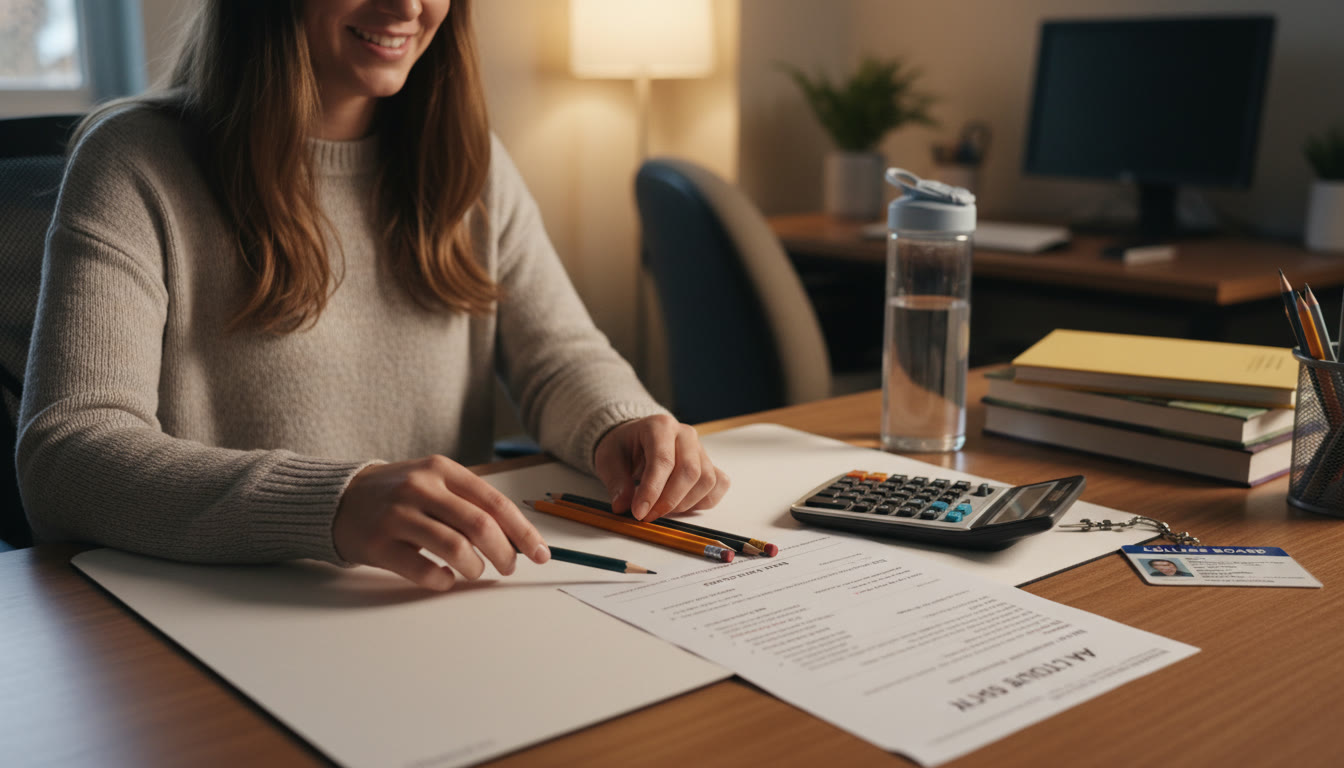
First Things First: Mindset and Sleep
Accept What’s Done
The night before the exam is not for learning new theorems or tackling unfamiliar multi-step proofs. Your brain’s job now is consolidation: letting the neural highways you’ve built strengthen overnight. Remind yourself of the progress you’ve made. A quick, honest review of key ideas is fine — but save the deep dives for earlier study sessions.
Prioritize Real Sleep
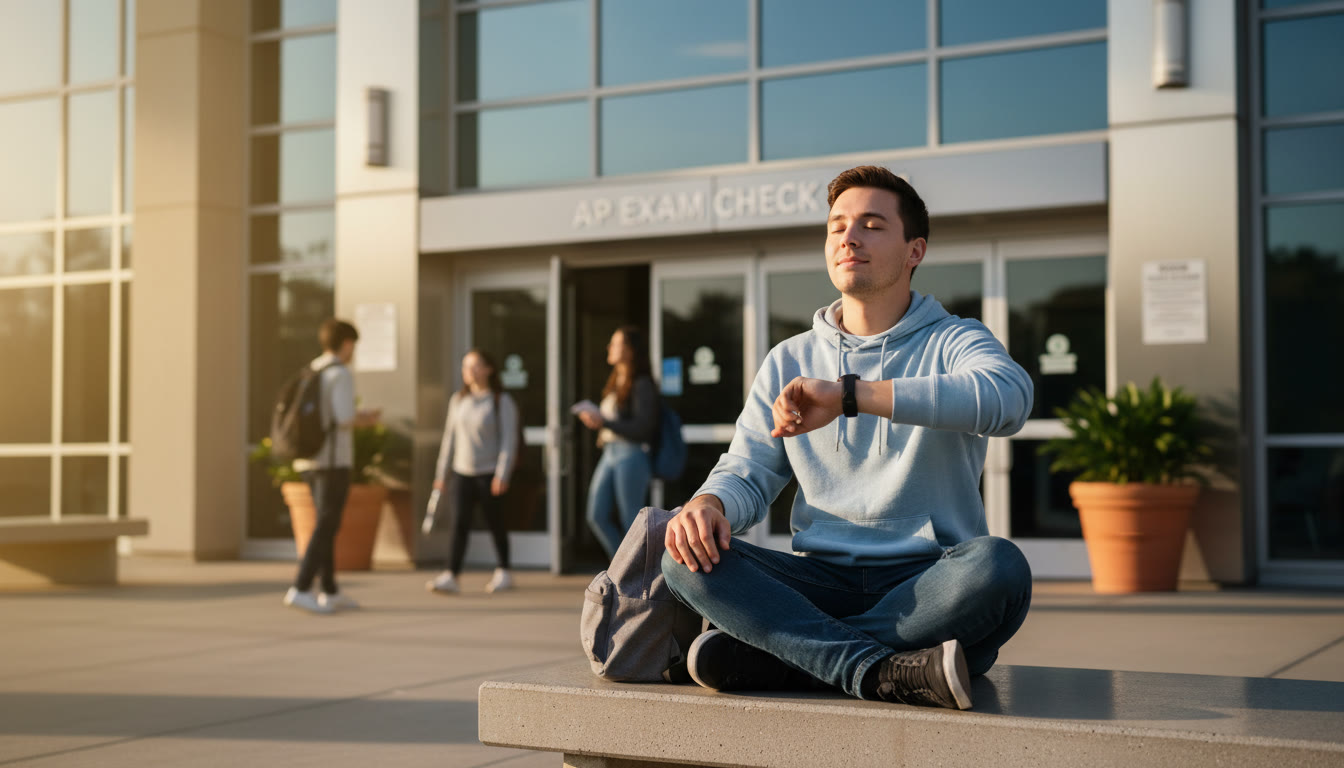
Quality sleep matters more than extra hours of last-minute study. Aim for 7–9 hours. If anxiety is an issue, try a 20–30 minute routine before bed: a short walk, a warm shower, and 10 minutes of low-stimulation reading (not math proofs). Avoid heavy caffeine after mid-afternoon. Even simple breathing — inhale for 4, hold for 4, exhale for 6, repeat 6 times — can help your nervous system settle.
Practical Prep: The Checklist (Do These Tonight)
Use this step-by-step to prepare everything you’ll need. Treat it like packing for a short trip — items you rely on should be in one place and inspected once more before bed.
- Confirm your exam time and location. Write the local time and address on a sticky note on your door or phone lock screen.
- Charge, test, and pack your device if you’re taking a digital/hybrid exam (Bluebook). Make sure Bluebook is installed and sign-in information is accessible.
- Gather physical supplies: 2 No. 2 pencils (or pens if allowed), eraser, approved graphing calculator(s) fully charged with fresh batteries, backup batteries, and a small pencil sharpener if needed.
- Pack your ID (school ID or government-issued), printed AP exam ticket if required by your school, and any accommodation letters if applicable.
- Lay out a comfortable exam-day outfit. Choose layers — exam rooms can be unpredictable in temperature.
- Prepare a simple breakfast plan and a light snack for the scheduled break (if allowed). Keep it bland and balanced: whole-grain toast, banana, peanut butter, yogurt, or a small trail mix portion.
- Plan travel logistics: how you’ll get to the test center, alternate route if needed, and what time to leave. Add a 20–30 minute buffer for unexpected delays.
- Do a 20–30 minute confident review: a mix of formulas, quick problem types you’ve mastered, and one or two past exam-style questions for rhythm — no new concepts.
What to Do About the Calculator
For AP Calculus and AP Statistics, calculators are allowed within certain policies. Tonight, make sure your approved calculator is charged, reset to default settings (no stored notes or unsanctioned material), and that you know how to access statistical functions or graphing tools you may need. If you have a second approved calculator, pack it as a backup.
What to Bring: Final Packing Table
Here’s a tidy table to help you check off at least 10 essential items. Put a checkmark in the morning; leave nothing to chance.
| Item | Why It Matters | Done (✓) |
|---|---|---|
| Photo ID | Required if you test away from your school; verifies identity. | |
| AP Exam Ticket / Confirmation | Some schools require it; keeps check-in smooth. | |
| Approved Calculator(s) | Allowed functions for quantitative questions; backup reduces stress. | |
| Pencils / Pens & Eraser | Multiple-choice and free-response booklet writing; bring extras. | |
| Charging Cord / Power Bank (if permitted) | For Bluebook device or calculator recharging if allowed by policies. | |
| Layered Clothing | Comfort in varying room temperatures. | |
| Watch (non-smart) | Time management during the exam; check-in tool for pacing. | |
| Snack for Break | Small energy boost during the break (if permitted). | |
| Water Plan | Know where water is available; bottled water usually not allowed in the testing room itself. | |
| Comfort Item (mask, small sleeve for calculator) | Minimizes distraction; non-decorative and permitted items only. |
Quick, Last-Minute Study: Smart Review Items
If you want to touch your notes, keep it fast and surgical. Spend 30 minutes on a focused loop of:
- High-frequency formulas and relationships (derivative/integral pairs, trig identities, distribution vs. sampling distribution, hypothesis testing steps)
- Two practice problems: one multiple-choice quick-solver and one free-response you can talk through aloud — emphasize reasoning and structure over algebraic grind.
- Common errors checklist: sign mistakes, unit mismatches, using wrong test (z vs. t), forgetting conditions (independence, linearity), and calculator input errors.
Example Mini Routine
Set a 30-minute timer: 10 minutes formulas and concept map, 10 minutes one multiple-choice section or 12–15 problems for rhythm, 10 minutes a free-response outline. Stop when the timer ends. Put the materials away and switch gears toward relaxation.
Exam-Day Timing and Pacing Strategy
Walk into the exam with a simple pacing plan. If you’re taking a hybrid digital exam with two sections of equal time (for example, many AP Quant exams split multiple-choice and free-response nearly evenly), use this general approach:
- First 5 minutes: set up your workspace, verify ID and exam screens, and read the first question carefully.
- Multiple-choice section: Rapid first pass — mark easy ones, flag medium for revisit, and skip the especially time-consuming ones. Return with calculator and deeper thought after you’ve secured high-confidence answers.
- Free-response: Spend the first few minutes per question outlining your plan and showing work clearly — graders look for method as much as final answer. If a question is taking too long, move on and return with fresh eyes.
- Last 10–12 minutes: review answers you flagged, check units, and make sure answers make sense directionally (limits, signs, plausible magnitudes).
Simple Time Blocks (Example)
| Section | Time | Strategy |
|---|---|---|
| Multiple Choice | ~90 minutes (40 Q) | First pass quick answers; use remaining time to tackle flagged items with calculator. |
| Free Response | ~90 minutes (6 Q) | Outline answers, show work, label steps, check units; save time to review final answers. |
Test-Taking Habits That Actually Help
Show Your Process
On free-response questions, graders award partial credit for correct methods even if the final numeric answer isn’t perfect. Write clearly, label steps, and box final answers. If you do arithmetic roughly, indicate your estimate — that can help the scorer see your reasoning.
Use the Calculator Wisely
Let the calculator do heavy computation, but don’t become a black-box user. Always understand what operation you’re asking it to perform. For statistics, double-check degrees of freedom, sample size, and whether you should be using t or z procedures. For calculus, use the calculator to check algebraic work and complex arithmetic; do not rely on it to choose the correct method.
Pace by Points, Not Time
When you know the point values or relative weight of sections, allocate attention accordingly. A multi-part free-response question with large weight deserves a solid outline first; smaller point questions are often quick conceptual checks.
Common Night-Before Traps—and How to Avoid Them
- Trap: Cramming whole new topics. Fix: Use a 30-minute targeted review, then stop.
- Trap: Staying up too late to “finish” study. Fix: Set a firm stop time and start a calming routine.
- Trap: Overloading on energy drinks. Fix: Opt for natural energy: protein + complex carb breakfast and adequate hydration.
- Trap: Forgetting check-in logistics. Fix: Pack tonight and set multiple alarms or reminders about departure time.
Practical Morning Routine: Arrive Calm and Ready
A simple, repeatable morning routine reduces decision fatigue so you can focus on reasoning. Here’s a morning template:
- Wake with enough time to eat slowly and to travel without rushing.
- Do 5–10 minutes of warm-up math: quick mental arithmetic, one derivative, or one z/t inference outline to get your brain in gear.
- Dress in layers. Use a non-smart watch to track time (not to obsess over it).
- Leave 20–30 minutes earlier than you expect to need — traffic and check-in lines are unpredictable.
If Anxiety Hits During the Exam
A surge of panic can be managed with immediate, practical steps:
- Stop and breathe: 4-4-6 breathing for one minute to lower heart rate.
- Anchor yourself: name three things you see, two things you hear, one thing you can touch. This reorients attention to the present.
- Break the problem down: write a one-line plan for the question. Even tiny structure calms the mind and makes the question solvable in parts.
How Sparkl’s Personalized Tutoring Fits In (When It Helps)
If you’ve used 1-on-1 support in the months leading up to the exam, tonight is not the time to change styles — but it is a great time to lean on what you learned there. Personalized tutors (like those at Sparkl) help by tuning pacing strategies, providing focused practice on your weak spots, and offering AI-driven insights that identify high-value review items. If you’ve worked with a tutor, keep their final quick notes or a tailored two-page sheet with you (not to use in the exam, but as a study guide last night).
Quick Reference: What You Shouldn’t Bring
To avoid cancellation risks or frustrated proctors, don’t bring any electronic devices (phones, smartwatches), unauthorized notes, or subject-specific clothing. If you have approved accommodations for small items, make sure documentation is with your proctor or exam coordinator.
Example Two-Hour Wind-Down Plan (Night Before)
Here’s a realistic two-hour plan to get you from last-minute review to lights-out without stress.
- 0:00–0:30 — 30-minute targeted review: formulas + 1 problem each from multiple-choice and free-response.
- 0:30–0:45 — Pack bag and prepare exam items (ID, calculator, pencils, watch, snack).
- 0:45–1:10 — Light dinner and hydration; avoid heavy or greasy foods.
- 1:10–1:30 — Short walk or gentle stretch to burn off tension.
- 1:30–2:00 — Calm routine: warm shower, set alarms, put devices away or on do-not-disturb. Read or listen to something relaxing for 10–15 minutes, then sleep.
Last Words of Encouragement
Show up as the version of yourself who has practiced deliberately and prepared practically. Exams reward calm, clear thinking as much as knowledge. If you trip over a problem, remember that graders can award partial credit for clear reasoning — so don’t hide your work. Use the strategies you practiced, breathe, and follow your plan.
And if you ever feel that a little more directed practice could make a big difference, consider targeted help — a brief 1-on-1 session with an expert tutor can turn a shaky concept into a reliable strategy. Many students find that last-minute coaching helps fine-tune pacing and confidence without adding pressure. Sparkl’s personalized tutoring, with tailored study plans and helpful AI-driven insights, is designed to give that kind of focused support when you need it most.
Final Checklist — Night Before & Morning Of (Quick Printable)
- Confirm time and location — written on your door or phone.
- Pack: ID, exam ticket, approved calculator(s), pencils/pens, eraser, watch, sweater, snack.
- Charge: devices and calculator(s), and leave cords at home unless allowed.
- Sleep: aim for 7–9 hours; start bedtime routine early.
- Morning: gentle warm-up problems, balanced breakfast, leave early.
- During test: pace, show work, use the calculator wisely, and breathe.
Good luck — you’ve got this.
Take the night to consolidate, rest, and step into the exam ready to demonstrate what you know. Remember: this one moment won’t define you — it’s the process you’ve built that matters most. Bring clarity, not chaos. Breathe. Do the math.























No Comments
Leave a comment Cancel