
Why Gene Expression and Regulation Matter (and Why You Should Care)
When you open an AP Biology exam packet and see a question about transcription, operons, or methylation, you’re not just being tested on vocabulary — you’re being asked to think like a living cell. Gene expression and regulation are the processes that turn DNA into action: proteins, traits, and adaptive responses. Understanding them deeply will help you score higher on AP exams, write stronger free-responses, and connect molecular mechanisms to ecology, evolution, and human health.
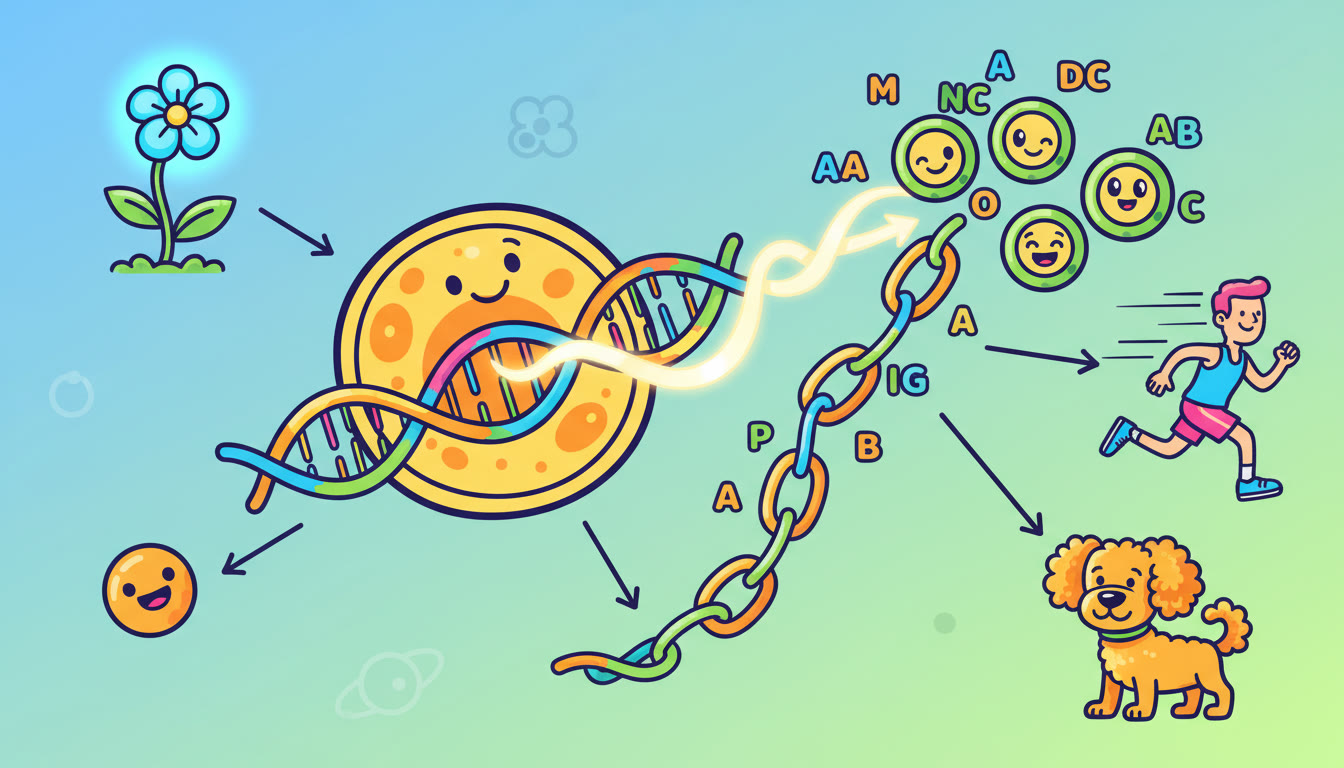
Big Picture: From DNA to Phenotype
At the broadest level, gene expression is the multi-step process by which information in DNA becomes an observable characteristic. The canonical flow is: DNA → RNA → Protein. But regulation can act at many points: when a gene is transcribed, how the RNA is processed, whether the RNA is translated, and how the protein is modified or degraded.
Think of the cell as a busy city. DNA is the city blueprint, RNA messages are the daily work orders, and proteins are the workers and machines. Regulation is the city manager deciding which orders are printed, how many copies are made, and when machines are shut down or upgraded.
Key Terms to Keep Handy
- Transcription: making RNA from DNA.
- Translation: building protein from mRNA.
- Operon: a set of adjacent genes under control of a single promoter in prokaryotes.
- Promoter and Operator: DNA sequences that control transcription initiation and repression.
- Transcription factors: proteins that increase or decrease transcription in eukaryotes.
- Epigenetics: heritable changes in gene expression that do not change DNA sequence (e.g., methylation, histone modification).
Prokaryotic Control: Operons Explained
Prokaryotes (like E. coli) often group genes that function together into operons. An operon includes a promoter, operator, and structural genes transcribed as a single mRNA. Two classic AP-friendly examples are the lac operon and the trp operon.
The lac Operon — A Model of Inducible Control
The lac operon controls the digestion of lactose. When lactose is absent, a repressor binds the operator and blocks RNA polymerase. When lactose (actually allolactose) is present, it binds the repressor, changing its shape so it can’t bind DNA, allowing transcription. CAP (catabolite activator protein) and cAMP add a layer: when glucose is low, cAMP rises, CAP binds DNA and boosts transcription — cells prefer glucose but can switch to lactose when needed.
The trp Operon — Repressible Control
The trp operon governs tryptophan synthesis. When tryptophan levels are high, tryptophan acts as a corepressor, enabling the repressor protein to bind the operator and shut down transcription — the pathway is turned off when the product is abundant.
Comparing Inducible and Repressible Systems
| Feature | Inducible (lac) | Repressible (trp) |
|---|---|---|
| Default State | Off (repressor active) | On (repressor inactive) |
| Signal | Inducer (allolactose) binds repressor | Corepressor (tryptophan) activates repressor |
| Typical Use | Catabolic pathways | Anabolic pathways |
AP tip: When a question gives a diagram of an operon, quickly identify whether a repressor or activator is present, whether a small molecule (inducer/corepressor) is binding, and whether glucose levels (via cAMP/CAP) might modify expression. These are common exam traps that reward clear logic.
Eukaryotic Regulation: Complex, Layered, and Contextual
Eukaryotes regulate genes with many more moving parts. Instead of simple operons, eukaryotic genes have enhancers, silencers, promoters, nucleosomes, and a host of transcription factors. There is also an extra step of mRNA processing (capping, splicing, polyadenylation) and nuclear export — each a potential control point.
Chromatin Structure and Accessibility
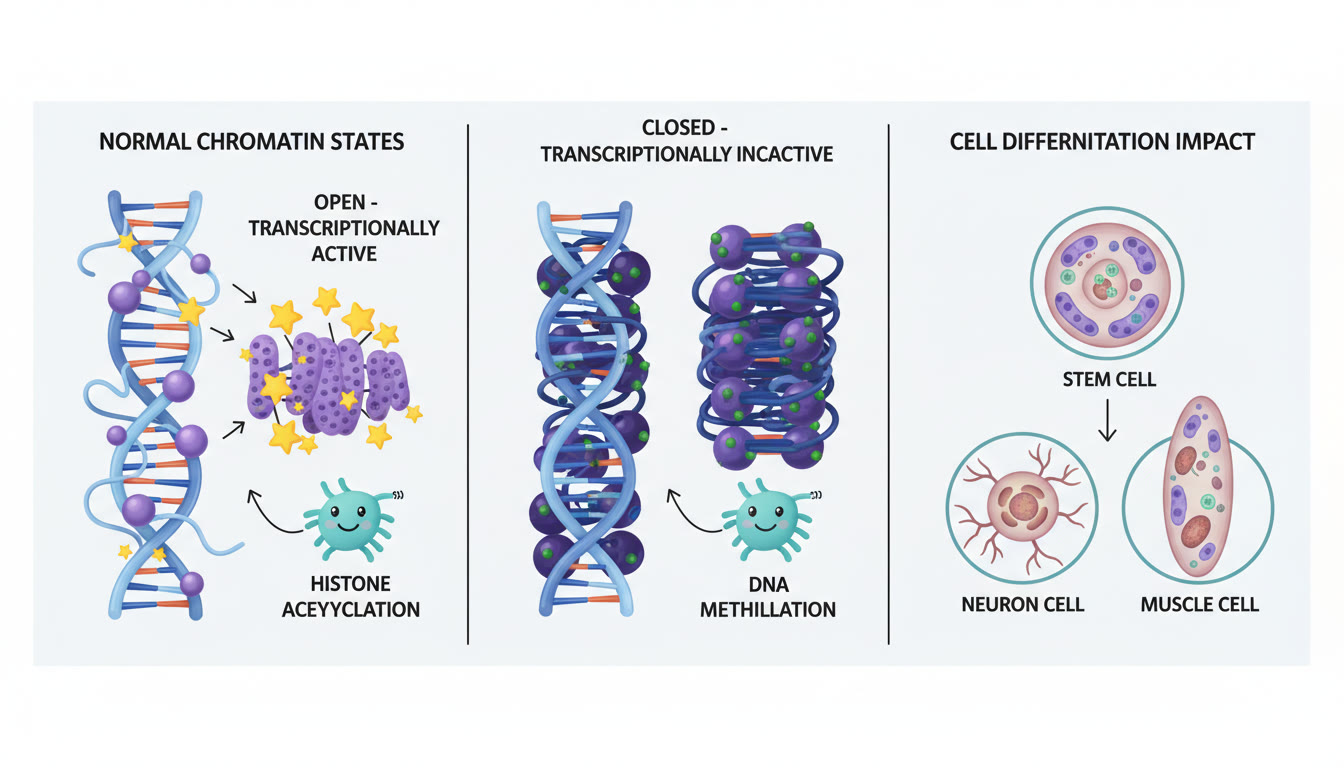
DNA in eukaryotes wraps around histone proteins, forming nucleosomes. Tight packing (heterochromatin) generally prevents transcription; open packing (euchromatin) allows it. Modifying histones — by acetylation, methylation, phosphorylation — changes how tightly DNA binds histones and thus changes access for transcription machinery.
Transcription Factors and Enhancers
Transcription factors (TFs) bind specific DNA sequences and recruit RNA polymerase II or block its activity. Enhancers are DNA elements that can be thousands of base pairs away yet loop through 3D space to interact with promoters and TFs, amplifying transcription. The combination of TFs active in a cell helps determine cell type-specific gene expression — this is how the same genome creates neurons, muscle, and liver cells.
Alternative Splicing and Post-Transcriptional Control
One gene can produce multiple protein isoforms through alternative splicing — the inclusion or exclusion of exons. Post-transcriptional regulation also includes mRNA stability (how long the transcript lasts), microRNA-mediated silencing, and translational control (e.g., via upstream open reading frames or binding proteins).
Epigenetics: Heritable Regulation Without DNA Changes
Epigenetics refers to stable changes in gene expression that don’t alter the underlying DNA sequence. These can be transmitted during cell division and, in some cases, across generations. The two primary mechanisms are DNA methylation and histone modification.
DNA Methylation
Adding methyl groups (—CH3) to cytosine residues — especially at CpG islands near promoters — usually represses transcription. Methylated DNA can block transcription factor binding or recruit proteins that condense chromatin. In development, methylation helps lock in cell fates; in disease, abnormal methylation can silence tumor suppressors.
Histone Modification and Chromatin Remodeling
Histone tails are chemical hot spots. Acetylation of histone tails generally loosens DNA-histone interactions and promotes transcription. Methylation of histone tails can either activate or repress transcription depending on which residue is modified. Chromatin remodelers use ATP to reposition nucleosomes and alter accessibility.
Epigenetic Examples with Real-World Context
- Development: Epigenetic marks guide stem cells to become muscle or nerve cells by activating lineage-specific genes and repressing others.
- Genomic imprinting: Some genes are expressed from only the maternal or paternal allele due to parent-specific methylation patterns.
- Disease: Aberrant methylation patterns can lead to cancers or imprinting disorders (e.g., Prader-Willi and Angelman syndromes).
Mechanistic Walkthrough: From Signal to Expression
To master regulation, practice tracing the causal chain. Here’s a typical flow for a stimulus-triggered gene:
- Signal arrives (hormone, nutrient change, stress).
- Cell surface receptor or intracellular sensor is activated.
- Signal transduction cascade activates transcription factors or chromatin modifiers.
- Transcription factors bind promoters/enhancers; chromatin remodelers open chromatin.
- Transcription increases; mRNA is processed, exported, and translated.
- Protein actions feed back to modify signal or restore homeostasis.
When you read AP passages, break down the paragraph into these steps. Label each molecule as sensor, messenger, effector, or regulator — it makes constructing an answer faster and more accurate.
Table: Control Points and Typical Molecular Players
| Control Point | Key Players | Effect on Expression |
|---|---|---|
| Chromatin accessibility | Histone acetylases/deacetylases, chromatin remodelers | Open chromatin increases transcription; closed chromatin represses it |
| Transcription initiation | RNA polymerase II, general TFs, enhancers | Regulates whether transcription begins and at what rate |
| RNA processing | Spliceosome, capping enzymes | Determines mRNA isoforms and stability |
| mRNA stability | microRNAs, RNA-binding proteins | Shorter lifespan lowers protein levels; stabilization increases them |
| Translation | Ribosomes, initiation factors | Controls actual protein production |
| Post-translational | Phosphorylation, ubiquitination enzymes | Modifies activity, location, or degradation of proteins |
Exam Strategies: How to Tackle AP Questions on Gene Regulation
AP questions reward clarity, logic, and connections. Here are practical steps to make your answers crisp and exam-ready.
1. Translate the Prompt to a Flowchart
When given a passage or diagram, sketch a quick flowchart: signal → receptor → TFs/chromatin → transcription → outcome. Label arrows with what changes (e.g., “increased methylation” or “repressor dissociates”).
2. Use Specific Vocabulary But Don’t Overdo It
Write terms like “promoter,” “operator,” “histone acetylation,” and “CpG methylation” where accurate. However, clarity beats name-dropping — explain how a change affects polymerase access or mRNA stability.
3. Predict Experimental Outcomes
Many AP questions describe hypothetical mutations or treatments. Ask: will this raise or lower transcription? How will it affect protein levels? Consider upstream and downstream effects and feedback loops.
4. Draw Simple Diagrams for Free-Response Questions
A small labeled diagram of an operon or chromatin state can earn points. Show where a repressor binds, or indicate methyl groups on DNA near a promoter to support your explanation.
Study Plans and Learning Techniques
Biology is conceptual and cumulative. Build a study routine that mixes conceptual review, practice questions, and active recall.
Weekly Study Structure (Example)
- Day 1: Concept review — read and summarize chapter on gene regulation.
- Day 2: Practice problems — multiple choice focusing on mechanisms.
- Day 3: Free-response practice — write one detailed FRQ and self-grade.
- Day 4: Active recall — flashcards for terms and pathways.
- Day 5: Integrative practice — connect gene regulation to evolution or development.
- Day 6: Review weak points with targeted notes or tutoring session.
- Day 7: Rest or light review to consolidate.
How to Use Past AP Questions Effectively
Complete past AP prompts under timed conditions, then spend extra time writing model answers and comparing to scoring rubrics. Look for common themes: operon regulation, epigenetics in development, experimental setups (mutations, promoter deletions, methylation assays).
How Personalized Tutoring (Like Sparkl) Fits Naturally Into Your Prep
Self-study is powerful, but targeted guidance multiplies results. Personalized tutoring — such as 1-on-1 sessions with an expert tutor — can clarify tricky mechanisms (e.g., how attenuation works in the trp operon), provide tailored study plans, and offer AI-driven insights into weak areas. A tutor can review your free-response answers, suggest concise language that exam readers reward, and give feedback on diagrams and argument structure.
If you find a consistent pattern of errors (confusing promoter vs. operator, or mislabeling methylation effects), a few focused tutoring sessions can turn those mistakes into strengths by providing custom worksheets, practice questions, and a clear roadmap to improvement.
Practice Problems You Should Try (Without Answers Here)
- Sketch and label a lac operon under these conditions: (a) no lactose, high glucose; (b) lactose present, low glucose.
- Predict the effect of a mutation that prevents CAP from binding DNA on expression of genes in the lac operon.
- Given a eukaryotic gene with a methylated promoter, explain the expected changes in transcription, chromatin state, and cell phenotype.
- Design a simple experiment to test whether an enhancer acts in a tissue-specific manner.
Mistakes Students Often Make — and How to Fix Them
- Confusing promoter and operator: The promoter is where RNA polymerase binds; the operator is where repressors/activators bind. Draw them side-by-side on practice diagrams until you internalize roles.
- Assuming methylation always means permanent silencing: Methylation often represses transcription, but context matters — some genes can be dynamically demethylated during development.
- Neglecting post-transcriptional regulation: If the mRNA is unstable or microRNAs target it, protein expression can stay low even with high transcription.
Connecting to Bigger Themes: Evolution, Development, and Medicine
Gene regulation sits at the heart of evolution and development. Small regulatory changes can produce large phenotypic differences without changing protein-coding sequences; this is a powerful mechanism for evolutionary innovation. In medicine, misregulated gene expression — whether by mutations in promoters, transcription factors, or epigenetic misfires — underlies cancers, metabolic disorders, and developmental syndromes.
Final Checklist Before Exam Day
- Know the difference between prokaryotic operons and eukaryotic gene regulation mechanisms.
- Be fluent with vocabulary (promoter, operator, enhancer, transcription factor, methylation, acetylation, alternative splicing).
- Practice translating experimental descriptions into predicted changes in transcription and phenotype.
- Review sample free-response answers and practice writing concise, labeled diagrams.
- Use targeted tutoring or study sessions for persistent weak points; a few 1-on-1 sessions can yield big returns.
Parting Thoughts: Think Mechanistically, Answer Clearly
Gene expression and regulation can seem like a tangle of terms, but they become elegant when you view them as a chain of cause and effect. Whether you’re decoding an operon or explaining epigenetic inheritance, trace the flow: what changed first, how that affects molecular players, and what the cell or organism does as a result. With deliberate practice, clear diagrams, and targeted help when you need it, these topics become not only manageable but fascinating.
Good luck on your AP journey — and remember, selective support (like personalized tutoring and tailored study plans) can make study time more effective and less stressful. Build your mental models, practice smart, and let the underlying logic of life carry you to the score you want.



























No Comments
Leave a comment Cancel