
Blueprinting Labs: Why Templates Matter for AP Students
Walking into a lab without a plan is like walking into the exam room without a pencil — technically possible, but why take the risk? For AP students, lab work is more than a checklist of steps and measurements. It’s an opportunity to practice scientific reasoning, document inquiry, and build evidence-backed explanations — all skills the College Board rewards. Using strong Pre-Lab, In-Lab, and Post-Lab templates turns messy experiments into clear stories: hypothesis, design, data, interpretation.
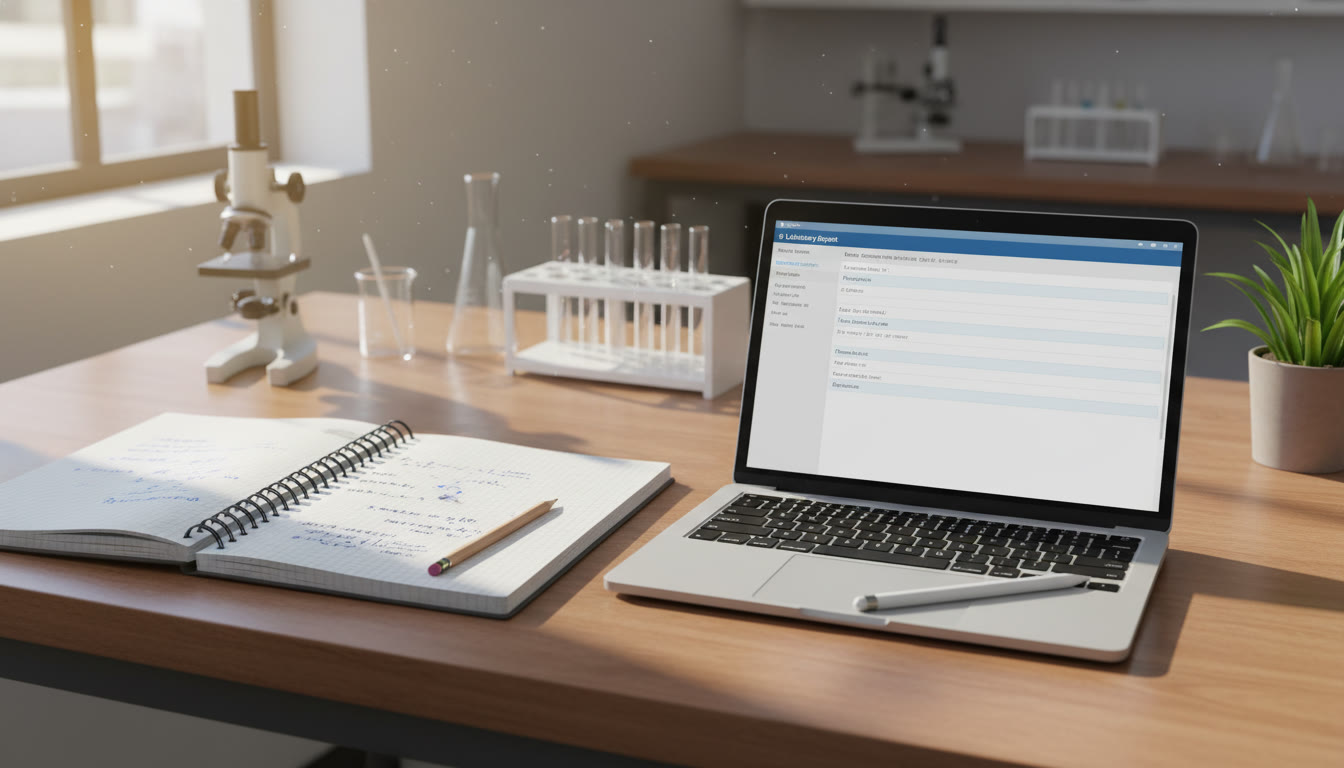
The payoff: clarity, consistency, and confidence
Templates standardize how you think and work during every stage of an investigation. They reduce cognitive load (so you can focus on interpreting results), make lab notebooks easy to grade and revise, and build a portfolio of reliable scientific writing. Teachers appreciate it; AP readers appreciate it even more when your writeups consistently show clear reasoning and proper use of science practices.
Overview: What Each Template Does
Think of the three templates as three chapters of a short scientific story:
- Pre-Lab: Map the terrain. Define the question, identify variables, list safety and materials, and sketch expected results.
- In-Lab: Execute the plan while capturing precise observations, measurements, and any deviations from the plan.
- Post-Lab: Interpret the data: analyze, explain, reconcile with the hypothesis, and suggest next steps.
Below you’ll find practical templates for each stage, example entries, and tips to make them work for AP classes like Biology, Chemistry, and Environmental Science.
Pre-Lab Template: Prepare Like a Scientist
Pre-lab work should take 15–45 minutes depending on the experiment’s complexity. The goal is to enter the lab with a clear purpose and a safety-first mindset.
Pre-Lab Template (Fields and Why They Matter)
- Title and Date: For easy referencing and portfolio organization.
- Big Question / Purpose: One or two sentences that answer “Why are we doing this?”
- Background / Rationale: Key concepts, formulas, or short literature notes that justify the experiment.
- Hypothesis (with rationale): A clear prediction and the reasoning that ties it to scientific principles.
- Variables: Independent, dependent, and controlled variables listed clearly.
- Materials and Equipment: Exact quantities and concentrations where applicable.
- Safety Notes: PPE, chemical hazards, and disposal instructions.
- Pre-lab Calculations: Sample calculations (e.g., dilutions, stoichiometry, expected measurement ranges).
- Initial Procedure Outline: Bullet-step plan of the method you expect to follow (so you’re not inventing steps on the fly).
- Data Table Template: A blank table with labeled columns and units for quick recording.
Example Pre-Lab Entry (AP Chemistry — Titration)
Title: Determination of Acetic Acid Concentration in Vinegar — 10/07/2025. Purpose: Find [CH3COOH] in a vinegar sample using NaOH titration. Hypothesis: Based on label (5% acetic acid), molarity should be ~0.83 M; I expect the equivalence volume to be ~25 mL with a 0.1 M NaOH solution. Variables: Independent = volume NaOH, Dependent = pH at endpoint, Controlled = temperature, indicator used. Safety: Gloves, goggles; neutralize spills with sodium bicarbonate. Pre-lab calculation: moles CH3COOH = (mass% × density × volume) / molar mass — sample calculation included.
In-Lab Template: Capture What Actually Happened
During the lab, details matter. The In-Lab template is where the plan meets reality — where you record deviations, raw data, and immediate observations.
In-Lab Template (Fields and How to Use Them)
- Time-stamped Procedure Log: A numbered list of actual steps taken with times. Note any changes from the Pre-Lab plan.
- Raw Data: Measurements recorded with units, uncertainties, and instrument used (e.g., buret resolution = 0.05 mL).
- Observations: Color changes, precipitation, smells (if safe to note), temperatures, notable behaviors.
- Qualitative Notes: Anything unexpected like delayed reaction, foaming, or instrument issues.
- Interim Calculations: Quick arithmetic done during the lab so you can adjust in real time.
- Preliminary Graphs or Plots: If relevant (e.g., titration curve points), sketch or attach printouts immediately.
- Data Integrity Checks: Record repeated measures, outliers, and possible sources of error observed in real time.
Example In-Lab Snippet (AP Biology — Enzyme Activity)
Time 9:05 AM: Added substrate to solution A. Time 9:07 AM: Immediate color change noted (yellow to orange). Raw data: Absorbance readings at 420 nm — 0s: 0.123, 30s: 0.210, 60s: 0.295 (instrument: Spectrophotometer Model X; cuvette path = 1.00 cm; temp = 25.1°C). Deviation: Reaction mixture heated to 28°C for 2 minutes due to hot plate drift — note for error analysis.
Post-Lab Template: Turn Data into Claims
After the lab, you have to tell the story. The Post-Lab template is where analysis, uncertainty, and the scientific argument live.
Post-Lab Template (Fields and How to Craft Them)
- Data Summary: Consolidated tables and averages with standard deviation or percent error where applicable.
- Graphs and Visuals: Properly labeled graphs (title, axes with units, best-fit lines or trendlines) and a short caption summarizing the pattern.
- Analysis and Calculations: Step-by-step math with units, significant figures, and propagation of uncertainty when needed.
- Conclusion: Direct answer to the Big Question, linked to evidence from your data.
- Error Analysis: Identify systematic vs. random error, quantify when possible, and discuss effect on results.
- Improvements and Extensions: Concrete changes for next time and ideas for follow-up experiments.
- Scientific Communication Check: One or two sentences that would be suitable for an AP-style short-answer or lab-report rubric (claim, evidence, reasoning).
Example Post-Lab Conclusion (AP Chemistry — Titration)
Data Summary: Average equivalence volume = 24.8 ± 0.2 mL. Calculated [CH3COOH] = 0.82 ± 0.01 M, percent error vs. label (0.83 M expected) = 1.2%. Conclusion: The measured concentration supports the hypothesis and is within experimental error. Errors: buret wobble introduced systematic under-delivery; improved buret clamping and repeated trials recommended. Extension: Perform a back-titration using standard base to confirm results.
A Printable Table: Templates at a Glance
Here’s a compact table you can print or transcribe into your digital lab notebook. It summarizes required fields and ideal length for student entries.
| Template Stage | Core Fields | Recommended Length | Why It Matters |
|---|---|---|---|
| Pre-Lab | Title, Purpose, Hypothesis, Variables, Materials, Safety, Pre-calculations, Data Table | 300–500 words / one page | Sets experimental intent; reduces on-the-spot errors |
| In-Lab | Time Log, Raw Data, Observations, Deviations, Interim Calculations | Variable — as needed (concise entries live) | Records reality; preserves evidence for analysis |
| Post-Lab | Data Summary, Graphs, Analysis, Conclusion, Error Analysis, Improvements | 500–800 words plus tables/figures | Transforms data into claims; aligns to AP rubric |
Tips for AP-Level Lab Notebooks and Reports
- Be proactive about units and significant figures. They’re small details that add up on AP rubrics.
- Include uncertainty and how you calculated it. Even a simple percent error demonstrates scientific thinking.
- Label everything on graphs. A missing axis label can cost more than you think.
- Write conclusions that explicitly connect to the hypothesis and data. Use short statements: Claim — Evidence — Reasoning.
- Keep the Pre-Lab honest: if you won’t perform a predicted step, update the Pre-Lab rather than pretending it happened.
- Use your teacher feedback. Classroom iteration is how your lab writing improves — treat feedback as a map, not a verdict.
Digital vs. Paper: How to Blend Both Smoothly
Many AP classrooms now combine digital and paper records. Digital templates make calculations and graphs easier; paper notebooks are still valuable for time-stamped logs and sign-off authenticity. Best practice: draft Pre-Lab and Post-Lab digital copies for clean presentation and keep In-Lab paper logs for real-time entries. Take high-resolution photos of key setups and paste them into your digital file after lab — that way you have both time-stamped proof and polished presentation.
Common Lab Scenarios and Template Adjustments
Every lab has quirks. Below are a few common scenarios and how to adapt the templates so they stay useful rather than rigid.
When your experiment goes off-script
Use the In-Lab deviation field to explain what changed and why. Document the effect on data (e.g., “heated for extra 2 minutes — expect increased reaction rate; data may be biased toward higher conversion”). In the Post-Lab, quantify the effect if possible and suggest a corrected method for the next run.
When your instrument gives inconsistent readings
Record each reading with context: who read it, the instrument serial or model, and calibration status if known. Use repeated measures and include a small subsection in Post-Lab describing instrument reliability and any steps taken (zeroing, re-zeroing, recalibration).
Fieldwork or long-term observations
For multi-day or field experiments, add a timeline field in your Pre-Lab and a daily log subsection in the In-Lab template. In Post-Lab, include seasonal or time-based confounders.
How Templates Help You on AP Exams and Coursework
AP exams don’t ask you to submit your lab notebook, but the skills you build using these templates — designing experiments, analyzing evidence, and communicating conclusions — are explicitly evaluated in free-response questions and the science practices. Regular use of templates trains you to think in the concise, evidence-driven way the AP rubric rewards.
For students aiming to translate lab practice into higher AP exam scores, consider supplementing your classroom practice with targeted tutoring. Sparkl’s personalized tutoring can help by offering 1-on-1 guidance, tailored study plans, expert tutors familiar with AP rubrics, and AI-driven insights that point out recurring mistakes in lab writeups. When tutoring focuses on real lab reports and templates, the feedback becomes actionable and immediate.
Checklist: Quick Pre-Lab, In-Lab, Post-Lab Reminders
- Pre-Lab: Hypothesis is testable; variables are clearly labeled; calculations are done.
- In-Lab: Time-stamped notes, raw data with units and instrument precision, note deviations immediately.
- Post-Lab: Graphs are labeled, error sources identified, conclusion ties to evidence, two concrete improvements suggested.
Practical Examples: Short Templates You Can Copy Tonight
Below are concise fill-in-the-blank templates you can paste into a notebook or digital file. Keep them handy and adapt to your instructor’s preferences.
Pre-Lab (Compact)
Title: __________________ Date: _______ Purpose: ________________________ Hypothesis: ____________________ Variables: IV = __________ DV = __________ Controls: __________ Materials: __________ Safety: __________ Pre-calculations: __________ Data Table: (attach)
In-Lab (Compact)
Start Time: _____ Procedure (actual steps with times): 1. ________ 2. ________ Raw Data (with units and instrument): ________ Observations: ________ Deviations: ________ Interim Calculations: ________
Post-Lab (Compact)
Summary of Results (include averages ± SD): ________ Graphs Attached: Y/N Analysis: (show math) ________ Conclusion (Claim — Evidence — Reasoning): ________ Error Analysis: ________ Improvements: ________
Scaffolding Templates for AP Lab Reports That Teachers Love
Teachers grading multiple lab sections appreciate clean, consistent reports. If you want to impress:
- Include a one-sentence abstract at the top of your Post-Lab that summarizes purpose, method, and key result.
- Use subsections and headers so graders can skim for Claim, Evidence, and Reasoning quickly.
- Attach raw data images or instrument printouts as appendices, labeled with figure numbers.
- Number your trials and consistently present units and uncertainties.
How to Practice Lab Writing — A 4-Week Routine
Templates become habits when you practice with deliberate frequency. Here’s a simple 4-week routine you can follow to lock in lab-writing skills before the AP exam season:
- Week 1: Use the compact templates for every classroom lab. Focus on pre-lab completeness.
- Week 2: Practice in-lab time-stamping and quick interim calculations. Aim for zero missing units in raw data.
- Week 3: Spend extra time on Post-Lab analysis — create two graphs per lab and practice writing Claim-Evidence-Reasoning paragraphs.
- Week 4: Revise two previous lab reports for clarity and stronger error analysis. Seek feedback from your teacher or a tutor.
If you want outside support during this routine, targeted tutoring can accelerate progress: Sparkl’s 1-on-1 sessions let you review real lab writeups, receive tailored study plans, and use AI-driven insights to target recurring weaknesses. That combination often yields faster improvements than practicing without feedback.
Final Notes: Make Templates Yours
Templates are scaffolds, not shackles. The best students treat them as living tools: edit templates to match a project’s complexity, add a field for anything your teacher asks, and preserve versions so you can track how your lab-writing improves over time. Above all, remember that a lab writeup is a story — your scientific reasoning needs to be readable, reproducible, and convincing.

Closing Thought: Small Habits, Big Results
Great lab work isn’t only about perfect technique — it’s about communication. When your Pre-Lab, In-Lab, and Post-Lab entries consistently show careful planning, accurate data, and thoughtful analysis, you’re not just collecting points: you’re learning to think like a scientist. That translates directly to better AP coursework, stronger lab reports, and clearer thinking under exam pressure. Use these templates, practice deliberately, and don’t hesitate to seek targeted support when you need it — a little focused feedback can make the difference between a good report and an exceptional one.
Quick Resources to Build Into Your Routine
- Keep a one-page checklist for each template stage on the inside cover of your notebook.
- Use a single digital folder per course to store polished Post-Lab PDFs and supporting photos.
- Practice Claim-Evidence-Reasoning writing in 100-word bursts to build concise science communication.
- Schedule a monthly review with your teacher or a tutor to revise older reports and track progress.
Good luck — and happy experimenting!
Whether you’re trying to improve your AP scores, build a compelling lab portfolio for college, or simply enjoy the thrill of discovery, consistent templates will be one of your best tools. Start small, iterate, and let each lab be a step toward clearer thinking and stronger scientific communication.
























No Comments
Leave a comment Cancel