
Why Small Wins Matter More Than You Think
There’s a cliché that success is made of small things done consistently. For AP students juggling classes, extracurriculars, and a social life, that cliché is also a lifeline. The path to a 4 or 5 on an AP exam isn’t usually built by one last-minute cram session. It’s built by a thousand tiny victories: a completed practice FRQ, a 20-minute review, a clear set of notes, or a single concept finally understood.
Neuroscience and learning science tell us that frequent, achievable wins help build confidence, strengthen memory consolidation, and reduce burnout. Psychologists call this the “progress principle”: when people notice forward movement, they’re more motivated and more resilient. For AP students, designing weekly rituals that create and highlight those moves is one of the smartest, kindest strategies you can adopt.
What This Post Will Give You
By the end of this post, you’ll have a realistic, student-tested weekly ritual you can start this week. You’ll find a flexible template for study sessions, a simple habit tracker, strategies for mixing deep work and active recall, and examples of how tools like AP Classroom materials and occasional 1-on-1 guidance — for example, Sparkl’s personalized tutoring and tailored study plans — can amplify each small win.
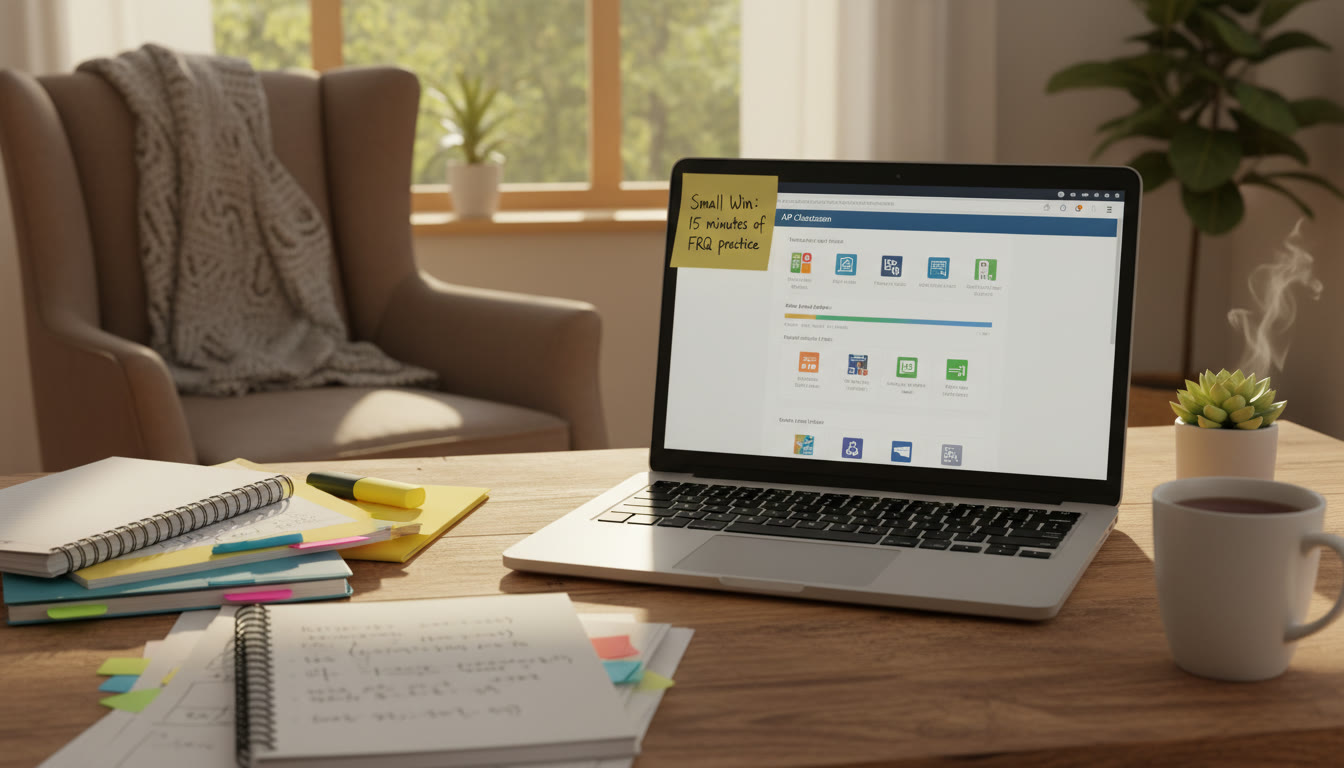
Designing a Weekly Ritual That Works
The point of a ritual is to make success habitual. Rituals reduce decision fatigue: when you have a pattern, you waste less energy deciding what to do and more energy doing it.
Core Principles
- Keep it short and consistent. A ritual that’s 20–45 minutes long is easier to sustain than a 3-hour marathon every Sunday.
- Make wins visible. Track them on a calendar or app. Seeing checks builds momentum.
- Mix skill-building and retrieval practice. Learn something new, then test yourself on it.
- Celebrate intentionally. Pause, mark the win, and maybe even write a one-line note about how it felt.
- Be kind to schedule shifts. Some weeks are busier — the ritual should flex, not break.
Weekly Ritual Template (Flexible)
Below is a template you can personalize. It’s structured around a 7-day rhythm but focuses on a single, reproducible session that anchors your week.
- Weekly Warm-Up (10 minutes): Review last week’s small wins. Open your planner or app and check off what you completed.
- Target Concept Review (20 minutes): Pick one AP course concept (e.g., Newton’s second law, rhetorical devices, the Roaring Twenties). Use AP Classroom videos or class notes to refresh the idea.
- Active Practice (25–40 minutes): Do targeted practice: one FRQ, a set of 10 MCQs, or a timed passage analysis. Aim for accuracy + speed, not perfection.
- Reflection & Next Steps (10 minutes): Write one sentence on what improved and one specific next step. If you’re stuck, schedule a 15–30 minute tutor check-in or teacher question.
- Micro Celebration (2 minutes): Cross off the session, breathe, and do a tiny reward (stretch, favorite sticker, or a 5-minute walk).
How to Pick Your Weekly Focus
Choosing the right focus keeps the ritual doable and meaningful. Here are three approaches you can rotate each week:
- Weakness Week: Tackle a topic you missed on a recent quiz or practice test.
- Application Week: Practice applying concepts in a new format, like essay-writing or lab analysis.
- Consolidation Week: Revisit several small concepts and stitch them together into a review.
Example: AP Biology Two-Week Cycle
Imagine you’re preparing for AP Biology. A two-week cycle might look like this:
- Week A (Weakness Week): Cellular respiration problems and FRQs.
- Week B (Application Week): Set of mixed MCQs, one practice free-response, and a lab skills drill.
Each week, your warm-up and reflection stay the same — only the content changes. The predictability helps the brain form a habit while the content rotation prevents boredom and covers the scope of the course.
Concrete Tools for Turning Rituals into Results
Rituals are only as good as the tools you use to support them. Below is a practical toolkit you can assemble with items you already have, plus choices for students who want guided support.
Essential Study Tools
- AP Classroom (or teacher-provided resources): Short AP Daily videos and progress checks are ideal for targeted review and immediate feedback.
- Practice Tests and FRQs: Use released questions to simulate exam conditions once every 2–3 weeks.
- Timer or Focus App: Use Pomodoro-style blocks (25 on, 5 off) to keep sessions productive.
- Notebook or Digital Journal: Track your small wins and reflections. A single line per day is enough.
- 1-on-1 Help: If you need targeted coaching, weekly check-ins with a tutor (for example, Sparkl’s personalized tutoring and tailored study plans) can turn confusion into clarity faster.
One-Page Weekly Planner (Simple)
| Day | Main Focus | Small Win Goal | Time |
|---|---|---|---|
| Monday | Concept Review | Read 1 AP Daily Video | 20m |
| Wednesday | Practice Problems | 10 MCQs + 1 FRQ part | 30–40m |
| Friday | Mixed Recall | Flashcard review | 20m |
| Sunday | Weekly Ritual | Warm-up + Target Review + Active Practice | 60–80m |
This planner keeps your weekly ritual simple to follow while allowing other days to be lighter touch. The table can be printed or copied into a notes app.
Measuring Progress Without Breaking Your Spirit
Grades and practice test scores matter, but not every metric motivates you the same way. Use a mix of objective and subjective measures:
- Objective: Accuracy on MCQs, number of FRQs attempted, and time-to-complete diagnostic sections.
- Subjective: Confidence rating (1–10), clarity of explanations in your own words, and energy level after a session.
Build a mini-dashboard that you update weekly. Simple columns like “Accuracy,” “Confidence,” and “Next Step” are enough. When you see steady ticks in confidence and accuracy, that’s proof your rituals are working — even when exam scores are still climbing.
Examples of Small Wins That Add Up
Small wins should feel meaningful. They might be tiny, but they should move you forward in a measurable way.
- Completing a timed section of 20 MCQs with improved accuracy.
- Writing a clear thesis and two supporting paragraphs for a practice AP English FRQ.
- Solving a lab analysis question without looking at notes.
- Teaching the concept to a friend or sibling for five minutes.
- Clearing a confusing practice problem after a 15-minute tutor explanation.
Real-World Example: From Confusion to Clarity
Jamal struggled with AP Chemistry equilibrium problems. Instead of spending long, unfocused hours on the whole unit, he dedicated two weeks of rituals to tiny wins: three 25-minute sessions per week, each with a one-minute warm-up, 20 minutes of targeted problems, and a quick reflection. He combined AP Daily videos for conceptual clarity with one 30-minute weekly check-in with a tutor for targeted feedback. After two cycles, his quiz accuracy rose from 55% to 78%, and his confidence rating went from 4/10 to 7/10. The combination of consistent practice, visible progress, and expert nudge made the difference.
When to Ask for Extra Help — and How to Make It Productive
Asking for help is itself a small win. Don’t wait until you’re overwhelmed. Schedule a short 1-on-1 session when a concept resists your best efforts for two consecutive rituals.
How to Use a 30-Minute Tutor Session Effectively
- Start with specific input: “I can’t get the energy diagrams questions in Unit 3.”
- Bring evidence: show a wrong practice problem or your notes.
- Ask the tutor to model thinking aloud and then give you a micro-assignment to try alone.
- End with a 2-step plan: what you’ll practice and what you’ll bring to the next check-in.
Micro-sessions like this are where tailored tutoring shines — targeted, efficient, and confidence-restoring. If you use a personalized program (for example, Sparkl’s personalized tutoring and AI-driven insights), be explicit about the skill you want to work on so your coach can tailor the session and adapt the next week’s ritual.
Keeping Rituals Human: Social Support and Accountability
Studying isn’t only a solo sport. A study buddy, a teacher check-in, or a weekly group review can turn individual rituals into social rituals — which increases accountability and makes wins more enjoyable.
Simple Social Rituals
- Weekly 30-Minute Study Buddy Call: Share one small win and one confusion.
- Group Mini-Quiz: Three students each write two MCQs from this week’s topic and swap.
- Sunday Share-Out: Post one sentence about your small win in a class message board or group chat.
These social moments are fuel for motivation. They normalize struggle and celebrate incremental gains.
Adjusting the Ritual as Exams Approach
In the months before the exam, your rituals should shift from exploration to simulation. Keep the same structure, but replace content review with timed, exam-like practice. Increase the frequency of full-section simulations gradually while keeping one weekly ritual focused on clearing lingering confusion.
Pre-Exam 8-Week Ramp (Example)
| Weeks Out | Primary Goal | Weekly Ritual |
|---|---|---|
| 8–6 Weeks | Coverage + Targeted Practice | Warm-up + 1 Topic Review + Mixed Practice |
| 5–3 Weeks | Timed Practice + Pacing | Warm-up + Timed Section + Reflection |
| 2–1 Weeks | Stability + Confidence | Light review, targeted weakness drills, rest, and confidence rituals |
During the final weeks, keep micro-celebrations non-food and non-disruptive: short walks, favorite playlists, or a 20-minute creative break. Rest and consistency beat last-minute panic.
Common Pitfalls and Gentle Fixes
Even the best rituals stumble. Here are frequent pitfalls and how to fix them without losing momentum.
Pitfall: The Ritual Feels Like a Chore
Fix: Shorten it. Make the win smaller (10 minutes), then build back up. Add a pleasant element: study with a favorite mug, or play soft instrumental music.
Pitfall: I Missed Two Weeks — Now I’m Behind
Fix: Reset with a micro-ritual. Do one 20-minute session and celebrate that you started. Remember, consistency over intensity.
Pitfall: I Don’t See Score Improvements
Fix: Switch metrics. Focus on speed and clarity or on teaching the concept aloud. Score gains sometimes lag behind skill gains — the visible improvement often appears after sustained practice.
Putting It All Together: A Sample Sunday Ritual
Here’s one complete ritual you can try this Sunday. It’s designed to fit into a busy week and give a clear small win.
- Warm-Up (10 min): Review last week’s wins in your notebook. Rate confidence (1–10).
- Target Review (20 min): Watch a 10–12 minute AP Daily video or re-read class notes on your chosen topic. Take two quick Cornell-style notes.
- Active Practice (30–40 min): Timed practice — 15 MCQs or one FRQ section. Correct mistakes immediately, and write a one-sentence explanation for each error.
- Reflection (10 min): Write “What improved?” and “What’s next?” in one sentence each.
- Micro Celebration (2 min): Stand up, stretch, and cross the day off your planner.

Final Notes on Mindset: Small Wins Build Big Confidence
AP prep can feel like a mountain. Rituals transform it into a staircase: one step at a time, steady and visible. Small wins aren’t small in their effect. They change how you see yourself as a learner — from someone who crams to someone who steadily grows.
If you want help designing rituals tailored to your schedule and learning profile, consider reaching out for occasional 1-on-1 guidance. Personalized tutoring — for example, Sparkl’s personalized tutoring and AI-driven insights — can help you identify the highest-impact small wins and build a study plan that respects your life outside of school.
A Quick Checklist to Start Tomorrow
- Choose one AP course as your first ritual focus.
- Schedule a 60–80 minute slot this weekend for your first ritual.
- Decide on one measurable small win (e.g., complete one FRQ, watch one AP Daily video, finish 15 MCQs).
- Set a celebration — brief and meaningful — to mark completion.
- If stuck for more than two rituals, schedule a 30-minute tutor check-in for targeted help.
Closing Thought
Preparation for AP exams is not a test of endurance alone; it’s a practice in building momentum. Weekly rituals that consistently produce small wins give you not only knowledge but also a resilient, confident study identity. Start small. Stay kind to yourself. Celebrate each step — because these are the steps that carry you all the way to exam day.
Ready to try your first ritual? Pick a day, set the timer, and let one small win kick off the rest.























No Comments
Leave a comment Cancel