
Why Thermodynamics Deserves More Than Number Crunching
When students open an AP Chemistry test or sit down for lab write-ups, thermodynamics often looks like a tangle of symbols: ΔH, ΔS, ΔG, T, spontaneity arrows, and equilibrium constants. Too often the instinct is to panic, search for a formula to memorize, and mechanically plug numbers into ΔG = ΔH – TΔS until a sign appears. But chemistry teachers and successful students know the smarter path: interpretation over computation.
This post is a conversational, example-rich guide to reading those symbols — not just calculating them. We’ll translate what the signs and magnitudes mean physically, how they show up in experiments and everyday chemistry, and how to use that intuition to answer AP-style questions faster and with more confidence. Along the way you’ll find study strategies (and a nod to Sparkl’s personalized tutoring for students who want tailored, 1-on-1 guidance to speed up this learning curve).
Quick refresher: What the symbols actually represent
ΔH — Enthalpy: heat at constant pressure
ΔH tells you whether a process absorbs or releases heat when performed at constant pressure (the common lab condition). Negative ΔH (exothermic) means heat flows out of the system into the surroundings — think hot to the touch or a flame appearing. Positive ΔH (endothermic) means heat is absorbed — ice packs getting cold or solid ammonium nitrate dissolving in water.
ΔS — Entropy: order, energy dispersal, or ways to arrange?
Entropy is the idea of dispersal of energy or the number of accessible microstates. Positive ΔS often corresponds to increased disorder (solid to liquid to gas is a handy mnemonic), but that’s an oversimplification. Entropy reflects how energy is shared among particles — dissolving ionic solids often increases entropy because the ions have more ways to be arranged in solution.
ΔG — Gibbs Free Energy: spontaneity at constant T and P
ΔG combines enthalpy and entropy into a single predictor of spontaneity: ΔG = ΔH – TΔS. If ΔG < 0 the process is spontaneous under the given conditions (constant temperature and pressure); if ΔG > 0 it is nonspontaneous; ΔG = 0 means the system is at equilibrium. Importantly, spontaneity does not imply speed — a spontaneous reaction may still be kinetically slow (glassroom oxidation or diamond converting to graphite are classic examples).
Signs first: how to read ΔH, ΔS, and ΔG without a calculator
The fastest way to a correct answer on an AP question is to reason about signs and magnitudes qualitatively before you compute. Here’s a practical checklist you can run through mentally:
- Is heat released or absorbed? (ΔH negative → exothermic; ΔH positive → endothermic.)
- Does the system become more dispersed or more ordered? (ΔS positive → more dispersal; ΔS negative → less.)
- What is the temperature and how might TΔS compare to ΔH? High T amplifies entropy’s role; low T amplifies enthalpy’s.
- Combine the two: if ΔH and TΔS have opposite signs, which is likely larger? Make a reasoned estimate before calculation.
Example 1: Melting of ice at 25 °C
Consider: ΔH for melting is positive (ice absorbs heat), ΔS is positive (solid to liquid increases dispersal). At 25 °C (298 K), TΔS is often large enough that ΔG < 0 for melting only above 0 °C. So at 25 °C, because it’s above 0 °C, melting is spontaneous. At -10 °C, TΔS is smaller so ΔG > 0 and ice does not melt spontaneously.
Example 2: Combustion of methane
Combustion reactions are usually strongly exothermic (large negative ΔH) and often increase entropy when gas is a product. Both terms favor spontaneity, so ΔG is very negative — consistent with combustion releasing energy and proceeding readily once initiated.
Magnitude matters: not all negative ΔG values are equal
When you see ΔG = -1 kJ mol-1 vs. ΔG = -500 kJ mol-1, both predict spontaneity, but they imply different equilibria and practical behavior. ΔG is related to the equilibrium constant K by ΔG° = -RT ln K (for standard conditions). Small negative ΔG might mean equilibrium lies near 1 (significant amounts of both reactants and products), while very negative ΔG corresponds to a K that heavily favors products.
| Approximate ΔG (kJ mol-1) | Implication for equilibrium (standard conditions) |
|---|---|
| 0 to -5 | Equilibrium near unity; appreciable amounts of both sides present |
| -20 to -80 | Equilibrium favors products strongly; reaction effectively proceeds toward products |
| < -100 | Equilibrium overwhelmingly favors products; reaction is essentially complete |
Use these ballpark windows to evaluate whether a reaction will produce measurable quantities of product at equilibrium or only trace amounts — a frequent AP exam trap.
Temperature is a lever: TΔS can flip spontaneity
Because ΔG = ΔH – TΔS, temperature can change the sign of ΔG if ΔH and ΔS have the same sign but opposite influences at different temperatures.
- If ΔH > 0 and ΔS > 0, increasing temperature can make ΔG negative (endothermic process that becomes spontaneous at high T — think vaporization).
- If ΔH < 0 and ΔS < 0, lowering temperature can make ΔG negative (exothermic but with decreased entropy — freezing at low T).
AP problems often present these relationships and ask you whether a process is spontaneous at high T, low T, or at all temperatures. The trick: map signs first, then reason whether T magnifies the entropy term enough to dominate.
Graphical intuition
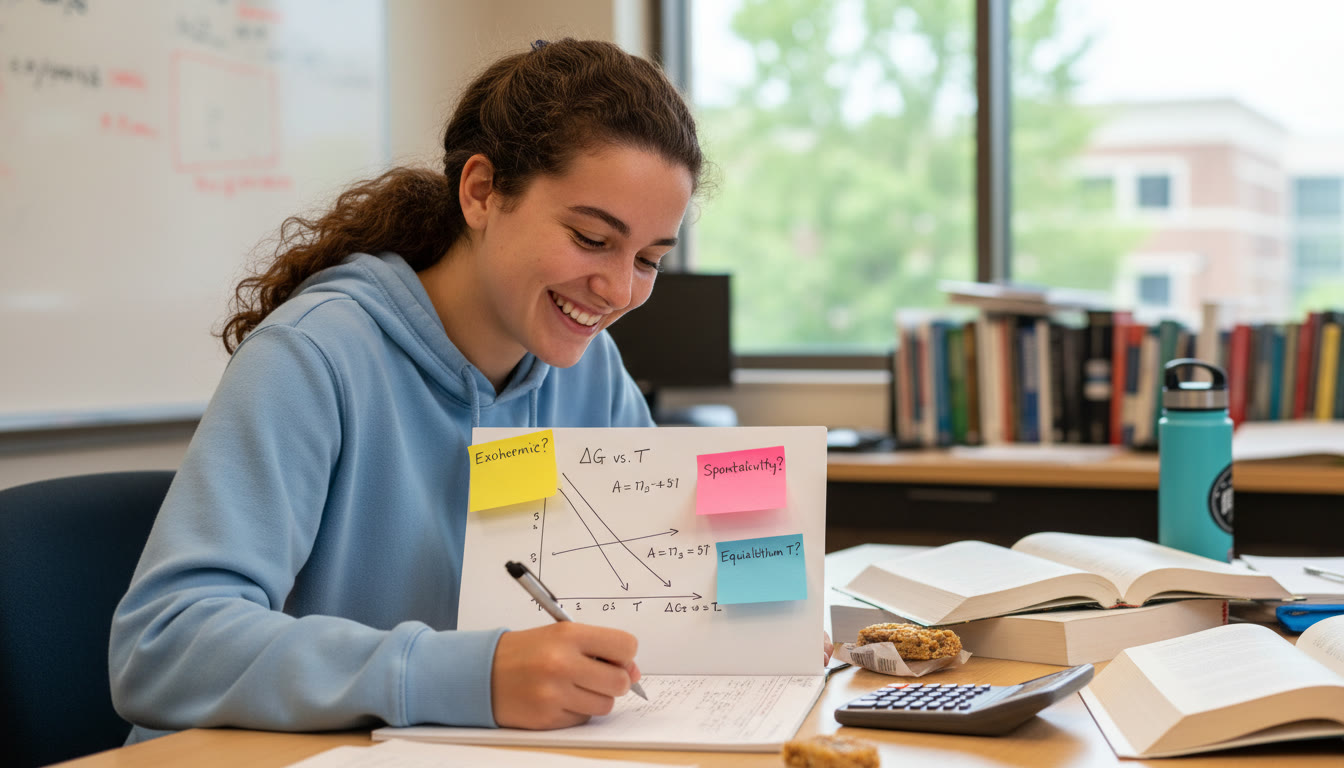
Picture ΔG vs. T as a straight line with slope -ΔS and intercept ΔH. Where the line crosses zero is the temperature at which ΔG = 0 (equilibrium). This line helps you predict behavior qualitatively without numbers.
Interpreting equilibrium and reaction direction from ΔG
Students sometimes mix up ΔG° and ΔG. ΔG° is the Gibbs energy change calculated with standard states (1 M for solutes, 1 atm for gases). ΔG depends on the actual concentrations or partial pressures and is given by ΔG = ΔG° + RT ln Q, where Q is the reaction quotient.
- At equilibrium, ΔG = 0 and Q = K (so ΔG° = -RT ln K).
- When ΔG < 0 the reaction proceeds in the forward direction to reach equilibrium (Q < K).
- When ΔG > 0 the reaction proceeds in the reverse direction (Q > K).
Key strategy for AP problems: check whether the system is at standard state or given concentrations. Then decide qualitatively if shifting concentrations will push the reaction forward or backward before computing.
Common AP-style question types and how to approach them
Type A: Identify spontaneity from sign combinations
These are mostly conceptual. Map signs of ΔH and ΔS, consider temperature, and answer. For example: “If ΔH > 0 and ΔS > 0, the process is spontaneous only at high temperatures.” Say that first — then justify in one sentence using ΔG = ΔH – TΔS.
Type B: Relate ΔG° to K or equilibrium shifts
Translate between ΔG° and K conceptually. Large negative ΔG° → large K → products favored. If given concentration changes, use ΔG = ΔG° + RT ln Q to argue the initial direction. Often you can avoid computing numbers by saying whether Q < K or Q > K qualitatively from reaction stoichiometry.
Type C: Thermochemical cycles and Hess’s law
Use Hess’s law for ΔH reliably — enthalpy is a state function. For entropy and free energy, similar path independence applies for ΔS and ΔG under consistent standard conditions. If an exam asks you to combine reactions, add ΔH and ΔS algebraically (and ΔG when appropriate).
Type D: Temperature dependence and sign flips
These problems test the ability to find a transition temperature where ΔG = 0. Setting ΔH – TΔS = 0 gives T = ΔH/ΔS (use absolute values and watch units). But if the question asks conceptually, you can argue without computing: if both ΔH and ΔS are positive, higher temperature favors spontaneity.
Worked examples with interpretation-first strategy
Worked Example 1: Predict spontaneous direction
Reaction: A(s) → B(aq). Information: ΔH is -40 kJ (exothermic), ΔS is -50 J K-1 (entropy decreases). Is the reaction spontaneous at 298 K?
Step 1: Signs — ΔH negative (favors spontaneity), ΔS negative (opposes spontaneity).
Step 2: Compare magnitude qualitatively — convert units mentally: -50 J K-1 = -0.05 kJ K-1. TΔS at 298 K is about -0.05 × 298 ≈ -15 kJ. ΔG ≈ -40 – ( -15) = -25 kJ (negative). So spontaneous at 298 K. Interpretation: enthalpic release outweighs the entropic penalty.
Worked Example 2: Temperature flip
Given ΔH = +20 kJ and ΔS = +80 J K-1, find qualitatively whether the reaction is spontaneous at low or high T.
Signs: both positive. At low T, TΔS small so ΔG ~ +20 kJ > 0 (nonspontaneous). At high T, TΔS large positive and TΔS > ΔH so ΔG negative (spontaneous). Thus spontaneous at high temperature.
Common pitfalls and how to avoid them
- Confusing spontaneity with speed: spontaneous only means thermodynamically favored; kinetics controls rate.
- Mismatching units: ΔH in kJ, ΔS in J K-1 — always convert to the same base before arithmetic.
- Forgetting standard vs. actual conditions: ΔG° tells about standard-state equilibrium; ΔG depends on concentrations via Q. Read the question for which is asked.
- Applying entropy = disorder too literally: think in terms of energy dispersal and microstates, not messy metaphors.
How to study thermodynamics effectively for the AP exam
Thermo is a conceptual goldmine for AP scoring if you prepare smartly. Here’s a practical study map:
- Build intuition with physical examples: melting, dissolving salts, combustion, osmotic processes.
- Practice sign reasoning on dozens of short problems — decide sign and spontaneity before calculating.
- Memorize a few anchor values (e.g., magnitudes for common phase changes) to judge relative sizes.
- Work equilibrium ΔG problems by comparing Q and K conceptually first, then calculate if needed.
- Use Hess’s law for enthalpy combinations and cross-check entropy changes for consistency.
If you like personalized pacing, Sparkl’s personalized tutoring can be especially helpful: an expert tutor can craft targeted practice that emphasizes interpretation (not just drills), provide 1-on-1 guidance to fix persistent misconceptions, and use AI-driven insights to identify weak spots in your thermo intuition so you spend time where it matters most.
Useful mental heuristics for quick reasoning
- Gas formation from solids/liquids → ΔS likely positive.
- Dissolution of ionic solids → ΔS often positive, but check hydration enthalpy (ΔH) too.
- Combustion and formation of stable bonds → ΔH negative and usually ΔG negative.
- Phase transitions: melting/vaporization ΔS positive, freezing/condensation ΔS negative.
- If a reaction becomes spontaneous only at very high T, entropy is the driving force; if it’s always spontaneous, enthalpy likely dominates.
Sample short practice set (interpret before computing)
Try these mentally; answer with a short sentence about spontaneity and why.
- 1) N2(g) + 3H2(g) → 2NH3(g): ΔH negative, ΔS negative. Is the reaction spontaneous at low T or high T?
- 2) CaCO3(s) → CaO(s) + CO2(g): ΔH positive, ΔS positive. Does decomposition become more likely at higher or lower temperatures?
- 3) Dissolution of KCl in water: ΔH slightly positive, ΔS positive. What happens as temperature increases?
Answers in brief: 1) Low T favors spontaneity (exothermic with decreased entropy). 2) High T favors decomposition (endothermic with increased entropy). 3) Higher temperature increases spontaneity because TΔS helps overcome small endothermic ΔH.
Putting it into the lab and real world
Thermodynamics isn’t just testable theory; it explains practical choices. Why are retorts heated for distillation? Because vaporization (ΔH positive, ΔS positive) becomes spontaneous as temperature rises. Why is refrigeration necessary to keep food fresh? Because many spoilage processes are thermodynamically favored at higher temperatures or have kinetics that increase with T.
In materials science, ΔG determines phase stability. Alloys, ceramics, and polymers are selected based on which phases are thermodynamically favored at service temperatures. In biology, many metabolic pathways use coupling (e.g., ATP hydrolysis) to push unfavorable reactions forward — a direct application of combining ΔG terms to achieve an overall negative ΔG.
Exam strategy: time-saving tips for AP questions
- Read the question through once to see whether it wants conceptual reasoning or a numeric value. If conceptual, avoid unnecessary arithmetic.
- Always check units for ΔH and ΔS before combining. This simple check saves arithmetic errors.
- For multi-part questions, use earlier parts to inform later parts: if asked for ΔG° in part (a) and K in part (b), reuse your result rather than recomputing from scratch.
- When given ΔG° at one temperature and asked about another, think about whether ΔH and ΔS are approximately constant over that range — often AP problems assume they are.
Final checklist before you answer a thermo question
- Have you identified the signs of ΔH and ΔS? Write them down quickly.
- Did you consider temperature and whether entropy will be amplified?
- Is the question about standard-state values (ΔG°) or actual conditions (ΔG)? If actual, is Q given?
- Have you converted units if needed? (J vs kJ.)
- Does your qualitative prediction match any computed value? If not, re-check units and arithmetic.
Wrapping up: Think like a chemist, not a calculator
Thermodynamics is more than an exam hurdle: it’s a lens that reveals why chemical systems behave the way they do. By prioritizing interpretation — reading signs, imagining energy flow and molecular dispersal, and thinking about temperature’s role — you’ll answer questions more accurately and with much less stress. That interpretive skill also serves you well in labs and in advanced courses.
If you want to accelerate that learning curve, consider focused, personalized help. Sparkl’s personalized tutoring pairs students with expert tutors who emphasize conceptual understanding, build tailored study plans, and use AI-driven insights to track progress. A few targeted sessions can transform confusion about ΔH, ΔS, and ΔG into confident, test-ready intuition.

A final practical exercise (do this before your next review)
Pick five reactions from your AP textbook or past exams. For each, write one sentence predicting spontaneity at room temperature and why (signs and magnitude intuition), then compute ΔG when values are provided to check your prediction. Time yourself — this trains the mental checklist and makes interpretation faster under exam conditions.
Good luck
Mastery of ΔH, ΔS, and ΔG is a turning point in AP Chemistry. Focus on reading meaning before performing arithmetic, practice with intention, and ask for targeted help when a particular concept keeps tripping you up. Thermo rewards curiosity: once you can “see” energy flow and dispersal in a reaction, the rest of chemistry begins to make more sense.

























No Comments
Leave a comment Cancel