
Cross-Arts: Building a Cohesive Visual Voice
If you’re preparing an AP Studio Art portfolio or trying to become a stronger visual communicator for any AP-related project, the secret ingredient isn’t just technical skill—it’s voice. And by voice I don’t mean a catchy slogan or a predictable motif; I mean a cohesive visual language that threads your ideas across drawings, photos, digital designs, and mixed-media pieces so the work reads as undeniably you.
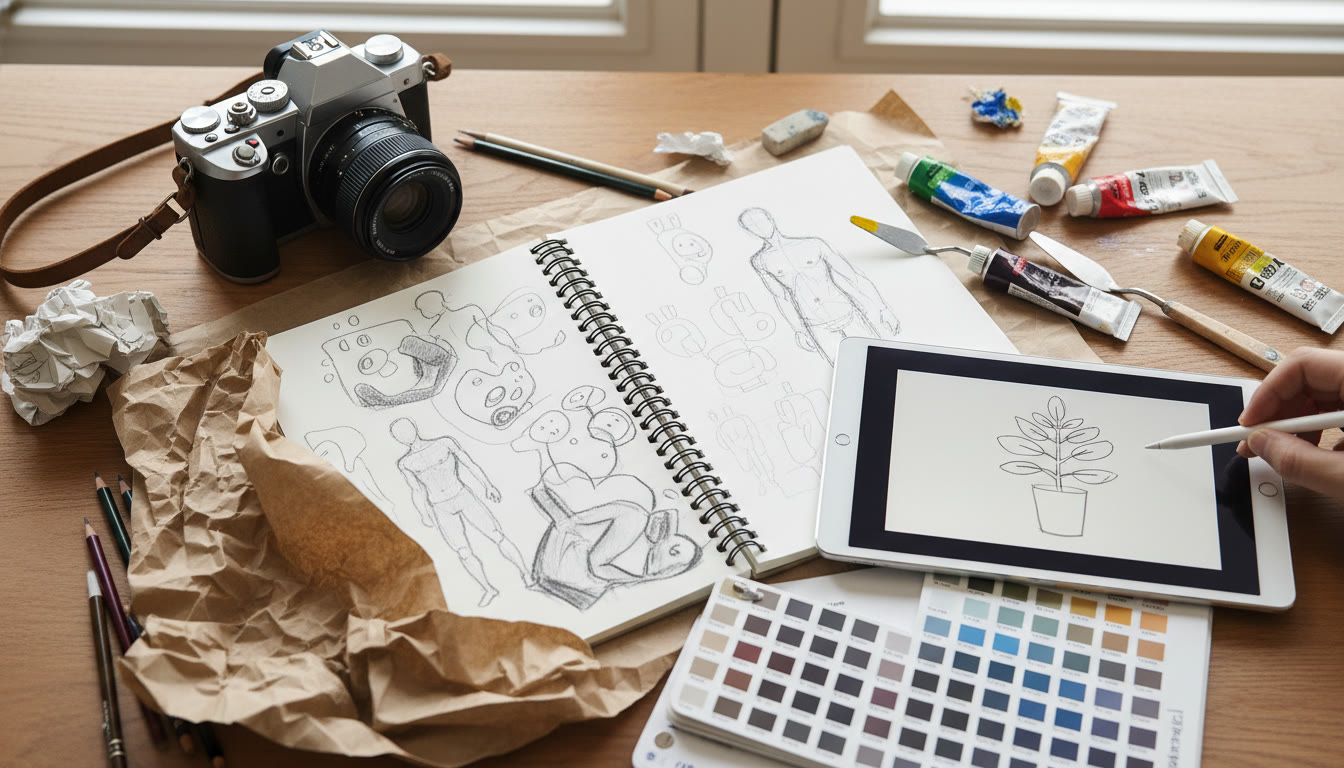
Why Cohesion Matters (Especially for AP Students)
Cohesion is what turns a collection of technically competent pieces into a memorable body of work. For AP Studio Art—where the portfolio reviewer is looking for sustained inquiry and personal investigation—consistency of voice demonstrates that your ideas aren’t random experiments, but a sustained conversation you’ve been having with your medium, your influences, and your world.
Outside of AP classes, colleges and scholarship panels also look for evidence that an applicant can think conceptually and synthesize across disciplines. When your sketchbook entries, photos, and finished pieces echo a set of recurring concerns—color, gesture, pattern, or a recurring subject—you’re sending a powerful message: you’re an artist who thinks beyond a single image.
What a Visual Voice Actually Is
- Motifs: recurring images or symbols (a repeated animal, a pattern, a fragment of architecture).
- Palette: a characteristic color range or approach to contrast and saturation.
- Gesture and Mark-Making: whether your strokes are rough and energetic, precise and measured, or somewhere in-between.
- Subject Preference: portraits, urban landscapes, found objects, or abstract forms.
- Conceptual Anchors: themes that tie pieces together—memory, displacement, identity, transformation.
Combine these elements and you get a voice: an aesthetic fingerprint that helps a viewer—like an AP reviewer—recognize the work as part of a coherent investigation.
How to Start Developing Your Visual Voice
There’s no one true path, but there are practical steps you can follow to discover and refine a voice that feels authentic.
1) Collect First—Curate Later
Begin by actively gathering. Use a sketchbook, a camera app, a folder on your desktop—whatever you’ll actually use. Collect things that catch you: textures on a city sidewalk, a moment of awkward human interaction, a color combo in a grocery aisle, abbreviations in notes. The aim is to expose yourself to variety so patterns emerge.
2) Set Short Challenges
Give yourself weekly micro-projects that force you to translate the same idea across media. For example:
- Week Challenge: “Hands” — draw five quick studies, photograph hands in natural light, make a digital collage using scanned drawings.
- Color Study: pick one palette and create a charcoal sketch, a photo series, and a mixed-media piece all dominated by those hues.
These exercises do two things: they accelerate skill across media and they show you which motifs recur naturally.
3) Make a Visual Vocabulary Sheet
Create a one-page document (digital or physical) that lists 6–10 signature elements: textures, brushstrokes, shapes, patterns, recurring subjects, and color swatches. Update it as your work evolves. This sheet becomes your north star when editing a portfolio or preparing for an AP submission.
Translating Ideas Between Media
Translating a concept from drawing to photography or from painting to digital collage can be revealing and delightful. Below are techniques for faithful and creative translation:
Technique 1: Keep the Core, Change the Means
Identify the concept behind a piece—let’s say “isolation”—and express it through different means: a single figure in a vast negative space (drawing), a photo of an empty chair under an overhead bulb (photography), and a digital composition where layers push the figure off-center (design).
Technique 2: Translate Formal Elements
Take a formal quality—line, texture, contrast—and look for its analogue in another medium. A coarse charcoal texture can become a gritty urban photograph; a looping ink line can become a long-exposure light trail.
Technique 3: Rework Source Material
Scan drawings and manipulate them digitally. Photograph a painted surface and crop it to reveal an abstract composition. Use repetition, scaling, and transparency to create visual resonance across works.
Exercises That Build Cohesion
Consistent practice is the bridge from good ideas to a confident voice. Try these exercises over a month, keeping a process log to capture insights.
- The Three-Medium Chain: Choose a single subject and make three pieces in different media, each building on the previous one.
- Palette Lock: For one week, restrict your work to three colors and explore texture and composition to vary expression.
- The Motif Test: Pick a motif and make it central in 6 works—observe how it mutates across contexts.
- Time-Limited Studies: Do 20-minute quick pieces across media to prioritize intuition over perfection.
Example Daily Structure
| Time | Activity | Goal |
|---|---|---|
| 10–20 minutes | Warm-up sketches or quick photos | Activate eye/hand coordination |
| 30–60 minutes | Focused piece in chosen medium | Explore depth of chosen idea |
| 15–30 minutes | Document and reflect (notes, photos) | Capture process and patterns |
Putting It Together for an AP Portfolio
AP reviewers look for sustained investigation, technical skill, and personal voice. Here’s a practical workflow to integrate cross-arts exploration into a portfolio that feels unified.
1) Define Your Investigation
Write a short statement (150–300 words) about what you’re exploring. Be specific—avoid vague claims like “identity”—instead try “the friction between memory and place in suburban architecture.” Use this statement to guide edits.
2) Sequence with Intent
Arrange works so there’s a narrative arc: early experiments, deeper studies, resolved works. Use your visual vocabulary sheet to ensure recurring visual cues appear throughout the sequence.
3) Provide Context in Sketchbooks
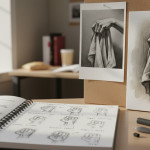
AP portfolios value process. Include sketchbook pages, photo contact sheets, and notes that show how a photographic experiment led to a mixed-media solution. This demonstrates inquiry and growth.
4) Edit Ruthlessly
Quality over quantity. It’s better to have fewer cohesive, strong pieces than many unrelated ones. Use your visual vocabulary to decide which pieces stay.
Design Principles That Strengthen Voice
Understanding basic design principles helps you make intentional choices that reinforce cohesion.
- Hierarchy: Decide what the viewer should see first and use scale, contrast, and placement to guide attention.
- Rhythm: Repetition of elements (shape, line) creates a visual beat that ties works together.
- Balance: Symmetry or asymmetry both can create unity—use them deliberately.
- Contrast: A consistent approach to high or low contrast builds a recognizable look.
Feedback and Revision
Getting outside perspective is crucial. Ask classmates, teachers, and mentors for specific feedback: “Which three elements feel most like ‘me’ in this sequence?” Use their answers to refine your visual vocabulary.
If you need focused, personalized help, Sparkl’s personalized tutoring can be a powerful resource—offering 1-on-1 guidance, tailored study plans, and expert tutors who can help you shape a portfolio narrative and provide AI-driven insights to track your progress. These supports are most useful when you’re deep in the editing phase and want targeted critique or strategic sequencing advice.
How to Receive Useful Critique
- Ask for actionable points, not general praise. (“What would make this composition read more like a finished work?”)
- Share your visual vocabulary sheet so reviewers have context.
- Test revisions quickly—small changes can reveal big improvements.
Case Studies: Translation Across Media
Here are short, realistic examples showing how one idea can spawn a coherent set of works across media.
Case Study A: “Transit”
Concept: transience and the overlap of personal and public space.
- Photography: candid photos of commuters framed with negative space, muted color grading emphasizing blues and greys.
- Ink Drawings: rapid gestural studies of hands gripping poles, rendered in a limited ink wash palette.
- Mixed Media: collage of ticket stubs and scanned ink marks layered with translucent photography, unifying motif of diagonal lines.
Case Study B: “Fragments”
Concept: memory as fragmented image.
- Digital Collage: overlapping scanned Polaroids with transparency masks to create visual echoes.
- Acrylic-on-Panel: a resolved painting that isolates one fragment, amplified with a restricted warm palette.
- Sketchbook Pages: thumbnails exploring cropping and scale, saved as evidence of experimentation.
Technical Tips for Cross-Media Cohesion
Small technical decisions have outsize effects when you’re trying to create a cohesive body of work.
- Maintain consistent image resolution and color profiles when moving between print and digital.
- When scanning, keep lighting and resolution settings constant so textures translate faithfully.
- Use consistent cropping rules—if you favor square crops, keep that in several pieces to build a rhythm.
- Document size relationships (e.g., small sketches vs. large paintings) so scale decisions feel deliberate in a portfolio context.
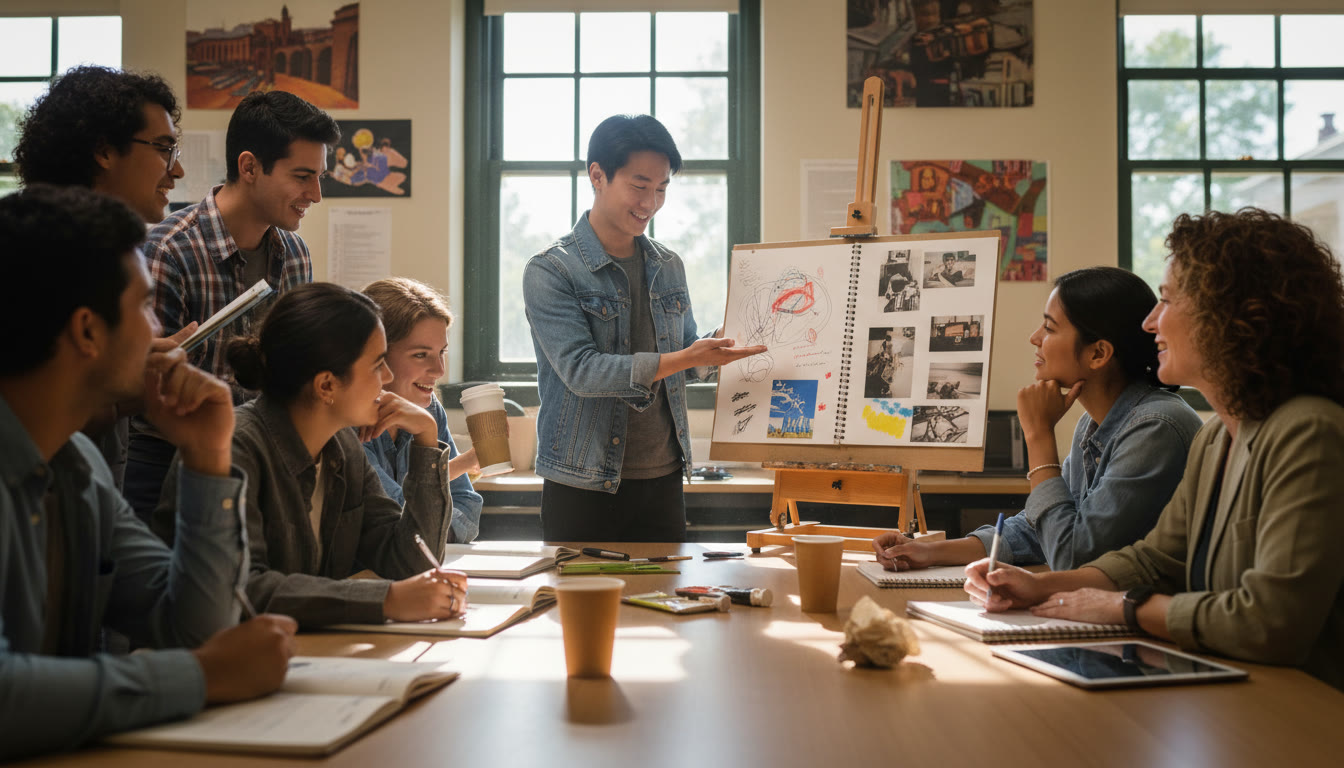
Presentation Matters: Digital vs. Physical
Whether you submit a physical portfolio or a digital one, presentation is part of the voice.
| Format | Strength | Checklist |
|---|---|---|
| Digital | Easy to sequence, includes multimedia (video, audio) | Consistent image sizes, clear captions, process images included |
| Physical | Tactile presence, strong materiality | High-quality prints, labeled sketchbook pages, neat mounting |
Balancing Originality and AP Expectations
It’s tempting to chase novelty, but originality is best shown through authenticity. AP reviewers won’t reward gimmicks as much as they reward a clear line of inquiry. Use cross-arts methods to deepen your investigation rather than distract from it.
Common Pitfalls and How to Avoid Them
- Too Many Directions: If your work looks like several unrelated projects, prune until one theme becomes visible.
- Surface Consistency Only: A repeated color palette alone isn’t enough—motifs and conceptual depth must also recur.
- Ignoring Process: AP values documentation of development—include sketches and notes that show how pieces evolved.
Wrapping Up: A Practical Roadmap
Here’s a compact plan you can adapt over 8 weeks to strengthen your cross-arts voice.
- Weeks 1–2: Collect and experiment—complete the Three-Medium Chain twice, build your visual vocabulary sheet.
- Weeks 3–4: Deepen—select your strongest motif and create 6 variations across different media.
- Weeks 5–6: Edit—sequence, remove weak pieces, refine presentation. Seek focused critique from a mentor or a Sparkl’s personalized tutoring session for tailored feedback and strategic edits.
- Weeks 7–8: Finalize—prepare high-quality documentation, write a concise investigation statement, and review the portfolio as a viewer would.
Final Thought
Developing a cohesive visual voice is a long-game practice, not a one-night sprint. It asks you to pay attention—to your curiosities, your instincts, and the small visual choices that, over time, add up to something distinct. Let cross-arts work be your laboratory: translate ideas across media, take notes, invite specific critique, and edit with intention. With persistence, your portfolio will stop being a collection of separate works and become a coherent conversation with the world—one that reflects who you are and where you’re headed.
Good luck, and trust the process. Your voice is already forming; it just needs time, practice, and the occasional nudge in the right direction.




















No Comments
Leave a comment Cancel