
Why Unit-by-Unit Practice Transforms Your AP CSA Prep
There’s a different kind of calm that comes from knowing exactly what to study next. For many students, AP Computer Science A (CSA) feels like a big, scary mountain: lots of topics, unfamiliar vocabulary, and those timed free-response questions that make your heart race. The antidote? Breaking the mountain into clear, climbable units—then attacking each unit with targeted practice sets and rubric checks. This blog walks you through a practical, human-friendly plan for unit-by-unit practice, shows you how rubric checks accelerate improvement, and offers realistic examples you can use starting today.
What “Unit-by-Unit” Means in Practice
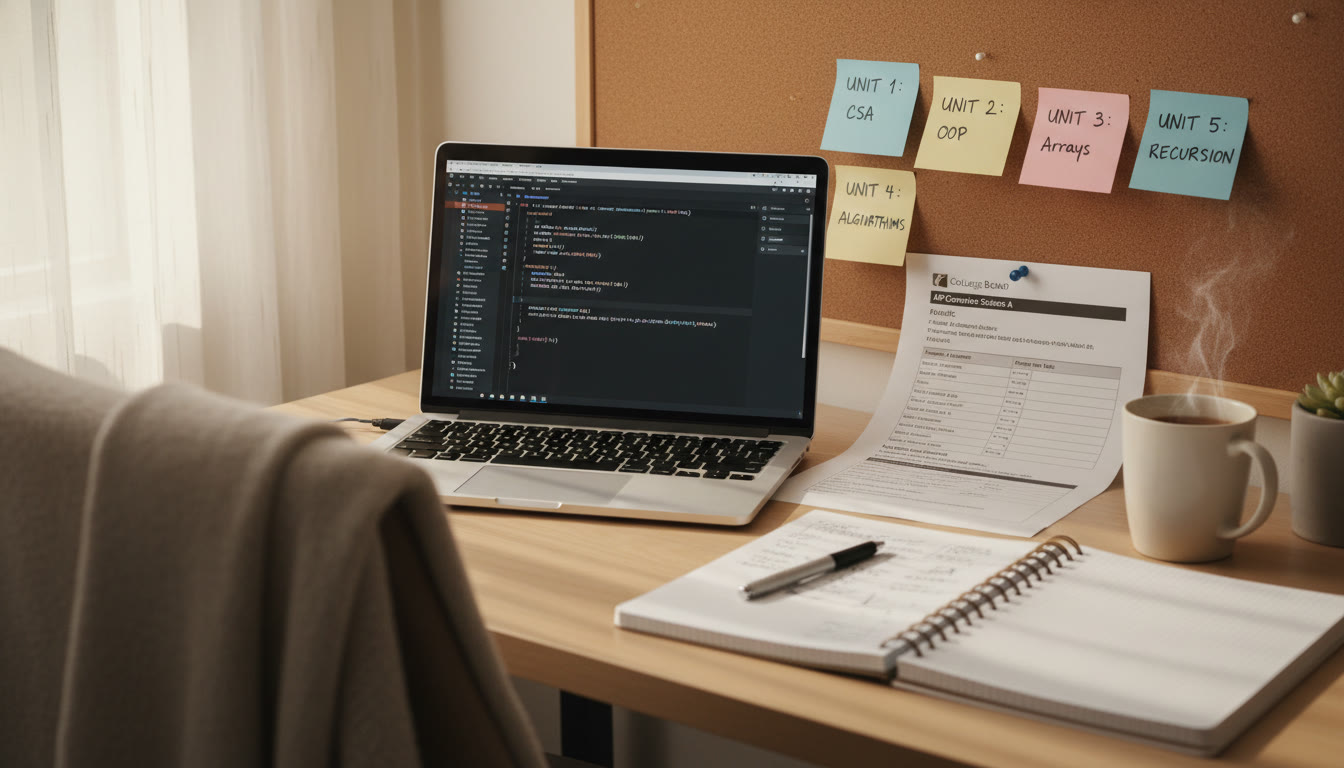
Think of the AP CSA course as a series of building blocks: Java syntax, control structures, object-oriented design, data structures, algorithms, and the free-response skills that pull them together. Unit-by-unit practice means you focus on one block at a time—developing foundational knowledge, practicing multiple question styles, and verifying your answers against official rubrics or rubric-like checklists. This prevents the common trap of shallow, surface-level studying and replaces it with deep, deliberate practice.
How to Structure a Unit Study Session
Each study session should feel purposeful. Here’s a repeatable structure you can use for any unit:
- Warm-up (10–15 minutes): Quick review of key definitions and a 5–10 question drill targeting the unit’s essential facts.
- Core practice (40–60 minutes): One or two medium-length practice problems—these should include writing code, tracing code, and reading code behavior.
- Rubric check (20–30 minutes): Carefully score your work against an official rubric or a detailed rubric checklist. Annotate where you lost points and why.
- Reflection & Fixes (10–20 minutes): Re-code or re-answer the mistakes, and jot down a 1–2 sentence plan to avoid the same mistake next time.
Use a planner to schedule sessions by unit and revisit weaker units more frequently. Spaced repetition plus rubric-driven correction is a powerful combination.
Unit-by-Unit Practice Sets: Example Breakdown
Below is an example roadmap of units often covered in AP CSA and a sample of focused practice for each. (Course sequencing can vary slightly by teacher.)
| Unit | Core Topics | Practice Focus | Rubric Check Points |
|---|---|---|---|
| 1: Java Basics | Variables, types, expressions, input/output | Short coding drills, trace outputs, syntax correction | Correct types, valid syntax, exact output |
| 2: Control Structures | If/else, loops, nested control flow | Loop construction, boundary testing, off-by-one checks | Loop invariants, correct termination, correct branch conditions |
| 3: Methods and Parameters | Method signatures, return values, parameter passing | Implement small helper methods and trace calls | Correct header, correct return, side effects only when allowed |
| 4: Classes and Objects | Constructors, fields, encapsulation, accessors | Write classes from specifications, use objects in main | Matching spec, correct use of this, correct visibility |
| 5: Inheritance & Polymorphism | Super/subclasses, method overriding, instanceof | Design class hierarchies, resolve dynamic dispatch scenarios | Correct hierarchies, correct overriding, correct polymorphic calls |
| 6: Arrays and ArrayLists | Traversals, modifications, resizing, common algorithms | Implement search/sort snippets, manipulate lists in place | Correct indexing, avoid concurrent modification errors, complexity awareness |
| 7: Recursion | Base cases, recursive decomposition, tracing recursion | Trace stacks, convert loops to recursion and vice versa | Correct base case, decreasing measure, correct combination of results |
| 8: Algorithms & Complexity | Sorting, searching, Big-O basics | Analyze runtime, choose best data structures | Correct complexity reasoning, justified algorithm choice |
| 9: Free-Response Practice | AP-style FRQs, multi-part problems | Timed practice, partial-credit awareness, rubric-driven scoring | Show work, align answers to rubric language, clear method steps |
How Many Problems Per Unit?
Quality over quantity matters. Aim for 8–12 well-chosen problems per unit spread over several sessions. Mix difficulty levels: 4 quick drills to build fluency, 4–6 medium problems that require multi-step reasoning, and 1–2 challenging problems that mimic exam complexity. For free-response practice, rotate between fully-timed questions and untimed deep-analysis sessions where you obsess over rubric alignment.
Rubric Checks: The Secret Sauce
Rubric checks are what separate guesswork from intentional learning. When you score your own responses against a rubric, you learn how graders think. Instead of asking “Did I get it right?” you ask “Which point(s) did I earn and which did I miss—and why?”
Making a Practical Rubric Checklist
Not all students can access the official scoring guide inside and out, so build a checklist that mirrors common rubric items. Example checklist for a short free-response method:
- Method header exactly matches expected signature.
- Return type and parameters used correctly.
- Algorithm produces correct output on sample inputs (include edge cases).
- Handles null or empty inputs if specified.
- Uses only allowed helper methods or data structures.
- Includes no extraneous prints or side-effects that violate spec.
After you score yourself, annotate your answer with the rubric items you lost. This note becomes the seed for your next practice session—targeted, specific, and high-leverage.
Example: Scoring a Sample FRQ
Imagine a 6-point FRQ asking for a method that removes duplicates from an ArrayList and returns the count of removed items. Your rubric checklist might look like this:
- Correct signature and return type (1 point)
- Iterates through list properly and identifies duplicates (2 points)
- Removes duplicates without skipping elements or causing errors (2 points)
- Returns the correct count (1 point)
If you implemented something that looks right but you forgot to adjust the iteration index after a removal, you can immediately see which rubric point fails (the removal behavior), and design a short drill to practice in-place removals. Over time this process rewires your coding habits so that common pitfalls become rare.
Practical Study Tools You Can Use
Unit-by-unit study benefits from small tools and routines that keep you honest and focused. Here are a few you can adopt:
- Mini-Rubric Cards: One-sheet checklists for each unit—laminate them if you can, stick them into your notebook.
- Test-Case Notebook: Keep a running list of edge-cases for each topic (e.g., empty list, single-element array, maximum/minimum values).
- Timed Free-Response Sessions: Simulate exam conditions for one FRQ per week. Time yourself and then spend double the time on rubric checking and corrections.
- Peer Review Swap: Exchange graded FRQs with a classmate and score each other using your rubrics. Explaining a deduction to someone else deepens understanding.

Common Pitfalls and How Unit Practice Fixes Them
Students often make the same kinds of mistakes across units. Fortunately, unit-focused practice plus rubric checks targets these quickly:
- Rushed Method Signatures: Habitually copy a header template into every answer during practice to build muscle memory.
- Off-by-One Errors: Create small index-focused drills that force you to think about loop bounds before coding.
- Not Showing Work: During practice, write concise comments that mirror rubric language—this helps graders give partial credit and trains you to be explicit.
- Poor Time Management: Timed unit practice builds pacing. Note how long each step takes and adjust.
How Sparkl’s Personalized Tutoring Fits Naturally Into Unit Work
When your practice reveals a pattern—say, you repeatedly lose points for incorrect loop mutations—an outside perspective can be invaluable. Sparkl’s personalized tutoring offers 1-on-1 guidance and tailored study plans that pinpoint those recurring issues. A skilled tutor can quickly model rubric-aligned answers, provide targeted drills, and use AI-driven insights to show where you improve over time. Use tutoring selectively: when you’ve already done the work and need expert feedback to level up, that’s the sweet spot for maximum efficiency.
How to Use a Tutor Effectively
- Bring your rubric-scored responses and ask for a line-by-line walkthrough.
- Request targeted micro-lessons—10–20 minutes—on precise trouble spots rather than broad reviews.
- Ask your tutor to generate similar practice problems and score them with you to build consistency.
Tracking Progress: Simple Metrics That Matter
It’s tempting to track every stat under the sun. Keep it simple. Use 3 core metrics to monitor unit progress:
- Average Rubric Score Per Unit: Track your average percent on practice FRQs for each unit weekly.
- Flawed Concepts per Session: Count distinct conceptual errors found in rubric checks (target to reduce by half every two weeks).
- Timed Completion Rate: Percent of practice problems you finish within target time with acceptable rubric score.
Here’s a quick example log you could keep at the end of each week:
| Week | Unit | Avg Rubric Score | Common Error |
|---|---|---|---|
| 1 | Arrays | 68% | Index management on removal |
| 2 | Methods | 82% | Incorrect return types |
| 3 | Inheritance | 74% | Overriding with wrong signature |
Real-World Examples and Mini Case Studies
Here are two short, realistic student stories showing the impact of unit-by-unit practice plus rubric checks.
Case Study 1: Maya (Junior, Improving Quickly)
Maya struggled with arrays and timed FRQs. She started doing 30-minute unit sessions devoted to array traversal and removal—each session ended with an explicit rubric check. After three weeks, Maya cut her average rubric deductions in half. A week before the exam she used targeted 1-on-1 tutoring sessions to fix one stubborn issue (off-by-one errors when removing elements), and the tutor suggested a short, repeatable mental checklist that she still uses in exams.
Case Study 2: Alan (Slow and Steady)
Alan had solid syntax but weak problem decomposition—he could write code but not plan it. He adopted a unit routine where the first 15 minutes were devoted to writing a high-level plan before coding. Then he practiced breaking FRQs into subproblems, and used rubric checks to ensure each sub-solution matched an anticipated rubric point. Over time, his code came to the point, and his free-response clarity improved dramatically.
Exam Week Strategy Using Unit Practice
Two weeks out from the AP exam, switch the emphasis from learning new things to consolidating and polishing. Here’s a simple taper plan:
- Day -14 to -8: Complete remaining unit practice sets and do one timed FRQ every other day. Continue rubric checks.
- Day -7 to -3: Do full practice exams spaced out. After each exam, spend 50% of your review time on rubric-driven corrections for missed points.
- Day -2 to -1: Light review of rubrics and edge cases. Short sessions only—no new topics.
- Exam Day: Trust your training. Use rubric language when writing answers and pace yourself. If you trained with timed FRQs and explicit rubric checks, your brain will know how to show work the grader wants to see.
Final Tips: Study Smarter, Not Just Harder
Before we wrap up, here are pragmatic tips that keep your unit-by-unit practice efficient and enjoyable:
- Be Ruthless with Review: If a practice problem doesn’t target a clear weakness or rubric item, shelve it.
- Keep It Visible: Post your mini-rubric checklists where you code. The small visual reminder saves points.
- Mix Modalities: Alternate reading, coding, tracing, and explaining out loud. Teaching an idea to a friend or tutor (even for 5 minutes) cements it.
- Celebrate Small Wins: When a previously recurring error disappears, acknowledge the progress. Small wins compound into confidence.
Wrapping Up
AP CSA isn’t about being a natural genius; it’s about practicing deliberately, checking your work against the rubric, and iterating. Unit-by-unit practice sets give you a roadmap; rubric checks give you the feedback loop. Add in focused 1-on-1 guidance when you need it—Sparkl’s personalized tutoring and AI-driven insights can accelerate improvement by zooming in on persistent patterns. Follow the structure, measure what matters, and keep your sessions purposeful. With steady, rubric-driven work, you’ll close knowledge gaps, sharpen exam skills, and walk into the test with calm confidence.
Parting Homework (Short and Useful)
This week, pick one unit you feel weakest in and do the following:
- Complete 6 practice problems over three sessions (2 per session).
- Score each problem with a rubric checklist and record the top 2 recurring errors.
- Do two 10-minute targeted drills that directly address those errors.
Small, focused steps like this are how big improvements start. Good luck—code thoughtfully, check the rubric, and keep climbing, one unit at a time.























No Comments
Leave a comment Cancel